Kathmandu
Tuesday, July 14, 2026





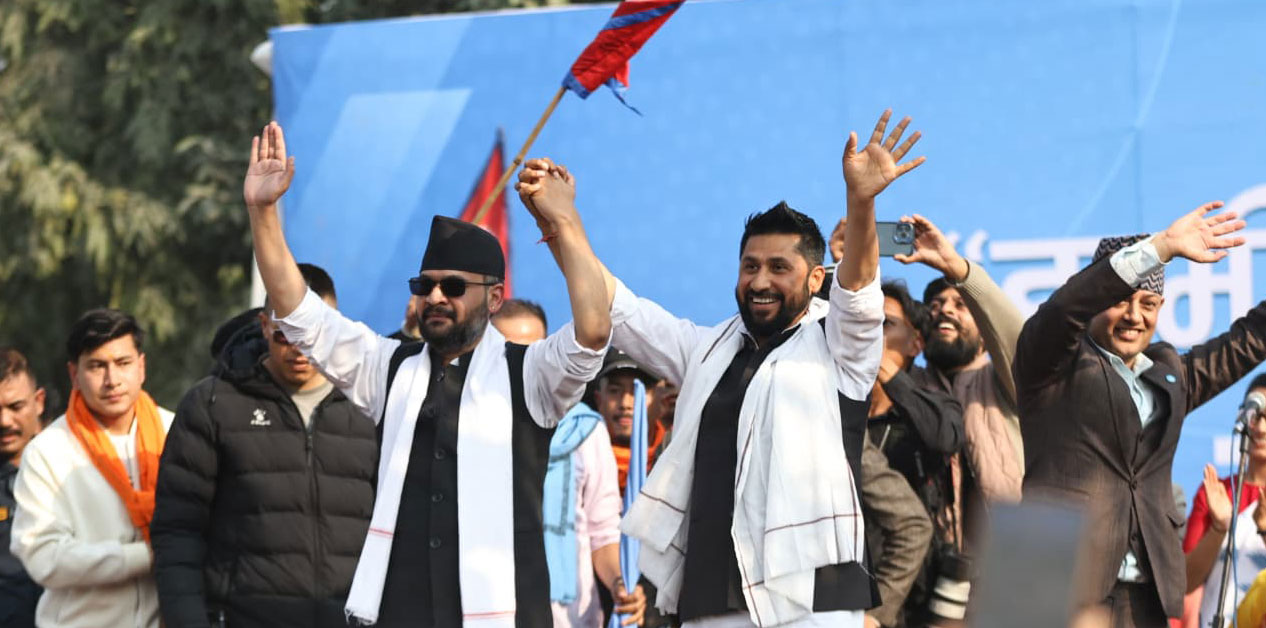
KATHMANDU: The elections of March 5, held in the wake of the Gen-Z-driven protests of September 8–9, have sent shockwaves through the politics of Madhesh Province. Parties that once claimed to embody the region’s identity and aspirations have suffered a stunning collapse. In constituency after constituency, voters turned instead to the insurgent Rastriya Swatantra Party (RSP), leaving Madhesh-centric parties without any representation in the House of Representatives. For the first time since 1991, a political current that dominated the province for decades has effectively vanished from the national parliament.
In Nepal’s electoral geography, Madhesh has long behaved like a political fortress. Parties that mastered its complex web of caste alliances, religious networks, organisational machinery and financial mobilisation could dominate its 32 parliamentary constituencies. For decades, the region’s politics revolved around these entrenched structures.
The latest election has upended that logic.
In a result that has stunned the political establishment, the Rastriya Swatantra Party swept almost the entire province. Of the 32 constituencies in Madhesh, the party won 30 seats. One constituency saw its candidate disqualified during the nomination stage (now legal case going on at Supreme Court), while another was won by the Nepali Congress. The outcome represents one of the most dramatic electoral realignments in the province since the advent of federal politics.
The scale of the victory suggests that Madhesh-long considered the domain of identity-based and organisational politics-may be undergoing a deeper transformation.
The collapse of the old electoral formula
Traditionally, success in Madhesh depended on five pillars: caste arithmetic, religious alignment, party networks, money power and local patronage systems. Candidates cultivated dense relationships with community leaders and relied heavily on mobilising these social, cast, poet and all necessary blocs during elections.This time, those mechanisms completely failed.
Instead, the election appeared to pivot around a different narrative: the rise of a new political force built around governance, anti-corruption sentiment and the promise of administrative efficiency. The RSP, which had earlier performed strongly in urban constituencies, managed to transform that national mood into a sweeping provincial mandate through social media, diaspora and effective message campaigns.
The Balen effect
Central to this shift was the emergence of Balendra Shah as a national political figure. After the RSP announced Shah as its prime ministerial candidate, a powerful narrative began circulating in Madhesh: the possibility that a son of the region could lead the nation. For many in a province that has historically complained of discrimination and second-class treatment within the state, the symbolism proved potent. The idea that a Madheshi figure could realistically ascend to the premiership generated a sense of pride and emotional mobilisation among voters, particularly the youth. Yet identity alone does not fully explain the scale of the shift.
Most candidates in Madhesh Province appear to have misread the election from the outset. Their campaigns relied heavily on outdated calculations-old vote banks, wrong data and information, traditional caste arithmetic and organisational strength-while failing to detect a rapidly shifting public mood. In doing so, they underestimated the scale of the political wave building around Balendra Shah and the Rastriya Swatantra Party.
The result was a collective miscalculation. As candidates clung to familiar tactics and historical data, the electorate moved in a different direction. The Balen wave swept across the province, cutting through party structures and entrenched networks alike. In the process, it toppled leaders at every level-from local power brokers to nationally recognised figures-almost simultaneously, exposing how far the political class had drifted from the public mood and can be humalating defeated all at once.
The Balen effect to have shifted the political mood in Madhesh Province. The idea that a Madheshi figure could plausibly lead the country has carried symbolic weight. The narrative has stirred a sense of dignity among older voters while energising the province’s youth.
The shift is striking when compared with the previous election. In the 2022 parliamentary polls, Madhesh’s 32 constituencies were divided among several parties: the Communist Party of Nepal (UML) won ten seats, the Janata Samajbadi Party six, the Loktantrik Samajbadi Party three, and the Janamat Party one. The Nepali Congress secured seven seats, the Communist Party of Nepal (Maoist Centre) three, while two constituencies elected independents.
This fragmented political map now totally shift. Much of the momentum behind the RSP in Madhesh reflects a broader desire for change. Swing voters-particularly younger and politically unaffiliated ones-have played a decisive role in amplifying the party’s rise. For many voters in the province, support for the RSP is less about party loyalty and more about a search for a different style of politics-one associated with governance, delivery and a break from the entrenched structures that have long dominated Madhesh.
A political graveyard for party heavyweights
Perhaps the most remarkable feature of the election was the list of political heavyweights who fell in Madhesh. Leaders who once dominated the region-many of them party chairs or national figures-were defeated across constituencies.
Among the most striking defeats was that of Gagan Thapa of the President of Nepali Congress in Sarlahi-4. Thapa, who had previously secured three victories in Kathmandu, attempted to expand his political base by contesting in Madhesh. Instead, he was defeated by RSP candidate Amaresh Kumar Singh, who secured over 35,000 votes compared to Thapa’s roughly 22,000. Singh’s consistent lead throughout the counting process ensured that Thapa’s attempt to build a Madhesh base collapsed early.
The setbacks extended across the Madheshi political spectrum with over 8 party chairman or presidents defected. Upendra Yadav of the Janata Samajbadi Party contested from Saptari District but was defeated by RSP’s Amarkant Chaudhary. Meanwhile, CK Raut of the Janamat Party—whose movement had previously reshaped Madhesh politics—also faced defeat in the same region.
Former deputy prime minister Rajendra Mahato of the Rastriya Mukti Party Nepal also finished far behind in Sarlahi-2, while Rizwan Ansari of the Nepal Federal Socialist Party lost in Mahottari District.
Another prominent casualty was Prabhu Sah, founder of the Aam Janata Party. Once a rising figure among Madhesh’s younger political generation, Sah lost in Rautahat District to an RSP challenger.
Elsewhere, the chairman of the Samunnat Nepal Party, former police chief Sarbendra Khanal contested from Bara District but was defeated by RSP candidate Rahbar Ansari. The same constituency also saw the defeat of Samim Miya Ansari, chairman of the Rastriya Nirman Dal Nepal and a former head of the Nepal Muslim Commission. Dozens of prominent Madeshi leaders including Mahindra Yadav of Nepali Communsit party to Raghubir Mahaseth of CPN (UML) lost the battles.
Nepal’s main poltical parties along with eight major regional outfits were decisively rebuffed, leaving the plains’ political landscape open to RSP. The cumulative effect was devastating for the region’s established leadership. Nearly every prominent party chair or national figure who entered the Madhesh battlefield emerged weakened.
The diaspora vote that never appeared on the ballot
Another decisive factor was the behaviour of Madhesh’s younger generation. A large proportion of the region’s youth now work abroad, particularly in the Gulf and Malaysia. Though absent physically during elections, their political influence remained visible. Many reportedly urged their families back home to vote for the RSP and its leadership rather than traditional parties.
The rise of social media further amplified this dynamic. Younger voters who are active online have increasingly shaped political narratives in Nepal, often bypassing traditional campaign structures. In this election, that digital mobilisation appeared to generate a significant swing vote-one that benefited new candidates with limited organisational infrastructure.
This phenomenon partly explains how relatively unknown RSP figures managed to defeat veteran politicians with deep local networks.
A rejection of the old Madhesh agenda
For decades, the political agenda of Madhesh revolved around identity recognition, federal autonomy and representation within the state. Those demands reshaped national politics after the Madhesh movements of the late 2000s and helped produce a generation of regional parties.
This election suggests that voters may now be seeking something different.
Across the province, the message that resonated most strongly was not identity mobilisation but governance reform. Many voters appeared to interpret the RSP as a vehicle for administrative change-one that promised corruption-free governance and more efficient public services.
In that sense, the Madhesh result may represent more than a regional shift. It signals a broader turning point in Nepal’s political evolution: a moment when the electorate, frustrated by the failures of established parties, began searching for alternatives that promise competence rather than patronage.
For the RSP, the sweep offers extraordinary momentum. Yet it also carries risk. Transforming an electoral wave into sustainable political power requires organisation, policy clarity and governance capacity-areas where the party still remains relatively untested.
Madhesh has delivered a dramatic mandate. Whether it marks the beginning of a durable political realignment or simply another chapter in Nepal’s turbulent electoral history will depend on what follows next.
The RSP vote map in Madesh: constituency results and PR numbers
In Nepal’s electoral arithmetic, few regions matter as much as Madhesh. Only Bagmati Province sends more lawmakers to the House of Representatives under the first-past-the-post system. Out of the 165 directly elected seats, Bagmati elects 33 members while Madhesh follows closely with 32. With each province accounting for roughly one-fifth of the national population, their influence extends beyond direct constituencies to proportional representation seats as well.
The Rastriya Swatantra Party broke decades-long strongholds in Madhesh, winning unprecedented seats and dominating the proportional representation (PR) vote. Nationally, it secured over 5.18 million votes and 57 seats. In Madhesh, the RSP received 1,300,468 PR votes-more than its direct votes across constituencies.
The nearest competitor, Nepali Congress, got 287,323, followed by CPN (UML) 187,901, and Janata Samajbadi Party, Nepal 137,878. Other parties trailed: Nepali Communist Party 107,612, Janamat Party 50,720, and Rastriya Prajatantra Party 35,642. At the bottom, Trimul Nepal received just 132 votes in the entire province. The scale of the RSP’s sweep highlights the failure of traditional parties to read the electorate and the full force of the Balen wave.
Across Madhesh, the results show an unusual pattern: in most of constituencies the Rastriya Swatantra Party (RSP) received more votes in the proportional representation (PR) ballot than in the first-past-the-post (FPTP) direct race. Out of 32 direct constituencies in the province, RSP fielded candidates in 30. In one seat the party had a vote lead but its candidate was cancelled by the Election Commission, and the case remains in court-yet the overall numbers still suggest strong RSP dominance across several areas of Madhesh Province.
In Saptari District, the results show a clear sweep across four constituencies. In Saptari-1, RSP received 38,195 direct votes and 40,602 PR votes. In Saptari-2, the party got 28,404 direct votes and 31,776 PR votes. In Saptari-3, it secured 32,875 direct votes and 36,153 PR votes, while in Saptari-4, RSP received 36,412 direct votes and 40,655 PR votes.
The pattern was similar in Siraha District. In Siraha-1, RSP received 41,322 direct votes and 41,536 PR votes. In Siraha-2, the party got 39,561 direct votes and 41,972 PR votes. In Siraha-3, RSP secured 32,249 direct votes and 37,958 PR votes, while in Siraha-4, the party received 36,210 direct votes and 39,358 PR votes.
In Dhanusha District, Dhanusha-1 shows only the PR figure—41,803 votes—because the RSP candidate was cancelled by the Election Commission. In Dhanusha-2, RSP received 41,637 direct votes and 48,169 PR votes. In Dhanusha-3, the party secured 43,988 direct votes and 48,112 PR votes, while in Dhanusha-4, RSP obtained 48,270 direct votes and 52,313 PR votes.
The same voting pattern appeared in Mahottari District. In Mahottari-1, RSP received 34,636 direct votes and 42,550 PR votes. In Mahottari-2, the party secured 32,722 direct votes and 36,366 PR votes. In Mahottari-3, RSP obtained 32,451 direct votes and 40,845 PR votes, while in Mahottari-4, the party received 30,132 direct votes and 35,706 PR votes.
In Sarlahi District, the numbers remained high across all four constituencies. Sarlahi-1 recorded 44,181 direct votes and 46,441 PR votes. In Sarlahi-2, the direct count was 42,512 with a PR total of 47,649. Sarlahi-3 saw 46,890 direct votes and 48,765 PR votes, while Sarlahi-4 finished with 35,688 direct votes and 45,516 PR votes.
Moving to Rautahat District, the data reflects a notable spread. Rautahat-1 had 28,946 direct votes and 37,200 PR votes. Rautahat-2 showed 9,325 direct votes—the lowest direct count in the set—and 26,143 PR votes. In Rautahat-3, the numbers were 27,318 direct votes and 39,350 PR votes, while Rautahat-4 concluded with 36,876 direct votes and 40,570 PR votes.
In Bara District, turnout remained robust. Bara-1 reported 39,998 direct votes and 42,171 PR votes. Bara-2 saw 35,590 direct votes and 39,619 PR votes. Bara-3 recorded 40,697 direct votes and 43,856 PR votes, while Bara-4 reached 41,200 direct votes and 50,421 PR votes.
Finally, in Parsa District, the figures rounded out the regional data. Parsa-1 had 27,274 direct votes and 34,463 PR votes. Parsa-2 saw 30,740 direct votes and 34,918 PR votes. Parsa-3 recorded 29,679 direct votes and 37,123 PR votes, and Parsa-4 finished with 28,006 direct votes and 30,389 PR votes.