Kathmandu
Sunday, January 18, 2026





Although the CIAA requested the Cabinet decision and Trishakti case papers, the documents have still not been provided
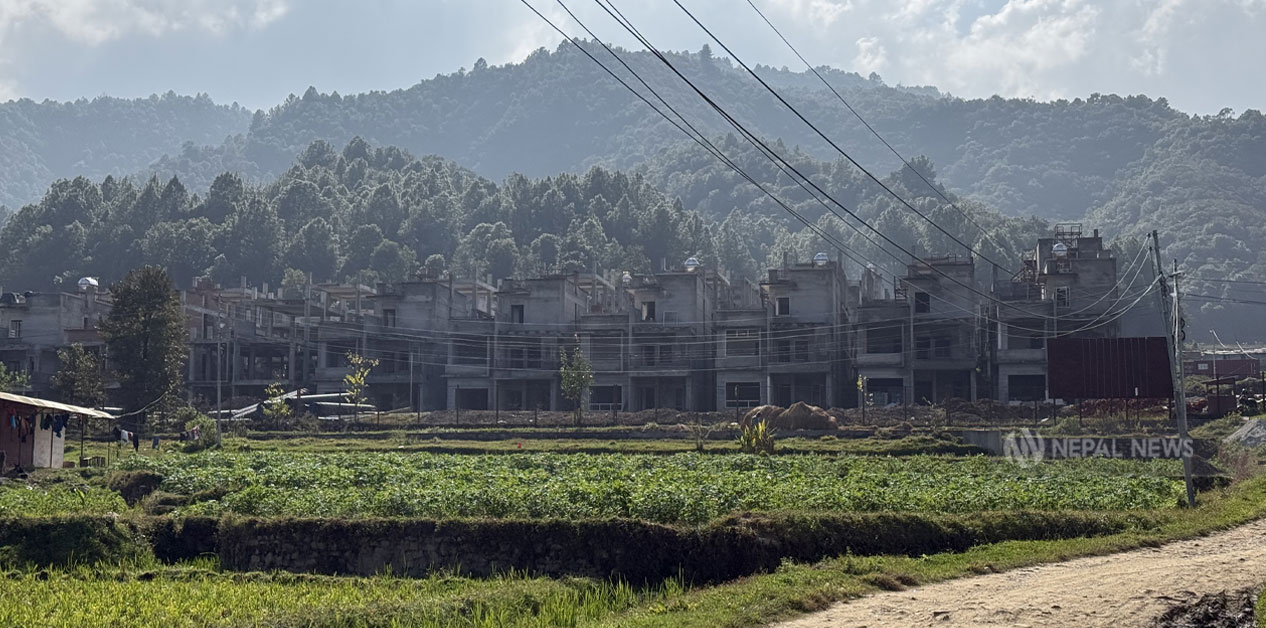
KATHMANDU: The decision by the then Girija Prasad Koirala-led Council of Ministers to authorize the release and subsequent sale of land exceeding the statutory ceiling limit, originally acquired by Trishakti Cement company in Dillibazar, Kathmandu, for industrial development, has now fallen under intense scrutiny.
Consequently, the Commission for the Investigation of Abuse of Authority (CIAA) has launched a detailed investigation into the Council of Ministers’ mandate. CIAA Spokesperson Rajendra Kumar Paudel confirmed that the detailed investigation into the Trishakti land sale is advancing, stating, “We have initiated a serious inquiry after this case became public.”
The Girija Prasad Koirala-led Council of Ministers, in its meeting on August 6, 1998, granted permission to release and sell 58865.95 square meters (115 ropani, 11 aana, one paisa, and two dam) out of the 108868.82 square meters (214 ropani) of land purchased by Trishakti Cement in Khopasi in ward 9 and Balthali in ward 11 of Panauti Municipality, Kavre. The then Council of Ministers mandated the release and sale of the land, specifically stipulating that the proceeds generated from the transaction were to be used to ‘cover expenses for the operation of the industry.’
A mere seven days later, the Council of Ministers dramatically reversed its initial decision. On August 13, 1998, the Council of Ministers formally amended the clause, shifting the stipulated purpose from ‘to cover expenses for the operation of the industry’ to the new justification: ‘to purchase land in a suitable location for the establishment of the industry.’
Chiranjibi Wagle was the Land Reform Minister in the Koirala Council of Ministers at that time. Two years after the Council of Ministers’ decision, on December 8, 2000, Trishakti Cement sold the land to industrialist Binod Chaudhary and others. The land was registered in the names of Binod, his brother Arun Chaudhary, and Chandbagh School, which is owned by the Chaudhary Group.

A copy of financial records pertaining to the sale of Trishakti land released by the Kavre Land Revenue Office
The Eighth Amendment to the Land Act, 1964, enacted in 2020, stipulates that corporations may be authorized to retain acreage exceeding the statutory ceiling limit, provided they obtain government sanction for such limited and specific endeavors as establishing industries. Industries, establishments, companies, projects, educational institutions, or any other organizations that acquire land exceeding the ceiling limit are only allowed to use it for the purpose for which it was obtained. The Act states that such land cannot be sold, distributed, transferred in any way, or exchanged by the concerned industry, establishment, company, project, educational institution, or any other organization to anyone. The Act provides that land illegally bought and sold shall be confiscated by the government.
However, if an industry, company, or organization is dissolved for any reason, it may be sold with the government’s approval, subject to the law, for the purpose of settling the organization’s liabilities. But such sales must be made only to an industry, establishment, or company with a similar objective, not to an individual. Contrary to this provision, Trishakti sold the land to individuals and not to an industry or company.
Since Trishakti Cement was not operating any industry when the Council of Ministers decision was made, the company was not in a state of dissolution. Therefore, from the Council of Ministers’ decision to the buyers and sellers, everyone involved in this case has been drawn into the CIAA’s investigation. The CIAA has asked the Ministry of Land Management, Cooperatives, and Poverty Alleviation and the Department of Land Management and Archives for the Council of Ministers’ decision, proposal, and other related documents. So far, those bodies have not provided the related documents.
There were repeated discussions in the Council of Ministers before permission was granted to release and sell Trishakti Cement’s land that was above the ceiling limit.
According to documents obtained by Nepal News, before the government made the decision, the land was discussed at the then Land Reform Ministry and the Law and Justice Ministry secretaries’ level, and even up to the Economic Committee of the Council of Ministers.

A copy of the official letter from then Chief Secretary Balaram Singh Malla to the Land Reform Ministry regarding the Council of Ministers’ decision.
The proposal for the sale and release of the land was presented to the Council of Ministers by the then Land Reform Minister Chiranjibi Wagle. The Koirala Council of Ministers began discussions on his proposal on July 6, 1998. At that time, the secretaries of the Land Reform Ministry and the Law Ministry were told to discuss the matter and submit an appropriate recommendation.
After the secretaries of the two ministries submitted their recommendation, another meeting of the Council of Ministers began discussions on July 20, 1998. That meeting decided to discuss the matter in the Economic Committee of the Council of Ministers and submit it with the Committee’s recommendation. Based on that, the Council of Ministers made the decision on August 6, 1998. The Council of Ministers revisited the issue on August 13, 1998, holding a second meeting to correct the decision yet again. The government’s chief secretary at that time was Balaram Singh Malla, who is notably deceased.
Government as a spectator
The decision of the Koirala Council of Ministers was published in the Gazette on August 30, 1998. At that time, Wagle was the Land Reform Minister, and Rewati Raman Pokharel was the Secretary.
The Gazette stated that the land must be sold within four years of receiving permission and that the equivalent amount of land must be purchased elsewhere within the same time frame. The Gazette also mentioned that the purchased land must be submitted to the Land Reform Ministry for land ceiling exemption. However, Trishakti sold the land to the Chaudhary brothers but has not purchased land elsewhere to this day.
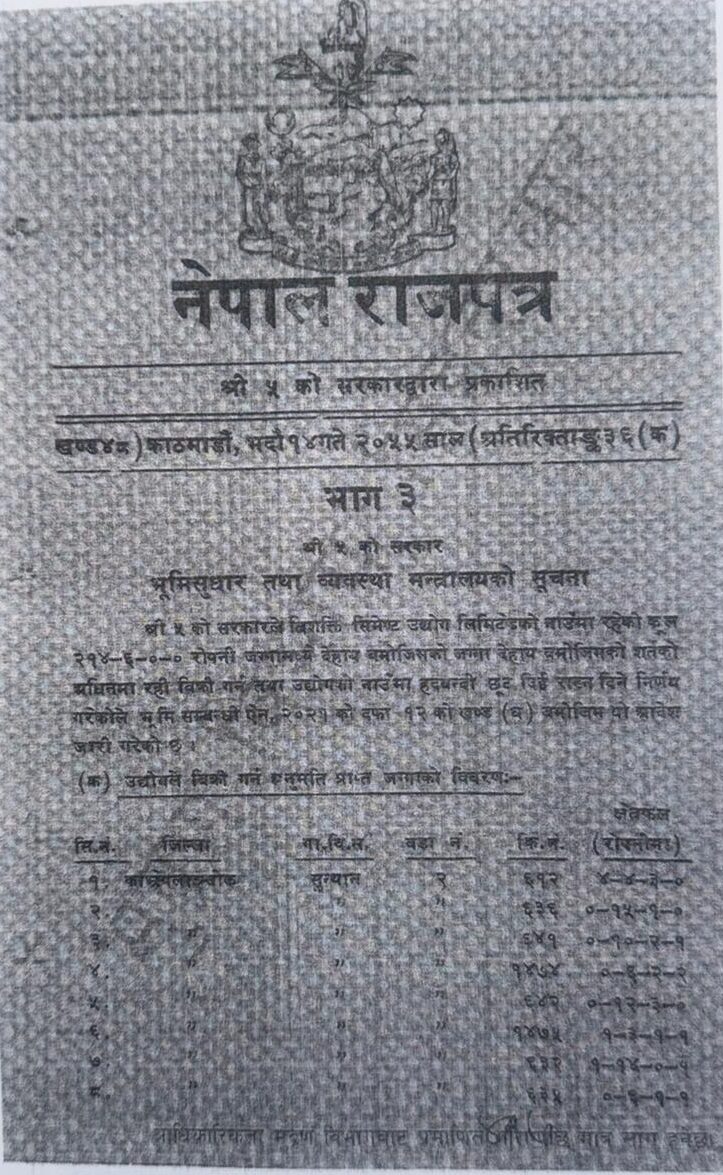
A copy of the Gazette notice on the Council of Ministers’ decision to release Trishakti Cement land for sale
Another condition was that the industry had to fully complete the work corresponding to the objective, goal, and condition of the exempted land within a maximum period of four years. The Gazette stipulated that the land would be confiscated if the work was not completed, except for reasonable cause. However, Trishakti does not appear to have carried out the work within four years, nor does it appear to have submitted a reasonable cause. The government has not confiscated Trishakti’s remaining 49855.82 square meters (98 ropani) of land to date.
Another condition was that the exempted land could not be transferred or used, either partially or in any way, by any individual, association, organization, or company without the government’s prior approval. It was stated that the land would be confiscated if this was done. However, Trishakti sold the exempted land to both individuals and an organization. The government has not confiscated the land sold in this manner.
Another condition in the Gazette was that the money received from the sale had to be kept in the industry’s account and spent only on purchasing land. The Gazette stated that the Ministry of Land Reform and Management would monitor whether the industry used the funds for the conditional work. However, the ministry itself allowed Trishakti to withdraw the money in its account but never monitored what the expenditure was used for.
Trishakti has already withdrawn and spent the money received from the land sale. Records show that some Rs 9 million deposited in the Agricultural Development Bank, Putalisadak, after the land sale, was withdrawn. However, the withdrawn money does not appear to have been spent on the industry, nor has new land been purchased elsewhere.
Trishakti deposited the funds in the Agricultural Development Bank following the land sale on December 8, 2000, and documents confirm the amount was subsequently withdrawn in 2001. This withdrawal was authorized by a decision at the State Minister for Land Reform level, presided over by Siddha Raj Ojha, the then Minister of State for Land Reform. Notably, both former Prime Minister Girija Prasad Koirala and Ojha, who were key figures involved in this case, have since passed away.

A copy of the Gazette notice on the Council of Ministers’ decision to release Trishakti Cement land for sale