Kathmandu
Friday, February 27, 2026





Seven years grounded, the Boeing 757 has cost NAC over Rs 73 million in parking and insurance alone
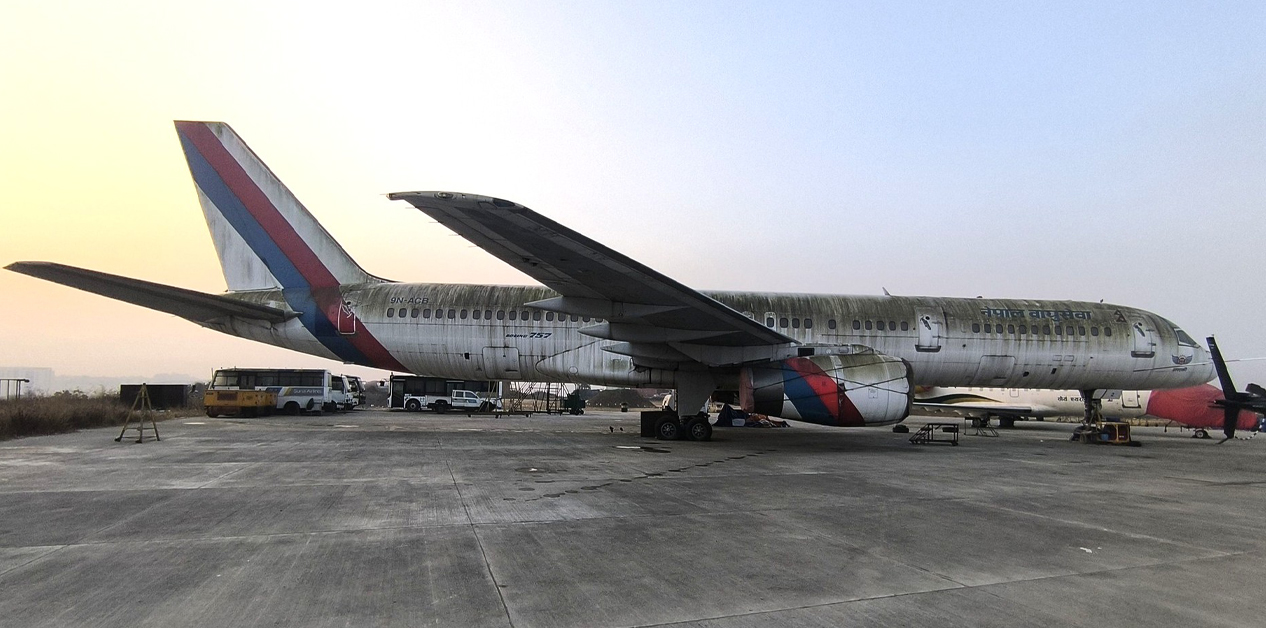
KATHMANDU: Seven years have passed since the Nepal Airlines Corporation grounded its Boeing 757-200 ‘ACB’ and left it parked in the open at Tribhuvan International Airport. Exposed to relentless sun, rain, dust, and pollution, the aircraft has steadily deteriorated. Even the sun and moon of Nepal’s national flag painted on its fuselage have visibly faded, reflecting years of neglect.
In the seven and a half years since mid-2018, the door of this aircraft has not even been opened. Forget checking the technical condition; no one has even reached out to wipe the dust accumulated over the years.
“We have no idea whether birds have built nests inside the aircraft or if rats have crept into its components,” said Mahesh Marita, the director of the Engineering Department of the Corporation.
The aircraft, which never incurred a loss during its 30 years of flying, is now adding a burden of expense to the corporation. The Corporation has been paying Rs 725,000 every month to the Civil Aviation Authority of Nepal (CAAN) just for the parking of the aircraft. Based on this rate, Rs 60 million has already been spent on parking fees alone in seven years.
The annual amount for the insurance of the aircraft is Rs 1.8 million. By this calculation, the Corporation has already paid Rs 13 million for insurance in seven years. When adding both the parking and insurance amounts, the Corporation has paid Rs 73 million so far.
With the start of the procurement process for the Airbus A-320 and A-330 in the fiscal year 2015/16, the corporation adopted a strategy to displace the Boeing. To purchase four Airbus aircraft by removing the Boeing, the corporation took loans from the Citizen Investment Trust (CIT) and the Employees Provident Fund (EPF) under the government’s guarantee. The total liability of the loan taken by the corporation to purchase the Airbus has reached Rs 52.46 billion, including principal and interest, until now. The corporation has been paying Rs 530 million monthly, covering the full installments for two Airbus A-320s and partial installments for two Airbus A-330s. Most recently, it appears the Corporation paid a monthly installment of Rs 530 million to the CIT and EPF at the end of January 14 this year.
Ironically, the Nepal Airlines Corporation neither restored the aircraft to regular service nor auctioned it in time. Had the Boeing been sold earlier, the corporation could have avoided mounting parking and insurance costs, while the proceeds might have helped ease repayment of loans taken to acquire Airbus aircraft.
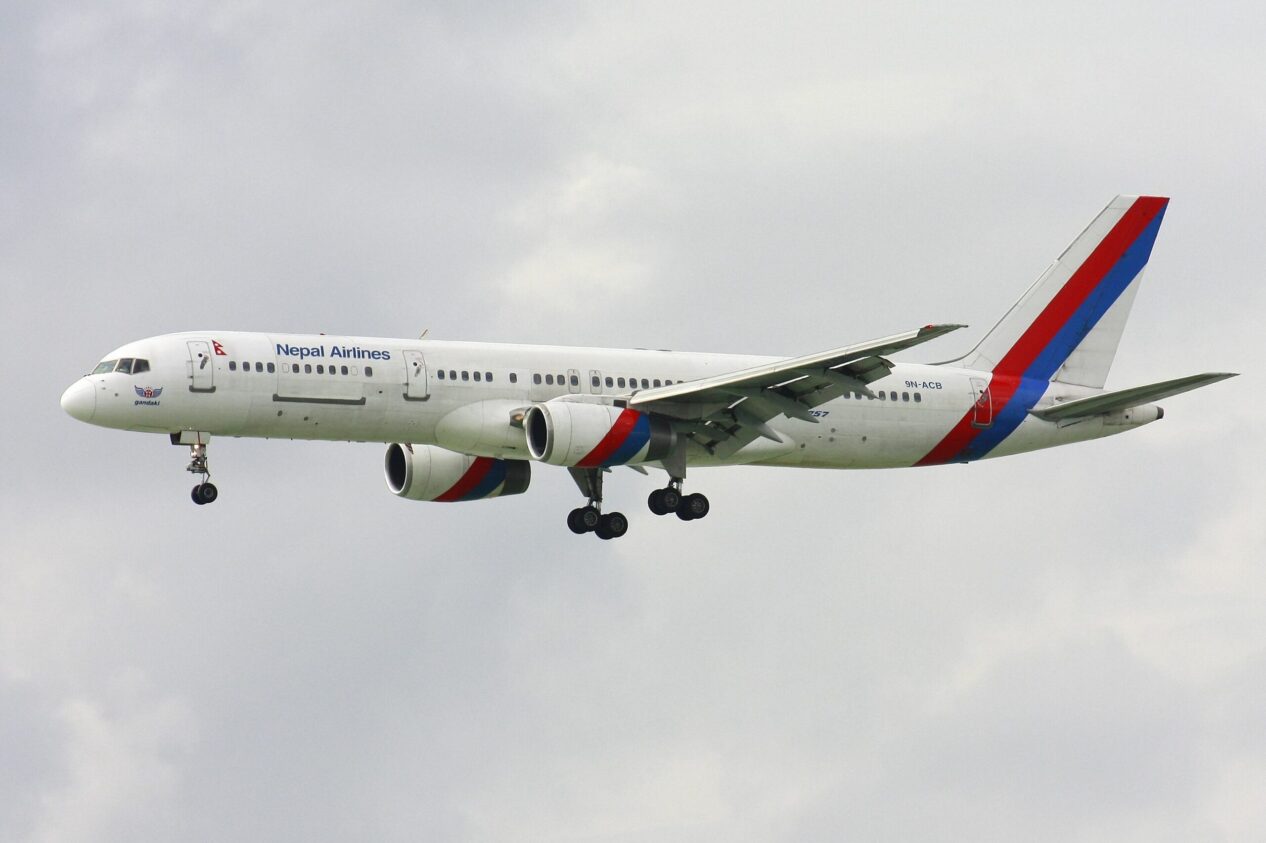
An aerial view of the Boeing 757 (Callsign 9N-ACB) during one of its operational flights
Meanwhile, the aircraft’s technical condition has continued to deteriorate due to years without regular maintenance. As a result, both its operational viability and its market value have steadily declined in the international arena. Devendra Pun, technical spokesperson for Nepal Airlines Corporation, said that the longer the aircraft remains out of regular service, the slimmer the chances of a successful sale.
“Twice in fiscal year 2019/20, efforts were made to sell the aircraft, but the process did not succeed. Since then, neither the board nor the management has taken a decisive step. As a result, the aircraft has remained stuck in limbo, and the corporation continues to incur losses,” Pun added.
Marita, the director of the Engineering Department of the Corporation, claims that in the current situation, the international value of the aircraft has been limited to Rs 200 to Rs 250 million. Whereas, when trying to auction the aircraft in 2019, an American company was already prepared to buy it for Rs 470 million.
The book value of the Boeing is currently Rs 370 million. Book value means the value derived after deducting the annual depreciation since the purchase. Because it has become unfit to fly, the aircraft now has to be sold as scrap. Since no proposals were received when calling for bids for sale two times previously, the Corporation has reached the conclusion that the aircraft must be sold as scrap. According to the Public Procurement Act 2007 and the Nepal Airlines Corporation Regulations 2008, an item that remains unsold after completing the auction/sale process two or more times can be sold as scrap.
According to spokesperson Pun, it is risky even for the manufacturing company to take back an aircraft that has been mothballed in an open space for such a long time and has been away from regular maintenance.
“Bringing an aircraft in this condition back into operation would require extensive technical assessments, structural inspections, and a complete engine overhaul, all of which involve significant risk,” said Marita of the Corporation.
Marita, the director of the Engineering Department of the Corporation, claims that in the current situation, the international value of the aircraft has been limited to Rs 200 to Rs 250 million. Whereas, when trying to auction the aircraft in 2019, an American company was already prepared to buy it for Rs 470 million.
In effect, Marita noted, the aircraft can no longer be treated as a readily tradable asset. Any buyer seeking to restore it to service would have to assume substantial technical uncertainties, additional expenses, and potential liabilities.
“An aircraft that has missed four C-check cycles cannot simply be returned to service. Even flying it out for repairs would likely require approval from the manufacturer, and I do not see that happening,” Marita added.
Marita further added that if any company were willing to dismantle the aircraft and take it away as scrap, it would be a matter of sheer luck.
Although countries like India and the USA are operating them in a limited capacity, today Boeing has been displaced globally. On one hand, it is already displaced, and on the other hand, the possibility of finding an airline company that would buy an old aircraft is high. This Boeing, which was flying regularly, was grounded around May 2018. At that time, one engine required a C-check, and the other required minor repair.
According to spokesperson Pun, currently, the corporation does not have skilled manpower such as Boeing engineers and pilots. Since there is no manpower within the country, there is a compulsion to bring in a foreign expert team for tasks like technical testing, structural evaluation, and flight worthiness testing. This could increase the cost of the auction process and lead to a risk of further economic burden.
“Before restarting the auction process, a comprehensive technical assessment is essential, and it appears that qualified experts for such an evaluation may need to be brought in from abroad,” said Marita.
Held hostage by hesitation
The Nepal Airlines Corporation had purchased two Boeing 757-200s in the fiscal year 1986/87. These aircraft with a capacity of 190 seats were once the main pillars of the corporation’s long-distance flights. The aircraft used to fly to India, as well as Shanghai in China, Frankfurt in Germany, Orly in France, Gatwick in Britain, and Osaka in Japan.
However, after the policy of bringing in Airbus, the corporation decided to gradually ground the Boeing. One 757-200 aircraft, ‘Karnali,’ which had flown 86,000 hours in 30 years, was auctioned in the fiscal year 2017/18. Under the condition of ‘accepting the aircraft as it is and where it is,’ the Nepali company BB Airways purchased the aircraft for Rs 149.2 million through a competitive auction. The story of Boeing Karnali ended there.
Another Boeing 757, ‘Gandaki,’ which had logged 89,000 flight hours and was still in regular service, was grounded in mid-2018, which is about a month before the wide-body Airbus A330 ‘Annapurna’ arrived in Kathmandu. The auction process began the following year, with the aircraft’s price set at Rs 850 million by the corporation.
To sell the aircraft, Nepal Airlines Corporation invited bids twice in 2019 but received no offers. It later entered negotiations with US-based CSDS Aircraft Sales and Leasing. According to spokesperson Devendra Pun, CSDS proposed to purchase the aircraft for Rs 499.4 million and deposited an advance of USD 500,000. However, as the auction process was underway, the global Covid-19 pandemic disrupted the deal, and the company ultimately did not proceed with the purchase.
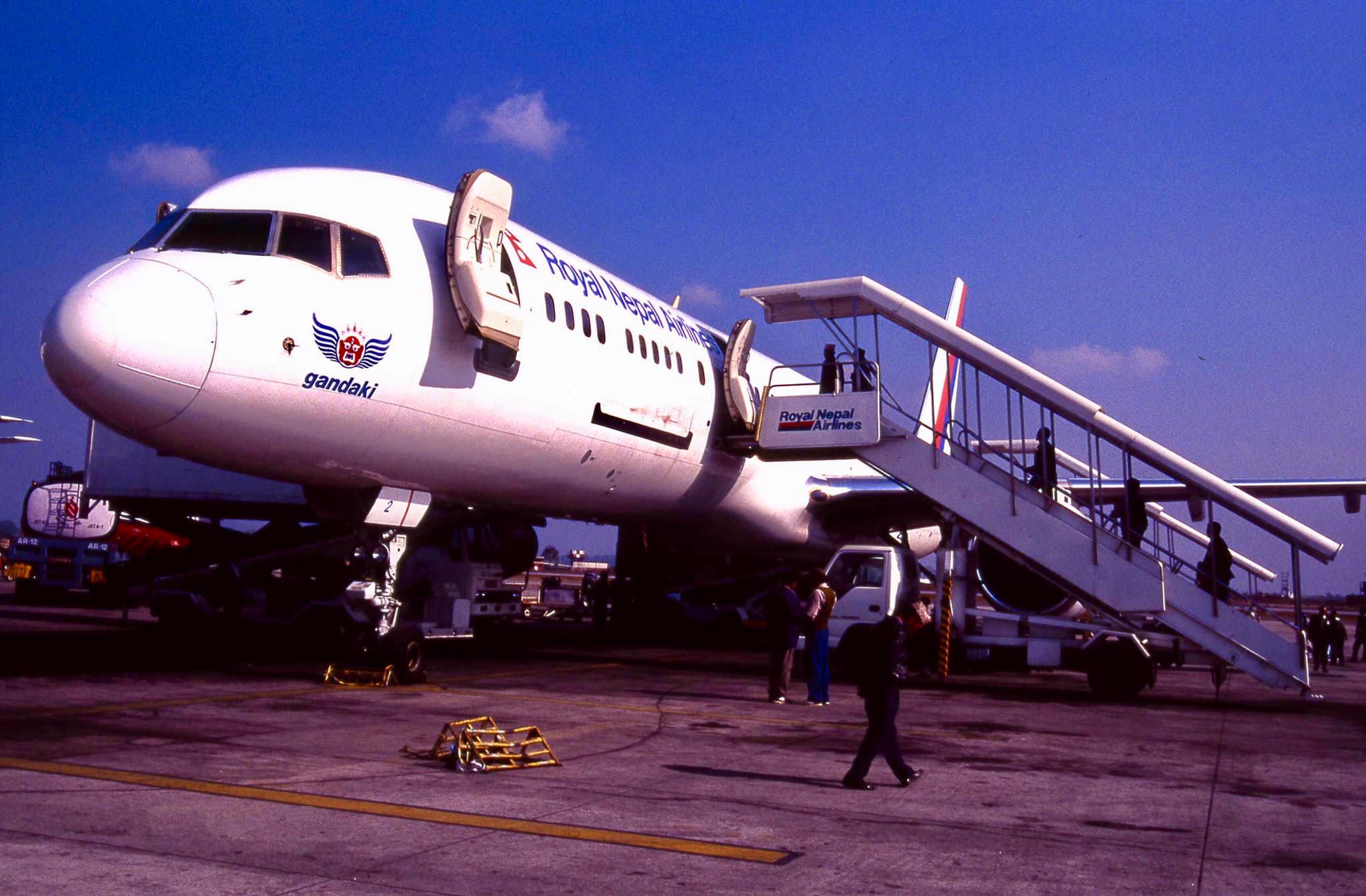
The Nepal Airlines Corporation Boeing 757 with callsign 9N-ACB at Tribhuvan International Airport
In 2023, CSDS also wrote a letter once saying they would take the aircraft. However, CSDS hesitated again, saying that the manufacturer company stated they could not bear the risk of flying the aircraft away. Here, citing that the aircraft was not taken on time, the then-executive chairman of the corporation, Yubaraj Adhikari, cancelled the process.
“After forfeiting the USD 500,000 given as an advance payment by CSDS, the Board of Directors and the management have not made any concrete decision regarding what to do with the said aircraft,” says Spokesperson Pun.
What should be done with an aircraft trapped in prolonged indecision remains unclear. From the Board of Directors to successive leadership and management, all bear responsibility for allowing the situation to drift. As its international market value continues to decline, Nepal Airlines Corporation has yet to finalize an auction decision. However, Executive Director Amrit Man Shrestha said a proposal has been forwarded to the Board to sell the aircraft as scrap based on its current book value.
Another Spokesperson of the corporation, Archana Khadka, says that a five-member committee has been formed under the leadership of the Engineering Department Chief Marita to study the current condition of the aircraft.
“The aircraft’s condition will be assessed once the committee submits its report, after which the Nepal Airlines Corporation Board of Directors or management will determine the next course of action,” said spokesperson Khadka.
Engine stranded in Spain
It is a matter of 2017; while the aircraft Gandaki was coming to Kathmandu from Kuala Lumpur, one engine overheated. The engine required repair. A C-check agreement for the aircraft had already been made between the Corporation and the Singapore Maintenance Repair Overhaul Organization (MRO). The aircraft was taken to the MRO. There was a spare engine for the Boeing there. The aircraft was brought to Kathmandu after removing the engine that required repair and installing the spare engine.
The engine removed in Singapore was taken to the Iberia Maintenance company in Spain for repair. There was another agreement for engine repair between the Iberia Maintenance company and the Corporation.
However, the then General Manager of Nepal Airlines Corporation, Sugat Ratna Kansakar, chose to ground the aircraft that was operating with the spare engine, while no further action was taken on the engine sent to Spain.
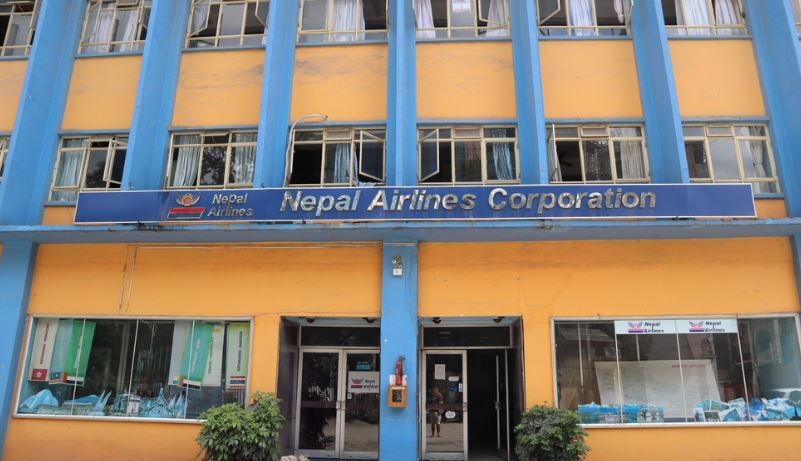
Nepal Airlines Building, Kantipath
After the retirement of Kansakar, on September 8, 2019, the government formed the Nepal Airlines Corporation Reform Suggestion Task Force. The said task force, led by Sushil Ghimire, had also evaluated the assets of the corporation. When the task force submitted the report on September 18, it missed not only the engine located in Spain but also the details of more than 1,000 spare parts of the aircraft. After Dim Prasad Paudel was appointed as the General Manager of the Corporation around September 2020, a search for the said engine was conducted. Upon searching, 1,000 spare parts of the aircraft were found in the storage of Tribhuvan International Airport. How those parts were missed in the asset evaluation remains a mystery even now.
General Manager Paudel had corresponded to assess the condition of the engine stored in Iberia, where the company estimated repair costs at Rs 500 to Rs 600 million and also required payment for storage expenses incurred so far.
Paudel explained that his brief eight-month tenure at the corporation prevented him from making further decisions about the aircraft engine. “During my time, we located the engine, but before finalizing what to do next, I had to leave,” he said.
After Paudel, next Yubaraj Adhikari was appointed as the Executive Chief in the Corporation. He formed a committee to study the engine located in Iberia. The then Board of Directors member Kishore Pradhan and the Acting Director of the Continuing Airworthiness Management Department, Upendra Paudel, were appointed to the committee. The two-member team reached Spain itself on August 10, 2023, to understand the engine.
After returning to Nepal, the team, including Pradhan, submitted a report pointing out that a huge amount of money would be spent if the engine was repaired and brought back. After this, the Corporation has not made any decision regarding the engine.
In the meeting with the members of the Corporation, Iberia officials stated that the repair cost for the engine would be Rs 870 million. The storage fee alone, where the engine was kept, was fixed at Rs 36.2 million. Iberia officials gave a deadline of two months, until October 15, 2023, to take the engine; otherwise, they said they would not take responsibility for the engine.
After returning to Nepal, the team, including Pradhan, submitted a report pointing out that a huge amount of money would be spent if the engine was repaired and brought back. After this, the Corporation has not made any decision regarding the said engine.
Pradhan stated that the aircraft engine has been stored in Iberia since 2017, and since the decision to ground the aircraft was made, corporation officials have not decided whether it is worth bringing the engine back at a cost.
The evaluation of the aircraft engine in Spain was conducted in 2023 during Yubaraj Adhikari’s tenure. At that time, the engine was valued at USD 900,000, equivalent to Rs 130 million at today’s exchange rate. Despite two attempts to auction the engine, no buyers came forward, says Corporation Spokesperson Khadka. “Both tender attempts failed; the final decision will be made after the aircraft study committee submits its report,” she adds.
Marita, Chief of the Engineering Department, notes that years of neglect have reduced the engine’s value. “In fiscal year 2023/24, the engine’s book value was Rs 50 million. Today, it could fall to Rs 30–40 million, and additional costs would be required for re-evaluation,” he explains.
The Boeing rusting in the open parking area and the engine stored abroad are more than just machines; they reflect the corporation’s mismanagement, indecision, and leadership failures. The recent youth-led movement for good governance in the country raises a question: can the government allow the nation’s moon-and-sun-flagged carrier to remain in this state of neglect? The new government will have to answer this.