Kathmandu
Sunday, February 22, 2026






KATHMANDU: Nepal News presents today’s snapshot of Nepal’s economic activities. Get quick updates on major market movements, policy shifts, and financial developments shaping the economy of Nepal. Here are the key economic highlights for today:
Preparations on to implement policy of mixing 10 percent ethanol in petrol:
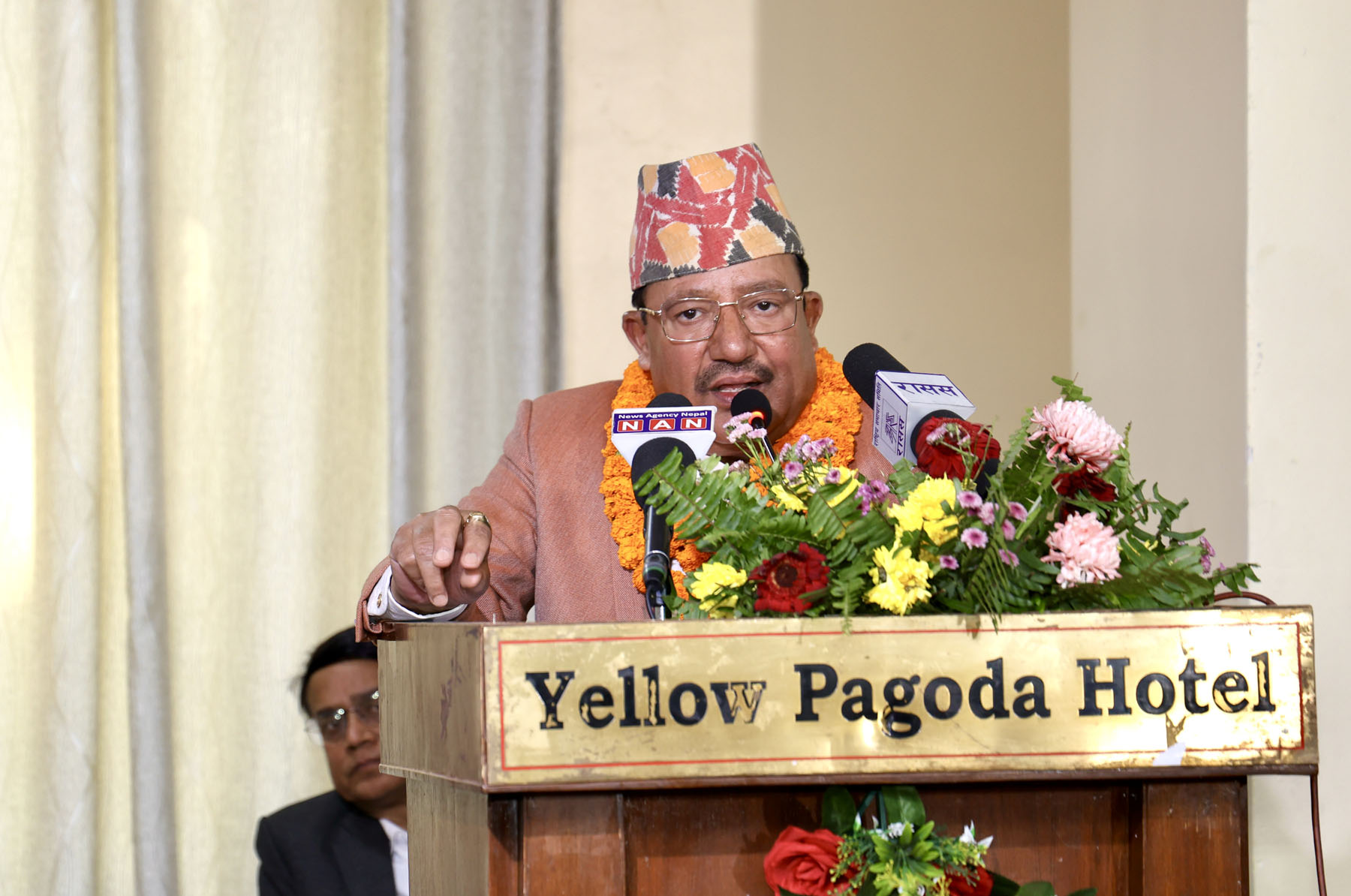
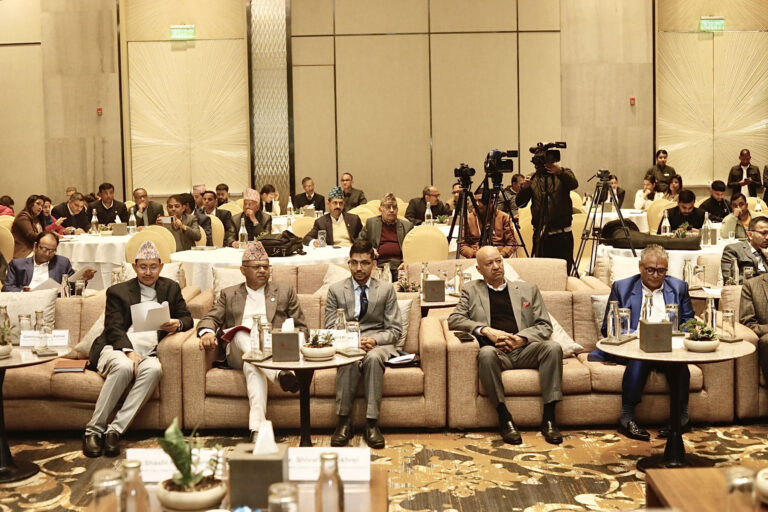
Minister for Industry, Commerce and Supplies Anil Kumar Sinha has stated that blending 10 percent ethanol in petroleum products could reduce Nepal’s annual import bill by approximately 6 billion Nepali Rupees. Speaking at an event organized by the Society of Economic Journalists of Nepal (SEJON) in the capital on Sunday, Minister Sinha said that the decision to blend ethanol in petrol has reached the final stage of implementation after extensive study and discussion. The government claims this move will significantly help in reducing the country’s growing trade deficit and increasing foreign exchange reserves. Although studies on ethanol blending have been ongoing in Nepal for two decades, the ‘Order to Blend Ethanol in Petrol, 2082’ has only recently been approved. Minister Sinha clarified that this policy will be published in the Nepal Gazette and implemented soon. Mentioning that blending ethanol in petrol is a significant step toward clean energy, he presented data indicating that this could reduce petrol imports by 130 million liters annually.
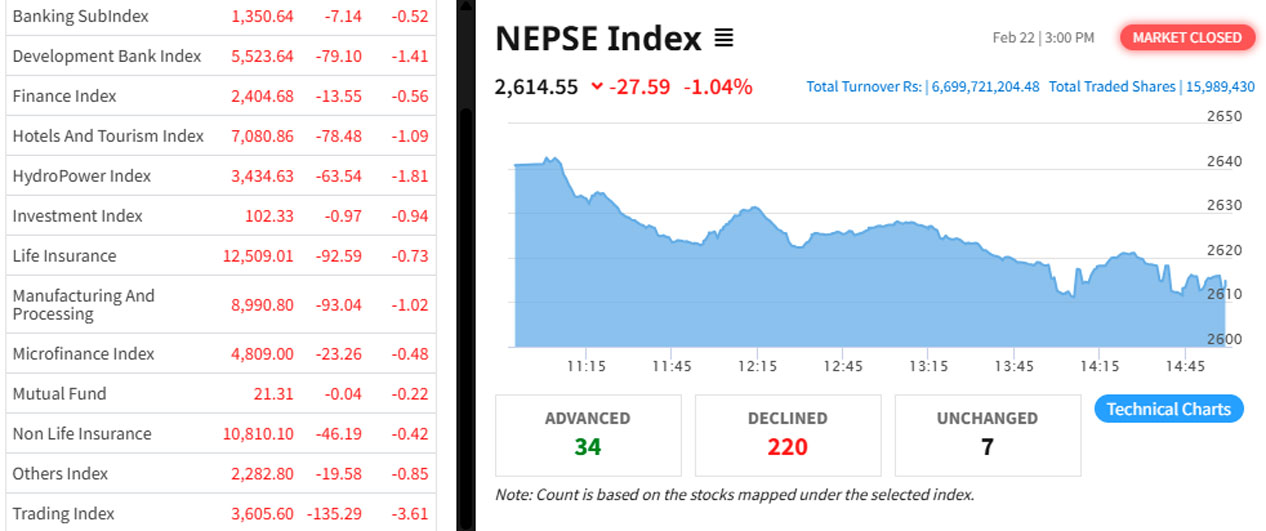
Nepal Stock Exchange Index Plummets by Over 27 Points
On the first trading day of the week today (Sunday), the NEPSE index declined by 27.59 points. All sector indices traded on NEPSE closed in the red. Compared to the previous trading day, NEPSE fell by 1.04 percent and settled at 2,614.55 points. The Sensitive Index also declined by 3.27 points to close at 449.39, marking a 0.72 percent decrease from the previous session. On Sunday, shares of 324 companies were traded 72,104 times, with a total of 15,989,430 shares changing hands. The total turnover amounted to Rs 6,69,97,21,204 (approximately Rs 6.69 billion).All 13 sector groups that were traded ended in negative territory. The commercial banks index declined by 0.52 percent, development banks by 1.41 percent, finance by 0.56 percent, hotels and tourism by 1.09 percent, hydropower by 1.81 percent, investment by 0.49 percent, life insurance by 0.73 percent, manufacturing and processing by 1.02 percent, and microfinance by 0.48 percent.
Cardamom Exports Surge at Mechi Customs in First Seven Months of Fiscal Year, While Tea Trade Declines
Cardamom exports through the Mechi Customs Office have shown significant improvement up to the end of Magh (mid-February) in the current fiscal year 2082/83 BS (2025/26). According to the customs office data, cardamom exports increased by 59.80 percent over the past seven months, reaching a value of Rs 8.612007 billion. According to Information Officer Ishwar Kumar Humagai, a total of 4,153.15 metric tons of cardamom was exported to India during this period. In contrast, exports during the same period of the previous fiscal year amounted to only Rs 5.388020 billion. While the cardamom trade is booming, the trade of tea, another major export item for Nepal, has seen a decline. According to the statistics, tea exports decreased by 26.70 percent by the end of mid-February in the current fiscal year. During this period, tea worth only Rs 2.321256 billion was exported, whereas Rs 3.166213 billion worth of tea was exported during the same period last year. The customs office stated that plywood exports decreased by 40.90 percent and amriso (broom grass) exports decreased by 24.90 percent, alongside tea.
Seven months’ foreign trade marked by Rs 955 billion deficit
In the first seven months of the current fiscal year, the country’s foreign trade transactions totaled Rs 1,291.63 billion, while the deficit exceeded Rs 955 billion. According to the Department of Customs, during the review period, imports amounted to Rs 1,123.48 billion, while exports were valued at Rs 168 billion. The data indicate the country’s ballooning trade deficit. In the past seven months, trade with India amounted to Rs 629 billion in imports and Rs 137 billion in exports. The trade deficit with the southern neighbor alone amounts to Rs 491 billion, followed by over Rs 234 billion with China. The details unveiled by the Department show that the trade deficit with Argentina stands at Rs 66.11 billion, followed by Rs 39.77 billion with the United Arab Emirates and Rs 12.64 billion with Indonesia. Similarly, the country has trade profits with some countries. The trade profit with Romania during the review period reached Rs 55.2 million, while Nepal made a trade profit totaling over Rs 33.3 million from Norway and over Rs 25.7 million from Iceland. Regarding imports, a significant portion of Nepal’s imports during this period is attributed to petroleum products.
National Economic Census Pre-Training Commences in Nepal
A master trainer training program has commenced in preparation for the National Economic Census 2082 BS, under the main theme of ‘Economic Calculation for Measuring the Economy’. This training program is being conducted with the objective of preparing trainers for the District Economic Census Officer and Enumerator and Supervisor training programs, and to facilitate the monitoring of on-site data collection. Deputy Chief Statistician Dhundiraj Lamichhane stated that everyone has the responsibility to make the upcoming census successful by fully utilizing the experience of the Economic Census 2075 BS. This time, the census incorporates e-Census as part of modern technology usage, which is expected to enhance efficiency and accuracy. The program particularly emphasized that trainers must possess a high level of accountability and a correct understanding of the subject matter. Instructions were given to ensure uniformity across the country in understanding the training materials regarding equality and consistency, and to provide training effectively. Furthermore, the Central Bureau of Statistics stated that trainers are being prepared to identify potential workplace problems, devise solutions, and ensure active participation. Since the quality of statistics depends on the quality of training, it was urged that this be taken seriously.
Nepalgunj Customs Office Collects Only 45% of Revenue Target in First Seven Months of Fiscal Year
The Nepalgunj Customs Office has collected 45 percent of its target revenue in the first seven months of the current fiscal year. The annual target for the current fiscal year 2082/83 has been set at Rs 24.545782 billion, but only Rs 11.046585 billion, or 45.01 percent of the target, has been collected by the end of Magh (mid-February), said Customs Office Chief Janardan Paudel. According to him, there is a challenge to collect the remaining 55 percent of the revenue in the remaining five months. The revenue collection has not met the monthly target in any month so far. In the current fiscal year, revenue collection for Shrawan, Bhadra, Asoj, Kartik, Mangsir, Poush, and Magh was only 74, 69, 87, 72, 83, 83, and 88 percent of the target, respectively. In the fiscal year 2081/82, the Nepalgunj Customs collected 74.64 percent of its target revenue, while in the fiscal year 2080/81, it collected 63.35 percent. Customs Chief Paudel stated that although there was an expectation of increased import-export and customs revenue after the Integrated Check Post (ICP) started operating at the Jamunaha point on the Nepal-India border, the target has not been met for the past few years. He mentioned that revenue collection has increased by more than Rs 90 million compared to the first seven months of the last fiscal year in the current fiscal year, indicating that revenue collection is on an increasing trend even if the target is not met. In the first seven months of the last fiscal year, revenue collection through the Nepalgunj checkpoint was Rs 10.954184 billion.
EV imports slow in Nepal after years of strong growth
Nepal has recorded a slowdown in electric vehicle (EV) imports during the first seven months of the current fiscal year 2025/26, signaling a possible moderation after few years of strong growth. According to statistics from the Department of Customs, a total of 5,894 electric four-wheelers—including cars, jeeps and vans—were imported during the review period. This marks a 6 per cent decline compared to the same period of the previous fiscal year. A total of 6,256 units of four-wheeler electric vehicles were imported during the first seven months of the last fiscal year. The decline has been seen since the beginning of the current fiscal year. In value terms, the country spent around Rs 13.84 billion on importing four-wheeler EVs in the first seven months of the current fiscal year 2025/26. The government had spent Rs. 14.74 billion for the import of 6,256 EVs during the first seven months of the last fiscal year. Similarly, two unassembled four-wheeler electric vehicles were imported during the review period. Imports of three-wheeler electric vehicles have also declined. The country imported 5,069 three-wheeler electric vehicles worth Rs 517.81 million in the first seven months of the current fiscal year.
Wholesale Price of Lemon Surges by Over 177% in One Month
In recent times, an increase in the price of lemons has been observed. The wholesale price of lemons has increased by 177.49 percent over a one-month period. According to the price details collected by the Kalimati Fruits and Vegetables Market Development Committee, the average price, which was Rs 95.50 per kilogram on Magh 10 (24 January), has now increased by 177.49 percent to an average price of Rs 265 per kilogram today. Looking at the price of lemons in the main vegetable markets across the country, the average price in Birtamod, Jhapa, is Rs 182.5 per kilogram today. Similarly, the average price is Rs 225 in Sindhuli, Rs 115 in Birendranagar, and Rs 265 in Pokhara.
Nepal India Economic Cooperation Must Become More Result-Oriented
The bilateral relationship between Nepal and India has reached a significant milestone as leaders from both nations gathered in New Delhi for the Second Indo-Nepal Trade Festival 2026. Speaking at the prestigious event on February 21, 2026, Chandra Prasad Dhakal, the President of the Federation of Nepalese Chambers of Commerce and Industry (FNCCI), delivered a compelling call to action. He argued that while the historical and cultural ties between the two neighbors are unparalleled, the current framework for Nepal India Economic Cooperation must be modernized to become more practical, streamlined, and result-driven. As the global economy grapples with shifting supply chains and the rapid pace of digitalization, Dhakal emphasized that the future of this partnership lies in structural reforms, the harmonization of standards, and the elimination of non-tariff barriers that have historically hindered the flow of goods and services across the 1,850-kilometer open border. The core of Dhakal’s address centered on the need for administrative efficiency at the border. Despite the geographical proximity, exporters in both nations often face delays due to mismatched customs procedures and divergent quality standards for agricultural and industrial products.
Development projects remain limited to rhetoric
Candidates are vying for the upcoming House of Representatives (HoR) election in Constituency No. 1 of Nawalparasi, pledging popular commitments such as infrastructure development, job creation, and agricultural advancement. However, the condition of the very roads they use daily to canvass for votes appears to mock their promises. The road section linking Narayanchowk in Bardaghat Municipality to the religious site in Triveni, which was meant to be completed within two years, remains unfinished even after six years. Candidates travel daily along this stretch from Bardaghat to Susta to solicit votes. As in the previous election, nearly all candidates have once again included in their manifestos a commitment to facilitate completion of the Postal Highway expansion. Yet anyone travelling along the dusty and potholed road expresses frustration towards political leaders. Protesting delays in the road’s construction, Umesh Chandra Yadav, Chair of Pratappur Rural Municipality, even staged a hunger strike last year. He ended the strike the very next day after receiving assurances that construction would begin immediately.
United Modi Hydropower Dividend and Bonus Announcement
The hydropower sector in Nepal continues to attract significant investor interest as United Modi Hydropower Limited (UMHL) officially announces its dividend proposal for the previous fiscal year. Following the board of directors meeting held on February 20, 2026 (Falgun 8, 2082), the company has moved to reward its shareholders through a combination of bonus shares and cash distributions. This decision reflects the company’s ability to maintain a profitable trajectory despite the inherent challenges of the energy sector, such as seasonal water flow variations and infrastructure maintenance costs. As a publicly listed company on the Nepal Stock Exchange, United Modi’s announcement is a critical signal to the market regarding its financial health and its commitment to providing a consistent return on investment to its diverse base of retail and institutional shareholders. The specifics of the United Modi Hydropower Dividend include a proposal to distribute 7 percent bonus shares and a 0.36842 percent cash dividend, the latter primarily intended for tax purposes.
Lumbini Bikas Bank Founder Share Sale Opens for Promoters
The development banking sector in Nepal continues to demonstrate a high level of regulatory compliance and administrative transparency as Lumbini Bikas Bank Limited (LBBL) officially announces a new founder share sale. On February 22, 2026 (Falgun 10, 2082), the bank issued a formal public notification regarding the availability of 20,290 units of its promoter shares. This sale is being conducted under the specific guidelines set forth by the Nepal Rastra Bank (NRB) regarding the transfer of ownership within financial institutions. In accordance with these regulations, the bank is prioritizing its existing group of founder shareholders, offering them the right of first refusal before these shares can be considered for sale to the general public or external investors. This structured approach is essential for maintaining the stability of the bank’s core ownership and ensuring that those who have been part of the institution’s journey have the primary opportunity to increase their stake.
IMF ECF Seventh Review Agreement Reached with Nepal
The economic landscape of Nepal has reached a pivotal juncture with the official conclusion of the staff level agreement for the seventh and final review under the Extended Credit Facility (ECF). Following an intensive mission in Kathmandu from February 6 to 20, 2026, the International Monetary Fund (IMF) delegation, led by Mission Chief Sarwat Jahan, announced that Nepal is set to receive approximately 43.2 million US dollars (nearly 6 billion Nepali rupees). This disbursement is the final tranche of a multi-year financial assistance program aimed at stabilizing Nepal’s economy after the dual shocks of the global pandemic and subsequent inflationary pressures. The successful completion of this review signifies that the international community recognizes Nepal’s efforts in maintaining fiscal discipline and pursuing structural reforms despite a backdrop of domestic political transitions and a slowdown in the manufacturing and construction sectors.
Gold Price Rises by Rs 5,600 per tola in Nepali Market
The price of gold increased by Rs 5,600 per tola on Sunday. According to the Federation of Nepal Gold and Silver Dealers Associations, gold price was fixed at Rs 310,300 per tola for the day. On the previous trading day, it was priced at Rs 304,700 per tola. Meanwhile, the price of silver rose by Rs 375 per tola. Silver, which was traded at Rs 5,050 per tola the previous day, has increased to Rs 5,425 per tola.