Kathmandu
Friday, January 9, 2026






KATHMANDU: Nepal News presents today’s snapshot of Nepal’s economic activities. Get quick updates on major market movements, policy shifts, and financial developments shaping the economy of Nepal. Here are the key economic highlights for today:
NEPSE Ends Week Up 4.59 Points to Close at 2,640.54
On the last trading day of the week, NEPSE ended on a positive note, gaining 4.59 points. Over the five trading days, the market rose on three days and fell on two. Specifically, NEPSE declined on Sunday and Wednesday, while it increased on Monday, Tuesday, and Thursday. Compared to Wednesday, NEPSE rose 0.17 percent to close at 2,640.54 points today. The Sensitive Index also increased by 0.92 points to 455.93, marking a 0.20 percent rise from the previous day. On Thursday, a total of 328 companies conducted 69,261 transactions, trading 14,301,760 shares, amounting to NPR 4.908 billion. Earlier in the week, NEPSE had dropped 10.29 points on Sunday, then gained 28.73 points on Monday and 9.93 points on Tuesday, before falling 13.35 points on Wednesday. Despite today’s gain, the overall trading volume decreased compared to the previous day. Out of 13 industry groups, six saw share prices fall while seven registered gains. Commercial and development banks rose by 0.30 percent and 0.18 percent respectively, whereas the finance group declined 0.44 percent.
Corporate Development Bank Limited to Skip Dividend Distribution to Shareholders
Corporate Development Bank Limited has decided not to distribute dividends to its shareholders. The decision was made at a meeting of the bank’s Board of Directors held on 7 Jan. Based on the audited financial statements for the fiscal year 2081/82, the meeting resolved that no dividend would be distributed to shareholders. The bank also informed that the same financial statements will be submitted to Nepal Rastra Bank for approval. Following approval from Nepal Rastra Bank, the financial statements will be presented for endorsement at the bank’s upcoming Annual General Meeting, the bank said.
Hotel Forest Inn Limited to Launch IPO from 18 Jan
Hotel Forest Inn Limited is set to issue its Initial Public Offering (IPO) starting from 18 Jan. Under the first phase, the company will issue shares exclusively to Nepali citizens working abroad. The company had received approval from the Securities Board of Nepal on Poush 20 to issue 4 million ordinary shares with a face value of Rs. 100 each, totaling Rs. 400 million. Out of the total issue, 10 percent—or 400,000 shares—will be allocated for Nepalis employed abroad. Eligible applicants can apply for a minimum of 10 shares and a maximum of 200,000 shares. The IPO will close as early as 22 Jan and no later than 1 Feb. Nepalis working abroad can apply through all ASBA-approved banks and financial institutions authorized by the Securities Board of Nepal, their designated branch offices, as well as through the Mero Share online system.NIC Asia Capital has been appointed as the issue and sales manager for the IPO. After completing the first phase for Nepalis working abroad, the company will issue shares to the general public in the second phase.
NRB Issues Rs. 10 Billion Worth of Debt Instruments
Nepal Rastra Bank (NRB) has issued debt instruments worth Rs. 10 billion today, Poush 24. As excess liquidity in the banking sector continues to rise, the central bank has issued one-year Nepal Rastra Bank debt instruments through a bidding and issuance process to absorb surplus funds. NRB stated that the interest rate on the debt instrument, named Nepal Rastra Bank Debt Instrument 2083 “Cha”, will be determined through a competitive bidding process. The minimum bid amount has been set at Rs. 50 million, and bids can be placed up to the total announced amount in multiples of Rs. 50 million. The principal repayment date has been fixed for Poush 24, 2083, while interest payments will be made on a semi-annual basis. Commercial banks, development banks, and finance companies are eligible to participate in the bidding process.
Salapa Development Bank’s IPO Allotment Scheduled for 9 Jan
Salapa Development Bank’s Initial Public Offering (IPO) is set to be allotted on Friday, 9 Jan. The bank had issued a total of 1,439,179 ordinary shares for general investors. According to CDS and Clearing Limited, 2,383,407 applicants applied for 27,884,570 shares, which is 19.37 times higher than the number of shares on offer. As per the Securities Issuance and Allotment Guidelines, shares will be allotted at a minimum of 10 shares per applicant. Accordingly, only 143,917 applicants will receive 10 shares each, while more than 2.239 million applicants will not receive any shares. Muktinath Capital is the issue and sales manager for the bank’s IPO.
Malla Elected SEMAN President
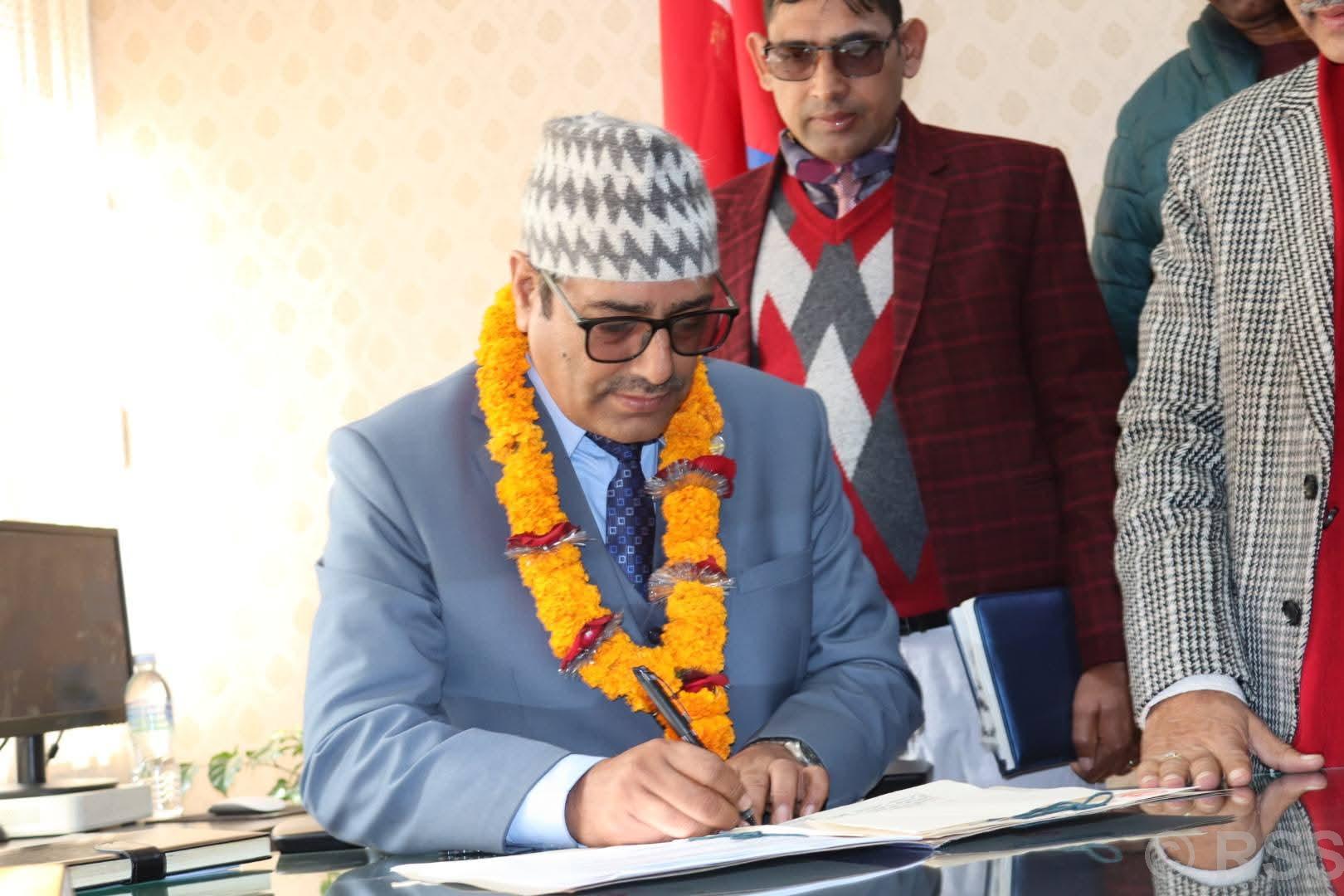
Bharat Kumar Malla has been elected as the president of the Solar Electric Manufacturers Association Nepal (SEMAN). A new 16-member executive committee was elected at the Association’s 25th annual general meeting held in the capital on Wednesday. Similarly, Deepak Gautam has been elected as the senior vice president, Rameshwor Wagle as the first vice president, Sudarshan Baniya as the second vice president, Netra Bahadur Khatri as the general secretary, Keshav Raj Sharma as the secretary, and Ram Prasad Koirala as the treasurer. The election subcommittee stated that Rajendra Bahadur Khadka, Nistha Gautam, Bishow Shah, Krishna Raj Chudali, Yogendra Bahadur Shrestha, Dipak Raj Poudel, Tilak Lal Shrestha, Kumar Basnet, and Subodh Rimal have been elected as members in the SEMAN executive committee. The newly-elected second vice-chair Sudarshan Baniya informed that the Association has been playing a role in providing services by carrying out electrification services in the health, education, irrigation, communication and drinking water sectors through solar energy.
NEA Earns Rs. 18.26 Billion from Power Exports to India and Bangladesh in Five Months
In the first five months of the current fiscal year 2082/83, the Nepal Electricity Authority (NEA) exported electricity worth a total of Rs. 18.26 billion to India and Bangladesh. According to data received from the authority up to the end of Mangsir, electricity exports during the period amounted to this value. During the review period, a total of 2,714 gigawatt-hours of electricity was exported to India and Bangladesh. Nepal exported 40 megawatts of electricity to Bangladesh from Ashar to Kartik, generating revenue of USD 94.36 million. Similarly, from Shrawan to the end of Mangsir, electricity exports totaled 2,714 gigawatt-hours, earning Rs. 18.26 billion, the authority said. NEA spokesperson Rajan Dhakal stated that this amount reflects combined exports to both India and Bangladesh. The authority exported around 1,200 megawatts of electricity to India. In the same period of the previous fiscal year, electricity exports stood at Rs. 13.23 billion.
Coffee Cultivation Boosts Income in Mahabharat Rural Municipality
Sikan Shankhalal Thokar of Koltar Lamadanda in Mahabharat Rural Municipality–4, a remote hilly area of the district, has been engaged in coffee farming since returning from abroad. Along with him, other villagers have also adopted coffee cultivation as a source of income. Currently, it is the coffee harvesting season, and hillsides are covered with coffee plants laden with ripe cherries. Thokar said he has continued coffee farming because it generates higher income compared to crops like maize and millet. He is now busy harvesting coffee, pulping, and drying the beans. Thokar estimates his income to reach around Rs. 2.5 million this year. “The price is better this year compared to last year,” he said, adding that the income has helped cover daily expenses, clothing, and his children’s education. His family was the first in the village to start commercial coffee farming. Similarly, Gyan Bahadur Bomjan from the same area has been involved in commercial coffee farming for the past six years. “Maize and millet require year-round labor, but coffee farming generates lakhs of rupees with just three months of work,” he said.
International Tarul Festival to Be Held in Bahundangi, Mechinagar
A two-day International Tarul Festival is set to be held at Bahundangi Bazaar, Mechinagar-4, from Poush 30 to Magh 1, coinciding with the Maghe Sankranti celebration. Arjun Karki, Ward Chairperson of Mechinagar-4 and chairman of the organizing committee, stated that 14 government and non-government organizations are jointly conducting the festival, which will feature tarul and other local food items from Nepal, India, and Bhutan. He added that this will be the fourth edition of the Tarul Festival in Bahundangi, a region known for human elephant interaction. The organizers said the festival will showcase 18 varieties of traditional tarul-based food items as the main attraction. With the support of NGOs such as UNDP, ISIMOD, WWF, and the Nature Conservation Fund, and participation from the Koshi Province Government and the Tourism Office in Kakarvitta, the festival is being organized to promote local culture and cuisine. Neeraj Ghimire, Secretary of the Organizing Committee, said that studies have shown traditional foods consumed in the area are nutritious and healthy. The festival is expected to raise awareness of these foods and attract tourists to the region.
Reconstruction of Damage from 8-9 September Protests Estimated at Rs 3.63 Billion
The reconstruction and repair of physical damage caused during the September 23–24 protests is estimated at Rs 36.3 billion, according to a five-member committee formed under the National Planning Commission. The total damage from the protests is estimated at Rs 84.46 billion, accounting for 1.38% of Nepal’s GDP and 4.3% of this fiscal year’s budget. Public and government assets bore 53% of the losses, private property 40%, and community or other assets 7%, with Bagmati Province suffering the highest damage at 66.5%. The protests damaged 2,671 buildings, mainly public structures, and caused losses to vehicles, other assets, cash, and valuables. Employment was also affected, with 2,999 people impacted, including 2,353 losing their jobs entirely. The human toll included 77 deaths, mostly men, with 39 aged 13–28. The report provides a detailed plan for rebuilding, repair, and compensation for affected public and private assets.
Gold and Silver Prices Decline in Nepali Market
Gold prices in the local market declined slightly on Thursday, falling by Rs 2,000 per tola. According to the Federation of Nepal Gold and Silver Dealers, the price of gold has decreased by Rs 2,000 per tola to Rs 265,700 today. On Wednesday, gold was bought and sold at Rs 267,500 per tola. Similarly, the price of silver has also decreased. The price of silver, which was Rs 4,935 per tola on Wednesday, has increased to Rs 4,835 on Thursday.