Kathmandu
Thursday, February 12, 2026





A government study identified 92 environmentally viable quarries across 14 districts more than a decade ago, yet forest laws, political hesitation, and policy delays have kept billions in potential infrastructure materials and export earnings untapped
Uddab Thapa
Eleven years ago, when the Department of Mines and Geology (DoMG) conducted a study on construction minerals, it identified 92 stone quarries across 14 districts that could be extracted. The department prepared a report stating that these quarries were environmentally suitable for extraction and that the produced construction materials could be used for domestic infrastructure projects, with surplus stones and aggregates exported abroad.
However, since the quarries were identified in 2071 BS (2014/15), no progress has been made toward operating them.
After the government imposed a ban on the extraction of stone, gravel, and sand in the Chure region and also stopped exports, the DoMG studied alternative stone mines located in the Mahabharat mountain range. Citing excessive exploitation in the Chure region and the export of construction materials to India, the Council of Ministers decided on 12 June 2014 to halt exports. The decision was based on recommendations from a field study conducted in 2066 BS (2009/10) by the then parliamentary committee on natural resources.
Based on the DoMG’s study, four years ago in the fiscal year 2078/79 (2021/22) budget, then Finance Minister Bishnu Poudel included a program to operate mines and quarries and export construction materials. The ordinance budget stated: “Based on environmental impact assessments, quarry-based stone, gravel, and sand will be exported to reduce the trade deficit.”
At the time, when the plan to extract construction materials appeared in the budget, it faced strong opposition, being linked to the destruction of the Chure region. Since construction materials had previously been extracted from Chure and exported to India, critics feared the government was attempting to repeat the same practice.
Meanwhile, on 12 July 2021, the Supreme Court reinstated the House of Representatives and issued a mandamus that removed the KP Sharma Oli-led government from power. The subsequent government also did not move forward with operating construction material quarries.
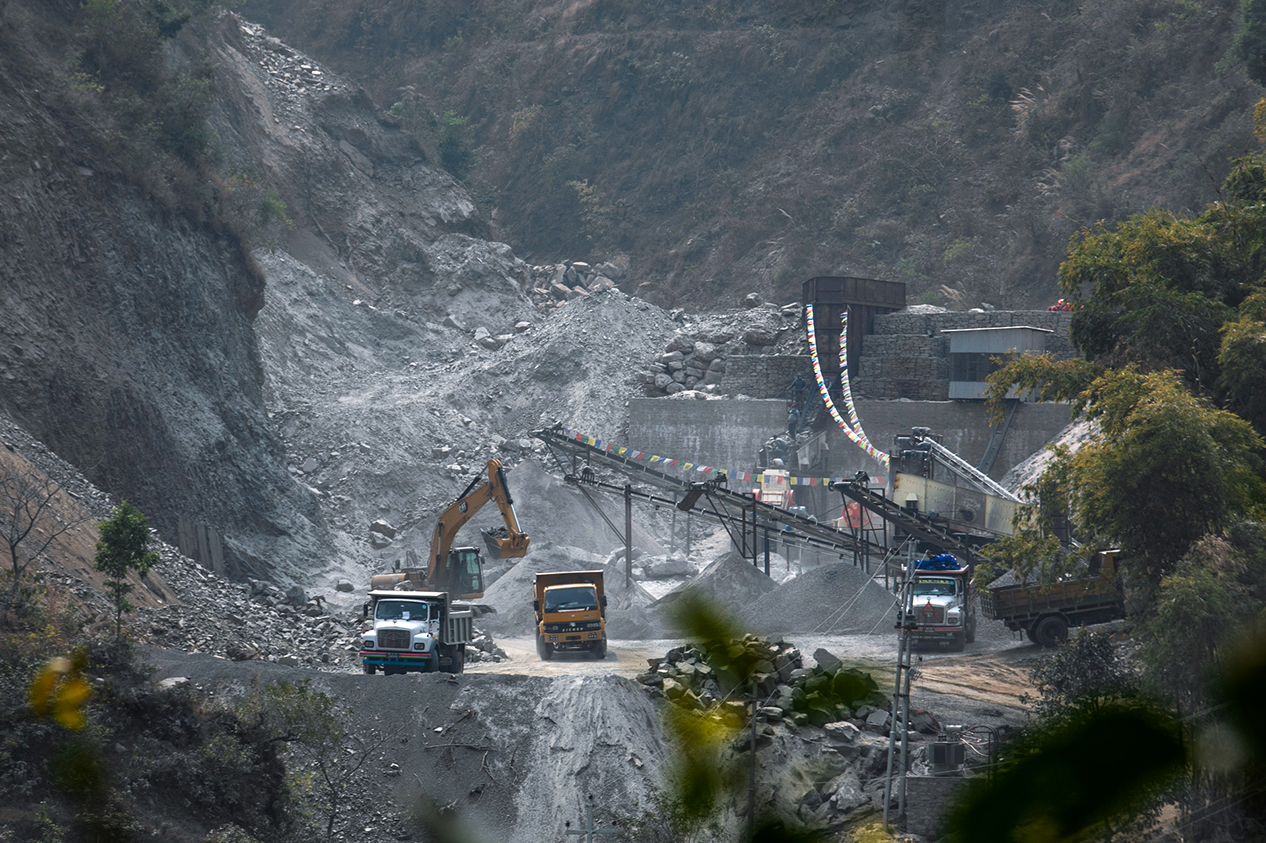
A crusher industry in the Chure Mountain Range. Photo: Bikram Rai/Nepal News
On 29 May 2025 of the current fiscal year 2025/26, then Finance Minister Poudel again introduced a program encouraging private sector participation in the commercial production and marketing of natural and mineral resources. Clause 87 of the budget states: “Arrangements will be made to extract and process mine-based and river-based materials deemed suitable and economically viable through environmental impact studies for domestic use and export.”
After the Gen-Z movement on 8 and 9 September 2025, a new government was formed. However, the new government has not yet taken any steps to implement this budget program.
Recently, on 16 January, the Confederation of Nepalese Industries (CNI), reminding the government of the budget provision, urged it to create an environment for the export of stone, gravel, and sand. The CNI wrote to the Office of the Prime Minister and Council of Ministers requesting that stone, gravel, and sand be extracted from quarries and allowed for export. The ban imposed in 2071 (2014/15) on the export of construction materials remains in place.
According to CNI President Birendra Raj Pandey, the government was reminded of the budget program because member companies, through letters, have requested facilitation to operate quarries, use the produced materials in domestic infrastructure, and export the surplus. “Operating Nepal’s construction material quarries will enhance infrastructure quality and contribute to economic prosperity. There is strong potential to export construction materials to Bangladesh and India,” he says.
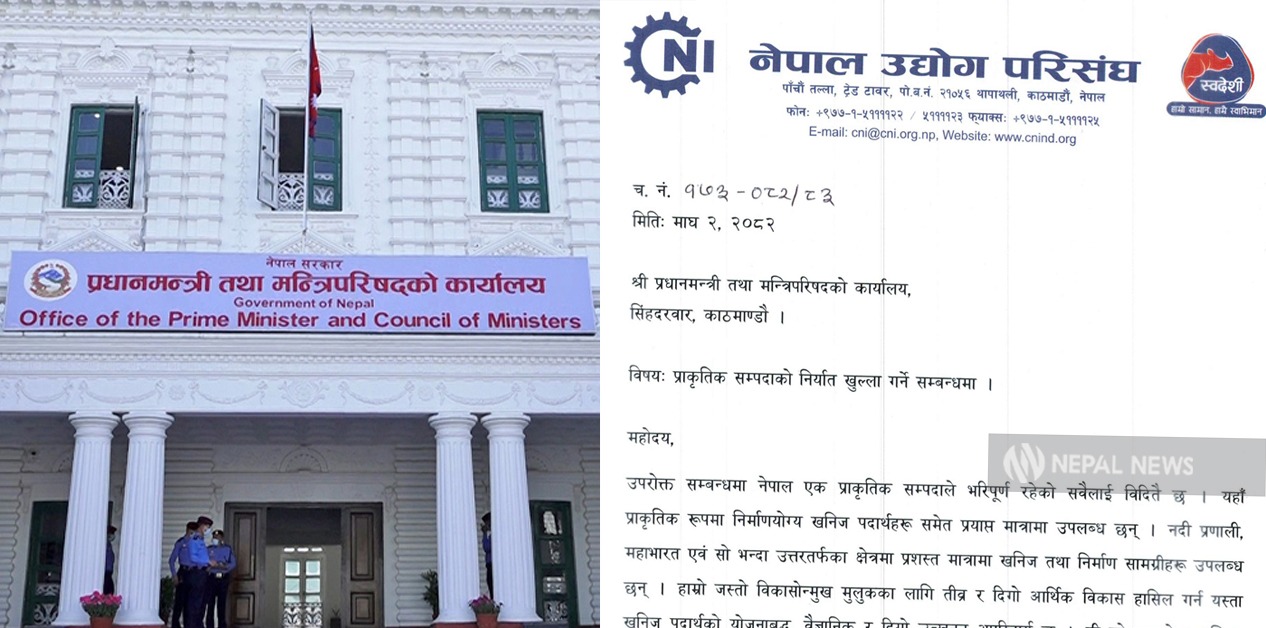
The letter sent to the Office of the Prime Minister and Council of Ministers by CNI
The High-Level Economic Reform Recommendation Commission, formed on 7 October 2024 under the coordination of current Finance Minister Rameshwar Khanal, also recommended operating quarries for domestic use and export of construction materials. Based on that report, the government’s Economic Reform Implementation Action Plan, 2082, states in point 212: “While maintaining environmental balance, designate areas in river zones and barren hills for construction material production, meet domestic demand, and arrange for exports.”
The Council of Ministers-approved action plan stated that these tasks should be completed within one year and continued thereafter. However, despite being the former coordinator of the commission, the current Finance Minister has not taken initiative to implement his own recommendations.
CNI President Pandey says that even if the materials produced from mines are not exported, their domestic use alone would improve infrastructure quality. “After meeting internal demand, there is an opportunity to export surplus materials to Bangladesh and India. Bangladesh has long been requesting construction materials from Nepal,” he says, adding, “We have advised the government to operate stone quarries in an environmentally responsible manner.”
Director General of the DoMG, Dinesh Kumar Napit, also says the department’s study identified locations where quarries could operate without harming the environment. “After the government banned exports of materials extracted from the Chure region and rivers, we studied stone quarries in the Mahabharat mountain range. Ninety-two quarries in 14 districts are ready for operation,” he says.
Napit adds that construction materials from rivers vary in quality, leading to inconsistent infrastructure standards, whereas materials extracted from a single quarry are uniform in quality. “River-carried stones are not of the same quality. Stones extracted from a single quarry are consistent, resulting in better infrastructure quality,” he says.
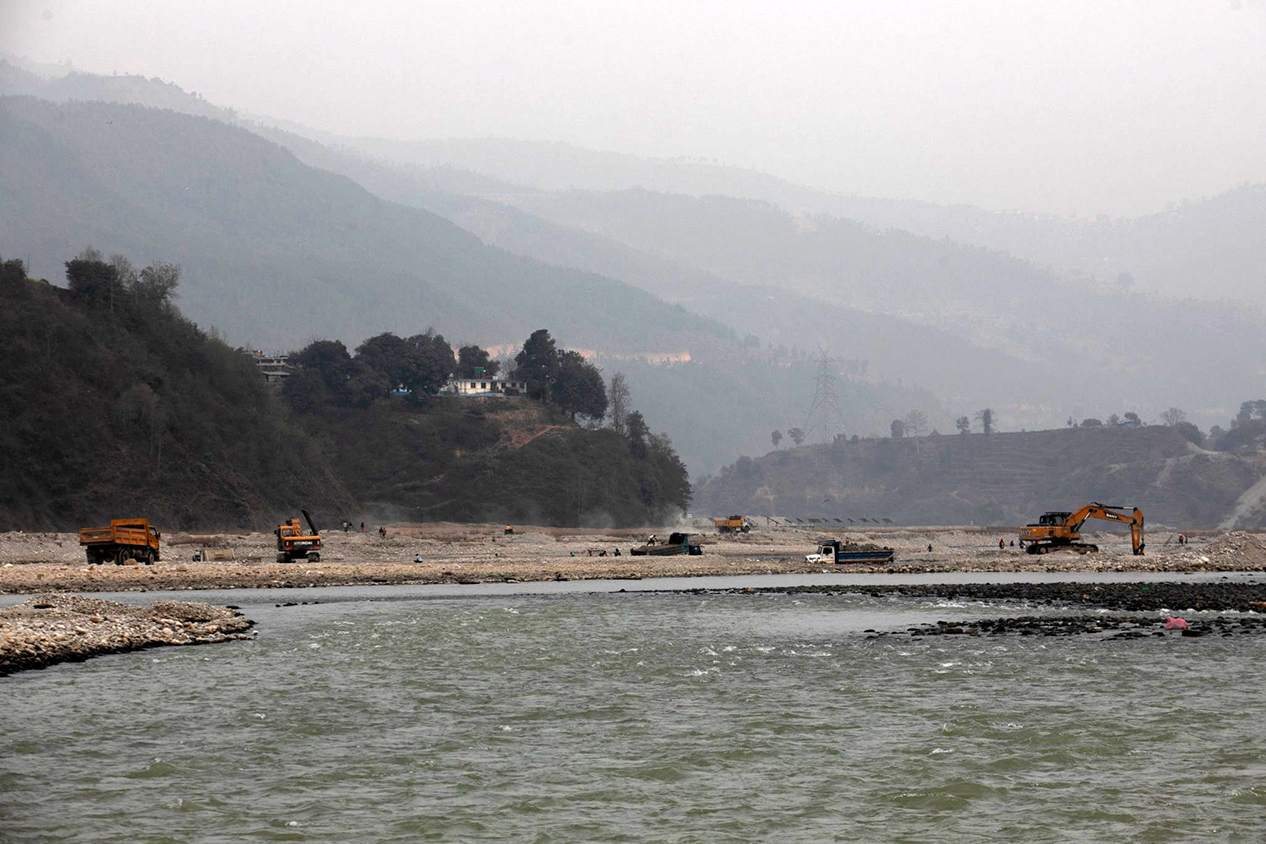
Construction materials being extracted from the Indrawati River in Sindhupalchowk district. Photo: Bikram Rai/Nepal News
He claims that using quarry-produced materials instead of current materials in road construction could improve road quality tenfold. Higher quality infrastructure would reduce maintenance costs, freeing resources for new investments. “The Department of Roads has also sought consultation on ensuring uniform construction material quality. We will recommend quarry-extracted materials as the best option,” says Director General Napit.
Quarries and Capacity
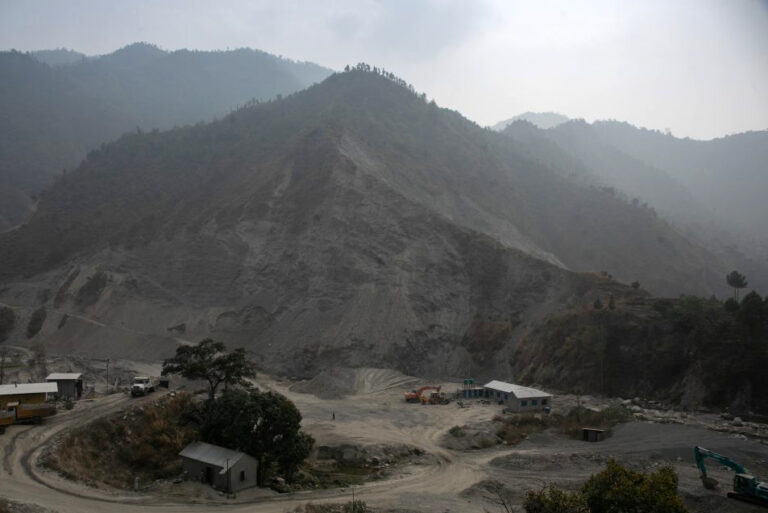
The DoMG conducted a detailed study of 92 mines located near the East-West Highway and prepared a report. DoMG officials say sites close to major road corridors were selected to ensure easier access. Each quarry covers five hectares. Although five hectares has been set as the limit for issuing extraction permits, each quarry potentially has up to 500 hectares suitable for extraction, according to Director General Napit.
In the first phase, the department selected 14 districts and conducted detailed geological, mining, and environmental studies, including Initial Environmental Examinations (IEE). The districts with identified quarries are Dadeldhura, Doti, Surkhet, Salyan, Pyuthan, Arghakhanchi, Palpa, Chitwan, Makwanpur, Sindhuli, Udayapur, Dhankuta, Morang, and Lalitpur. However, access roads and electricity transmission lines would need to be constructed to operate these quarries.
Quartzite and dolomite rocks are found in these quarries. According to the DoMG, the 92 mines contain a total of 201,707,730 cubic meters of construction materials. If each mine extracts 300 cubic meters per day, all the mines could operate for more than 20 years.
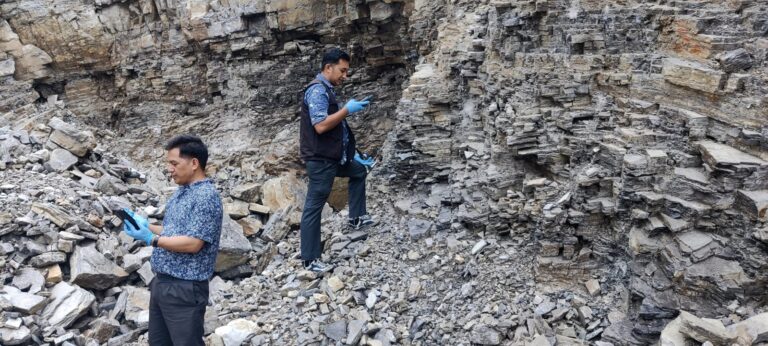
Officials of the Department of Mines and Geology studying a stone quarry in Palpa district. Photo: Courtesy DoMG
Senior Divisional Geologist Kumar Khadka of the Mineral Resources Division of the DoMG says each mine has been limited to five hectares because of a legal provision that prohibits granting extraction permits for more than five hectares for construction materials.
Currently, contractors are purchasing eight cubic meters of construction materials at prices ranging from Rs 12,000 to Rs 24,000. Sitaram Neupane, president of the Federation of Nepali Crushers and Mining Industries’ Associations (FNCMIA), says, “The price of construction materials varies depending on how far the source is. On the other hand, tax rates also differ by local government.”
If we calculate the average price of processed construction materials at Rs 2,000 per cubic meter, the total value of the materials in the 92 identified mines amounts to approximately Rs 403.41 billion. This estimate is based only on extraction from 460 hectares (five hectares per quarry across 92 quarries). If construction materials were extracted from 500 hectares per mine, the total value would reach around Rs 40 trillion.
CNI President Pandey says that if stone and gravel are extracted from these quarries while protecting the environment, it would improve the quality of national infrastructure and, if exported, would also support the economy. Bangladesh, which is geographically close to Nepal, lacks sufficient construction materials. It imports such materials from India, China, other Middle Eastern countries, and Bhutan via sea routes. Since transporting materials from Nepal would be faster and easier, Bangladesh has long shown interest in Nepal’s construction materials.
Pandey says, “Bangladesh has been demanding construction materials for decades. After meeting domestic needs, there is strong potential to export surplus materials. Private sector colleagues have also shown interest in operating the quarries.” Pradeep Kumar Shrestha of Panchakanya Group and businessman Nirendra Pradhan have expressed interest in operating the quarries.
FNCMIA President Neupane also says natural resources should be mobilized with due consideration to environmental aspects. “The country’s natural resources have not been mobilized at all. There is strong potential to earn foreign currency by exporting mineral resources. But inter-ministerial conflicts and obstacles in the name of environmental experts have prevented mine extraction,” he says.
Industrialists have also urged the government to allow mine operations in areas where infrastructure construction activities are high. Pandey says, “When materials have to be transported from far away, costs increase. If quarries are operated near major infrastructure project sites, construction costs will decrease and quality will improve.”
Environmentalist and member of the President Chure Tarai Madhesh Conservation Development Board, Susmita Dhakal, says quarries can be operated in a way that does not harm the environment. “Proper management of waste generated from mining is essential. If mining waste is not managed properly, people living in downstream areas suffer, so this must be taken seriously,” she says.
A crusher plant in Kavre. Photo: Bikram Rai/Nepal News
She also emphasizes the need to assess whether road networks are capable of handling heavy transport when exporting construction materials. In 2009/10 (2066 BS), a field study by the then parliamentary committee on natural resources found that export-related transport had damaged roads, requiring significant state expenditure for repairs. The report noted that overloading vehicles had damaged 537 kilometers of nine roads, with repair costs estimated at Rs 10.74 billion.
To address this issue, in the fiscal year 2078/79 (2021/22) budget, then Finance Minister Poudel had stated: “To facilitate the transport of export-oriented quarry-based construction materials, arrangements have been made to provide customs duty exemptions for the construction of ropeways from industries to export points.”
Environmentalist Dhakal says, “Businesspeople focus only on commercial profit. But the government must consider overall national benefit when deciding on mine and quarry operations. Quarries should be extracted while protecting the Chure region and minimizing environmental damage as much as possible.”
Legal obstacles
Most of the construction material quarries identified by the DoMG lie within forest areas. To operate these quarries, the law must be amended to allow the use of forest land. The Forest Act 2019 (2076 BS) prohibits the extraction of construction materials in forest areas. Although Section 43 of the Act allows forest areas to be used for mineral activities, Subsection 2 of the same section imposes restrictive provisions.
The subsection states: “Except for the use of raw materials in nationally prioritized projects, projects approved by the Investment Board, projects of national pride, or nationally prioritized industries meeting government standards, rocks, stones, and soil located within forest areas shall not be extracted.”
In Kartik 2080 (mid-October to mid-November 2023), the government introduced the “Bill to Provide for the Management and Regulation of Construction-Oriented Materials” to create a separate legal framework for operating such mines. The bill, tabled in Parliament by the Ministry of Federal Affairs and General Administration, proposed that the government could identify and designate mineral areas on government and public land for extraction, collection, and processing of construction minerals. It required geological and environmental studies before designation, and the government would define boundaries and publish a notice in the Gazette. However, the House of Representatives was dissolved before the bill could be passed.
In the letter to the government, the private sector has requested amendment of the relevant provision of the existing Forest Act to allow mine and quarry operations. DoMG Director General Napit says that once the legal provision is amended, the Department o could issue licenses and proceed with operations.
Department officials met members of Prime Minister Sushila Karki’s Secretariat to request legal amendments that would create an enabling environment for operating construction material quarries. According to Director General Napit, they met repeatedly with the Prime Minister’s political advisor Ajay Bhadra Khanal to discuss creating a legal framework for mine and quarry operations. However, they were told that due to the election period, attention could not be given to this matter. “We have repeatedly discussed arrangements to allow forest land use for mining operations with the Prime Minister’s political advisor. But he said the focus must remain on the elections for now,” Napit says.
The Constitution also grants local governments authority over the extraction and management of construction materials. Currently, local governments are only managing materials in rivers and streams. Provincial governments have enacted laws to operate mines and quarries, but they have been unable to proceed because forest land use has not been permitted.