Kathmandu
Thursday, February 19, 2026





Mustard is back in Chitwan, contributing more than Rs 2 billion annually
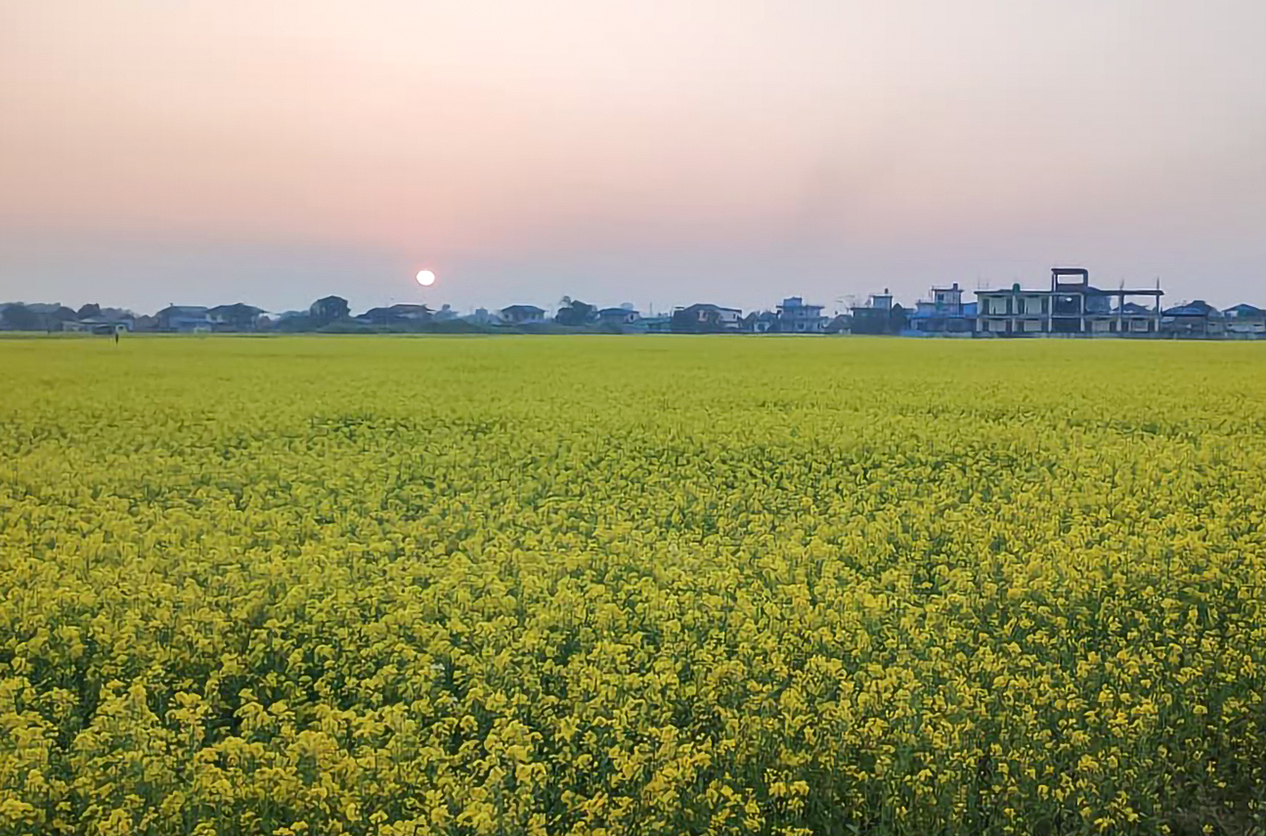
CHITWAN: Pratibha Pandey Acharya, 41, from Jhurjhure in ward 3 of Rapti Municipality, Chitwan, was not initially interested in mustard cultivation. Since the fiscal year 2012/13, she has been engaged in commercial farming, growing food crops while also raising poultry, cattle, and goats.
In recent years, however, she has developed an interest in mustard farming. She plants mustard between the monsoon and spring paddy seasons as an additional crop.
“I’m currently busy harvesting mustard. Unseasonal rain in October damaged the crop this year, so harvesting and storage have been slightly delayed,” said Acharya.
In the Jhurjhure area, it is common to sow mustard immediately after harvesting the paddy crop.
Acharya has also cultivated mustard on about 30476.82 square meters. Due to the rain, the mustard could not germinate well. Because the mustard did not sprout, it had to be sown a second time.
“I avoid chemical fertilizers, using a mix of cattle manure and poultry droppings instead. This keeps the soil fertile and helps reduce crop diseases,” says Acharya.
After reserving enough for her own use, she sells around 15 quintals of mustard each year, earning between Rs 12,000 and Rs 16,000 per quintal. Many farmers grow paddy twice a year and mustard once. When winter arrives, her fields turn golden with mustard, which she says also adds to the beauty of the land.
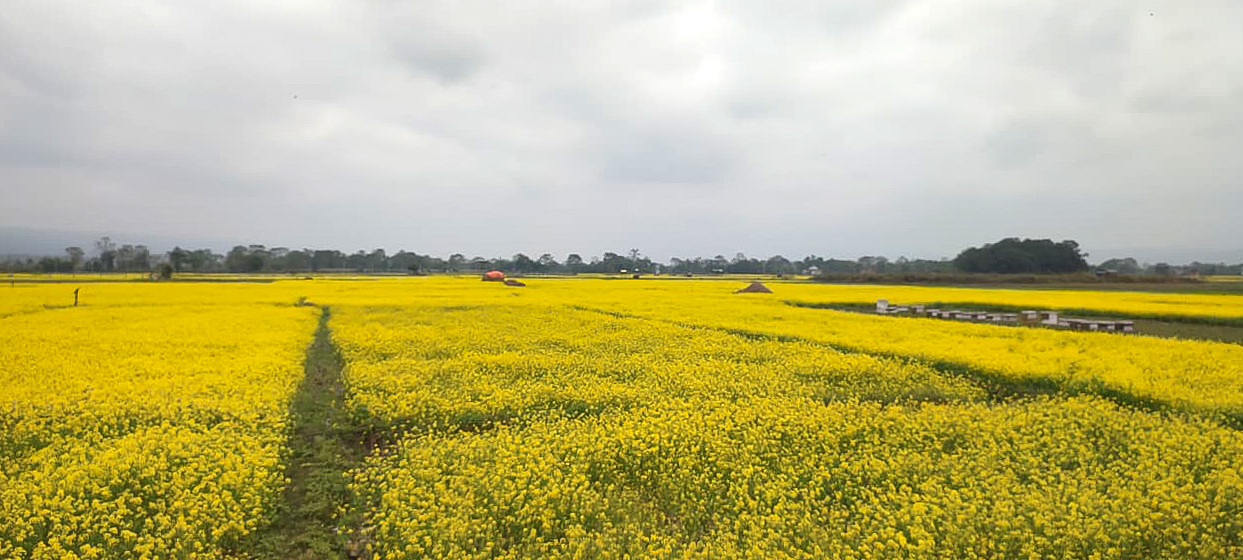
In the past, the mustard oil of Chitwan used to reach the palaces of kings and Ranas. The mustard cultivation and the purity of the oil in Chitwan were famous. Among the many identities of Chitwan, mustard was also one.
In the last decade, mustard cultivation has declined due to urbanization and farmers shifting to other businesses.”
“Government data shows that in 1993, mustard was grown on 22,000 hectares in Chitwan.”
“According to the District Agriculture Development Office, by the fiscal year 2009/10, this area had fallen to 10,309 hectares.
However, the mustard cultivation data of the last four years has raised hope again. According to Nirmal Paudel, an agricultural economist at the Chitwan Agriculture Office, mustard was cultivated on 14,173 hectares in the fiscal year 2024/25. In that year, 18,565 metric tons of mustard were produced. In the current fiscal year, mustard cultivation is also around the same as last year.
The area of mustard cultivation has not decreased compared to last year. The crop has been good this year. Currently, mustard is being harvested in Chitwan,” says Paudel.
In the fiscal year 2023/24, while mustard was cultivated on 13,642 hectares, 17,689 metric tons were produced. According to the current market price, this mustard is worth about Rs 2.38 billion. In the fiscal year 2022/23, while mustard was cultivated on 14,765 hectares, 19,194 metric tons were produced.
“Government data shows that in 1993, mustard was grown on 22,000 hectares in Chitwan.”
Before that, in 2021/22, there is data from the Agriculture Office that 14,718 metric tons of mustard were produced from cultivation on 12,265 hectares.
Previously, less than one ton of mustard used to grow on one hectare, while for the past three years, production of 1.3 tons per hectare has started. This shows that for a few years, mustard cultivation and production in Chitwan have been increasing again.
It was once said that mustard had disappeared from Chitwan, but now, farmers have returned to cultivating mustard, and production is also increasing,” says Jhalaknath Kandel, Chief of the Agriculture Development Office, Chitwan.
Cash crop with instant returns
Mustard, which yields production in 75 to 90 days after sowing the seeds, is considered an interval crop. Mustard, which does not tolerate dry weather and is produced in slightly cold weather, grows in the Terai, Inner Madhesh, and some hilly districts. Chitwan is considered fertile from the perspective of mustard production as well.
Suman Dhakal, director of the Farm Directorate at the Agriculture and Forestry University in Bharatpur, says, “Mustard does not need to be stored for a long time; it is considered a cash crop as it is sold immediately for use. The market demand is good. In areas where mustard is cultivated, beekeeping has flourished as an additional business.”
In the past, mustard was sown from mid-September to October, sometimes even until mid-November. However, with paddy ripening getting delayed, mustard planting also started later. This late sowing made the crop more vulnerable to aphids and other pests. Additionally, the lack of improved seed varieties affected yields. As a result, both mustard cultivation and production in Chitwan had declined.
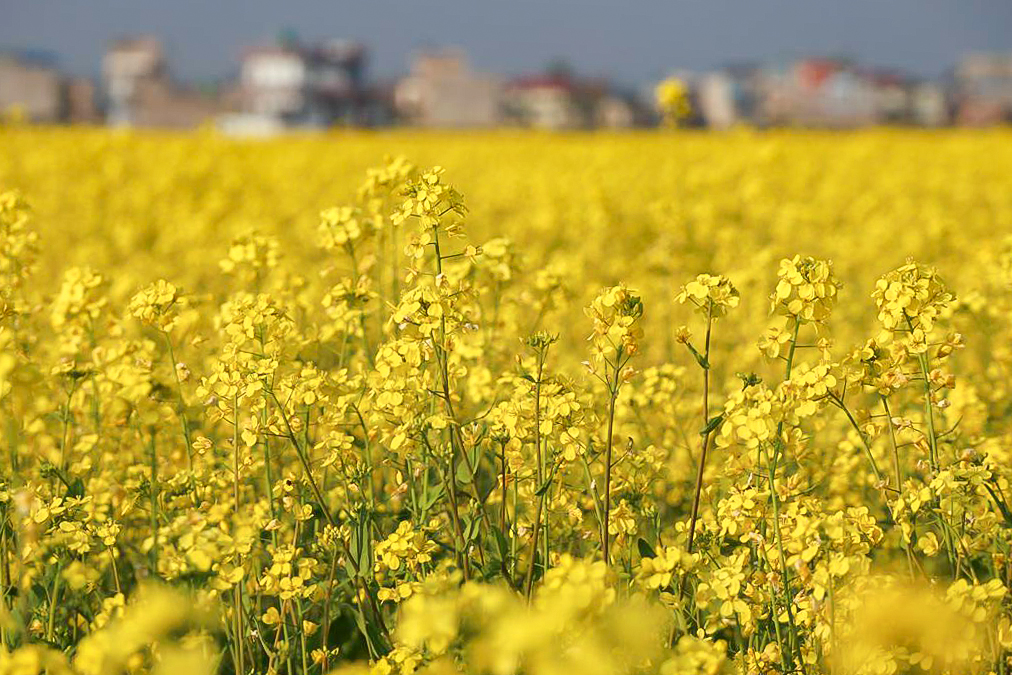
However, Dhakal says that mustard cultivation has been thriving over the past four years. He adds, ‘With irrigation facilities now available, farmers no longer rely solely on rain. Since paddy is harvested in September and October, mustard can be planted on time.
When mustard cultivation was decreasing in Chitwan after the fiscal year 2003/04, the mustard mills of the district had to depend on mustard production from outside districts and foreign mustard.
Currently, local production is more than sufficient,” says Sudarshan Paudel, an oil mill operator in Bharatpur-3, Kshetrapur. “We produce oil using only local mustard because Chitwan’s mustard is high-quality and clean,” Paudel adds.
Paudel, who is also the immediate past president of the Chitwan Lok Oil Producers Association, adds that there are about 700 mustard mills in Chitwan. Among these mills, some crush mustard to sell oil themselves, while others charge a fee for processing mustard brought by local farmers,” he further added.
Shrinking agricultural land
Not only mustard, but in Chitwan, which is considered fertile for agriculture, the area of cultivable land is decreasing every year. As agricultural land decreases, it has started becoming difficult for farmers who do commercial farming to find suitable land as per necessity.
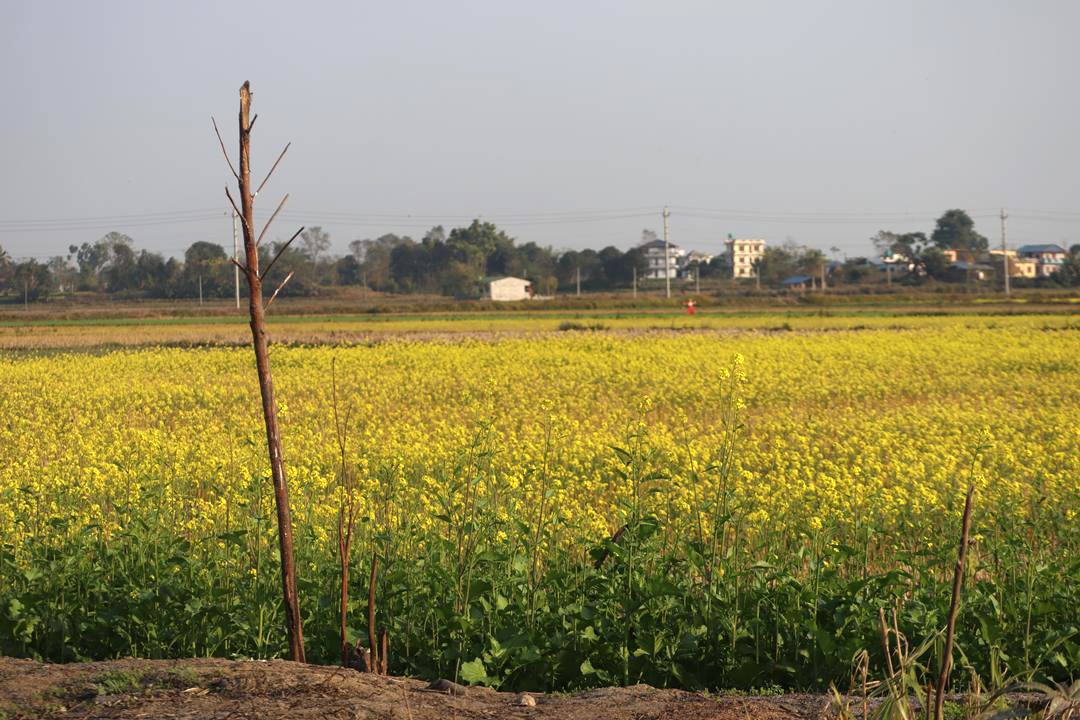
In the last decade, fields have been decreasing. For example, according to the National Agriculture Census, 2011, there were 88,242 farmer families in Chitwan. They practiced farming on 40,631.6 hectares. Among that, 33,468.1 hectares were irrigated. The remaining 7,163.5 hectares are cultivable land without irrigation facilities.
In the decade since then, although the number of farmers has increased, cultivable land has decreased.
According to the National Agriculture Census, 2021, the number of farmer families in Chitwan has increased to reach 89,519. They have been farming on 35,647.3 hectares. Among them, 73,225 farmer families have utilized irrigation facilities. Irrigation facilities are available on 29,519.7 hectares in Chitwan.
In the last decade alone, about 5,000 hectares of cultivable land have decreased in Chitwan. This may lead to a lack of land for commercial mustard farming for farmers like Acharya, who have recently been attracted toward mustard cultivation.