Kathmandu
Saturday, February 21, 2026





A decade of rising female participation in farm and non farm businesses is steadily reshaping income patterns, leadership, and local economies
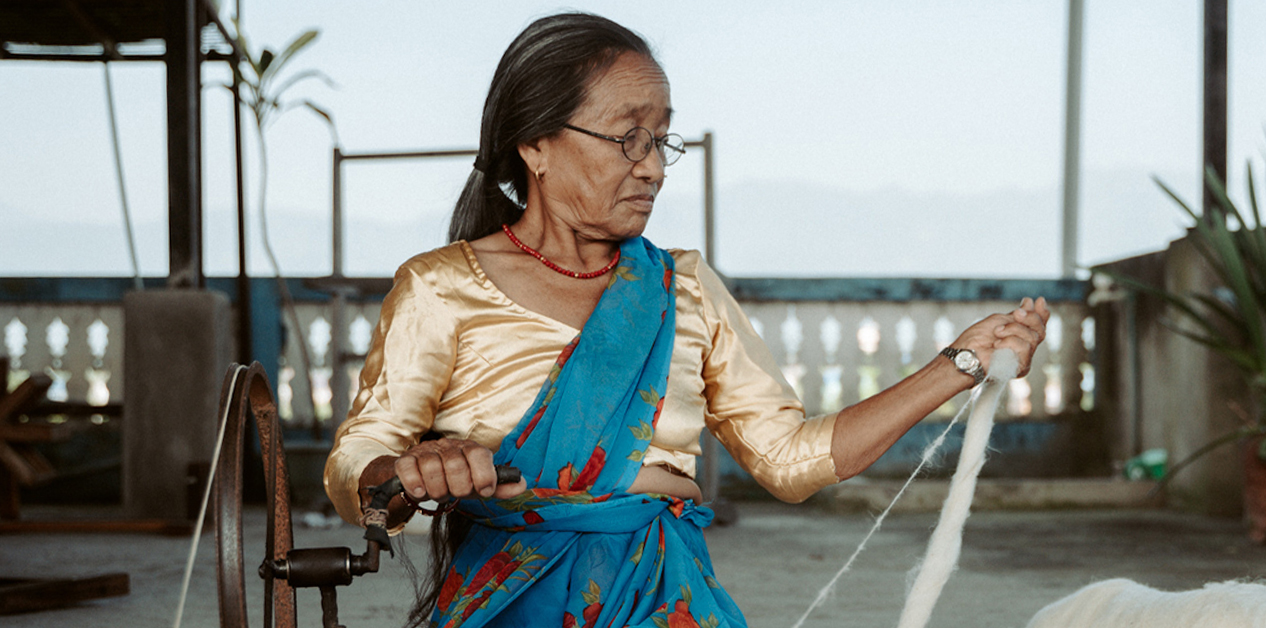
KATHMANDU: In the ground-floor passage of a two-story house, four teenage girls sat in a row, busy weaving carpets. When one girl’s thread jammed in the loom, causing the carpet pattern to shift, she first tried to fix it herself. Unable to do so, she called for her instructor, Buddhimaya Ghale, for guidance.
Buddhimaya, who was arranging items in the gift shop next to the passage, immediately came to the girl’s side. As she carefully fixed the damaged section, she said softly, ‘This is how you learn by making mistakes; there is no need to panic.’ The girl watched attentively. On the afternoon of October 12, during a visit to Buddhimaya’s BM Handicraft Training Industry, learner girls often faced similar confusion. Buddhimaya guided them patiently and never showed irritation.
The BM Industry is located in Padampur Village in ward 2 of Kalika Municipality in Chitwan, where housewives and teenage girls learn to spin wool on spinning wheels, weave carpets and Dhaka (a traditional, hand-woven cotton fabric from Nepal) on loom machines, and make gift items including glass bead necklaces. It costs no money to learn the skills. Instead, it opens a path to earn money from here.
Thirty-eight-year-old Buddhimaya is not only a skilled instructor but also a successful entrepreneur. She exports carpets, mats, and Dhaka products to international markets, including China, India, and Japan. She collects goods produced by her industry as well as items made by local women and sells them in bulk. The producers are paid wages for their finished products, and this income has created a sustainable livelihood for housewives, women, and underprivileged families in Padampur.
In Padampur alone, 600 local women have gained income opportunities, including 422 from indigenous communities, 40 Dalits, 52 Chepangs, 60 single women, 14 Khas Arya, and 12 persons with disabilities. The industry employs 14 regular staff members, three men and 11 women.
Once a learner, now an entrepreneur
Buddhimaya’s skill and work have spread across the country and are exported abroad. Behind this lies her two-decade-long tireless hard work and sweat. To understand this, one must go back to the fiscal year 2005/06, when Padampur was a new settlement, shifted near the former Jutpani Village Development Committee, located 15 kilometers north of the 200-year-old ancestral home on the banks of the Rapti.
Buddhimaya used to carry construction materials needed for building the school for the children of the new settlement. As the forest was cleared and the settlement of about 2,000 households in Padampur was just established, everyone did some form of daily wage labor to survive. They were forced to give up the fertile ancestral land for the sake of safe living. They were compelled to leave their ancestral home after suffering increased due to annual river erosion destroying crops, being unable to cross the river during monsoon floods to go to another village, being unable to go for treatment across the Rapti, and having to fear going to another village in the evening because the number of wild animals in Chitwan National Park (then Royal Chitwan National Park) had increased.
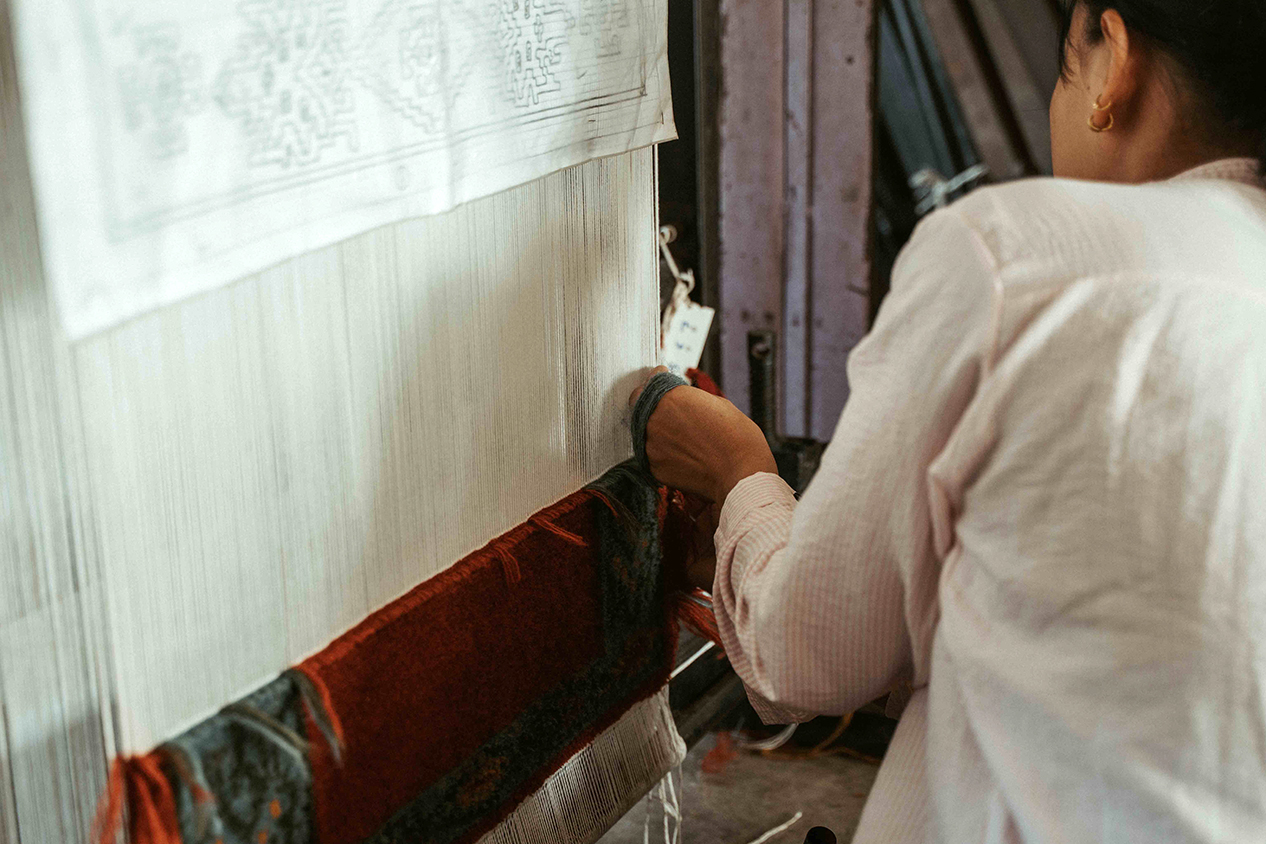
Local women busy weaving carpets at a factory situated in Padampur, Chitwan. Photo Credit: Suraj Ratna Shakya
It was around 2005. She was carrying sand when she noticed women near the village school, women the age of her mother, sister-in-law, and elder sisters, spinning wool. Watching them, she felt a strong desire to learn. At the time, a wool-spinning program was being run in Padampur to promote skill development, income generation, and women’s empowerment. The initiative was supported by the government through the National Trust for Nature Conservation and the United Nations Development Program (UNDP) under the Tiger Rhino Conservation Project (TRCP). Through this project, local housewives were receiving training in wool spinning.
To uplift the livelihood of the new settlement, which the government had shifted by forming the “Padampur Village Development Committee Relocation Committee” in 1995, the TRCP project was implemented from 2001 to 2006. Through this, skill-based training and income opportunities such as wool spinning, mushroom farming, beekeeping, husk stove construction, soap making, and incense stick making were made available. Among these, wool work, mushroom farming, and beekeeping have flourished commercially.
After requesting Bin Maya Gurung, a member of the first batch who received wool-spinning training in 2005, Buddhimaya was also given the opportunity to learn. That very skill later shaped her identity as a successful entrepreneur. Reflecting on her past, she says, ‘There was hardly any job I did not try. I distributed newspapers, worked as a laborer, and even took a job at a hotel. When nothing seemed to work, I considered going abroad.
Initially, she received wages by spinning wool, just as she pays wages to others today. After the National Trust for Nature Conservation added training, wool, spinning wheels, and loom machines through the “Green Forest Program” in the fiscal year 2015/16, she took leadership of the group. This helped in further capacity and personality development.
In the fiscal year 2016/17, some nine sisters joined together, collected an investment of RS 300,000, and expanded the wool work through a group named BM, meaning ‘Bikash Mahilako,’ meaning Development of Women.
In the fiscal year 2018/19, they registered it as a training industry. When the industry did not run well as a group, Buddhimaya took responsibility alone. She learned tailoring. She expanded the industry. After the enterprise flourished, it became easier to manage the household. She called her husband, who had gone for foreign employment, back home.
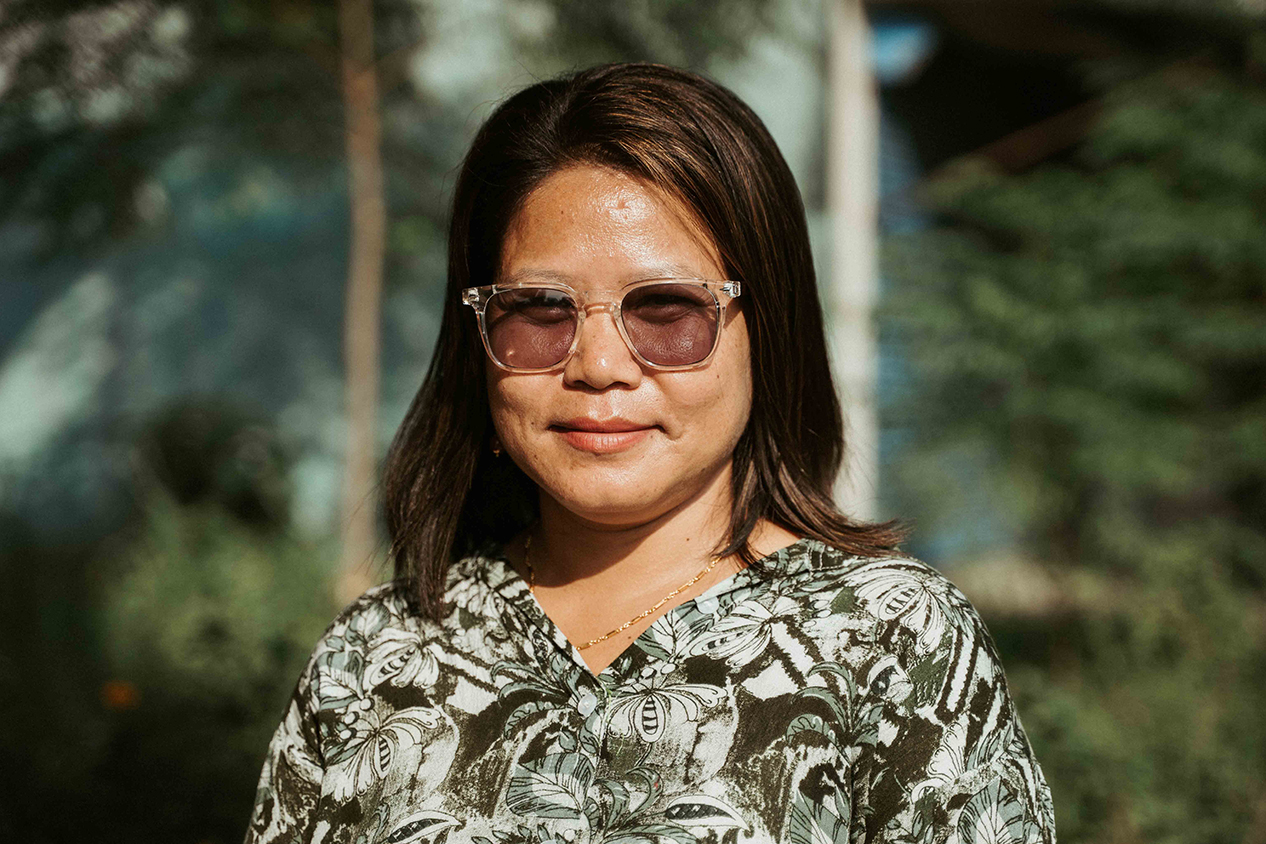
Entrepreneur Buddhimaya Ghale. Photo Credit: Suraj Ratna Shakya
Nowadays, Buddhimaya handles the management of raw materials and marketing required for running the industry. Her husband helps in looking after the children and operating the industry. Even so, it is difficult to meet the demand. “Even by working this hard, I am unable to meet the demand for carpets according to the orders in the market,” Buddhimaya adds.
Employment opportunities
Buddhimaya imports raw wool from China and gives it to the local village women to spin it. Once the thread is ready, she sends it to Kathmandu for dyeing. She brings the dyed thread back to the village and distributes it in the village to make items like mats and carpets. She provides spinning wheels and loom machines at their homes for free. The locals also produce Dhaka and gift items and hand them over to her.
Since Buddhimaya arranges the wool, spinning wheels, and marketing, the residents of Padampur are delighted to be able to earn while staying at home.
Eighty-one-year-old Thulimaya Praja of the Chepang community says, ‘Because of Buddhimaya’s factory, we did not have to sit idle even during the coronavirus pandemic.’ Bin Maya, Thulimaya, and others earn a monthly income ranging from Rs 6,000 to Rs 16,000 simply by spinning wool.
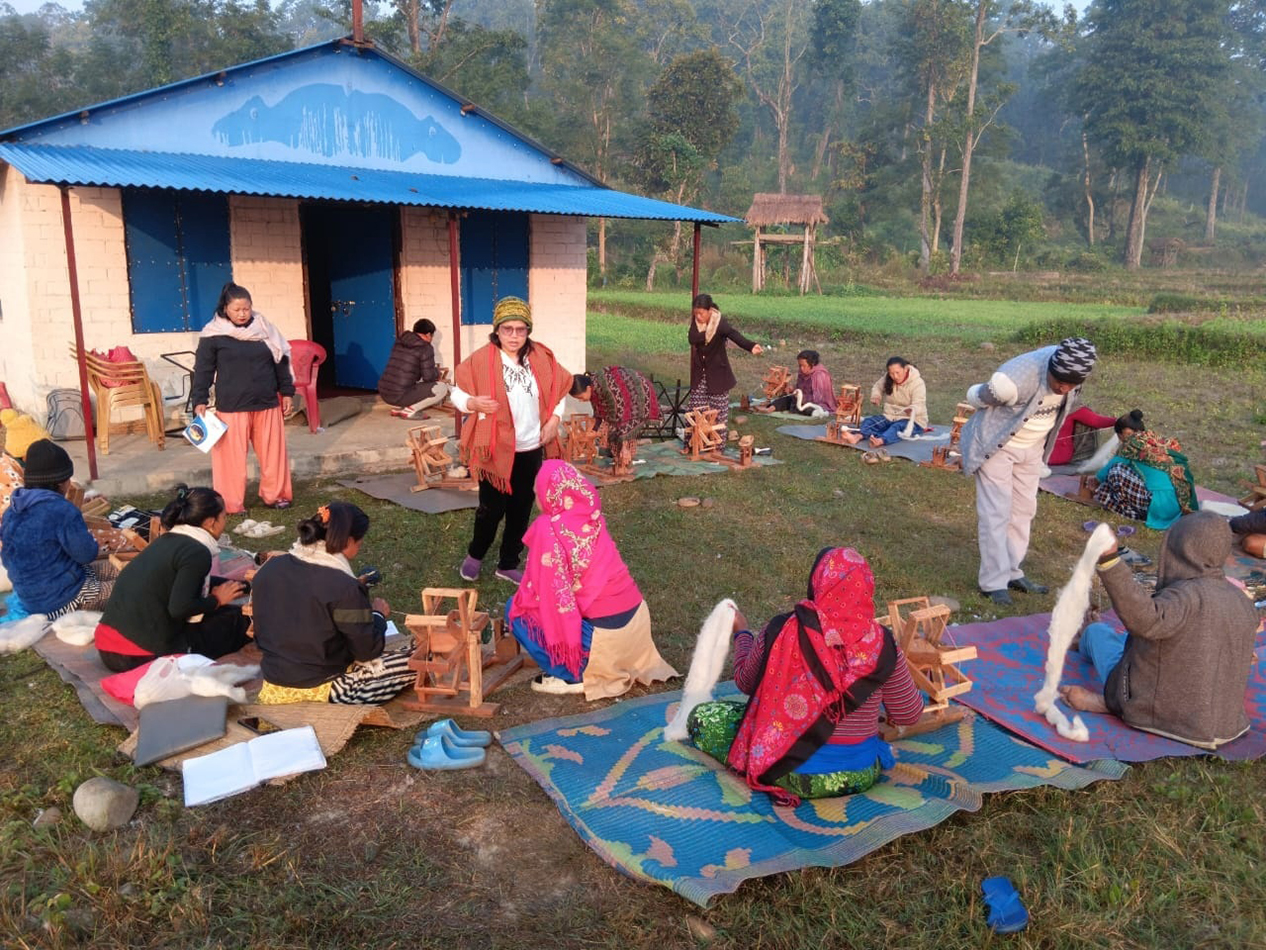
A training session for spinning wool and thread. Photo Courtesy: Buddhimaya Ghale/ Facebook
With earnings from wool work, women’s dependence on forests has significantly declined. Seventy-two-year-old Bin Maya recalls, ‘We used to brew and sell alcohol or raise cattle just to afford basic items like salt and oil. That meant frequent trips to the forest, where we feared wild animals. Wool work has made life much easier. At this age, I no longer have to sit idle.’
Habit of saving
The women of Padampur save a portion of their earnings in cooperatives. “It has become easy to borrow, lend, or take loans during illness or emergencies,” says Buddhimaya. The UNDP, in coordination with the government and stakeholder organizations, provided assistance for skill development training and enterprise establishment across the country, including Padampur, and produced 80,000 small entrepreneurs in the five years from 2018 to 2022 alone. Among them, 82% are women. Among the women, 72% are young women and teenage girls.
The wave of becoming entrepreneurs
Challenging the old belief that ‘women should be limited only to the kitchen,’ the trend of women getting involved in trade, enterprise, business, and income generation has increased across the country. Skill-based activities started with the support of the government, donor agencies, and organizations have helped improve the living standards of women specifically. Women’s involvement is increasing in both the agricultural and non-agricultural sectors.
Only six years ago, after a 380-kilowatt micro hydropower project was constructed through the ‘Renewable Energy for Rural Livelihood Program’ in Tarakhola Rural Municipality, Baglung, it became easier for women to generate income. Women join groups to extract thread from Allo, Himalayan nettle (Girardinia diversifolia), weave cloth from that thread to produce ready-made materials like coats, waistcoats, and bags, and run enterprises like making local potato chips and soap.
Thirty-five-year-old Bhima Roka of the Sonam Allo Cloth Weaving Group in Tarakhola Rural Municipality-5 says that once there was electricity, it became easier to make thread by processing Allo in the village. “After finishing the farm work in the morning and afternoon, it has become easier to weave at night using the light of the bulb,” she says. From mid-October 2013 to mid-January 2014, Bhima and other women of the village had learned to weave Allo thread cloth on machines through a micro-enterprise development program.

Prepared thread for weaving carpets. Photo Credit: Suraj Ratna Shakya
The Sonam group of 12 women has been continuing the work of weaving cloth for 12 years. Allo is found in abundance in the Baglung, Myagdi, and Parbat districts. There was a custom in the grandmother-mother generation of wearing and bedding Allo clothes woven on handlooms. The new generation also learned to operate handlooms. 46-year-old Bhimkali Roka says that after receiving training and machines for weaving on power looms, they got the opportunity to earn while staying at home.
According to the analysis of Nepal Rastra Bank’s Deputy Governor Neelam Dhungana Timsina, women’s dominance in enterprise and business is slowly starting to increase.
“Previously, there was male dominance in Nepal’s enterprise and business, but now, from cities to villages, women’s involvement from agriculture and handicrafts to technology and enterprise is encouraging,” Deputy Governor Timsina added.
According to the 2021 census, among a total of 627,887 households operating small domestic businesses other than agriculture that are not registered with any government agency and do not keep even one paid worker, 45% of the domestic businesses are mainly operated by women. Among the economically active population (10 years or older), the number of women adopting agriculture, forestry, and fishing as their main occupation is higher than men. Also, women dominate the industrial sector based on agriculture, forestry, and fishing.
Encouragement for women entrepreneurs
Deputy Governor Timsina says that because the Rastra Bank has implemented a policy of providing subsidized loans to women through its subordinate banks and financial institutions, it has motivated them toward income generation. “Among those taking loans for enterprise and business, 98% are women, and many have utilized it well,” she adds. “Similarly, other government efforts like allocating gender-responsive budgets and investing in women’s advancement have taken place.” To ensure women’s participation in economic, social, and political processes for empowerment, the government has been allocating a gender-responsive budget since the fiscal year 2007/2008.
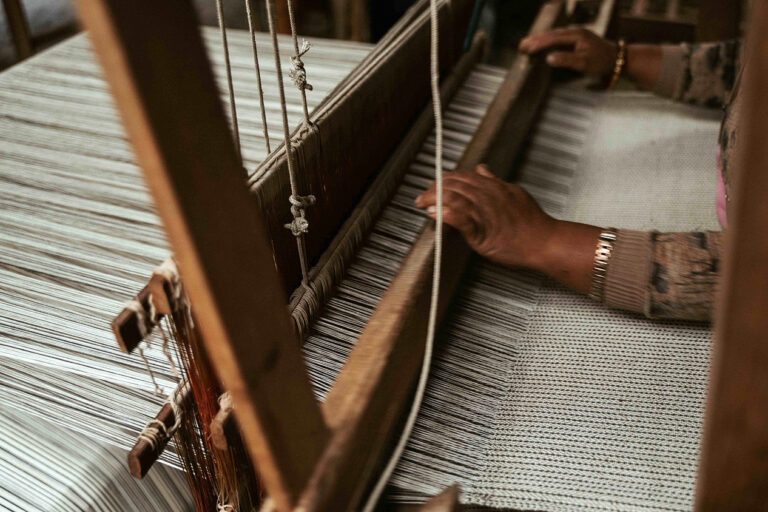
Bhima Roka of Baglung busy weaving cloth made from Allo. Photo Credit: Suraj Ratna Shakya
According to the Ministry of Finance, in the current fiscal year 2025/2026, at least 44.28% of the country’s total budget has been allocated under gender-responsive headings so that women receive 50% or more direct benefit. The Ministry of Women, Children, and Senior Citizens, with the aim of supporting women’s economic empowerment, provides technology support to encourage those who want to become entrepreneurs after taking entrepreneurship and skill-based training. In this, each woman entrepreneur receives at least Rs 200,000, and a group of women entrepreneurs receives an amount for suitable technology support ranging from Rs 300,000 to Rs 500,000.
Similarly, Narulal Chaudhary, General Secretary of the Municipal Association of Nepal, says that local levels have been running encouragement programs such as providing financial literacy, seed capital, and grants to help women in income generation.
Opportunities to lead home and business
The study paper titled ‘Women and Entrepreneurship in Nepal’ published in the Journal of Tourism and Adventure two years ago highlighted that the concept of women entrepreneurship is becoming popular as a means of social and economic development in Nepal. The trend of women doing enterprise and business to improve their and their families’ living standards is increasing.
The study titled ‘The Status of Women in Nepal,’ published by the National Women’s Commission last year, shows that as a result of policy arrangements and programs targeted at women and inclusion, women’s representation, leadership, and contribution in the social, economic, and political fields are gradually improving. Women’s economic empowerment has started to gain them a place in the leadership and decision-making of the house.
Similarly, Chaudhary, who is also the mayor of Ghorahi Sub-Metropolitan City, Dang, says that because the rate of male family members going for foreign employment is high, the women members staying at home have started to engage in everything from managing the household to professions, business, and enterprise.
“For centuries, the hand of men remained in the house’s decisions, income, and expenses. After men started going abroad, women are doing the work of raising, growing, and educating children and managing expenses; they have found the opportunity to engage in some form of income generation and support the family,” Chaudhary further added.