Kathmandu
Saturday, February 14, 2026





About 150,000 people and institutions are still blacklisted due to the impact of the sluggish economy on the economic life of the citizens
KATHMANDU: On November 14, Nepal Rastra Bank (NRB) Governor Biswo Nath Poudel, while addressing the annual general meeting of the Confederation of Banks and Financial Institutions (CBFIN), said, “The number of blacklisted people has reached some 150,000. Maybe some one million people are entrepreneurs. We need to consider how appropriate it would be to blacklist 150,000 of them. A discussion is needed on the extent to which cases of check bounce should be made a subject of action.”
The reason why the Governor is of the opinion that the issue of check bounce should be reconsidered is the number of people getting blacklisted has started increasing in recent years. According to the data of the Credit Information Bureau, as many as 139,213 people and institutions are blacklisted.
A month after the Governor’s public statement, on December 15, the NRB issued a directive and made a general amendment to the blacklist system. The amended provision states, “If any person, firm, company or corporate body that should not have been included in the blacklist is mistakenly included in the blacklist or defaulter list, then upon a request from the executive head of the concerned licensed institution, such person, firm, company or corporate body shall be removed from the blacklist without maintaining any archive.”
The NRB had made such an amendment to address the individuals who were blacklisted due to not updating their details to the concerned bodies when they were associated with a company or firm at some point and had already been relieved of their responsibilities. This provision protects unrelated individuals from being blacklisted. The amended provision states, “A person, firm, company or corporate body that was mistakenly included in the blacklist and removed shall not be considered to have been included in the blacklist. The licensed organization will have to submit the details of the individuals, firms, companies or organizations that have been mistakenly blacklisted and removed to its board of directors on a quarterly basis.”
Entrepreneurs and businessmen have been demanding that the system be revised, claiming that the number of those on the blacklist is continuously increasing. Non-performing loans are increasing as loan investments made by banks and financial institutions (BFIs) cannot be recovered. According to the data of the NRB, 5.03 percent of the total loans are non-performing loans as of mid-October 2025.
Public procurement Monitoring Office. File Photo
When individuals and companies that do financial transactions with BFIs affiliated with the Credit Information Bureau fail to repay their loans and when checks bounce, the Bureau blacklists them based on the recommendation of those institutions. There is a legal provision to remove them from the blacklist after they clear their liabilities. Similarly, as per the provisions of the Public Procurement Act, 2007, the Public Procurement Monitoring Office (PPMO) blacklists government and private companies and the authorized persons of those institutions that do not perform procurement and construction work as per the provisions in the Act.
Mirror of the vicious cycle the economy is in
In the four months of the current fiscal year 2025/26 (mid-July to mid-November) alone, 14,315 people have been blacklisted. The number is 26.72 percent more than that in the first four months of the previous fiscal year.
In the last fiscal year 2024/25 alone, 53,571 people and organizations were blacklisted. That year, the number of people blacklisted had increased by more than 100 percent compared to that in the previous fiscal year. Before that, in the fiscal year 2023/24, as many as 52,303 people and organizations were blacklisted. From mid-July of 2023 to mid-November 2025 alone, some 120,189 people and organizations were blacklisted, while only 37,574 were removed from the list.
There is a provision related to loans and blacklisting that if the payment date of the principal, installments or interest of loans taken from BFIs exceeds one year, if it is proven that the loan and facility has been misused, if the borrower goes missing or is not in contact for 90 days, if it is proven that the goods or property kept as collateral have been misused, such a person or organization can be blacklisted. Similarly, there is a provision to include such a person in the blacklist if he is found guilty by the court in of fraud by using fake checks, drafts, foreign currency, credit/debit cards, etc. documents and devices.
There is a legal provision that the person or organization tries to deceive a person by issuing a check without enough balance in their bank accounts will also be blacklisted. According to Bijay Kunwar, spokesperson for the Credit Information Bureau, in recent years, the number of people who have been blacklisted due to cases of check bounce has been higher than that of not paying back their bank loans. He says, “After the 2015 earthquake, the number of people blacklisted due to cheque bounce has been continuously rising. Of the total number of people blacklisted, 70 percent are blacklisted for cheque bounce, and 30 percent for non-payment of loans.”
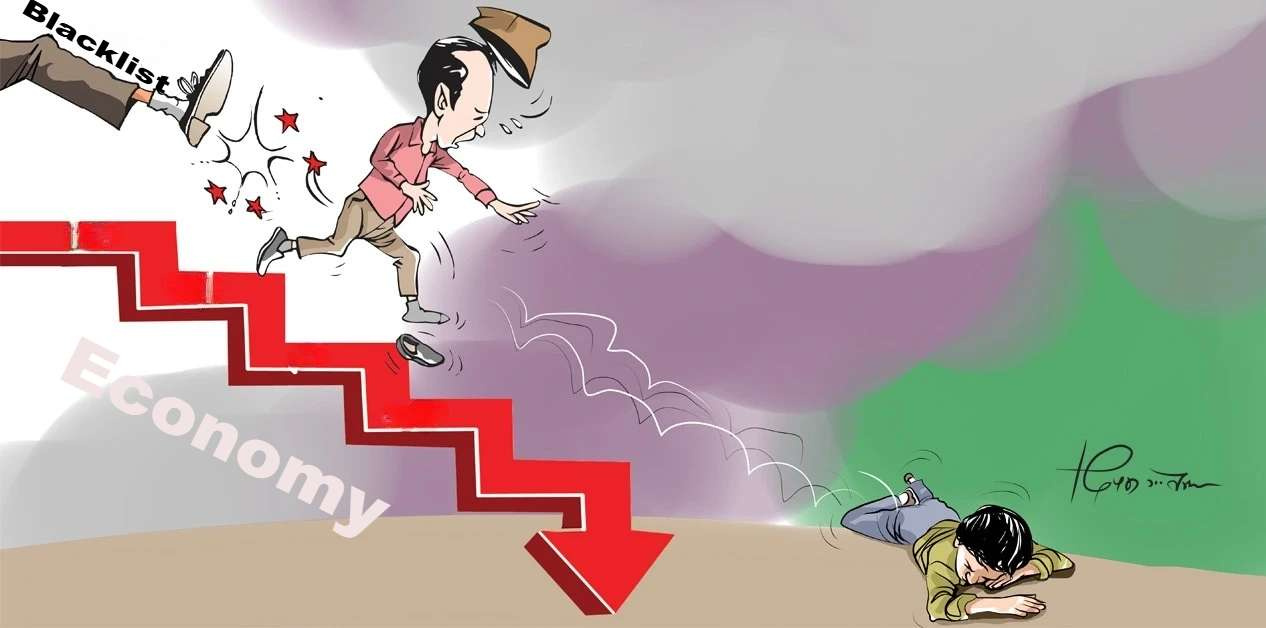
The increasing number of blacklisted people indicates that the country’s economic cycle is being affected. In addition, the Nepali economy has not yet strengthened since the COVID-19 pandemic. The impact of this has affected people’s financial lives.
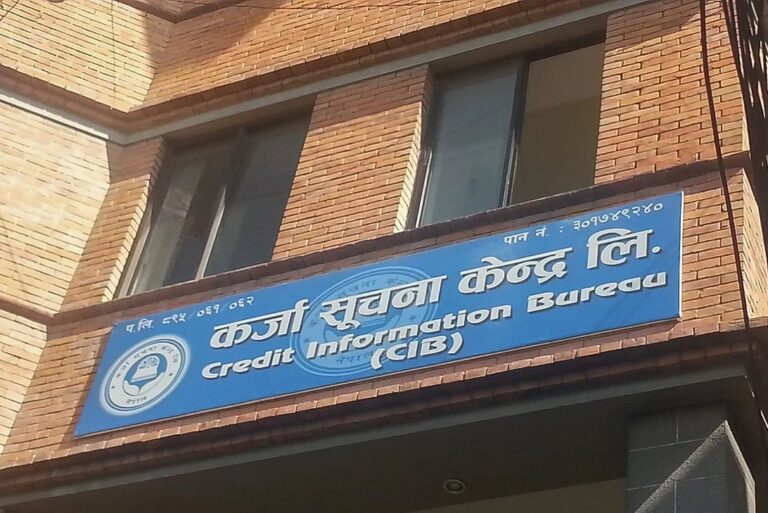
Credit Information Bureau. File Photo
Upendra Paudyal, president of the CBFIN and former banker, says that the number of people blacklisted has been increasing due to the slowdown in the economy for the past few years. “The interest on loans taken from banks keeps increasing over time, and when the economic situation is not good, it becomes impossible to repay the loan on time. That increases the number of people blacklisted,” he says. He adds that BFIs, too, recommend people to the blacklist for reasons and when nothing else works.
The real estate business has declined in recent years. The government withheld the payments to be made to construction entrepreneurs for a long time. Former banker Bhuwan Dahal says that these reasons, too, have contributed to the increase in the number of those blacklisted. “The loans taken for real estate transactions are being affected, and construction entrepreneurs were not able to repay their loans because the government had not paid them. The number of those blacklisted has increased due to all these reasons,” he says. On the other hand, he also says that there is a tendency in Nepalis to avoid repaying loans to the extent possible.
Twenty commercial banks, eight national-level and nine regional-level development banks, 18 financial institutions, 52 microfinance companies, five cooperatives, 10 hire purchase companies, one infrastructure development bank and one other company, totaling 124 organizations, are affiliated with the Credit Information Bureau. When individuals and organizations doing financial transactions with these organizations fail to repay loans and when the checks issued by them bounce, the Bureau blacklists them based on the recommendations made by the organizations affiliated with it.
Former banker Poudyal says that the problem of blacklisting will be solved if the country’s economy is brought back on track. “It is not enough to express concern over the rising number of blacklisted companies or individuals; it is the government’s responsibility to improve the economy,” he says.
Another body that blacklists companies is the PPMO. The PPMO puts a company on the blacklist when the latter does something against the Public Procurement Act. There is also a provision to blacklist companies if the bidder selected through public bidding fails to sign the procurement agreement, fails to fulfill its obligations as per the agreement, or if it is proven that the quality of goods is not on par with the contract. The PPMO has blacklisted 1,094 organizations and their directors as of last mid-July. In the last fiscal year alone, 145 organizations were blacklisted. The number of companies blacklisted in this way has increased sharply since the fiscal year 2017/18. In that fiscal year, 52 organizations were blacklisted, while in the fiscal year 2020/21, as many as 104 companies were blacklisted. That year, the growth rate of the country’s economy turned negative due to the COVID-19 pandemic. In the fiscal year 2023/24, as many as 235 institutions were blacklisted in a single year.
The NRB made a provision from the fiscal year 2021/22 to allow microfinance institutions to recommend for blacklisting. This has also increased the number of those blacklisted.
There are two types of borrowers: those who intentionally default on loans and those who intend to repay but are unable to repay due to adverse circumstances. The provisions on loans and blacklisting state that BFIs should classify borrowers who intentionally default on loans and borrowers who default on loans due to circumstances. Individuals who have not contacted the bank for a year after the payment deadline, who have disappeared without paying the loan, who have not initiated the process of restructuring or rescheduling the loan, and who have not expressed a commitment to repay are considered to be willful defaulters.
The PPMO has blacklisted 1,094 organizations and their directors as of last mid-July. In the last fiscal year alone, 145 organizations were blacklisted.
There is a legal provision that borrowers and institutions who have not been able to repay their loans due to circumstances beyond their control despite having the intention to repay the loan but have suffered losses or become problematic, or who have not been able to repay the loan within the deadline but have contacted the institution from which they borrowed the loan and completed the process of debt restructuring or rescheduling and expressed their commitment to repay the loan are classified as debtors who have defaulted on the loan due to circumstances.
Stain on reputation, deprived of financial facilities
Blacklisting is a matter directly related to financial discipline. However, the effects of this tool of financial discipline are multifaceted.
Once an individual or institution is blacklisted, all bank and financial institution accounts in its name are blocked for the period of time it remains on the list. While on the blacklist, it is not even allowed to open a new bank account. That is, a person on the blacklist is not allowed to conduct any banking transactions.
However, the NRB has made arrangements that opening accounts for the purpose of receiving social security allowances, salary accounts, and pension funds is not prohibited. The NRB has asked BFIs to verify that the depositor is not blacklisted according to the details of the Credit Information Bureau before opening any account. Kunwar, the spokesperson for the Bureau, says, “The bank account of a person or organization that is blacklisted is frozen. The person or organization that is blacklisted cannot withdraw the amount in such an account. However, they can deposit money into the same account for the purpose of paying off liabilities.”
Once a person or organization that is blacklisted pays off its liabilities, its name is removed from the list, it is freed from legal restrictions, but the record of being blacklisted for a certain period of time remains forever. This not only tarnished the reputation of the person and organization, but it also continues to cause problems for the person or organization concerned to conduct business and banking transactions. Credit Information Bureau Spokesperson Kunwar says that BFIs will decide whether to conduct financial transactions with a person or organization that is blacklisted once, only after considering many aspects. “Even after an individual or organization is removed from the blacklist, they may face problems in doing business with BFIs, so it is better to avoid being blacklisted,” he says.
The Banking Offences and Punishments Act, 2025 provides for imprisonment for the issuer of a check that bounces, besides providing the amount mentioned on that check, interest as per law from the date of issuance of the check to the date of payment of the amount, and a fine of five percent of the amount to the recipient. The imprisonment can range from one month to four years depending on the amount. The law also provides for BFIs to get blocked the passport of the debtor, who is blacklisted, by recommending it to the NRB.
According to the Public Procurement Act, there is a provision for blacklisting for one to three years depending on the seriousness of the offense. Based on the provisions made by this Act, a person or company which is blacklisted cannot participate in procurement and construction work during the period of blacklisting. Since the bank accounts of such a person or company are frozen, their banking transactions come to a standstill.
The law also provides for BFIs to get blocked the passport of the debtor, who is blacklisted, by recommending it to the NRB.
There are many companies related to the construction sector on the blacklist maintained by the PPMO. Companies that did not complete the work on time and whose contracts were terminated in the meantime have been blacklisted. In recent times, the Ministry of Physical Infrastructure and Transport has been terminating contracts in droves. Construction entrepreneurs say that this will increase the number of companies that will be blacklisted. Rabi Singh, president of the Federation of Contractors’ Associations of Nepal (FCAN), says, “There is a cruel provision in the Public Procurement Act, which needs to be amended. If contracts are left and paid no heed, construction entrepreneurs are forced to spend extra money to extend the deadline of even those contracts that cannot be completed, fearing that they will be blacklisted.”
According to Singh, extending the deadline of any contract once costs one and a half percent of the total cost of the project, including bank guarantees and insurance. He says, “In a contract that has been extended for 15 years, as much as 22.5 percent of the contract amount is spent on extending the deadline. This is a slow poison for the construction sector.”
He says that to solve this problem, Sub-section 8 of Section 59 of the Public Procurement Act should be repealed. The section stipulates that if the contract agreement is terminated in the middle, the entire security deposit for the contract will be forfeited and the amount required to complete the remaining work of the contract will be recovered from the construction entrepreneur as government dues. After failing to pay this amount, construction entrepreneurs are blacklisted.
Singh also reveals that there is a distortion in construction entrepreneurs working in joint ventures (JVs) where they issue checks to trap other partners and get them blacklisted. “In JVs too, there is a distortion in issuing checks to trap partners and getting them blacklisted even for transactions that never took place. Only the person who issued the check should be held responsible and action should be taken against him/her, not everyone should be brought under the ambit of action just because they are in the JV,” he says.
Other small business owners, too, believe that the blacklist provision should be corrected. Kamlesh Agrawal, president of the Nepal Chamber of Commerce, says, “The blacklist provisions adopted by the central bank and financial institutions have been implemented in a harsh and opaque manner. This has put small and medium entrepreneurs and businessmen at great risk.” He says that if any person or firm is blacklisted, the existing system under which other firms or individuals with partial ownership or involvement in it are also blacklisted should be abolished.
Dahal, an economic expert and a former banker, says that the problem can be solved to some extent if the concerned BFIs decide not to blacklist those who have been unable to repay their loans due to circumstances beyond their control. He believes that the blacklist system should be strictly implemented for those who intentionally default on loans. “They do not even try to repay loans without collateral, and there is a tendency to attack BFI employees who approach them, requesting them to repay the loans. If the blacklist system is not strictly implemented, BFIs will not be able to function,” he says.