Kathmandu
Wednesday, February 11, 2026





Nepal's thematic position paper for COP30 outlines nine priority points, including Global Stocktake and Science, Loss & Damage, Adaptation, Climate Finance, and Paris Agreement Article 6.
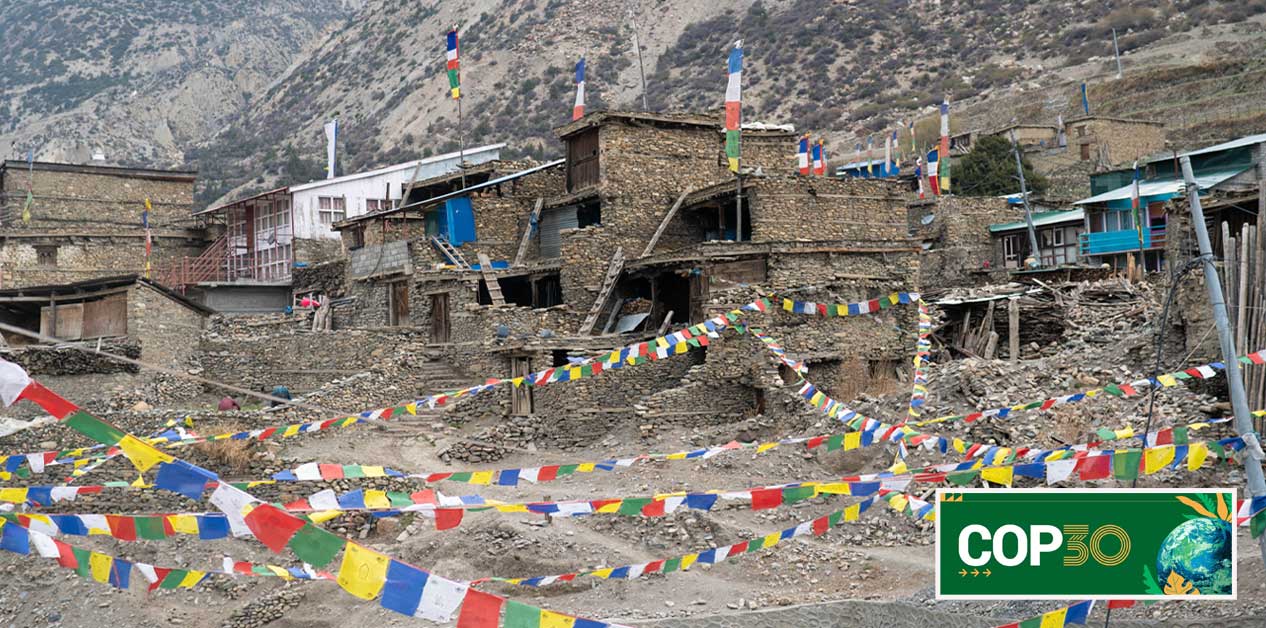
KATHMANDU: This year, Brazil is hosting the 30th Conference of the Parties (COP30) to the United Nations Framework Convention on Climate Change (UNFCCC). As host, Brazil has adopted the slogan “Global Mutirão,” calling on the world to unite in a collective effort for climate action.
The word Mutirão is derived from Brazil’s indigenous Tupi-Guarani language group, meaning ‘collective effort.’
The conference, which will take place in the city of Belém, known as the gateway to the world’s largest Amazon River, is scheduled from November 10 to November 21 and is viewed with significant importance. Reasons for this include the United States abandoning the Paris Agreement, Brazil’s leading role in sustainable development goals at the 1992 conference in Rio de Janeiro, Brazil, the hosting of COP30 in the same region, and the 10th anniversary of the Paris Agreement.
Another reason why COP30 is viewed with importance is the ‘Baku to Belém roadmap’ set at COP 29 in Baku, Azerbaijan, last year. Its objective is to raise at least USD 1.3 trillion annually by 2035 for climate action in developing nations. Crucial discussions regarding this roadmap will take place at COP 30. In addition, discussions will cover climate adaptation, climate finance, and the financial costs of loss and damage.
The new issue this year is the tropical forest agenda raised by Brazil. As home to the tropical Amazon rainforest, Brazil has introduced the ‘Tropical Forest Forever Facility’ (TFFF) concept to generate necessary financial resources for its preservation.
On the other hand, the Paris Agreement was signed by 195 nations at COP21 in Paris, France, in 2015. A review and assessment of this agreement, which turns 10 years old, will also take place this time. The Paris Agreement resolved to attempt to limit the increase in global temperature to 1.5 degrees Celsius. Recently, United Nations Secretary-General António Guterres, in an interview with the Guardian, pointed out that humanity has failed to limit global warming to 1.5 degrees Celsius and stated that an immediate change of direction is necessary.
Important agreements within the Paris Agreement included that party nations must submit their Nationally Determined Contributions (NDCs) to commit to reducing greenhouse gas emissions, and developed countries must support developing countries in reducing emissions and adapting to climate change.
Over the last 10 years, most party nations have submitted their NDCs twice, with a deadline for the third submission set for February. So far, only about 60 countries, including Nepal, have submitted their third NDCs. Nepal’s NDC includes targets based on the energy system, including cooking and transport sectors; agriculture, forestry, and other land uses; waste; industrial processes and product use; urban settlement; and tourism. It has been indicated that newly determined contributions will also be discussed and agreed upon at this year’s COP.
Another reason why COP30 is viewed with importance is the ‘Baku to Belém roadmap’ set at COP29 in Baku, Azerbaijan, last year. Its objective is to raise at least USD 1.3 trillion annually by 2035 for climate action in developing nations. Crucial discussions regarding this roadmap will take place at COP30.
Experts and activists monitoring the COP are stating that although Nepal participates in the conference every year, it has not achieved effective results. They suggest that countries like Nepal get squeezed because agreements on climate justice issues raised by developing nations are often dominated by developed nations.
Nepal at COP
The first COP conference was held in Berlin, Germany, in 1995, which Nepal signed as a party nation of the United Nations. More than 40,000 representatives concerned with climate from 200 nations typically attend the conference each year.
At COP29 in Baku last year, when President Ramchandra Paudel participated, Nepal presented key agendas, including climate finance, climate-induced loss and damage, carbon trading, emission measurement, technology, and capacity building. Similarly, then-Prime Minister Pushpa Kamal Dahal participated in COP28 in the UAE. At that time, Nepal, leading the mountain countries, organized a session in its pavilion for the first time.
Before that, at COP27 in Egypt, Nepal presented issues related to climate adaptation, climate finance, and mountain regions. At COP26 in Scotland, Nepal presented the goal of sustainably reducing carbon emissions and achieving net-zero emissions by 2045. Accordingly, Nepal has also introduced programs for the development of various climate-related strategies, policies, plans, and technologies.
The impact of climate change disasters is directly affecting Nepal’s sectors, including agriculture and food security, water resources, energy, forestry, biodiversity, rural tourism, nature, health, clean water, and disaster risk reduction and management.

Annapurna III. Photo: Durga Rana Magar
Climate-induced disasters cause loss of life and property in Nepal every year. This year alone, on July 8, the flood caused by a glacial lake outburst in the Lende River, Rasuwa, resulted in significant physical damage, the death of nine people, and the disappearance of 19 others. This same year, 47 people died due to monsoon-induced disasters, while the plains (Terai) were affected by long droughts. To cover these diverse issues, Nepal has recently been strongly raising the issues of loss and damage and climate finance at the COP.
Nepal’s National Adaptation Plan (2021 to 2050) introduced 64 plans based on nine thematic areas to address long-term climate change risks. For this, Nepal requires USD 47 billion by 2050.
Similarly, the Government of Nepal has stated that USD 33 billion is needed by 2030 for emission reduction and adaptation.
Likewise, the Adaptation Gap Report 2025, released by the United Nations Environment Programme this week, estimates that developing countries will require an annual USD 310 billion to USD 365 billion by 2035 for climate change adaptation.
Climate expert Manjeet Dhakal states that discussions are underway for the group of least developed countries to demand USD 120 billion annually at this year’s COP to achieve the climate adaptation goal by 2030.
Dhakal, who also serves as a climate expert advisor for the group of least developed countries, mentions that since this resource is to be obtained through competition, dialogue is also underway on how to facilitate that process.
Nepal’s National Adaptation Plan (2021 to 2050) introduced 64 plans based on nine thematic areas to address long-term climate change risks. For this, Nepal requires USD 47 billion by 2050.
What is Nepal doing?
While the President and Prime Minister have previously participated, an 11-member delegation led by the newly appointed Minister of Agriculture and Livestock Development, Madan Pariyar, is preparing to participate in COP30 from Nepal. In contrast, the ministry directly connected with climate is the Ministry of Forest and Environment. That responsibility currently lies with Prime Minister Sushila Karki. On the other hand, Nepal may miss out on important debates where the head of state or government participates if the prime minister is unable to attend.
Nepal has included nine priority points in its thematic position paper for COP30. These include global review and science, loss and damage, climate adaptation, carbon and climate finance, and Article 6 of the Paris Agreement. The issues of climate transparency, capacity building and technology transfer, and climate justice are also priorities, according to Maheshwar Dhakal, the focal person for the Nepali team and chief of the Climate Change Management Division at the Ministry of Forest and Environment.
Dhakal states that Nepal will also prioritize presenting the conclusions and achievements of the ‘Sagarmatha Sambaad 2025,’ which Nepal hosted last May. The Sagarmatha Sambaad resulted in a 25-point conclusion covering biodiversity conservation, promotion of science and technology to combat climate crisis disasters, preservation and respect for mountain ecosystems, and the role of local and indigenous communities in climate policies.
Dhakal states that Nepal has repeatedly held discussions with stakeholders in preparation for COP30. He mentions that this year, Nepal has prioritized diplomatic debate, agreements, and networking. Dhakal also suggests that Nepal will push for grants to address climate risk crises and advance diplomatic efforts for international investors to invest in feasible sectors in Nepal, such as clean energy.
Raju Pandit Chhetri, Executive Director of the Prakriti Resource Center, also suggests that since a primary agenda was not set for this year’s COP as in the past, discussions might revolve around adaptation and just transition. Chhetri states that Nepal is currently going through a period of climate transition, which could affect its presence and debate at COP30. He suggests that Nepal should focus on identifying sources for important meetings and investment opportunities.