Kathmandu
Saturday, February 14, 2026





If we want to prevent people from turning into inhumane and undemocratic mobs, we must use digital platforms consciously and expand access to broad knowledge.
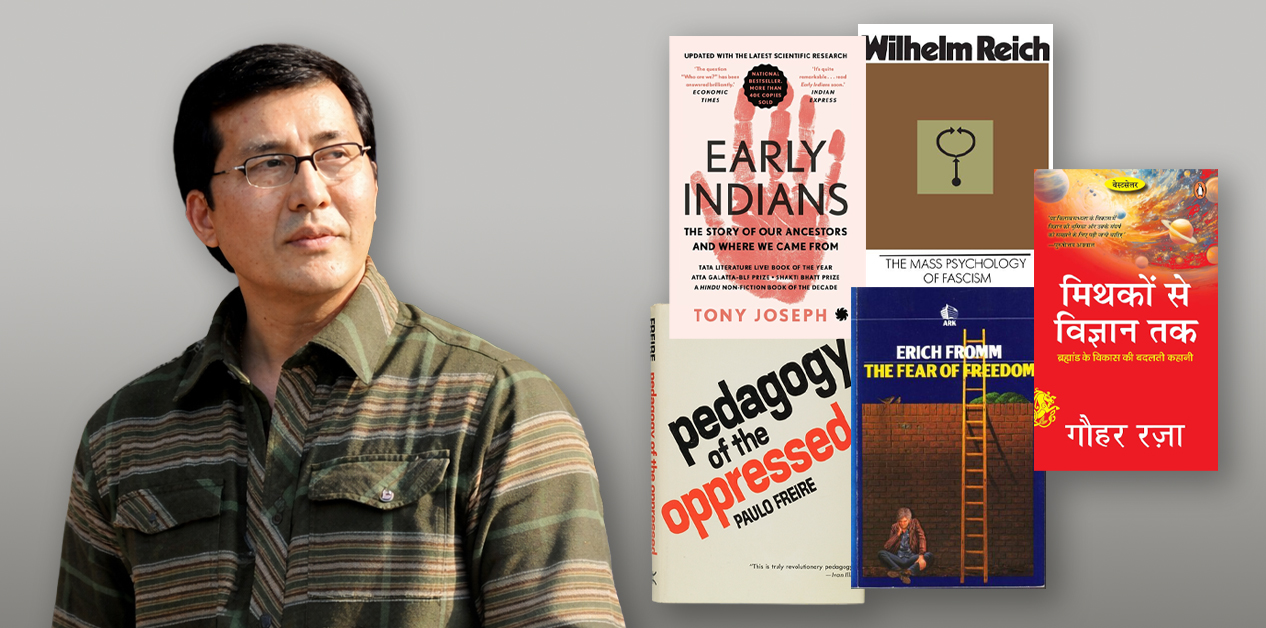
Rajendra Maharjan, active in writing and editing, has published eight books including Silu Mye Ra Samajik Pratirodh, and Samajbadko Sapana, with three more forthcoming. Around 40 books edited by him, such as Pujibad ra Marxwad and Nepalma Varnavyawastha ra Bargasangharsha, have already been published. In this conversation with Nepal News, he talks about books and reading:
What was the last book you finished? What are you reading now?
I recently finished Mithakon Se Vigyan Tak (2024) by Indian poet and scientist Gauhar Raza. The book critically reviews how different civilizations and religious scriptures have interpreted the origin of the universe and the creation of human beings. It helps shift our perspective from mythological explanations toward scientific understanding.
Currently, I am reading Early Indians by Tony Joseph. It gives the sense that modern humans – Homo sapiens – who evolved around 300,000 years ago, began migrating out of Africa about 70,000 years ago. The ancestors of people across the world today – white, brown, red, and black – were once of the same color.
What genre do you prefer? Tell us about your time, place, and environment for reading.
Since reading and writing are both my passion and my profession, I simply need a book in hand and I forget everything else. So I am always looking for time and opportunity to read, wherever and whenever possible. Still, having my own library or workspace makes it more comfortable.
How much time do you set aside daily for study?
I don’t set aside a specific time. Study, writing, and editing are my work itself, so I rarely keep track of time.
Name three of your favorite books. Why do you like them?
Paulo Freire’s Pedagogy of the Oppressed helped me understand prevailing education systems and modes of thinking with critical reasoning, and contributed to my view of making the world more humane, democratic, and progressive.
A book that helped Freire himself broaden his thinking is Erich Fromm’s The Fear of Freedom (published in the United States as Escape from Freedom).
The third is Wilhelm Reich’s The Mass Psychology of Fascism.
Freire revealed that even within a worker, there can exist two distinct personalities: the oppressor and the oppressed. Going to the roots of that idea, Fromm pointed toward the “authoritarian character” within individuals – whether worker or capitalist. In fact, the authoritarian tendencies within the middle class of crisis-ridden Germany gave birth to fascism, something that remains worth reflecting on in today’s world.
Wilhelm Reich argued, based on extensive research, that it is not Hitler or any populist, demagogue, or authoritarian leader who creates fascism. Rather, it is the social conditions and contradictions within society – and the mass psychology shaped by them – that create and embrace such leaders.
Their ideas about how social movements and populist leaders transform citizens with critical consciousness into mere crowds under nationalist slogans form the foundation of my new book Unmaad: Fascism Manthan. Just as the Pied Piper of Hamelin lured rats into the sea with his enchanting tune – and later entranced children to bargain with the townspeople – these books help us understand today’s many modern “pied pipers.”
What is the biggest change books have brought to your personality and life?
Books helped me see, understand, and interpret both the world of words and the world itself through written words. Without companionship with books that offer deep insight into language and life, I would not have become a writer.
Why should one read books?
To develop a perspective on how the world is changing and to understand one’s own place within it. Otherwise, many people end up living as status quoists, fatalists, or egoists, often causing harm.
In the digital age, what should be done to preserve reading culture?
There is a saying: “For those who understand, even sweet pudding is meaningful; for those who don’t, even a tool handle is useless.” The digital age, like any other era, is both an opportunity and a challenge – often serving as a cultural weapon for those in power.
If we want to prevent people from turning into inhumane and undemocratic mobs, we must use digital platforms consciously and expand access to broad knowledge. Otherwise, just as traditional scriptures and propaganda machines once did, digital tools can also render people unaware, ignorant, and uncritical. It is essential to cultivate the understanding that progress and justice are impossible without deep and wide-ranging study and research.