Kathmandu
Tuesday, July 28, 2026





Beyond the viral social media tunes, Katha Ghera’s 11-destination theatrical journey across Karnali and Sudurpashchim became a living mirror reflecting the raw geography, joys, and sorrows of Nepal

KATHMANDU: Bus park? Somewhere by the roadside? Near a police station? Beneath a public pavilion? Or in front of a house with a wide courtyard? Where would be the right place to build the stage?
Where could they tap into electricity? If a thousand spectators showed up, where would they sit? How much would it disrupt the road? Would there be shade if the sun turned harsh? What if it rained?
The microphone system was arranged, the stage cleaned, and seating managed. They searched for ways to make the sarangi’s melody ring louder. Props were positioned. Spaces were marked for the musicians.
Everything was set. The audience gathered. And then, right there along the road, the play began:
Tara rara ra ra ra, tara rara ra ra ra…
Last month, Katha Ghera showed this play in 11 places in Karnali and Sudurpashchim. Batai Bato, which had been increasing people’s curiosity on social media right from the rehearsal of the play, succeeded in drawing the attention of thousands after descending onto the street. The songs used in this became viral on TikTok, Instagram, and Facebook. The follower count of Katha Ghera increased rapidly. This play, made on the subject of women’s empowerment, created a complete stir on social media.
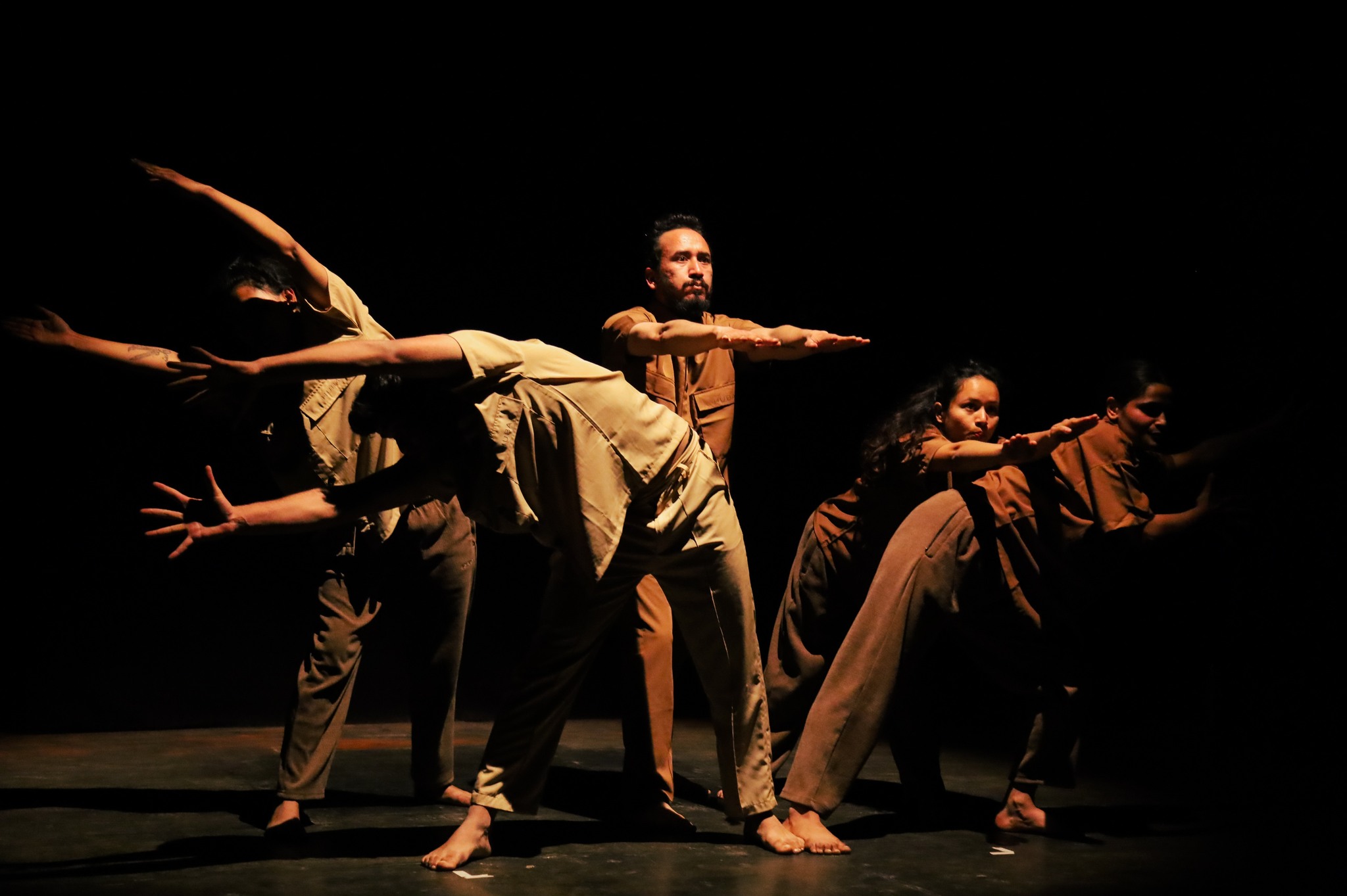
A theatrical performance by Katha Ghera
The main companion of Batai Bato’s theatrical journey was director and artist Sudam CK. During his school-going days, having toured the Village Development Committee (VDC) by acting in a play related to polio drops, he had won the hearts of everyone from friends to male and female teachers. As an artist in street plays regarding violence against women, he had reached various places in the East-West. As a director, Batai Bato is his first street play.
Almost all the plays we watch in Kathmandu take place in a ‘Black Box’ theater. Where, in a place like a large room, a stage is made by hanging huge black curtains and hanging lights. The play is watched from the place of the audience sitting closely connected. From there the stage is visible, but the ‘backstage’ is not visible. Nor can the artists see the audience properly. In addition to acting in dozens of plays, Sudam, who has already directed plays like Ubur Ubur Tikki, Like Let’s Abhinaya Garau, Ye Maya, and Paanch, has acted in movies like Red Monsoon, Talakjung Vs Tulke, and Hostel Returns. In recent times, he has been active even as a casting director in movies.
If a character provokes anger, a spectator might even scold the performer in the middle of the act. He notes that in street theatre, there is no space for an artist to complain about distractions, saying, “I got distracted.”
“On the street, the audience sees an artist rising and coming to the stage and also sees them going to the back and sitting,” Sudam shares the experience of his recent journey, stating that a street play remains under the control of the audience. “We had designed the Batai Bato play to have a three-sided audience. In Mangalsen of Achham, we built the stage by tying ropes in the palace premises. After the play started, the audience increased and filled even behind the side where the musicians were sitting, becoming like a four-side audience.”
In a Black Box or ‘Proscenium Theater,’ we enter inside the hall at a specified time, paying the specified fee and buying a ticket for the play being performed. The mobile phone is told to be turned off or put on silent; moving around or speaking is prohibited for one and a half to two hours. He states that in a stage play, it can be controlled according to the design of the play. Sudam says, “In a street play, the audience can come at any time and can leave at any time. A vehicle keeps running right from there; another person keeps shouting right there; someone keeps speaking on the phone; someone keeps shooting a video. The person sitting at the very front and watching can get up right in the middle and walk away; you cannot say, “Please do not go, the play is not finished yet.”
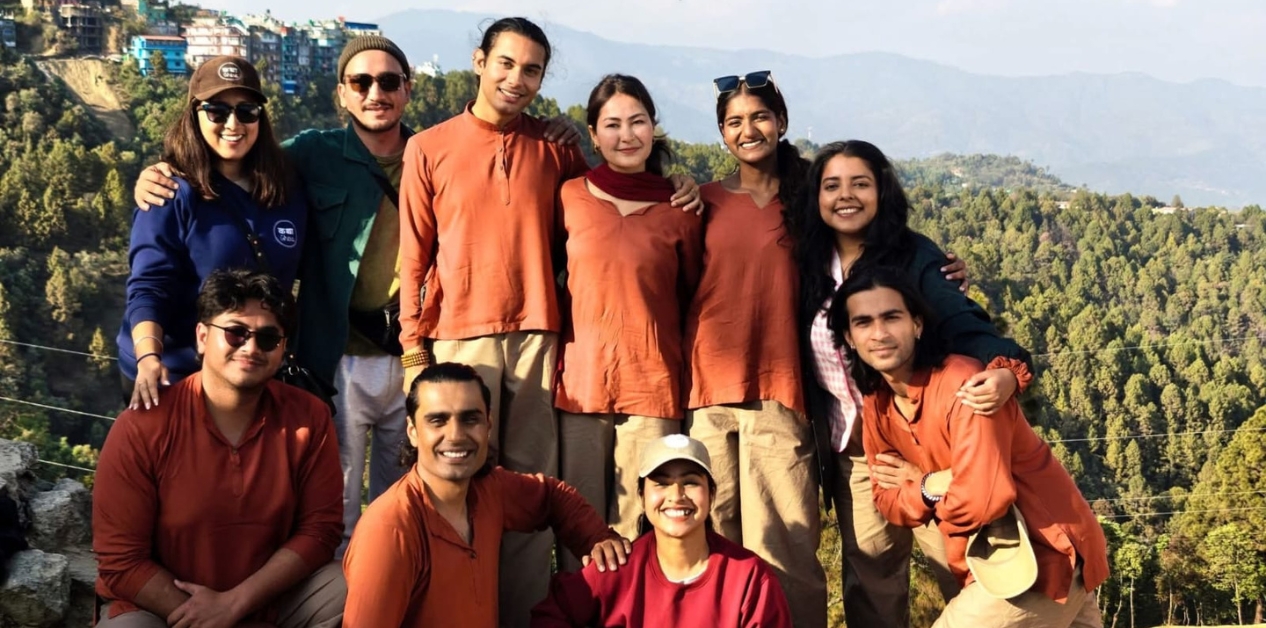
Director Sudam CK alongside the cast of ‘Batai Bato.’ Photo courtesy: Katha Ghera
“A stage play is our own place. A place with which there is good acquaintance. Because of the lights, because of the time, many things are under our control. An actor gets to remain just an actor,” Sudam says, “But, when doing a play outside, one must be ready to announce as well; if there is too much noise, one must be prepared to say, ‘Please do not make noise.’ If some reaction comes instantly from the audience, one must be ready to move the play forward by incorporating that as well. Looking at how many people there are and how they are sitting, one must speak so that everyone can hear. The sun is shining, sweat is coming; one must ignore all those things.”
In a street play, the mood of the artist must be ‘performative.’ For an artist having the thought of doing extremely realistic acting, a street play might not be an appropriate ‘form.’ However, his opinion is that a street play does help to break patterns and bring self-confidence. It is not that it won’t work even by keeping realistic characters, but because showing and making people hear are the main things, it must be ‘loud.’ Due to that, the essence of reality dies. This is a new experience that he has gained.
In a stage play, even if the artist does not see the audience properly, it can be clearly known which side they are looking at, but on the street, it is not known from where and who is watching. Someone is climbing a tree and watching, someone is far away on the roof of a bus, someone is watching from a balcony.
When doing a play on a stage, regular staging keeps happening at the same place at the same time. Advertising is also done accordingly. Looking at posters, audience reactions, newspapers, online media, and materials that have appeared on social media, the audience keeps watching the play by choosing it based on the recommendation of their friend circle. A street play is also something the audience comes to watch by selection, but many people keep coming with the mindset of ‘Let’s see what it is; let’s just sit.’ If you say you will watch the play by reaching 10 minutes after the stage play has started, you won’t get to. But that facility is there in a street play. Even if you catch only the final scene, you get to watch it. While watching, if you do not feel like it, you can leave and walk away. Sudam says, “In a stage play, the audience has curiosity about who is doing it. What kind of play is it? What is it about? But, on the street, most of the audience does not care about who they are. Where did they come from? Where did they go?”
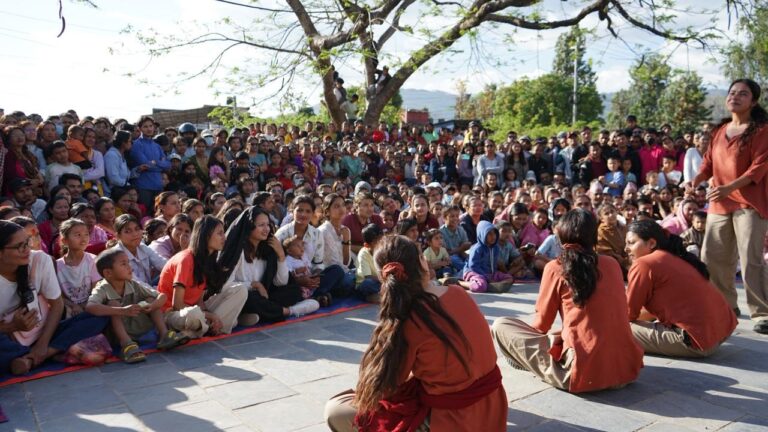
Katha Ghera Group performing their street play ‘Batai Bato’ live on location
They do not care only about what is being shown to the audience or what the message is. Many spectators come only for entertainment. If one thousand people are watching the play, it can be hoped that at least 50 people listened to and pondered the subject matter of the play seriously.
Stating that in the recent journey, many old people and children watched the Batai Bato play, considering it fun, but they did not have much interest in the issue the play was raising, Sudam says, “Even if we went to show a play, another person might be motivated by a completely different thing. After the play was finished at one place, some spectators were coming to speak with the musician friends. Someone might want to become a musician. James, an artist of our own play, also happened to feel that ‘I also have to do acting like this’ after seeing a street play in Dharan. Similarly, many children might have also dreamt of becoming an actor after watching this play.”
Recalling the performance at Dullu in Dailekh, Sudam says, “One woman was sitting near the stage and watching the play. But, as if watching by hiding, as if feeling uncomfortable. Someone was watching while breastfeeding a child. There were also young women who appeared as if trying to open up a little.” There is the matter of women’s empowerment in the play. They were looking at those characters by connecting themselves to them. Seeing the female character succeed, happiness was reflected on her face.
These sights made Sudam feel glad and also made him sad. There is a story of success; there is a celebration in the play. The reality of the people is different. Which is larger than the play he made. Therefore, the question ‘who am I to go and teach’ also kept following him.
Sudam states that while the audience was feeling happy after watching the play, the reality that he could do nothing to lift them from the problems they were facing in daily life troubled him throughout the journey.
“People are seeing dreams, but life continues just as it always has. Change does not happen simply by wishing for it. At times, I felt small myself. I also wondered what I was really doing,” he says.
“At other times, I felt it was fine, that what I was doing mattered. After six months, someone might recall something from the play and say it like this. Some might even find a path toward their dreams. I also felt our work could create at least a small impact. Throughout the journey, I kept moving between these two feelings.”

Director and artist Sudam CK
It is difficult to shift even slightly the direction of a society that keeps turning in a fixed cycle. The state also runs various campaigns and programs for women’s empowerment, which may work in some places and not in others. What appears to be a major change can, at times, also be attempted through a single street play.
Sudam says, “People call it development work. We have certainly done it for money as well. But it is also the work I truly wanted to do. My biggest struggle was how to make it more meaningful, more purposeful, and something I could be proud of.”
Is this the play I wanted to make? The song went viral, but did the play create the kind of impact we hoped for? Could it have been better? Did I miss something? Sudam kept asking himself these questions throughout the journey.
Katha Ghera’s Batai Bato reached millions of viewers both on the ground and online. What image of the play has settled in people’s minds, and what its lasting impact will be, remains to be seen. Sudam also carries back with him many scenes from this journey.
In Birendranagar, the play was performed before around 2,500 people. The audience was spread across three layers: those seated in front of the stage, those standing behind them, and those watching from a pavilion further back. People also watched from rooftops across the area. At one point, the noise in Birendranagar became so intense that the performance had to be paused briefly.
The scenes that remain in his memory include a sudden storm just before a performance in Mahendranagar, a roadside staging in Chhunchhe, the strong winds of the Bheri region, the excitement stirred among locals by ongoing gas extraction work, people living in unexpected and difficult conditions, and the barren hills around Sallibazar in Salyan that made one imagine settling down there despite everything.
Sudam says, “All these scenes contain the geography of my country, the people of my society, and their joys and sorrows. For me and the Katha Ghera group, Batai Bato was not just a play. It was a way of seeing and understanding the face of our own country.”