Kathmandu
Monday, June 8, 2026





From mass culling and farmer losses to food prices and public health risks, a look at how recurring H5N1 outbreaks are exposing deep weaknesses in Nepal’s poultry sector
KATHMANDU: What began as a cluster of sudden deaths at commercial farms in Morang’s Sundarharaicha and Urlabari municipalities in mid-March has grown into one of Nepal’s most geographically sweeping bird flu outbreaks in years.
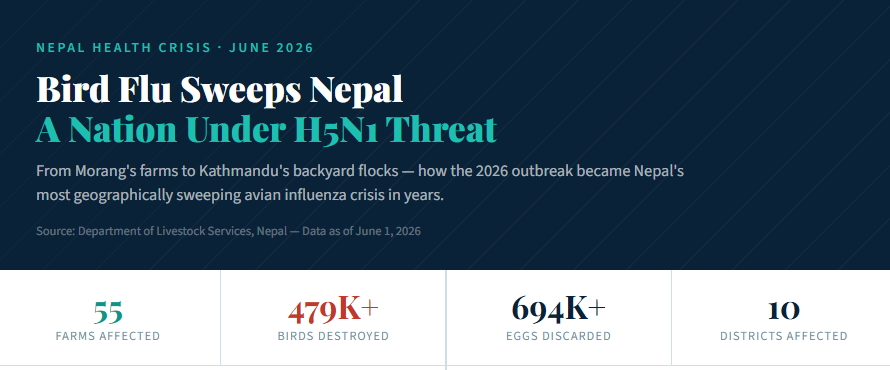
By early June, the highly pathogenic H5N1 virus has cut through 10 districts and struck 55 commercial and backyard farms, forcing authorities to destroy more than 479,000 birds, over 694,000 eggs, and nearly 183,000 kilograms of poultry feed.
The disease, which first entered Nepal in 2009, has now pushed past Koshi Province into the Kathmandu Valley, alarming authorities as infections are confirmed in Kirtipur, Chandragiri, Gokarneshwar, Godawari, and Suryabinayak, with Bhaktapur’s Changunarayan neighbourhood the latest to report casualties.
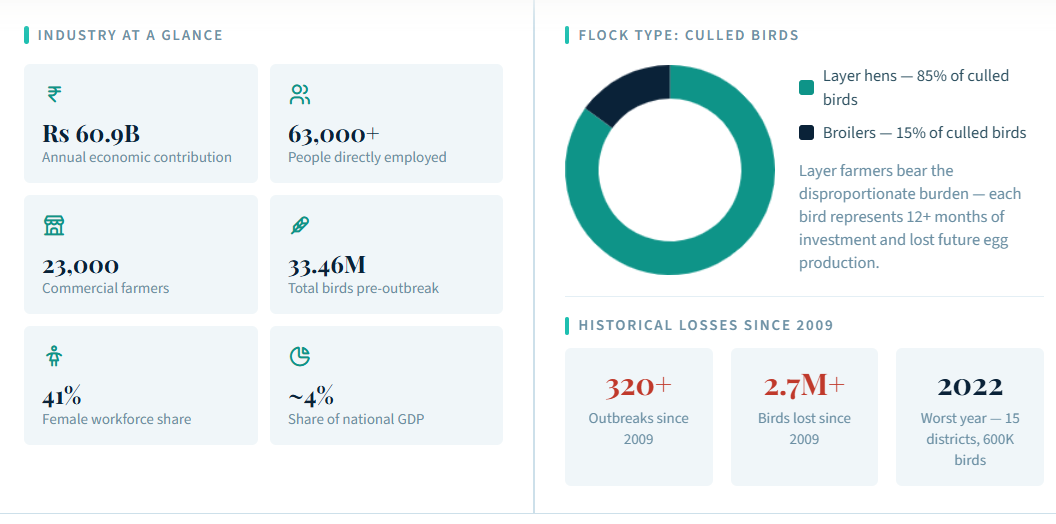
Nepal’s Rs 60 billion poultry industry and the livelihoods of tens of thousands of farming households are once again under severe threat.
What exactly is bird flu, and why does it matter so much to Nepal?
Bird flu, formally called avian influenza, is a viral infection that circulates among birds but can under certain conditions cross into other species, including mammals and humans. The strain driving the current crisis is H5N1, classified as highly pathogenic, meaning it kills quickly and spreads aggressively. In infected flocks, mortality can exceed 50 percent within a matter of days.
Nepal is exposed to this disease from multiple angles. The country sits along migratory bird flyways where waterfowl carry the virus silently across borders. Its long and porous frontier with India, where H5N1 has simultaneously flared across multiple states in 2026, creates a constant entry route. And its poultry industry, densely packed in the Terai belt and now growing into the Kathmandu Valley, offers the virus fertile ground once it arrives.
The stakes are not abstract. Chicken and eggs are among the most affordable proteins available to ordinary Nepali households. Disruptions to the supply chain drive prices up, squeeze rural incomes, and leave farming families exposed to devastating debt.
Every outbreak is not just a veterinary emergency. It is an economic shock and a food security crisis rolled into one.
When did bird flu first arrive in Nepal, and how has the outbreak history evolved over the decades?
Nepal recorded its first confirmed case of highly pathogenic avian influenza in January 2009, when the virus surfaced among chickens and ducks in Jhapa district, close to the Indian border. Veterinary authorities believe the infection crossed over from West Bengal and Assam, where India had been battling its own large-scale outbreak and culling hundreds of thousands of birds.
Nepal declared an emergency zone around Kakarbhitta, imposed a quarantine, and culled birds within a three-kilometre radius. The outbreak seemed contained, but the virus returned to the same district in February 2009. The following year brought an outbreak in Pokhara’s Kaski district, where more than 11,000 birds were destroyed.
From that point, the disease has reappeared in Nepal almost every single year across varying districts. The year 2013 recorded the highest number of outbreaks at the time.
The 2022 episode was the most catastrophic in scale, spreading simultaneously across 15 districts and forcing the culling of over 600,000 birds in a single wave.
Nepal has now logged more than 320 confirmed outbreaks since 2009, with over 2.7 million birds lost to disease and preventive culling across those years.
What is the present situation, and which areas are now under threat?
The current wave of outbreaks began on March 18, when cases were simultaneously confirmed at farms in Sundarharaicha-4 and Urlabari-8 of Morang district. The virus spread quickly eastward and westward. By mid-May, it had reached 10 districts: Sunsari, Morang, Jhapa, Chitwan, Kathmandu, Lalitpur, Bhaktapur, Bara, Nawalparasi (Bardaghat Susta Paschim), and Mahottari.
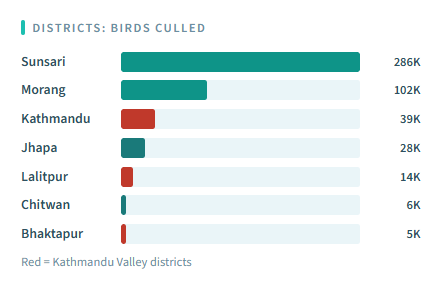
The Department of Livestock Services data as of June 1 shows 55 farms have been affected, with 479,156 birds destroyed, 694,193 eggs discarded, and 182,775 kilograms of feed incinerated. Sunsari has suffered the most, with 23 farms hit and 285,564 birds lost along with 427,580 eggs.
Morang follows with 11 farms and more than 101,860 birds culled. In the Kathmandu Valley, eight farms in Kathmandu, three in Lalitpur, and two in Bhaktapur have been confirmed. Kathmandu alone has lost 39,481 birds. Bhaktapur’s Changunarayan Municipality was the latest to report sudden poultry deaths among backyard birds, which tested positive on June 3.
Animal health officials say the Koshi Province situation is slowly stabilising, but the Valley’s spread remains deeply concerning and is being monitored closely.
How large is Nepal’s poultry sector, and why does an outbreak of this scale threaten the broader economy?
Nepal’s poultry industry is one of the most commercially dynamic sub-sectors within agriculture. A 2024 National Statistics Office survey placed the sector’s annual contribution to the national economy at over Rs 60.96 billion, with broiler farming alone responsible for revenues exceeding Rs 57.86 billion.
Commercial poultry operations exist in 75 of Nepal’s 77 districts, with nearly 23,000 farmers engaged in production. The industry directly employs more than 63,000 people, over 41 percent of whom are women, making it particularly significant for female rural employment.
Nepal’s total poultry population stood at roughly 33.46 million birds before the current outbreak, including 24.5 million broilers and 6.58 million layer hens.
Bagmati Province is the largest producing region. Researchers broadly estimate the sector’s contribution to national GDP at between 3.5 and 4 percent, and at 8 percent of agricultural GDP.
The industry is not just about the farms. It anchors feed producers, hatcheries, veterinary suppliers, transporters, cold storage operators, and traders across the Terai and into the hills.
When flocks are destroyed at this scale, the economic disruption travels through each of these connected layers, contracting activity across the entire rural supply chain at once.
What does this outbreak mean for ordinary farmers on the ground?
For poultry farmers, a confirmed bird flu case at their farm is financial devastation. Every bird within and around an infected farm is culled regardless of whether it shows symptoms. Farmers lose their entire stock overnight, along with stored eggs, feed, and the income they had planned for the weeks and months ahead.
The burden falls hardest on layer farmers, who invest more time and capital per bird because layer hens produce eggs over a production cycle that can stretch beyond a year. In the current outbreak, approximately 85 percent of all culled birds across the initial affected districts were layers, meaning the blow has fallen disproportionately on this group.
Farmers must then wait until their farms are fully disinfected and cleared before they can restock, a process that can take weeks and sometimes months. Many have outstanding loans taken to purchase their original flocks and the equipment to run their farms. They continue to repay those loans with no income coming in.
In the 2022 outbreak, the financial pressure was so severe that hundreds of farmers abandoned the profession entirely. Several are still fighting for compensation from that episode four years later. The current crisis is pushing many of the same vulnerable farming households back to the brink.
Why does bird flu keep returning to Nepal season after season?
The recurring nature of Nepal’s outbreaks is not accidental. It reflects a set of structural vulnerabilities that have never been fully resolved. Nepal lies along the Central Asian flyway, a migratory corridor used by millions of waterfowl each autumn and spring as they travel between breeding grounds in Siberia and Central Asia and wintering areas across South and Southeast Asia.
Species like bar-headed geese and various duck varieties can carry the H5N1 virus without appearing ill, depositing it through their droppings into rivers, wetlands, paddy fields, and the water and soil around farms.
The current outbreak in Kathmandu Valley has revealed another dimension of this threat: 30 house crows near Tribhuvan University tested positive for H5N1 in March 2026, showing that urban wild birds are now part of the transmission chain.
Nepal’s border with India adds further pressure. Informal cross-border poultry trade operates with minimal veterinary checks, and India’s own 2026 outbreak, confirmed in at least eight states including Bihar and West Bengal directly adjacent to Nepal, provides a steady source of re-introduction.
Within Nepal, weak biosecurity at many farms, inadequate fencing, uncontrolled vehicle and visitor access, and the reuse of egg crates without proper disinfection all accelerate transmission once the virus enters a farming area.
What role did wild birds play in the 2026 outbreak specifically?
The involvement of wild birds in the current outbreak is unusually well documented. Veterinary investigators working on the Koshi Province outbreaks identified tall trees near affected farms, which function as roosting sites for wild birds, as a likely transmission bridge between infected wildlife and domestic flocks.
Proximity to rivers and wetland areas, where migratory waterfowl land and rest during migration, was flagged as another key risk factor at multiple affected farms. The most striking development came in mid-March 2026, when 30 house crows found dead near the Tribhuvan University campus in Kathmandu tested positive for H5N1.
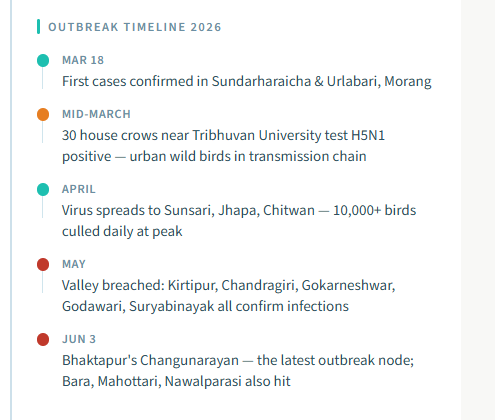
This was a significant finding because it demonstrated the virus was circulating among urban wild birds at the same time as it was moving through commercial farms, suggesting a broader wildlife reservoir than authorities had previously been tracking.
Experts noted that the timing of the outbreak, beginning in mid-March during the tail end of the southward-to-northward spring migration, fits Nepal’s established seasonal pattern perfectly. Outbreaks in Nepal consistently cluster between October and March, coinciding with the peak periods of migratory bird activity through the country’s river systems and wetlands.
Has bird flu ever infected and killed a human being in Nepal?
Yes. Nepal has recorded one confirmed human fatality from bird flu. In 2019, a 21-year-old man from Kavrepalanchok district died of a severe respiratory illness. He worked as a truck driver hauling live poultry between farms and markets, which placed him in regular close contact with birds and contaminated materials. After his death, the WHO Collaborating Centre for Influenza in Japan confirmed through laboratory analysis that he had been infected with the H5N1 strain.
His case stands as the only confirmed human death from bird flu in Nepal’s recorded history, though it remains a sobering reference point for the risks faced by people whose work brings them into sustained contact with poultry. Globally, the picture is grimmer.
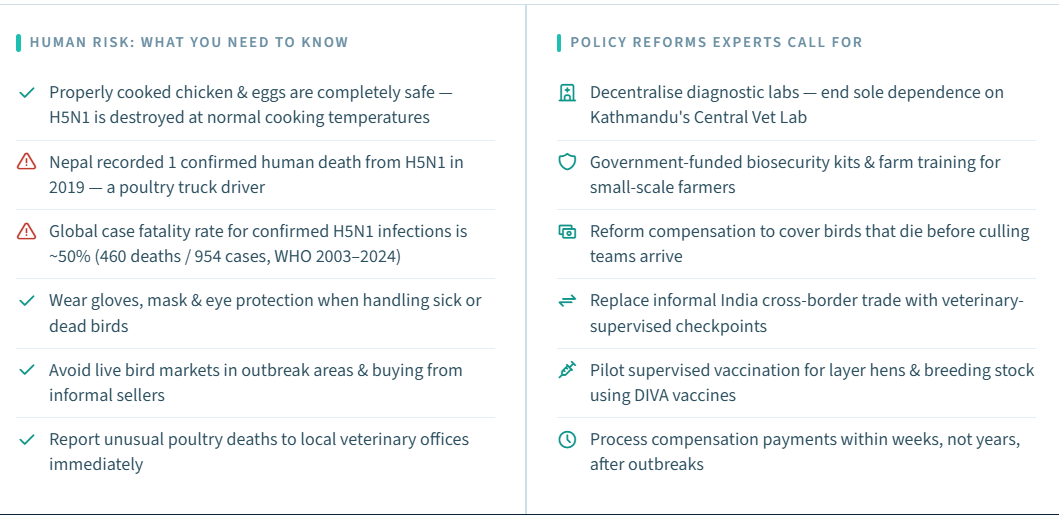
The WHO recorded 954 confirmed human H5N1 infections between 2003 and December 2024, resulting in 460 deaths, putting the case fatality rate among confirmed infections at around 50 percent.
The strain currently circulating in Nepal, identified as clade 2.3.2.1a, was previously associated with human infections in both Bangladesh and Nepal between 2015 and 2019, and related strains have been found in humans and cats in India during 2024 and 2025.
Scientists describe this clade as retaining significant zoonotic potential, meaning the risk of human infection, while still rare, is far from negligible for those who handle sick or dead birds without protection.
What does the government do when a farm tests positive, and how quickly does it move?
The standard response protocol when the Central Veterinary Laboratory confirms a positive result involves declaring an infected zone around the farm, imposing movement restrictions on poultry and poultry products from that area, deploying a rapid response culling team to destroy all birds within the designated radius, disposing of carcasses and manure through burial or incineration, disinfecting the premises, and placing surveillance on surrounding farms.
Authorities also impose transport restrictions on eggs, feed, and live birds from affected districts, as has happened in Sunsari, Morang, and Jhapa in the current outbreak. All three tiers of government, federal, provincial, and local, are involved in coordinating the response.
The challenge in the current crisis was stark from the start. When poultry farmers in Morang first reported sudden bird deaths in late February and early March 2026, many veterinary officials were deployed on election duty for parliamentary elections, and confirmation from the Central Veterinary
Laboratory only came days after the initial reports. By the time rapid response teams reached some farms in Sunsari, the senior livestock officer there confirmed that all the chickens in certain farms had already died of the infection before culling teams arrived, indicating the speed with which the virus can overtake a flock and the cost of delayed detection.
How effective is the compensation system for farmers who lose their flocks?
Nepal’s compensation framework, established under the Bird Flu Control Regulation of 2022, entitles farmers to up to 75 percent of assessed losses when birds are officially culled by government teams. Compensation is calculated according to market rates at the time of the cull and disbursed through a rate fixation committee led by the chief district officer of the affected district.
The policy exists, but its implementation has been consistently disappointing for farmers. After the 2022 outbreak, which destroyed over 600,000 birds across 15 districts, compensation payments moved so slowly that many farmers received nothing for years. Some had already walked away from the profession by the time payments began to process.
A structural flaw in the current system compounds the problem significantly. Compensation is triggered only by officially culled birds. Birds that die from the virus before a culling team arrives are not covered, and given the rapid progression of H5N1 through a flock, many farmers lose a substantial portion of their birds in that window.
This gap creates a dangerous incentive: some desperate farmers, knowing that birds dying naturally will not be compensated, sell sick birds to traders or markets before authorities can intervene. Experts have repeatedly warned that this behaviour, driven by financial desperation rather than malice, accelerates the virus’s geographic spread.
What impact does bird flu have on egg and chicken prices for consumers?
The disruption flows from farms to markets with uncomfortable speed. When large numbers of layer hens are destroyed in a district, the local supply of eggs drops sharply. Restrictions on moving eggs out of affected areas then cut off supply chains that would normally distribute eggs across regions, tightening supply nationally.
Egg prices climb first in affected areas and then in nearby urban markets as distributors scramble to source from unaffected farms. Consumers in Kathmandu, where eggs represent one of the most affordable daily protein sources, feel the pressure quickly.
On the other side of the equation, public fear about purchasing poultry products from affected regions can cause demand to collapse in areas where farms remain perfectly healthy. This consumer anxiety, while understandable, is largely unfounded for cooked food, since the H5N1 virus cannot survive normal cooking temperatures.
But the fear is real and persistent, and it can depress demand for weeks after an outbreak is brought under control, leaving farmers with healthy flocks unable to sell their products at a normal price. The combination of a supply shock in affected districts and a demand shock in unaffected ones squeezes the entire poultry economy at once.
How far could this outbreak spread if it is not contained?
The geographic progression of the current outbreak already tells a cautionary story. The virus moved from Morang to Sunsari, then to Jhapa, then to Chitwan, then into the Kathmandu Valley at Kirtipur, Chandragiri, Gokarneshwar, Godawari, and Suryabinayak, and then into Bhaktapur, Bara, Nawalparasi (Bardaghat Susta Paschim) and Mahottari within just two months. That is roughly the territory from Nepal’s eastern Terai to its capital valley to the central and western Terai, covered in a single outbreak wave.
Experts point to several pathways of continued spread. The movement of chicks, eggs, and feed between districts through shared supply chains provides ongoing opportunities for contamination, particularly when biosecurity at farm gates is not rigorously enforced. Live bird markets, where birds from dozens of farms are mixed in close quarters, are particularly high-risk environments.
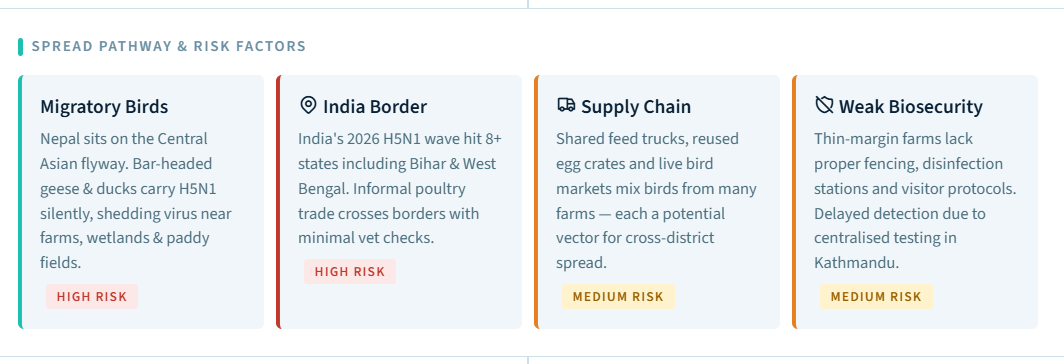
The 2022 outbreak reached 15 districts simultaneously, demonstrating how quickly the virus can saturate Nepal’s poultry belt once it gains momentum. With India simultaneously experiencing active H5N1 outbreaks in states bordering Nepal’s south and east, the risk of continued re-introduction from across the border remains very real throughout the outbreak season.
What are the key biosecurity failures that allowed this outbreak to spread so far?
The Department of Livestock Services, in its own analysis of the current outbreak, identified several contributing factors. Wild birds roosting in tall trees near farms were seen as a likely bridge between wildlife reservoirs and domestic flocks. Farms situated near wetlands and river banks provided regular opportunities for contact between migratory waterfowl and commercial poultry.
The unchecked movement of vehicles between farms, including those carrying feed, chicks, and equipment, allowed the virus to travel physically from one location to another. Visitors entering farm premises without following decontamination procedures added another transmission pathway.
Egg crates being reused and transported between farms without thorough disinfection have been identified in previous outbreaks as a particularly efficient vehicle for spreading the virus across long distances, since contaminated crates from an infected farm can introduce the pathogen directly into a healthy flock when the next batch of eggs is collected.
At the farm level, many operations, particularly smaller ones, lack the physical infrastructure to fully enforce biosecurity because the costs of proper fencing, disinfection stations, and protective equipment fall on individual farmers who often operate on thin margins.
What policy changes do experts say Nepal urgently needs?
The veterinary and public health research community has coalesced around several reforms it considers overdue.
The most immediate is strengthening farm-level biosecurity through government-funded support rather than leaving it entirely to individual farmers who may not be able to afford the necessary infrastructure. This includes subsidised biosecurity kits, regular training, and extension services that proactively reach farmers rather than waiting for farmers to seek out guidance.
On the detection side, experts argue that Nepal needs to decentralise its diagnostic capacity so that samples do not always have to travel to the Central Veterinary Laboratory in Kathmandu for confirmation. Faster district-level testing would dramatically reduce the window between an outbreak’s start and the government’s containment response.
There are also growing calls for regulated, veterinary-supervised cross-border trade with India to replace the current informal system, which allows infected birds and eggs to enter Nepal without inspection. On compensation, advocates have consistently pushed for a reformed system that covers birds killed by the disease, not just those destroyed by government teams, and that processes payments within weeks.
The idea of supervised vaccination pilots for layer hens and breeding stock, using vaccines that allow laboratories to distinguish between vaccinated and infected birds, has gained traction and is being cited as a medium-term solution that could reduce the scale of future losses.
What precautions should farmers, market workers, and ordinary people take right now?
For people who work directly with poultry, including farm workers, transporters, culling teams, and live market handlers, the risk of exposure is real and the precautions are straightforward but must be followed consistently. Gloves, masks, and eye protection should be worn when handling sick or dead birds.
Clothes worn on affected farms should be changed and washed before leaving. Hands must be washed thoroughly with soap after any contact with poultry or their environment. Anyone who develops fever, cough, or breathing difficulty after contact with sick birds should seek medical attention immediately and tell the doctor about the exposure so that the right tests are ordered.
For the general public, the message from health authorities is clear and evidence-based: properly cooked chicken and eggs are entirely safe to eat because the H5N1 virus is inactivated at normal cooking temperatures.
Avoiding live bird markets in outbreak areas, not handling sick or dead wild birds, and not purchasing poultry from farms without proper health certification are the key practical steps for ordinary consumers.
People should avoid buying birds from informal sellers in outbreak districts and should report unusual poultry deaths to local veterinary offices rather than attempting to dispose of dead birds themselves.
The virus remains primarily a disease of birds, and with sensible precautions, the risk to the general public remains low.