Kathmandu
Saturday, February 14, 2026





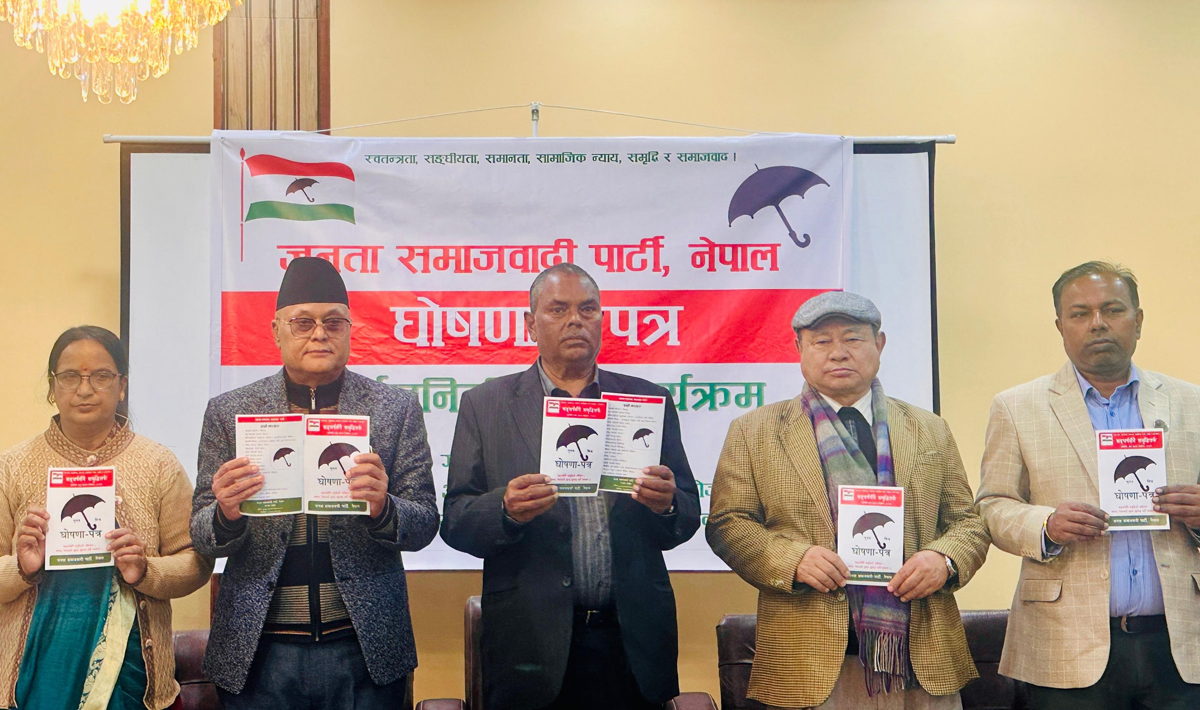
KATHMANDU: The Janata Samajbadi Party, Nepal (JSP-N) released its election manifesto under the slogan “Strong Federalism, Prosperity and Inclusive Development.” The document reiterates the party’s longstanding demands for identity-based federalism, constitutional amendments, and proportional inclusion while adding commitments on free healthcare and education, anti-corruption measures, cashless economy, and social justice
. It emphasizes scientific agricultural modernization, infrastructure expansion, industrial growth, and poverty reduction. The manifesto, aimed at projecting a people-centric and welfare-oriented agenda, sets out broad ambitions but offers limited detail on financing and implementation. Nepal News presents a detailed look at the Janata Samajbadi Party, Nepal’s election manifesto, breaking down its key commitments and priorities for voters.
What is the overall theme of the JSP-N manifesto?
The Janata Samajbadi Party, Nepal (JSP-N) has released a 27-point manifesto that reflects the party’s long-standing ideological pillars of freedom, equality, social justice, prosperity, and socialism. Constitutional reform is placed at the centre of its political vision, signalling the party’s focus on structural change as the foundation for addressing national issues. JSP-N manifesto arguing that the current constitution has not fully embraced the fundamental principles of inclusive and social democracy.
What is the party’s slogan and broader vision?
The party has adopted the slogan “Struggle Alongside Prosperity.” It envisions a state where the primary objective is to deliver quality services to citizens, emphasising just service delivery, equal opportunity, and transparent governance.
What does the party propose regarding the constitution?
JSP-N calls for either amending or completely rewriting the constitution to resolve what it describes as persistent national problems. The party presents constitutional change as a means to address political and social challenges, strengthen governance, and ensure equitable representation of diverse communities.
JSP-N proposes forming a high-level constitution review commission comprising constitutional experts. Amendments, revisions, or a complete rewrite would be based on the commission’s recommendations.
How does the manifesto address federalism and state restructuring?
The manifesto endorses state restructuring based on the 2068 High-Level State Restructuring Commission report. The manifesto pledges to establish an inclusive democratic governance system and build an egalitarian society through the implementation of its proposed programmes, aiming to actively engage citizens in nation-building.
Specifically, it supports the ‘10+1’ provincial model, which seeks to align provincial boundaries with national and ethnic identities. This approach reflects the party’s continued emphasis on identity-based governance and the demands of communities, particularly those highlighted during the Madhes movements. JSP-N pledges to implement federalism based on identity and capacity through constitutional amendment.
What social and economic priorities are included in the JSP-N manifesto?
The manifesto prioritises free health services, free education, corruption-free governance, scientific agricultural modernisation, infrastructure development, and social justice.
The JSP-N manifesto combines ambitious social programs with a strong economic agenda aimed at inclusive growth and structural transformation. Economically, the party emphasizes agriculture as the backbone of the national economy, promising scientific land-use planning, cooperative and mechanized farming, vertical farming, expanded irrigation, fertiliser supply, minimum support prices, crop insurance, and improved market access. It also envisions industrial expansion through domestic and foreign investment and proposes ration cards for the poorest households to manage inflation.
Infrastructure is a key priority, with plans to complete the Hulaki Highway, prioritize the East-West Railway, operationalize the Kathmandu-Nijgadh Fast Track within two years, and develop north-south economic corridors in Madhesh. Socially, the manifesto pledges free healthcare and education, expansion of social security, and inclusive policies for women, Dalits, gender and sexual minorities, persons with disabilities, and youth, alongside investments in sports facilities and skills development. However, financing, implementation timelines, and administrative capacity remain vague, reflecting past criticisms, and voters may judge the plan based on the party’s ability to deliver on prior unfulfilled commitments.
What are the anti-corruption priorities in the JSP-N manifesto?
The JSP-N manifesto positions anti-corruption as a central pillar of its policy framework, emphasizing structural and systemic reforms to enhance governance and economic efficiency. It proposes a zero-tolerance approach toward corruption, reinforced by the establishment of a Jan Lokpal tasked with scrutinizing the assets and financial conduct of prime ministers, ministers, lawmakers, and senior officials dating back to 1990. The manifesto also underscores the promotion of cashless transactions as a means to reduce opacity in financial flows, while ensuring restitution and justice for victims of cooperative fund misappropriation. By extending support measures such as free visas and travel arrangements for migrant workers, the party seeks to reduce transactional costs and curb opportunities for exploitation, aligning its anti-corruption objectives with broader economic and social inclusivity goals.
How does the JSP-N manifesto address youth concerns?
The manifesto explicitly targets ‘Gen Z’ and youth-led grievances, promising job creation, startup capital, skills training, and unemployment allowances until employment is secured.
The party pledges free and quality education, state responsibility for healthcare, and scholarships for the poorest students. It also includes technical and vocational training for marginalised Dalit and women communities.
JSP-N commits to social security for persons with physical and mental disabilities and guarantees legal and social protection for sexual and gender minorities.
What institutional reforms does the JSP-N manifesto propose?
The manifesto reiterates calls for a directly elected executive president and emphasizes proportional and inclusive representation in parliament. It proposes population-based constituency delimitation, reserved constituencies for Dalits and women, and proportional representation in the National Assembly according to provincial populations.
These proposals largely mirror earlier pledges from previous election cycles. They reflect continuity in the party’s agenda on inclusivity and representation but do not address why similar commitments failed to gain public trust, even when JSP-N controlled a provincial government for a full term from 2017 to 2022.
The repetition suggests a lack of reflection on past implementation gaps. Without analysis of previous shortcomings, the manifesto risks being perceived as a reiteration of unfulfilled promises rather than a realistic plan for institutional reform.
How does the JSP-N manifesto address climate change and environmental issues?
The JSPN’s manifesto includes commitments to climate change mitigation and environmental protection, reflecting a growing public concern over climate risks. It calls for the conservation of the Chure hills to prevent desertification in the Terai-Madhes region, alongside pledges for forest protection, green development, and pollution control.
The party promises to protect communities affected by climate change and commits to conserving biodiversity while promoting environmental sustainability. These environmental issues were less prominent in earlier JSP-N manifestos, indicating a shift to address rising public awareness of climate and disaster risks, particularly in the Tarai-Madhes region. The manifesto provides limited details on institutional responsibility, funding, or coordination across federal, provincial, and local governments, leaving questions about how these commitments would be operationalised.
What are JSP-N’s priorities in health and education?
The JSP-N manifesto frames health and education as strategic investments in human capital, emphasizing universal access and quality enhancement. It proposes the establishment of a super-specialty hospital and health sciences academy in each province, alongside well-equipped local hospitals, aiming to improve healthcare infrastructure and reduce regional disparities. Complementing this, the party commits to free healthcare services and comprehensive education from early childhood through university, reflecting a long-term vision to expand the productive capacity of the workforce, enhance social mobility, and strengthen inclusive economic growth.
What employment targets does the manifesto set?
The manifesto pledges to create five million (50 lakh) jobs over the next five years.