Kathmandu
Sunday, February 1, 2026





KATHMANDU: The sight of our national flag definitely fills us with a sense of pride and collective belonging as Nepalis. The world’s only national flag that is not rectangular, with its tricolor combination of crimson red, deep blue edges, and crowned with white moon and sun is truly unique. The national flag represents our unfragmented sovereignty and has helped unite the ethnically-diverse nation into one single race – Nepali. And for obvious reasons, this national emblem belongs to all Nepalis.
In recent times, however, political behavior across the spectrum has tried to prove otherwise – as if the national flag belonged to only certain political parties. Needless to say, widespread misuse of the national flag by them has brought about this situation. This misuse of the national flag by some political parties and actors, both old and new, has been a matter of great concern for some time now. The misuse by the so-called new ones, in an apparent bid to appear more nationalistic than the old parties, is perhaps even more alarming.
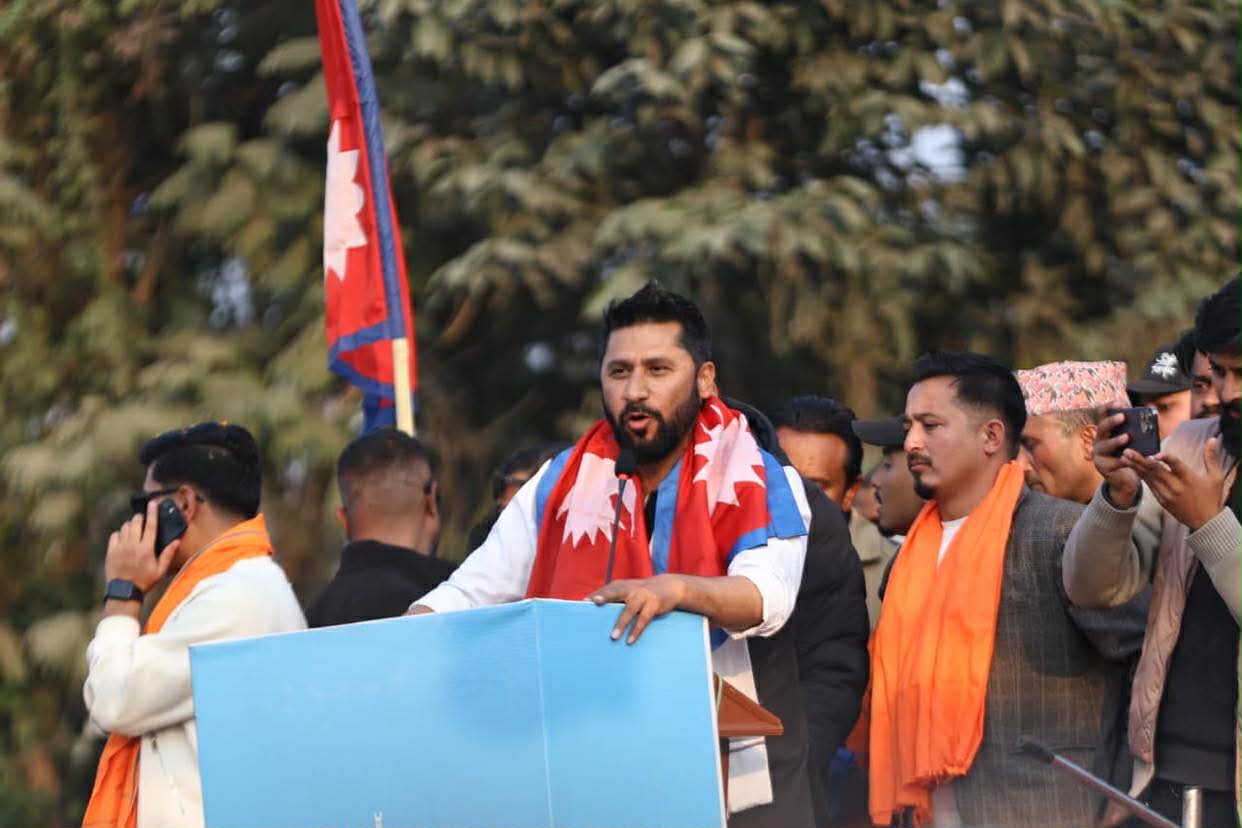
Rabi Lamichhane
The scene becomes definitely unsettling when political leaders and cadres shout angry and hateful slogans, vandalize and set fire to public and private property, while holding the national flag. The whole country saw this during the Gen Z revolt to such an extent that the widespread misuse cannot be brushed aside by the routine defense – “it was an act of infiltrators”. It is not difficult to understand that such political gimmicks and stunts organized under political banners are aimed at competing for attention.
However, all this raises a crucial question – what happens when a symbol meant to embody unity, sovereignty, and collective pride is pulled into the heat of partisan conflict and street confrontation?
The misuse of the national flag has increasingly drawn public concern, legal scrutiny, and sharp warnings. Constitutional experts such as Dr Bhimarjun Acharya have been quite vocal about this objectionable misuse of the national flag. They stand firm against the alarming increase in the worrying trend of misusing the national flag during protests, using it as a political prop in rallies, printing it on campaign materials, or displaying it in ways that violate both constitutional spirit and legal norms.
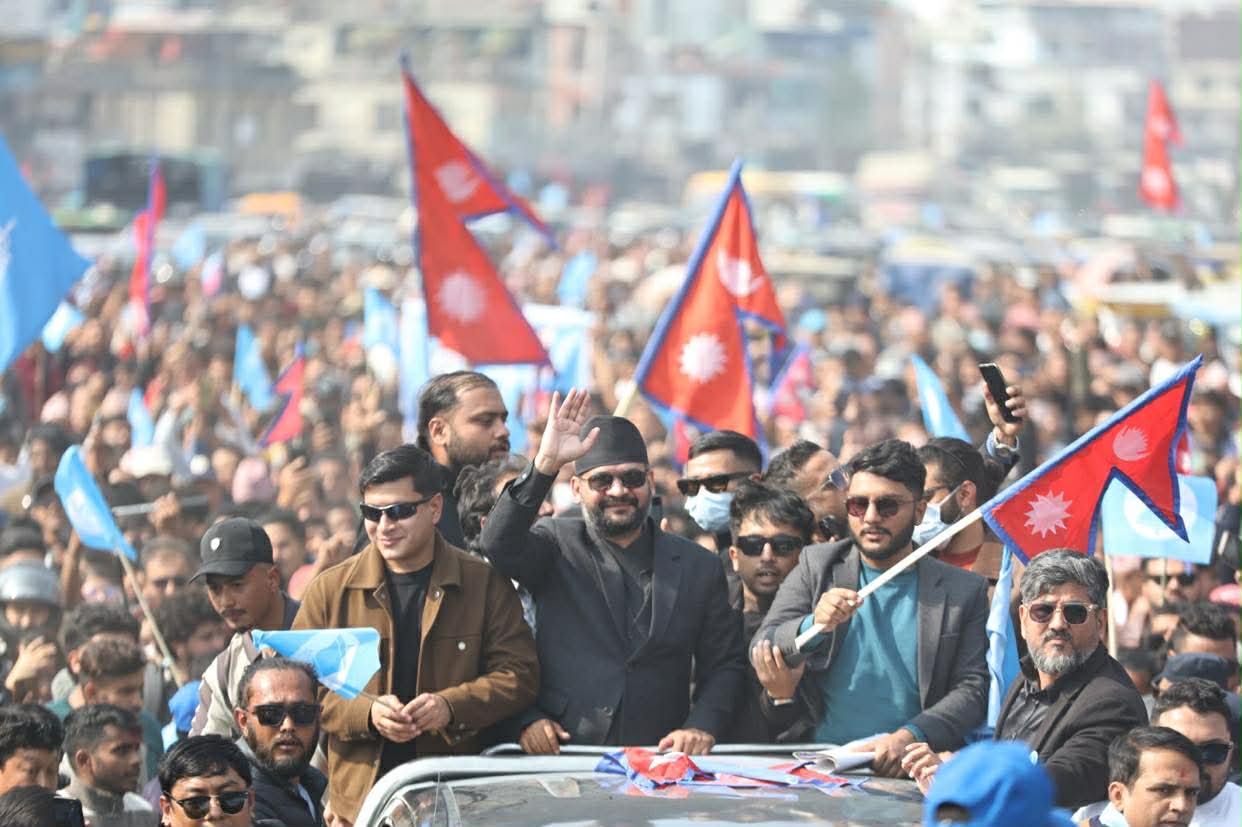
One of the most visible and most controversial forms of the misuse of Nepal’s national flag has been the growing practice of draping it around one’s shoulders like a shawl and participating in political protests, street demonstrations, and election campaigns. What was once a rare and solemn gesture reserved for moments of national mourning or honor has increasingly become a performative act of political signaling.
Wearing the flag as personal attire blurs the line between reverence and appropriation. It also transforms a constitutional symbol of the state into a costume of political assertion, besides stripping the flag of its dignity and reducing it to an accessory. Who tells those doing this knowingly or unknowingly that this behavior contradicts the very values the flag is meant to uphold?
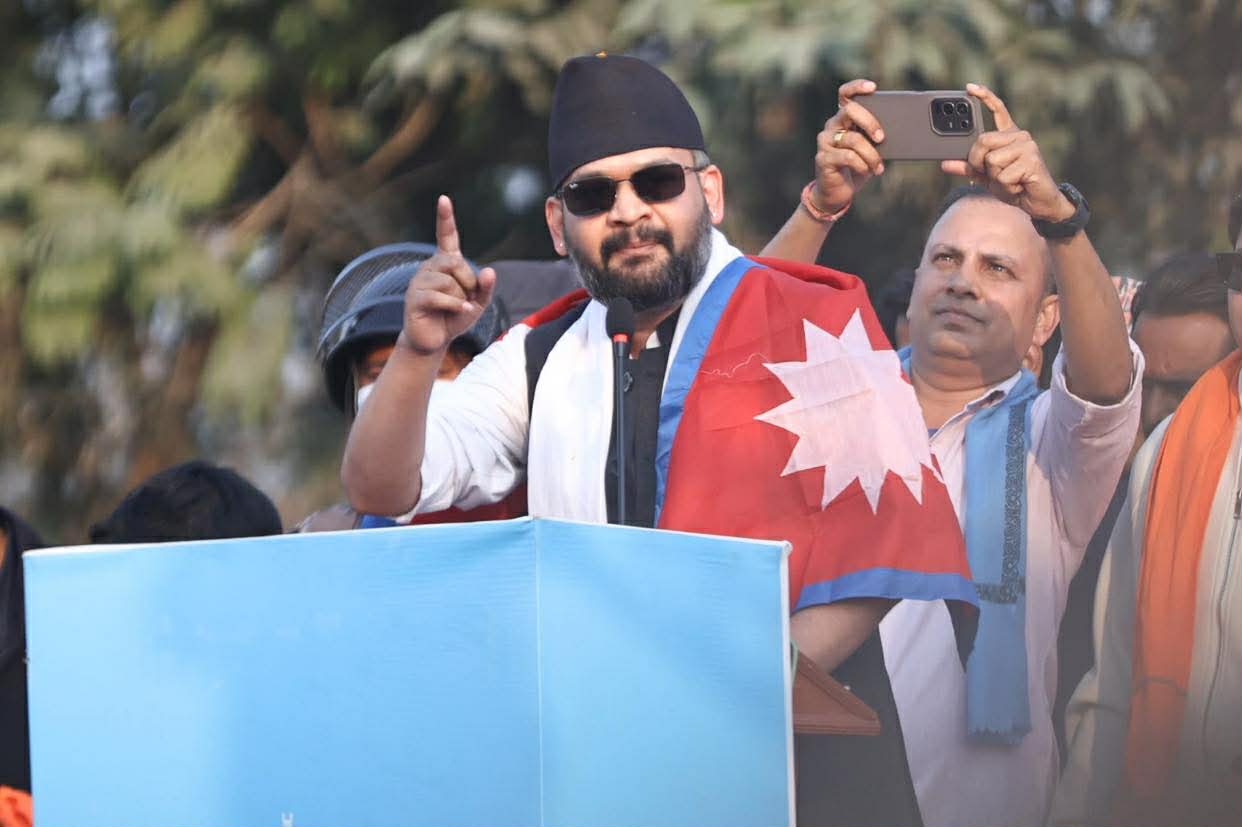
Balendra Shah
It is, however, clear that this trend is driven less by patriotism and more by competitive nationalism – an attempt to appear more loyal to the nation than one’s political rivals. In political rallies and campaign events, flag-draped shoulders have become a common sight, implying moral superiority – and that opposing views are somehow anti-national.
Such artificial displays are deeply objectionable for several reasons. One, they seek to monopolize national identity. Two, they weaponize state symbolism for partisan gain. Three, by equating political allegiance with ownership of the flag, they bear the risk of excluding dissenting citizens from the national community. Ultimately, they undermine the constitutional principle that the national flag belongs equally to all Nepalis, regardless of political belief.
From national symbol to political tool
Nepal’s national flag is unique in the world. It is the only non-rectangular national flag, made of two stacked pennants. Its design predates the modern Nepali state. The flag has been in prominent use especially since the era of Great King Prithvi Narayan Shah, who unified modern Nepal. Although the flag was slightly different in its earlier form, with the moon and sun given human face, it evolved through time. It was finally formally standardized in the Constitution of Nepal 1962, during the rule of King Mahendra. That constitutional formalization of the flag was reaffirmed, with precisely defined geometric specifications, in Schedule 1 of the Constitution of Nepal 2015.
In modern interpretations of the national flag, the crimson red symbolizes bravery and sacrifice. The blue border represents peace. The moon signifies serenity and the cool climate of the Himalayas. And the sun symbolizes determination and the southern plains. Together, they express the belief that Nepal will continue to exist as long as these celestial bodies exist.
Our national flag is not just any piece of cloth. History bears testimony to the fact that our Nepali flag has been flown in the thick of war, in the midst of political movements, and in the throes of national tragedies. More importantly, it is the flag of a nation that was never conquered.
It is precisely because of this glorious history that recent trends have caused disquiet among scholars, lawyers, and policymakers.
Recent years in Nepal have witnessed an increase in the loudness of the public sphere. Protests have become the order of the day, political mobilization an almost everyday feature, and symbolism an aggressive trend. Amid all this, the national flag has increasingly appeared in contexts that are objectionable.
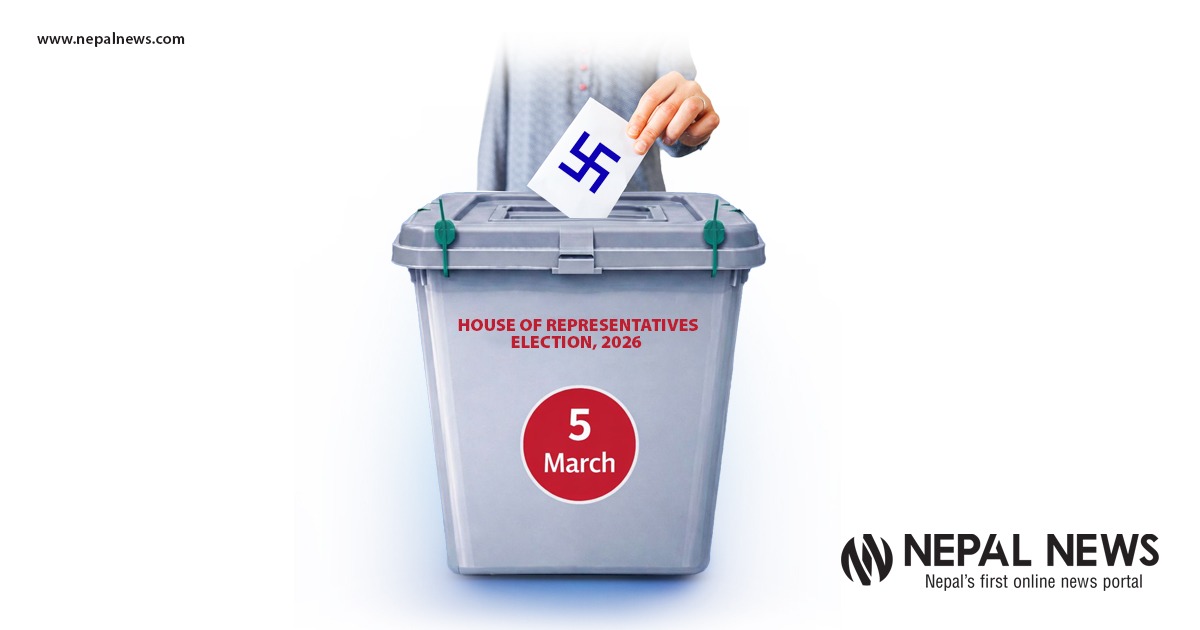
At street demonstrations these days it has become customary to wave national flags alongside party flags. This clearly blurs the line between the state and partisan interests. Unfortunately, this trend has found continuity in the campaigns of the political parties in the build-up to the elections slated for March 5. Pictures of the national flag have been seen in the campaigns and on social media, and in some instances, at the scenes of arson, vandalism, and confrontations with security forces.
The defenders of the rule of law posit that these acts could change the national flag from a symbol of national unity to a political tool for contest.
“Using the national flag to legitimize unlawful acts or partisan agendas devalues constitutional order. When the flag is carried into acts that violate the law, it sends a dangerous message that the state endorses, or is complicit in, those actions,” warns Dr Bhimarjun Acharya, a well-respected constitutional expert and commentator, in one of his media interviews.
Why misuse matters
Nepal is still marred by economic hardship, corruption, governance failure, and political instability. So, some people may find these concerns over the national flag use overly symbolic. But perhaps symbolism matters, especially in constitutional democracies.
Nepal’s national flag is clearly defined as a symbol of the Nepali state in the country’s Constitution itself. The Constitution does not mention every prohibited use, but it establishes the national flag as belonging to all citizens equally, not to any political group, movement, or ideology. But it seems today certain parties have issued orders to their cadres to use the national flag in ways that would mean as if it belonged to them only.
Such misuse of the national flag trivializes the sacrifices associated with it. Thousands of Nepalis have given away their lives — in wars, political struggles, and peacekeeping missions abroad – to earn respect for their national flag. To see the same symbol waved amid destruction or intimidation must strike one as a profound disrespect.
Nepal’s is one of the very rare national flags that finds a place in the country’s constitution itself. Nepal’s legal framework provides guidance – if not always enforcement clarity – on the proper use of the national flag.
Besides the Constitution, there are various laws and regulations which address public order, state symbols, and electoral conduct. The Election Commission has time and again cautioned political parties against misusing national symbols, including the national flag, in a bid to mislead voters or suggest official endorsement of their political campaigns.
The National Penal Code contains provisions related to acts that may insult or undermine national symbols. It’s a different story altogether that enforcement has historically been rare and selective. This gap between legal principle and practice has fueled further misuse.
It appears that, at its core, the debate over flag misuse reflects a deeper challenge – the state of Nepal’s civic culture.
For the time being, given the state’s failure to control the misuse effectively, one can find some solace in the argument that Nepal is not a country with long democratic traditions and that it is naive to expect a separation between state symbols and political movements ingrained in society. That the Nepali state itself has undergone radical transformation in a comparatively short period of time, and that ‘separation’ is still being negotiated.
Disrespecting the national flag is tantamount to disrespecting the law of the land. Taking the national flag as just another banner that can be waved at any event, good or bad, weakens the authority of the constitutional order.
The emphasis on the proper use of the national flag should not be taken as a restriction on expression. It should be taken as an attempt made at preserving the meaning and upholding the value of the national flag.
Nepal today clearly stands at a critical juncture in its journey as a sovereign, independent nation. Its institutions are still evolving, its political culture still gaining shape. It is understandable that symbols matter more, not less, in such situations.
However, we must remember the national flag as a reminder that despite the party lines, political divisions, street protests and demonstrations, and election rallies, there is a symbol of unity. The misuse of this symbol is not merely the violation of a rule but the weakening of a fragile consensus on what the Nepali state stands for.
Through a notice issued recently, the Ministry of Home Affairs has once again reminded everyone of the proper use of the national flag. The notice stated clearly how the flag is to be displayed, where it is to be placed, and how it is not to be altered or defaced. Although like previous such reminders, this one too has come after the eruption of controversies, this must be heeded by everyone.
One does not become a patriot simply by holding the national flag or draping it around one’s shoulders. In fact, without matching words and actions, such gimmicks become no more than political theatrics. Therefore, it’s high time we reaffirmed the collective understanding that some symbols belong to everyone and therefore must be protected, preserved and properly used by all.