Kathmandu
Sunday, February 15, 2026





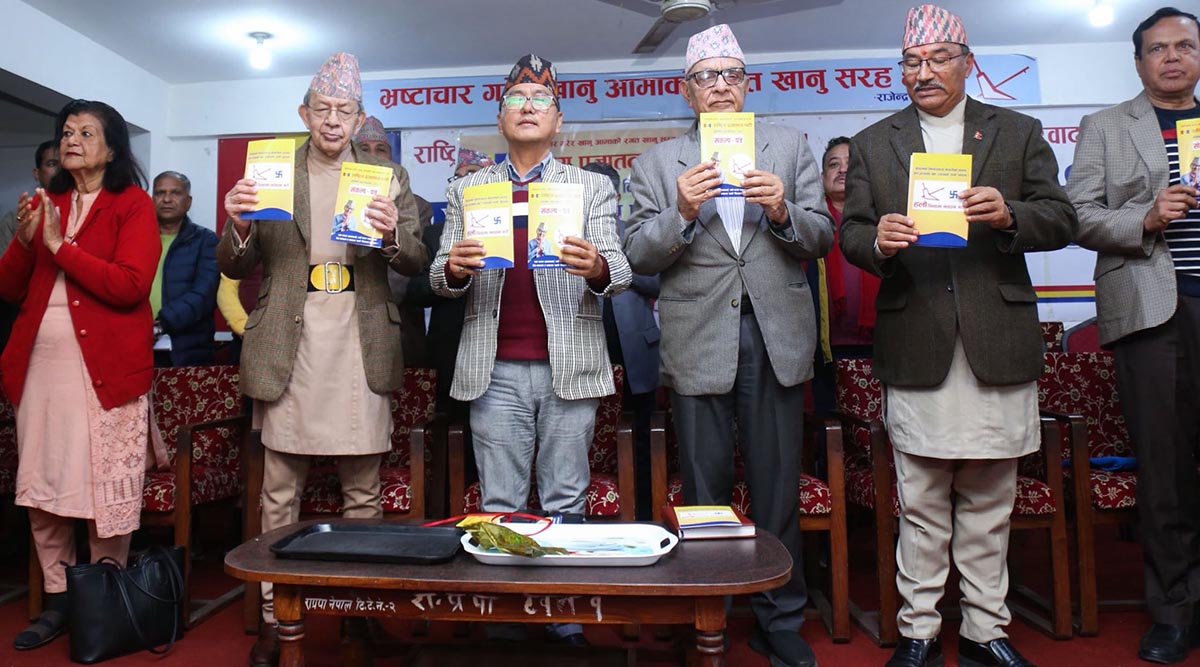
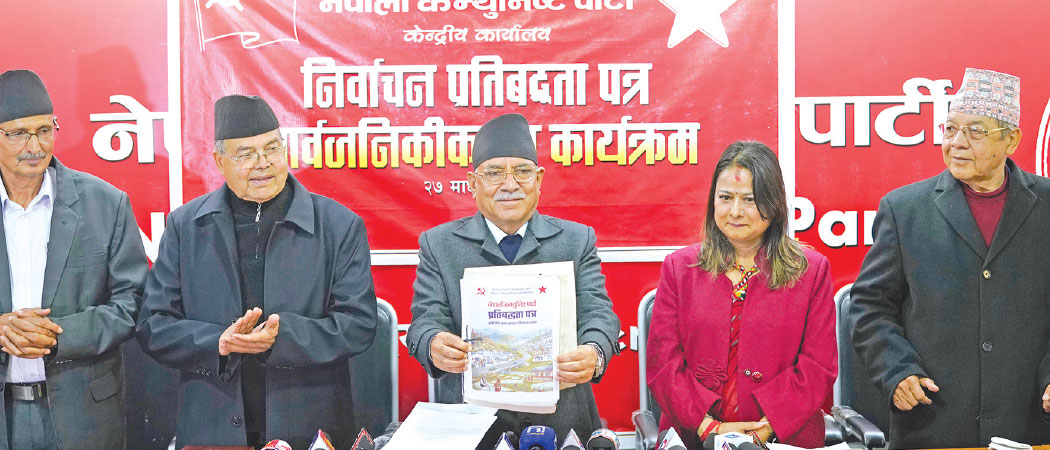
KATHMANDU: The Rastriya Prajatantra Party (RPP) has rolled out its 24-page election manifesto in preparation for the upcoming House of Representatives polls on March 5.
The manifesto emphasizes political stability, good governance, economic reforms, and social justice as the pillars of national prosperity. It highlights initiatives in capital formation, sustainable development, education, health care, social security, and youth-focused job creation, alongside proposals for poverty alleviation, technological advancement, infrastructure expansion, and urban planning.
RPP underscores its commitment to national independence, unity, sovereignty, and the protection of Nepal’s natural, religious, and cultural heritage, while aiming to contribute 82% to GDP and 77% to capital formation through sectors like water resources, tourism, agriculture, and IT. The manifesto also pledges to promote a Hindu nation guided by Vedic Sanatan Dharma under a two-tier governance model.
Nepal News has closely examined the full 24-page manifesto to provide insights into the party’s electoral vision.
What kind of state structure, governance system does the Rastriya Prajatantra Party (RPP) propose in its manifesto?
In its election manifesto, the Rastriya Prajatantra Party (RPP) outlines a fundamental restructuring of Nepal’s state system. RPP proposes a monarchy-based constitutional system, major reforms in the electoral and public expenditure systems, and a two-tier governance structure without provinces. The party supports a Hindu state based on traditional values while guaranteeing equal religious freedom and rights for all faiths. It also emphasises stronger and more autonomous local governments.
The party proposes restoring the monarchy as a guardian institution, arguing that the king would serve as a unifying national symbol rather than an executive authority. Alongside this, RPP calls for the abolition of the provincial structure introduced under federalism and advocates a two-tier governance model with a strong central government and empowered local governments.
The manifesto also introduces the idea of non-partisan local governments, asserting that local bodies should prioritise service delivery and development over party politics. This overall framework is described as Nepal’s original governance destination under the concept of Prithvi Path, which envisions a return to a monarchy-inclusive system combined with administrative simplification and stronger local governance.
What change has RPP made to its stance on the system of governance?
In its newly released election manifesto, the Rastriya Prajatantra Party (RPP) has revised its earlier position on the structure of governance. Unlike in previous elections, the party has dropped its long-standing demand for a directly elected prime minister. In earlier manifestos, RPP had consistently advocated a governance model combining a directly elected prime minister with a guardian monarchy. However, the latest “commitment paper” made public on Saturday is silent on the issue of a directly elected prime minister, signalling a noticeable shift or softening in the party’s approach to executive power and institutional design.
What economic transformation model does the RPP propose in its election manifesto?
The Rastriya Prajatantra Party has framed its economic agenda around a six-pillar model that it describes as the backbone of Nepal’s long-term prosperity, presented under the Prithvi Path roadmap. The strategy seeks to shift Nepal from a remittance-dependent economy toward domestic production, investment and energy-led growth.
At its core is hydropower and energy, with the party proposing to declare the next decade an “energy production decade” and targeting 28,500 MW of electricity generation by 2035. The vision is to make Nepal a fully green-energy economy, expand cross-border power trade with India, Bangladesh and China, provide free electricity to households below the poverty line, and replace cooking gas with electricity to raise domestic demand and reduce imports.
Tourism forms the second pillar, with a push to brand Nepal as an international centre for yoga, meditation and Ayurveda, alongside religious, adventure and nature tourism. The party links tourism growth to improved aviation safety and the goal of removing Nepal from the EU aviation blacklist.
Agriculture is positioned as the third pillar, with promises of fertiliser factories, compulsory crop insurance, direct subsidies and market guarantees to achieve self-sufficiency in food grains, vegetables and fruits, while restoring farming as a viable and dignified livelihood.
The fourth pillar combines information technology and governance reform. IT would be elevated to a national priority industry, with policies aimed at reversing brain drain, introducing AI and coding from school level, and promoting “earn while you learn” models to link education with employment.
The fifth pillar focuses on mobilising the Nepali diaspora by integrating overseas skills and capital into national development, including commitments on citizenship continuity and voting rights.
Finally, the private sector is cast as the main driver of growth under an “Economic Reform 3.0” agenda, promising reduced political interference, an end to trade-union syndicates, one-stop service delivery and incentives for industries based on domestic raw materials. Taken together, the party argues, these six pillars would enable a structural shift toward sustained growth, higher productivity and economic sovereignty.
The Rastriya Prajatantra Party has pledged to permanently renounce Nepal Bandh—the practice of nationwide strikes—describing it as economically and socially damaging. RPP arguing that repeated shutdowns have undermined economic growth and disrupted everyday life. The manifesto states that, in view of these adverse impacts, the party will never resort to such actions. It also proposes a complete ban on strikes in essential services and key sectors, including healthcare, aviation, drinking water, electricity, gas, petroleum supply and distribution, as well as other critical industrial activities.
What does the Rastriya Prajatantra Party (RPP) propose for education?
RPP’s manifesto promises to depoliticise the education sector by ending political interference, trade unions and partisan appointments in schools and universities. Tribhuvan University will be developed as a national Centre of Excellence, while independent Boards of Trustees will appoint vice-chancellors and senior officials in universities. Education up to Grade 12 in public schools will be free, computer education will be mandatory at all levels, and technical and vocational education will be expanded nationwide through a dedicated TVET Fund. The party also pledges to promote “earn while you learn” programmes, local-language education at the basic level, and reduce the quality gap between public and private schools.
What are RPP’s commitments in health care?
RPP commits to free and compulsory basic healthcare services for all citizens. No patient will be denied treatment due to lack of money, and hospital deposits will be abolished for basic care. Senior citizens and persons with disabilities will receive basic health services at their doorstep. The party plans to expand health insurance coverage so insured citizens can receive treatment at hospitals of their choice, while reforming the system to ensure timely payments. Drug price regulation will be strengthened to make medicines affordable and accessible.
How does RPP plan to address employment and skills development?
RPP links employment generation to technical education, entrepreneurship and private sector growth. The manifesto prioritises nationwide access to vocational and technical training, short- and medium-term skills programmes for unemployed youth, and practical education connected to work. Students will be allowed to work part-time, during vacations or full-time while studying. The party aims to create large-scale domestic employment and reduce forced foreign migration.
What governance and anti-corruption reforms does RPP promise?
RPP pledges strict anti-corruption measures, including the formation of a high-level citizens’ commission to investigate and confiscate illegally acquired assets of political leaders and senior officials since 1991. The manifesto promises whistleblower protection, conflict-of-interest laws, an end to political interference in constitutional bodies, reforms in asset recovery mechanisms, and restructuring of the judiciary to restore credibility and public trust.