Kathmandu
Tuesday, February 17, 2026





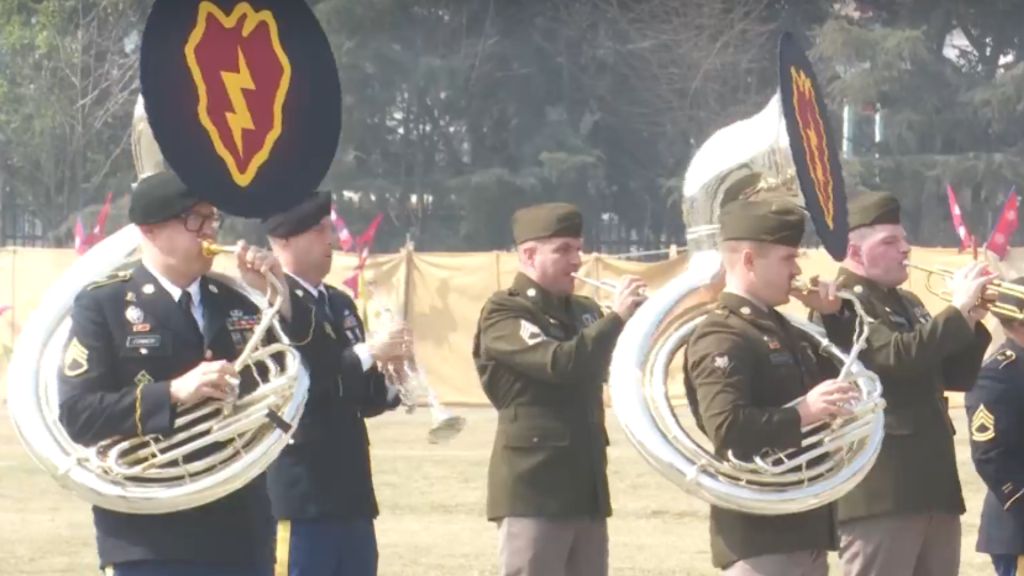
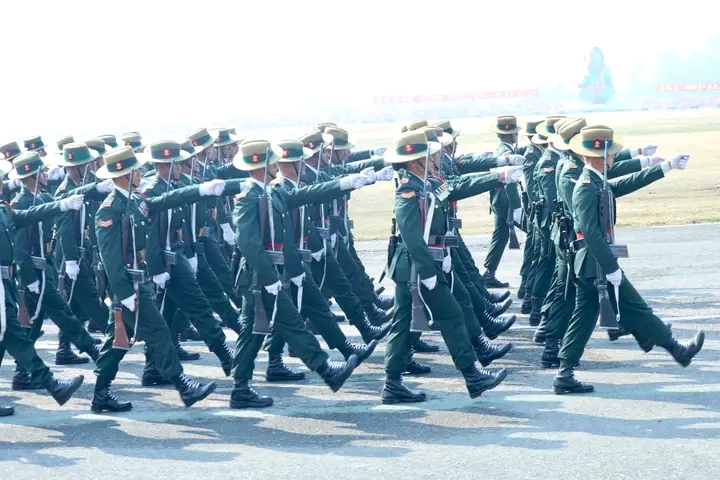
KATHMANDU: As Nepal marked its 263rd Army Day alongside the Hindu festival of Maha Shivaratri, the Nepali Army (NA) showcased feu-de-joie and skill demonstrations at Tundikhel, with army bands from friendly nations participated in a tradition of ceremonial diplomacy.
A performance by a United States Army band at Tundikhel went viral on social media ahead of Nepal’s elections, sparking debate and the circulation of misleading claims. Hardline political factions attempted to frame the event as foreign interference.
The NA’s Public Relations and Information Directorate clarified that such performances are a long-standing tradition aimed at strengthening ties among friendly militaries, routine and reciprocal ceremonial exchange. Demonstrations by units from the United States, the United Kingdom, and India are common practice and symbolize friendship, cooperation, and professional exchange rather than any intervention. Nepal News Fact Check Desk unpacks the rumors, the background of U.S.-Nepal military cooperation, areas of collaboration, contextual details, and the essential facts you need to know.
Why did a photo of a U.S. Army band at Tundikhel go viral, and what was the official response?
A photograph circulating on social media appeared to show the United States Army staging a parade at Tundikhel in Kathmandu.
Photos and videos circulating on social media claim that the U.S. Army held a parade at Tundikhel, Kathmandu, sparking speculation and controversy-especially as Nepal approaches parliamentary elections.
The image went viral just weeks before Nepal’s parliamentary elections and around the time of Nepal’s Army Day and the Hindu festival of Maha Shivaratri, prompting public debate and speculation about foreign military presence & interfrance. In response, the Nepali Army Headquarters urged the public not to be misled, explaining that the event was a routine and reciprocal ceremonial exchange between friendly militaries.
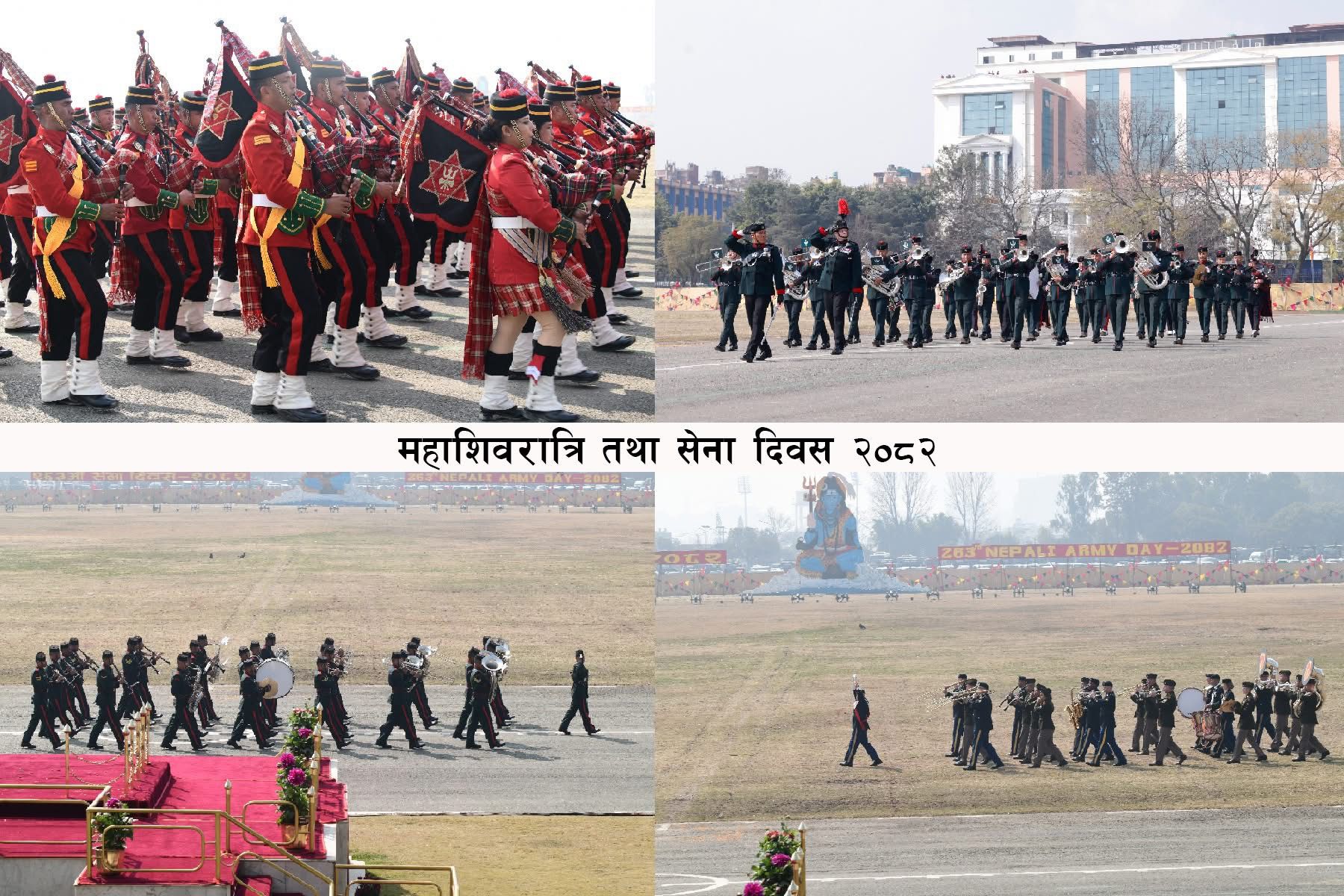
Brigadier General Rajaram Basnet told Nepal News that foreign military bands regularly participate in Nepal’s Army Day ceremonies as a gesture of friendship and that Nepal similarly sends its own military bands abroad. He cited a recent example in which a Nepali band took part in India’s Army Day celebrations. He emphasized that such participation, along with joint exercises and army-to-army programs, is a regular and long-established process.
What actually happened at Tundikhel?
The event was part of Nepal Army Day celebrations, which coincide with Mahashivaratri. A U.S. Army band performed as a friendly participant, following long-standing military traditions and diplomatic practices. According to the Nepal Army Headquarters, inviting military bands from friendly nations is a regular practice during Army Day. Nepal also sends its own military bands to similar ceremonies abroad. The viral videos claim that the U.S. Army “paraded” in Nepal as a form of intervention is misinformation.
The event was a routine ceremonial performance by a friendly nation’s military band, consistent with decades-old diplomatic and military traditions.
Why did a foreign army perform during Nepal Army Day?
The participation of foreign military bands during Nepal Army Day is not a sudden or unusual development but part of a long-established ceremonial and diplomatic tradition. Army Day in Nepal has historically been observed not only as a military anniversary of the Nepali Army, but also as a platform to reflect friendship, mutual respect, and defense diplomacy with friendly nations.
For decades, Nepal has routinely invited military bands from partner countries to take part in Army Day celebrations held at the Army Pavilion in Tundikhel, alongside performances by the Nepali Army’s own band. These events are symbolic in nature and are meant to showcase goodwill, cultural exchange, and long-standing military-to-military relationships rather than operational or strategic military activities.
In this context, the presence of a foreign military band—whether from the United States, India, or the United Kingdom—does not signify foreign military deployment or activity inside Nepal. Instead, it represents ceremonial cooperation and diplomatic engagement, practices that are common across armies worldwide.
Foreign military bands participate in Nepal Army Day as part of reciprocal military relations and goodwill exchanges. During celebrations such as Mahashivaratri and Army Day 2082, the program included military arts and musical performances by the Nepali Army as well as bands from friendly countries, including India, Britain, and the United States. However, public debate emerged after attention focused narrowly on the participation of the U.S. Army band, leading to speculation and misleading interpretations.
Nepal’s military engagement is not one-sided. The Nepali Army regularly sends its own military bands and contingents to Army Day ceremonies, joint exercises, and international military events in other countries as part of standard army-to-army cooperation. Such exchanges are a normal feature of defense diplomacy and have been ongoing for years.
Viewed in this broader context, foreign military band participation during Nepal Army Day is a continuation of established tradition rather than a departure from it, reflecting Nepal’s ongoing efforts to maintain balanced and friendly relations with multiple countries through ceremonial and cultural military engagement.
Were other foreign armies also involved in the Army Day program?
Yes. According to the official clarification issued by Nepal Army Headquarters, the Army Day celebration included musical performances not only by the U.S. Army band but also by military bands from India and the United Kingdom, in addition to the Nepali Army band. This fact is significant because it demonstrates that the event was multinational in nature and consistent with past practices.
However, public debate and criticism remained largely centered on the U.S. Army alone. Military analysts suggest this selective reaction reflects Nepal’s sensitivity to global power politics rather than any procedural irregularity in the event itself.
Does this kind of foreign military participation threaten Nepal’s sovereignty?
No, From an institutional and military perspective, such participation does not undermine Nepal’s sovereignty. Sovereignty concerns typically arise when foreign forces operate independently, conduct military operations or exercises without consent, or establish a permanent presence without any approval. In this case, the foreign military personnel were invited guests participating in a ceremonial program organized, invited and controlled by the Nepali Army.
Former senior military officials have emphasized that these events fall squarely within the framework of defense diplomacy, where symbolic gestures-such as band performances-are used to strengthen relationships rather than project power. Seen this way, the event represents Nepal exercising its sovereign right to engage with friendly nations on its own terms.
Has this happened before under previous governments?
Yes, repeatedly. Foreign military participation in Nepali Army Day celebrations is well-documented. In recent years, military bands from India, the United Kingdom, and the United States have taken part in similar programs. Notably, during an earlier Army Day celebration when KP Sharma Oli, Pushpa Kamal Dahal ‘Prachanda’ and Sher Bahadur Deuba were prime minister, foreign military bands—including those from the same countries—performed at Tundikhel without triggering comparable controversy. This continuity suggests that the current debate is not rooted in a change of practice, but rather in a change of political interpretation and timing.
Where did communication fall short in the Nepal Army Day controversy?
The Army Day event itself followed a long-standing and routine practice, many believe the controversy could have been significantly reduced through clearer and earlier public communication by the Nepali Army. In Nepal’s current political environment-where issues of sovereignty, foreign influence, and national identity are especially sensitive-even symbolic military events can easily be misinterpreted if they are not properly explained in advance.
The Army Day celebration included ceremonial and musical performances by military bands from multiple friendly nations, a practice that has been repeated consistently over the years. Similar foreign military participation took place during Army Day celebrations in 2020, 2021, 2022, 2023, and 2024 without triggering widespread public debate. However, in this instance, the absence of proactive communication allowed speculation to grow, particularly after attention focused narrowly on the participation of the U.S. Army band.
Defense diplomacy involves cooperation between armed forces through joint exercises, ceremonial events, training programs, and exchange initiatives, all aimed at building trust and professional relationships rather than signaling strategic alignment or foreign intervention. When such routine diplomatic practices are not clearly communicated, they risk being perceived through a political or geopolitical lens, especially during periods of heightened public scrutiny.
In this case, earlier clarification-explaining who was invited, why the invitations were extended, and how such participation fits into established military tradition-could have helped the public better understand the purpose of the event. Instead, delayed explanations created space for misunderstanding, allowing broader anxieties related to geopolitics, electoral politics, and national identity to shape the narrative.
Ultimately, the controversy highlights not a departure from past military practice, but the growing importance of transparency and public engagement. As Nepal navigates an increasingly complex political and geopolitical landscape, analysts argue that clear, timely communication by state institutions is essential to ensure that routine diplomatic activities are understood in their proper context and do not become sources of unnecessary controversy.
Why did the event become politically controversial ahead of the elections?
With just over two weeks remaining before Nepal’s general elections, the appearance of an American military band became a topic of partisan debate. Some political actors claimed that Western powers were supporting a recent Gen Z–led protest movement and portrayed the band performance as part of a broader pattern of foreign influence. Government and military officials strongly rejected these claims, warning against the spread of misinformation and stressing that the event was consistent with past practice. Officials noted that similar military engagements and ceremonial exchanges occurred during the tenures of former prime ministers K.P. Sharma Oli, Pushpa Kamal Dahal, and Sher Bahadur Deuba. They urged political groups not to turn routine military cooperation into an election issue and reiterated that Nepal regularly conducts joint military exercises and exchanges with countries such as India, China, the United States, Britain, and Pakistan, both inside Nepal and abroad.
What role did social media play in spreading the claim?
Social media posts often shared the videos without context or paired them with unrelated political speeches, which led many users to believe the event was connected to foreign political influence or national security threats.
What did Nepal News Fact Check Desk find after investigating the claim about the U.S. Army parade?
Nepal News Fact Check Desk confirmed that the practice of inviting military bands from friendly nations during Nepal Army Day is a long-standing tradition. After a thorough investigation, it was found that claims suggesting foreign military entry or intervention in Nepal were entirely false. Specifically, the claim that the U.S. Army conducted a parade in Nepal as an act of intervention is untrue. The event in question was a routine ceremonial performance by a friendly nation’s military band, fully consistent with Nepal’s established military and diplomatic practices.
What is the United States Army band?
The United States Army Band, known as “Pershing’s Own,” is the premier musical ensemble of the U.S. Army, founded in 1922 by General John J. Pershing. Comprising seven ensembles-including the Concert Band, Ceremonial Band, Chorus, Army Blues, and Downrange-the band performs at national ceremonies, international events, and military morale programs, but it is purely a musical and ceremonial unit, not a combat force. Over the decades, it has played at historic moments such as President Kennedy’s funeral, the U.S. Bicentennial, and multiple Olympic Games, toured internationally, and collaborated with renowned musicians and entertainers. Headquartered at Fort Myer in Virginia, the band continues to host training workshops and uphold a tradition of ceremonial excellence, diplomacy, and goodwill around the world.
Does Nepal conduct military cooperation only with the United States?
No, Nepal conducts joint military exercises and cooperation programs with multiple countries, including India, China, the United Kingdom, Pakistan, and others, both inside Nepal and abroad. Many Nepali Army officers have studied at staff colleges in the United States, and similarly, foreign military personnel also visit Nepal for training programs and joint activities.
What is the history and purpose of U.S.–Nepal military cooperation?
The United States and Nepal have maintained military-to-military cooperation for several decades, with formal ties dating back to 1947. This cooperation has focused on practical, non-combat areas such as humanitarian assistance, disaster response, training exchanges, and professional military education. Over the years, Nepal has benefited from U.S. support during major crises, including humanitarian assistance following the devastating 2015 earthquakes and more than 7.5 million dollars in COVID-19–related assistance during the pandemic. The cooperation also includes regular training programs and exchanges between the U.S. military and the Nepali Army, aimed at improving disaster preparedness, peacekeeping capacity, and emergency response while respecting Nepal’s sovereignty and leadership.
How does recent U.S. military assistance support Nepal’s disaster response and humanitarian capacity?
Recent U.S.–Nepal military cooperation has focused strongly on humanitarian assistance, disaster response, and resilience building. On September 4, 2025, the United States handed over two new M28 Skytruck aircraft to the Nepali Army under a 37-million-dollar Foreign Military Financing grant, significantly enhancing Nepal’s airlift and emergency response capabilities. With these aircraft, Nepal’s Skytruck fleet now totals five, including two provided by the United States in 2019 and one purchased directly by Nepal. One of the aircraft delivered in 2025 is configured as an air ambulance, enabling rapid medical evacuations and stretcher transport during emergencies. Nepali Army pilots and ground crews will receive specialized training in Europe and Nepal to ensure effective operation and maintenance.
Officials from both countries emphasized that the aircraft are critical tools for disaster relief, medical evacuations, and humanitarian missions, particularly in Nepal’s remote and mountainous terrain.
What kinds of military training and disaster-response activities do the U.S. and Nepal conduct together?
The U.S. military regularly conducts humanitarian assistance and disaster relief training and exercises with the Nepali Army and other Nepali security institutions. These activities include engagements at the Birendra Peace Operations Training Center, cooperation with the Explosive Ordnance Disposal Holding Unit, and disaster-response training with the Armed Police Force through its Disaster Management Training School. One prominent example is the Disaster Response Exercise and Exchange, a biannual exercise that focuses on how the Government of Nepal, the Nepali Army, partner nations, international organizations, private-sector actors, and non-governmental organizations can work together effectively during disasters. These exercises are designed to improve coordination during emergencies and to ensure faster, more organized responses when natural disasters strike.
What form does U.S. military support for Nepal take today?
In the post-insurgency period, the United States has continued to maintain a steady and cooperative military relationship with Nepal, focusing on professionalization, peacekeeping, disaster response, and democratic civil-military relations. Support has continued through programs such as International Military Education and Training, Foreign Military Financing, and the Global Peace Operations Initiative, which funds training and assistance for Nepalese peacekeepers. The U.S. has also provided equipment, including armored vehicles for Nepal Army personnel deployed in United Nations missions, and expanded disaster risk reduction programs involving the Nepal Army and Nepal Police. These initiatives emphasize rescue training, risk awareness, and emergency preparedness, particularly in response to earthquakes and floods. U.S. supported stronger civilian oversight of the military and democratic governance, reflecting a long-term partnership centered on stability, resilience, and professional military conduct.
How did military relations between Nepal and the United States begin and evolve?
Military relations between Nepal and the United States have developed gradually over several decades, beginning with education, training, and humanitarian cooperation. Under U.S.-supported education and training programs, around 600 Nepal Army personnel have received formal military training. One of the earliest major instances of cooperation occurred during the July 1993 floods in Nepal, when the United States supported the Nepal Army’s disaster response efforts. While formal defense diplomacy continued routinely, bilateral military ties deepened significantly during the Maoist insurgency from 1996 to 2006, a period when Nepal faced severe internal security challenges and the United States had intensified its counterterrorism engagement in South Asia following the 2001 September 11 terrorist attacks.
During the Maoist insurgency, the United States emerged as one of Nepal’s most engaged external military partners. The U.S. Indo-Pacific Command dispatched a special assessment team to Nepal to evaluate the Nepal Army’s operational needs and combat structure, offering recommendations to strengthen counter-insurgency capabilities. In January 2002, then U.S. Secretary of State Colin Powell visited Nepal at the height of the conflict, marking the first such visit in 54 years of bilateral relations. He traveled directly from the airport to Nepal Army Headquarters to discuss support, receiving a rare Guard of Honor exception than head of state or government. The visit underscored strong U.S. backing for the Nepali Army during one of the most difficult periods in the country’s modern history.
How did military cooperation translate into operational and structural support?
After Maoist guerrillas launched their first major attack on Nepal Army barracks in Dang in November 2001, the United States was the first foreign country to express immediate concern and assurance of support. According to senior retired Nepal Army officials, U.S. Pacific Command promptly initiated assessment missions to assist Nepal’s combat operations. During this period, the U.S. Embassy in Kathmandu maintained extensive contact with Nepal’s top military and security leadership, particularly after Maoist attacks targeted American interests, including the killing of two embassy guards in 2001 and the bombing of the American Center in 2004. U.S. support extended to advising on a unified command structure that coordinated the Nepal Army, Armed Police Force, Nepal Police, and intelligence agencies. This cooperation included training, command reforms, the creation of rapid-response units, and facilitation of modern equipment procurement, including the purchase of modern M16 rifles to replace outdated weapons.
Following the signing of the Comprehensive Peace Agreement in November 2006, the United States adopted a careful and balanced approach toward Nepal, supporting peace, reconciliation, and the professional integrity of the Nepali Army.