Kathmandu
Wednesday, January 28, 2026





The practice of awarding 100 percent marks to all civil servants in their performance appraisals is making a mockery of the evaluation system
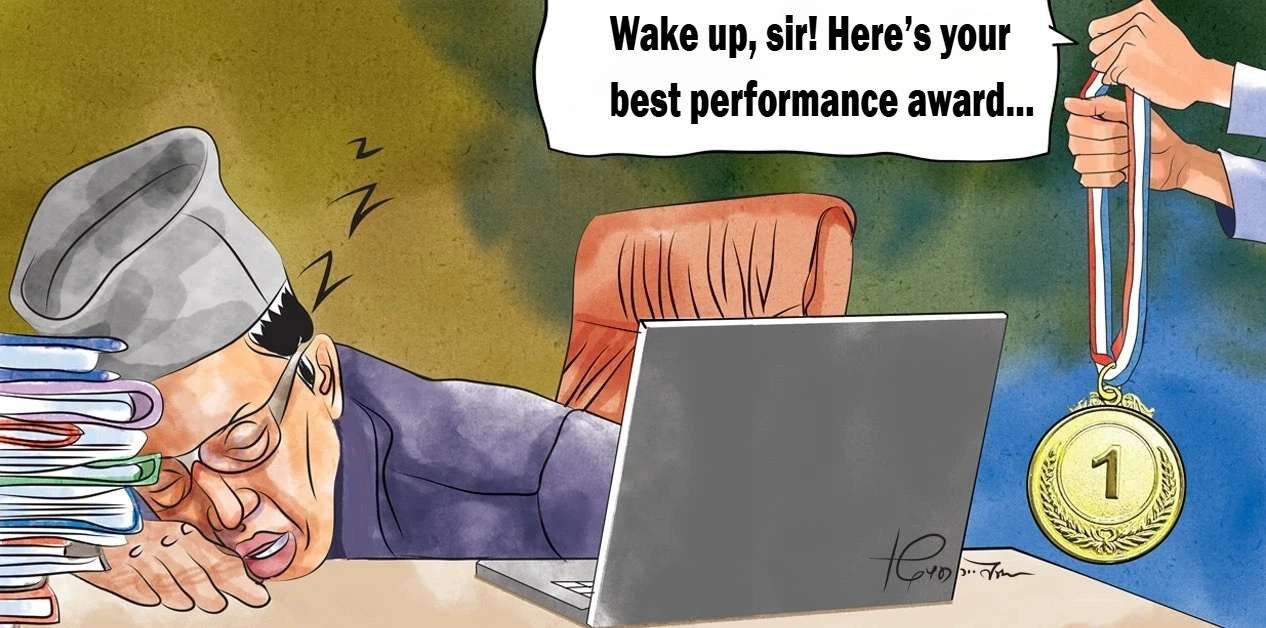
KATHMANDU: On 22 January 2026, during a mid-year review meeting in Surkhet assessing the work carried out in Karnali Province over the first six months of the current fiscal year, the province’s Chief Secretary Birendra Kumar Yadav came down hard on civil servants. Warning that non-performing employees would henceforth lose marks in their Performance Evaluation (PE), he reprimanded officials sharply. Expressing frustration over the tendency of employees who fail to get contractors to work on the ground but still submit progress reports on paper to project themselves as high performers in PE, Yadav warned that marks would be deducted in such cases.
Addressing the officials, he said, “Do not continue the practice of showing zero progress—even 10 percent—on contracts awarded since 2020 and merely submitting reviews of others’ progress while looking at one another’s faces. If you have reported only 20 percent progress on contracts from fiscal year 2020/21, your marks will be cut in the performance evaluation—mark my words.”
Fifteen road projects contracted in Surkhet five years ago remain abandoned. Yet, officials there have been submitting reports showing 10 to 20 percent progress and awarding themselves additional marks in PE for ‘good performance.’
Angered by this trend, Yadav added, “You can take action against non-performing contractors—issue a 15-day notice, terminate the contract, move the work forward. You don’t earn PE marks by merely showing letters.”
While Chief Secretary Yadav’s outburst highlights Karnali’s problems, it essentially reflects a broader, nationwide picture within the civil service administration. Civil servants routinely receive full marks in performance evaluations simply by presenting progress reports, regardless of actual work done. No one ever scores less, nor does anyone ever ‘fail’ an evaluation. In the absence of objective assessment, PE contributes nothing to improving efficiency, enhancing performance capacity, or identifying the need for training and professional development.
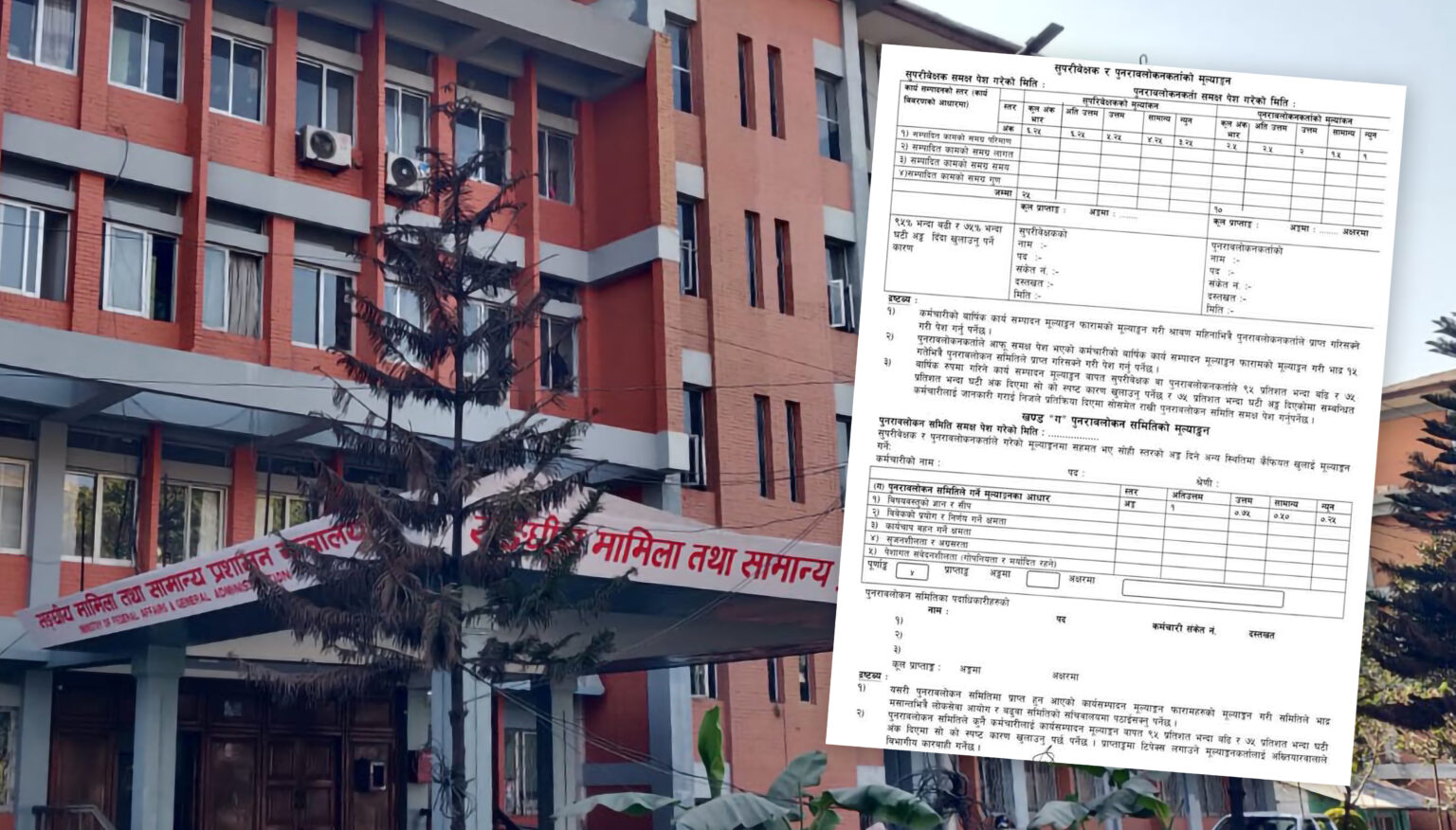
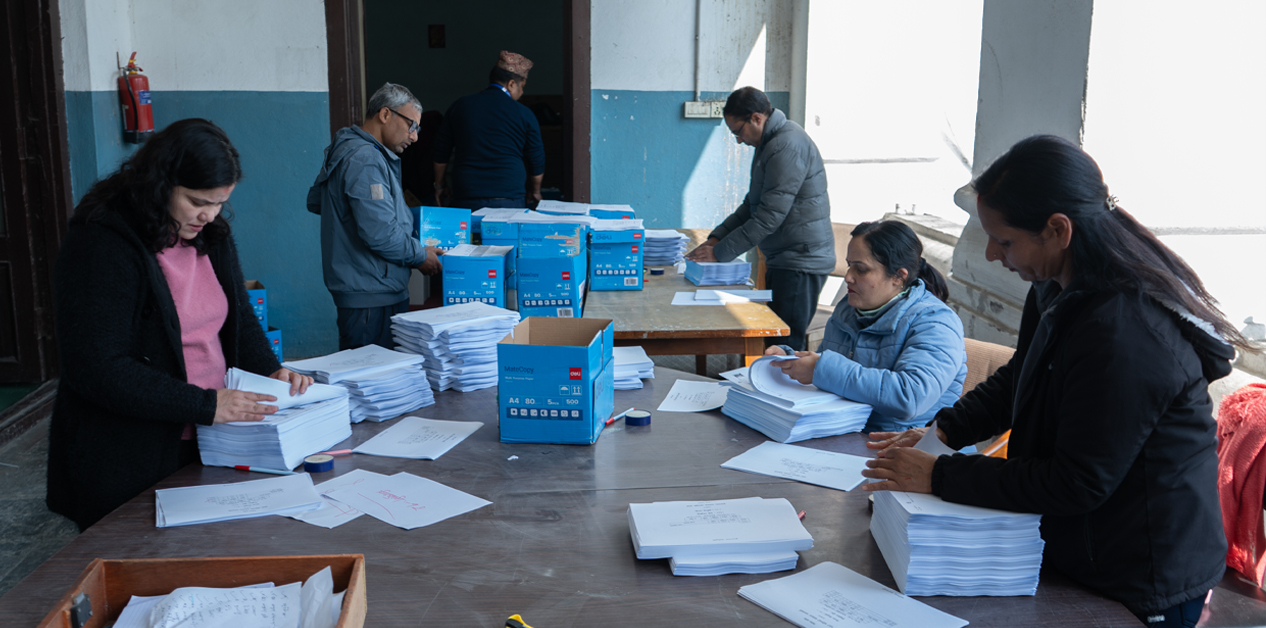
Ministry of Federal Affairs and General Administration, Kasamu form in INSET.
Although legal instruments exist to evaluate employee performance, PE has been reduced to a ritualistic formality. This practice, entrenched in the civil service for decades, has not only trivialized the evaluation system but has also rendered the bureaucracy increasingly ineffective.
A useless PE
According to statistics for fiscal year 2023/24 from the Civil Service Records Office, Nepal has 85,328 civil servants in service. Performance evaluation is the mechanism designed to measure and evaluate an employee’s annual performance. The system was introduced following the enforcement of the Civil Service Act, 1993. Employees are required to submit their performance evaluation forms to their immediate superior by 7 Shrawan each fiscal year. The KASMU process follows a hierarchical structure: employees list their work accomplishments and submit the form to their immediate supervisor, who is responsible for evaluating the work and awarding marks.
Performance evaluation was established to verify whether public office employees have fulfilled their assigned responsibilities. Ironically, despite being labeled an ‘evaluation,’ PE involves little to no actual assessment. Every employee is awarded full marks, making everyone appear outstanding on paper. As a result, excellent and average employees are measured by the same yardstick. This system neither motivates good performers nor alerts, disciplines, or penalizes poor ones.
A legal mechanism intended to improve public service delivery and accelerate development and construction has been reduced to a ceremonial exercise, stripped of any real purpose.
The PE form carries a total of 40 marks, and with rare exceptions, everyone scores 100 percent. More amusing—and troubling—is the assumption that no employee will ever fail. Once an officer-level employee submits the form, a joint secretary-level supervisor awards 25 marks. A secretary-level reviewer then adds 10 more marks. Finally, a review committee chaired by the Chief Secretary adds the remaining five marks. In the process, the officer is deemed to have delivered 100 percent performance and receives full marks.
If one were to judge solely by PE scores, it would appear that all public servants are exemplary—efficient, diligent, and committed. Public service delivery should therefore be smooth, citizens should face no inconvenience, and development and construction projects should progress swiftly. Reality, however, paints a starkly opposite picture. Service seekers routinely complain of bureaucratic hassles, delays, and the inability to get work done without paying bribes. On the other hand, development projects remain stalled for years as officials responsible for monitoring them turn a blind eye.
Performance evaluation is also used as one of the bases for selecting outstanding civil servants. Since 2004, Civil Service Day on 22 Bhadra marked the awarding of one Best Civil Servant Award, ten Excellent Civil Servant Awards, and thirty Civil Servant Awards annually. However, despite PE portraying all employees as outstanding, the inability to identify a genuinely deserving candidate for the top honor led to the discontinuation of the Best Civil Servant Award from 2017 onward.
Former Public Service Commission Chairperson Umesh Mainali describes a system where everyone scores full marks as one whose value has effectively dropped to zero, calling PE impractical.
“Except in cases of personal animosity, marks are rarely reduced in PEs,” he says. “Since it is limited to formality, it clearly requires comprehensive reform.”
Mainali suggests that instead of numerical scoring, PE should adopt a grading system, with separate evaluation frameworks for each position and service group. “Despite repeated amendments to civil service regulations, this issue was never addressed. Although the Administrative Reform Commission proposed reforms, they were never implemented. Under the current conditions, PE serves no real purpose,” he says.
Former administrator and former chairperson of the Administrative Reform Commission, Kashiraj Dahal, argues that performance assessment is neither scientific nor objective. Looking at public service delivery and overall development work, he believes PE has failed to produce results anywhere. “In my experience, 10 percent of employees do good work, while the remaining 90 percent are indifferent. They engage in politics and work based on personal gain,” he says. “There is a culture of non-performance among employees. Corruption and irregularities are its outcomes. This is why politics and administration must be separated.”
To make PE results-oriented, Dahal suggests assigning clear responsibilities to employees and awarding marks based on whether the work was completed, incorporating service users’ evaluations into the assessment process.
Limited to promotions
One copy of an employee’s PE form is sealed in an envelope and submitted to the concerned office, another is sent to a designated body depending on the service sector, and a third copy is forwarded to the Public Service Commission. Performance evaluation records of civil servants are kept at the Ministry of Federal Affairs and General Administration; those of judicial employees at the Judicial Service Commission; and those of teachers at the Teacher Service Commission.
Once submitted, PE forms are neither reviewed nor examined. The sealed envelopes are opened only when an employee becomes eligible for promotion. In other words, beyond serving as a basis for promotion or career progression, PE has virtually no practical utility at all.
According to Nita Pokharel Aryal, spokesperson for the Ministry of Federal Affairs and General Administration, the PE files of employees above the officer level are kept sealed in envelopes at the ministry’s promotion division. “Only the file of the candidate whose promotion is due is opened; the others are not opened at any other time,” she says. She adds that PE forms are filled strictly in accordance with the Civil Service Act.
Section 21 of the Civil Service Act stipulates the minimum length of service and educational qualifications required to be eligible for promotion. For promotion, employees in non-gazetted positions must have completed at least three years of service, while those in gazetted positions—officer level and above—must have completed five years.
According to Public Service Commission Information Officer Eknarayan Sharma, 1,050 positions were filled through promotion in fiscal year 2024/25.
“On average, around one thousand positions in the civil service are filled each year through promotion after calculating PE and other promotion-related criteria,” he says.
Devi Prasad Subedi, undersecretary at the Ministry of Industry, Commerce and Supplies, says that because civil servants are not clearly assigned specific duties, there is no basis for evaluation, rendering PE effectively meaningless. “Either clear job descriptions must be assigned and employees evaluated accordingly, or if no work is assigned at all, what exactly is being evaluated?” he asks.
According to him, an employee’s performance should be assessed using a 360-degree evaluation framework: 180 degrees for work performance, 90 degrees from colleagues, and 90 degrees from service recipients.
There are only two situations in which an employee receives less than full marks in PE. First, if the employee has a poor relationship with the supervisor. Second, if the employee is subjected to departmental action or if a case has been filed by the Commission for the Investigation of Abuse of Authority (CIAA). Data from the National Records Office show that by the end of mid-July 2024, as many as 1,195 government employees had faced departmental action.
If marks are reduced in PE, the basis and reasons must be clearly stated. While PE is used to grant awards and promotions, it is never used to penalize employees for non-performance.
Narayan Prasad Bhatt, Joint Secretary and spokesperson of the National Vigilance Centre, says that the failure to make PE objective has resulted in uniform evaluations for all employees. He points out that political access enjoyed by evaluated employees makes objective assessment virtually impossible. “A senior official does not dare to give low marks based on conscience or by taking a risk, because the system is politicized. The person receiving the marks is often in a stronger position than the person awarding them,” he says.
According to Bhatt, the prevailing belief that no one should be ‘harmed’ through PE, combined with the practice of awarding full marks for promotion purposes, has entrenched the 100-percent scoring culture. “There is no practice of evaluating employees based on their actual work and conduct. The system has not been structured in a way that allows objective assessment,” he says. “To reform this, PE forms must be filled out impartially.”
Former secretary Balkrishna Prasai says that for genuine performance evaluation in the civil service, roles and sectors of work must be clearly defined. “There is no certainty about who does what in the administration. Work allocation must be ensured, and evaluation should be based on objective criteria and the quality of work,” he says. “Under the current situation, where everyone scores 100 percent in PE, the system has no meaning.”
According to him, government employees are not being assigned sufficient work. “If work itself cannot be assigned, how can marks be awarded or deducted?” he asks. “This creates a compulsion to award full marks even to employees one barely knows. In reality, supervisors should sit down with subordinates, discuss areas for improvement, and then award marks,” he says, adding, “I, too, followed the established practice when awarding marks.”
Studies say PE serves no purpose
The 2019 report of the High-Level Administrative Reform Implementation and Monitoring Committee recommended developing measurable mechanisms to make civil servants’ performance evaluation objective and scientific. The report emphasized strict enforcement of provisions to reduce PE scores for officials who fail to fulfill their responsibilities on time.
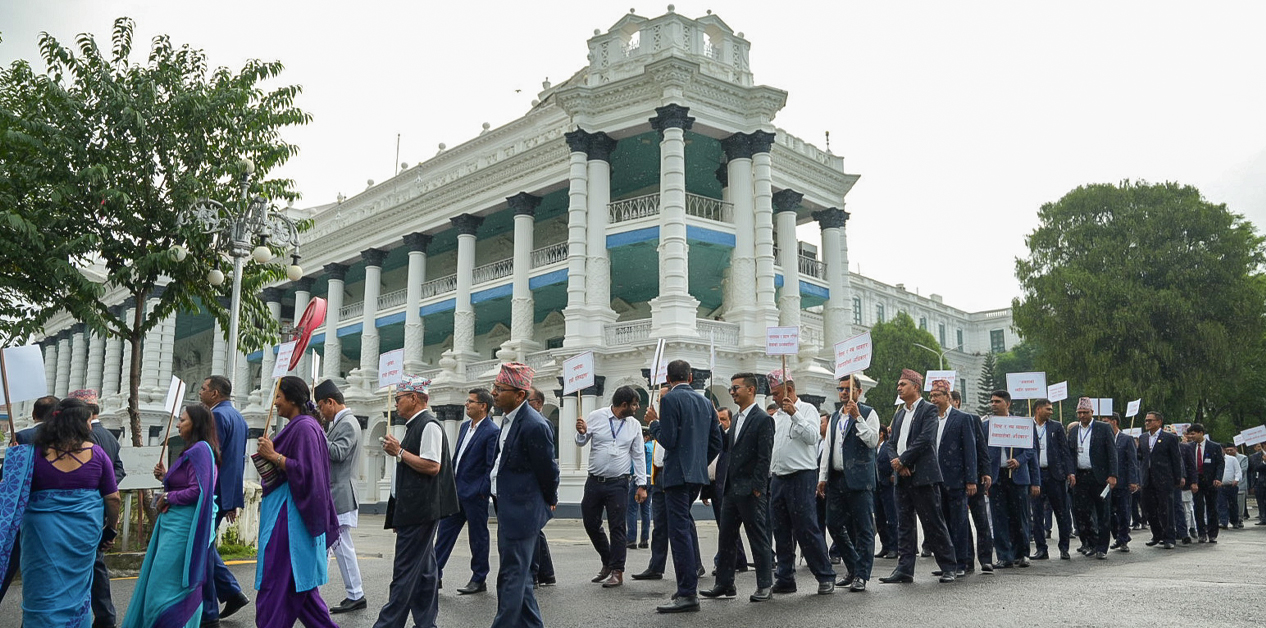
Employees celebrating the 22nd Civil Service Day at Singha Durbar on September 09. Photo: RSS
Performance evaluation is uniform across all sectors, offices, and categories of civil servants. As a result, employees working at the local level are supervised by officials stationed at the center. In such a situation, supervisors often do not even know the employees they are evaluating. Despite claims that evaluations consider quality, cost, and timeliness, the PE form itself is incapable of enabling objective assessment. The report questions how real performance evaluation is possible when central-level supervisors award marks to local-level employees they barely know. It also notes that PE has been confined solely to promotion purposes.
The report states: “PE is unscientific, incapable of objective evaluation, opaque, and vague; therefore, it is in urgent need of reform.” Pointing out issues such as the lack of accountability of evaluating officials, the report recommends a comprehensive review of the evaluation system. It also suggests studying performance evaluation systems in other countries and revising PE accordingly.
To make PE transparent and objective, the report recommends that evaluators clearly specify performance indicators instead of awarding marks without knowing what work has been done. It also suggests having separate PE forms for employees of the same rank working under different responsibilities. At present, the same PE form is used for civil servants, teachers, and security personnel alike.
Former Minister for General Administration Lal Babu Pandit says that implementing the recommendations of the high-level administrative reform report requires moving forward by enacting legislation. According to him, although a Civil Service Bill was tabled in Parliament in 2018, it could not be passed. He says the practice of awarding 100 percent marks in PE persists largely to keep employees satisfied. Sharing his experience, he notes that civil servants often obstruct or manipulate the implementation of reforms that do not align with their interests, making the introduction of a new PE system equally challenging.