Kathmandu
Sunday, January 11, 2026





From Himalayan trade routes and winter bhattis to urban restaurants and global recognition, Thakali food has grown into more than a dining tradition established through intergenerational transfer of Thakali women’s culinary skills, becoming a marker of Nepali identity, authenticity and taste
“Have you eaten?”
This common Nepali greeting reflects the centrality of rice in our lives. There is a popular saying: no matter how much momo, pizza, burgers, or pasta one eats, in the end a Nepali still longs for rice.
This attachment to rice is not confined to the home. The practice of going out to eat dal, rice, and vegetables at restaurants is also on the rise. In urban areas where restaurant culture is rapidly expanding, eateries serving cuisines from across the seven seas are available. Amid this crowd, one name has already been established as a synonym for Nepali food and that name is none other than Thakali cuisine.
The roots of Thakali cuisine’s dominance in the food business are linked to the Thakali community of Thak Khola in Mustang. In the Thakali language, Thak Khola is known as Thasang, which includes 13 villages stretching from below Tukuche to above Ghasa.
In 1997, when members of a single family – Rekha Bhattachan, Jyotiman Sherchan, Indira Gauchan, Bindu Shakya, and Aruna Gauchan -were choosing a name for their restaurant in Durbar Marg, they used the name of their ancestral home, Tukuche.
Similarly, 15 years ago, when Sharmila Tulachan of Kobang, Mustang, began her restaurant business in Jhamsikhel, she chose a name that reflected her roots: Thak Khola Thakali.
Like these two, many others have linked the identity of Thak Khola to the names of their Thakali eateries. The list is long: Thasang Thakali, Tukuche Thakali, Lete Thakali, Mustang Thakali, Muktinath Thakali, Jomsom Thakali, Ghasa Thakali, and many more. In Kathmandu alone, names such as Jimbu Thakali, Mantra Thakali, Monalisa Thakali, Melung Thakali, Ghar Aangan Thakali, Thakali Bhanchhaghar, Gauchan Thakali, Sherchan Thakali, and House of Thakali have remained popular with customers. Many established Thakali restaurants have already expanded their branches, and this trend continues.
Sharmila, who spent more than a decade in Japan, also worked in restaurants there. Before that, she had helped her mother run a restaurant in Jomsom, which drew her toward the food business.
“From the day we opened the restaurant until today, we have never lacked customers,” she says. Because of its popularity, Thak Khola Thakali has expanded branches to New Baneshwor and Thamel as well.
Arjun Sherchan, who spent 15 years in Japan, was involved in the hospitality business even while there. He began by working in others’ restaurants and later ran his own. After returning to Nepal, he and his friends opened Gambesi Thakali Kitchen two decades ago. Currently operating Bagan Thakali in Thamel, he is preparing to open a new branch in Baluwatar from this coming February.
Names such as Mantra Thakali, Jimbu Thakali, and Daura Thakali could also be added to this list. Alongside branch expansions of older establishments, new Thakali restaurants continue to open. Marsi Thakali in Jhamsikhel and Ghasa Thakali in Patan were added just this year.
Marsi Thakali food
According to Japanese researchers Shigeru Iijima and Yoshikazu Takaya in their book Thakali and Nepali Agriculture, the rise of Thakali power dates back to the mid-19th century. In the mid-1850s, war broke out between Nepal and Tibet. Then Rana Prime Minister Jung Bahadur Rana appointed Thakali leader Kalu Ram Timtsen as a Tibetan-language interpreter.
Timtsen went beyond the role of interpreter and served almost as a strategic advisor on Tibetan and Himalayan affairs. Impressed, Jung Bahadur rewarded him with the title ‘Subba’, along with the name Balbir. The book notes: “In addition to the Subba title, Balbir Sherchan was granted a monopoly over the salt trade and appointed judicial authority over the upper Kali Gandaki basin and surrounding areas.”
With administrative and judicial authority, the Thakalis were involved in trans-Himalayan trade between Tibet, Nepal, and India. Tukuche became a major trading center for Thakalis.
According to the authors, until the Tibetan uprising of 1959, Thakali traders imported sheep, goats, yaks, horses, mules, wool, hides, butter, cheese, and rock salt from Tibet and the northern highlands. In return, they exported Nepali and Indian goods such as rice, wheat, barley, maize, lentils, buckwheat, oil, tea, chilies, spices, Nepali paper, cotton cloth, metal utensils, guns, and gunpowder.
Because Mustang is extremely cold, Thakali traders would descend to Myagdi, Baglung, Pokhara, and even Butwal during winter. Arjun Sherchan of Bagan Thakali explains, “To escape the cold, they would come down and open small eateries called bhatti in those days, selling dal, rice, and vegetables. What began modestly has now evolved into a modern business.”
These bhattis were enclosed with woven reed screens. From mid-October to mid-March, Thakalis ran temporary businesses at crossroads.
The food was delicious, guests were allowed to stay overnight for free, and the sleeping spaces were exceptionally clean. “That’s why people began actively seeking out Thakali hotels,” he says.
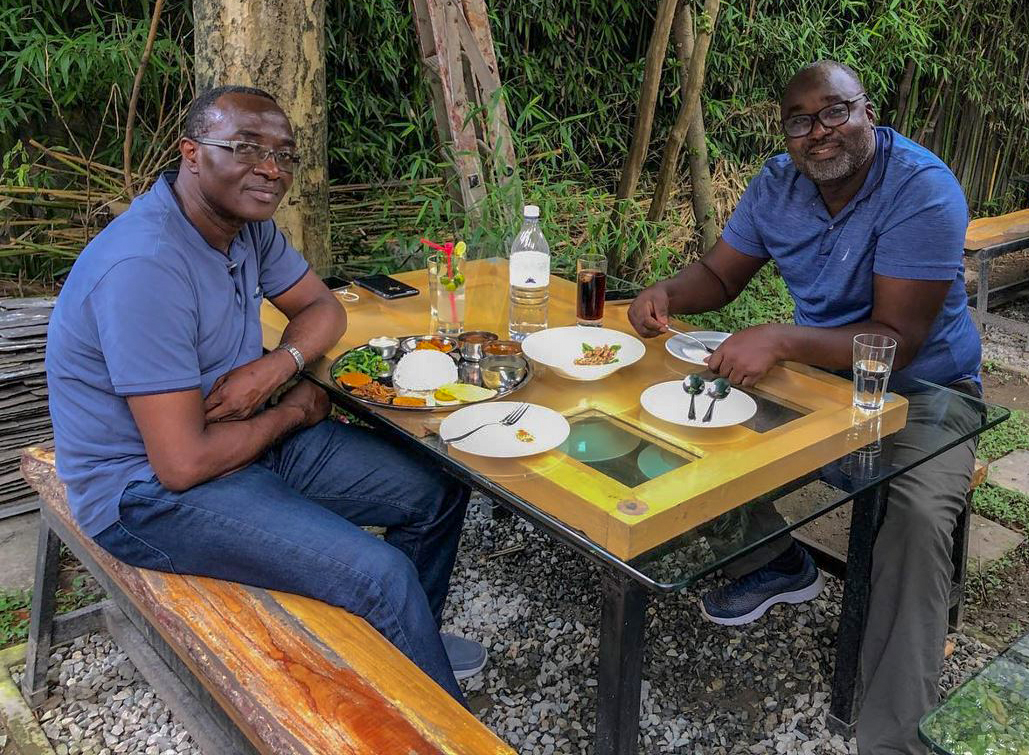
Among those who modernized this traditional business is Usha Sherchan of Tukuche, Mustang. With support from her mother Ratna Tulachan, Usha opened Usha Lodge at the age of 18. After moving from Mustang to Pokhara, she ran Valley Lodge for four years before starting Monalisa Thakali. Operating in Pokhara for three decades, Monalisa Thakali has also been running a branch in Kathmandu’s Bhatbhateni stores for the past four years.
Foreigners dining at Mona Lisa Thakali
Another prominent name in the expansion of Thakali cuisine in Kathmandu is Rekha Bhattachan. The Tukuche Thakali restaurant she opened with her family 28 years ago in Durbar Marg moved to Gairidhara a decade ago, and another branch opened in Jhamsikhel two years back. That branch is now overseen by her daughter Mahima, who says, “My mother, aunts, and uncles started Thakali food to let foreign tourists taste our own cuisine. But in the end, locals loved it even more.”
As Mahima notes, Thakali cuisine spread nationwide precisely because Nepalis embraced it.
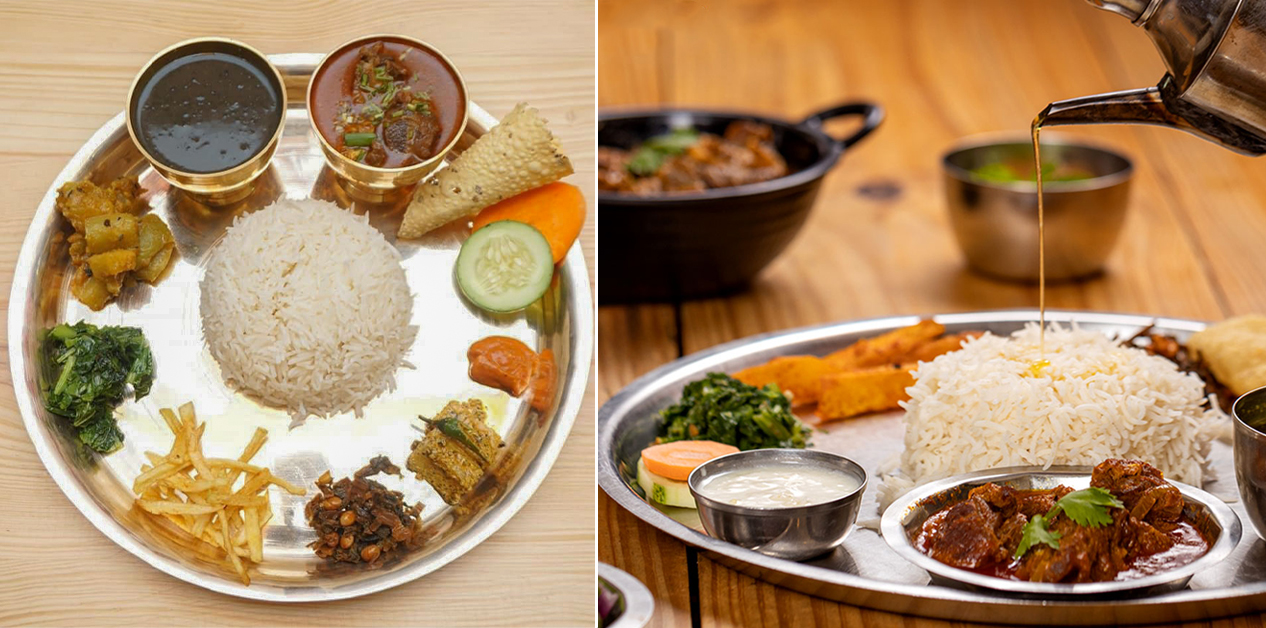
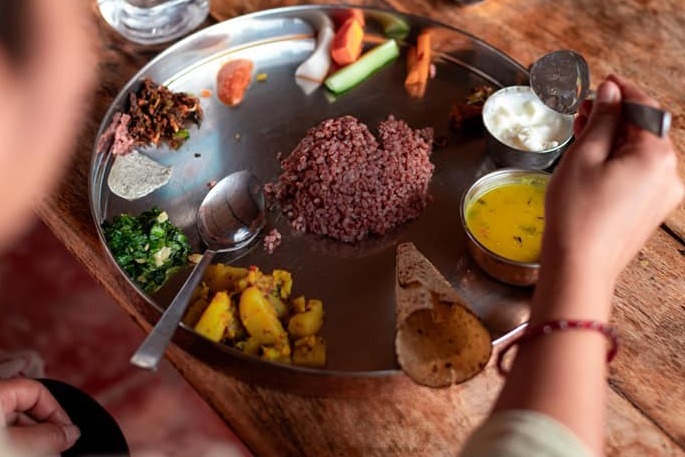
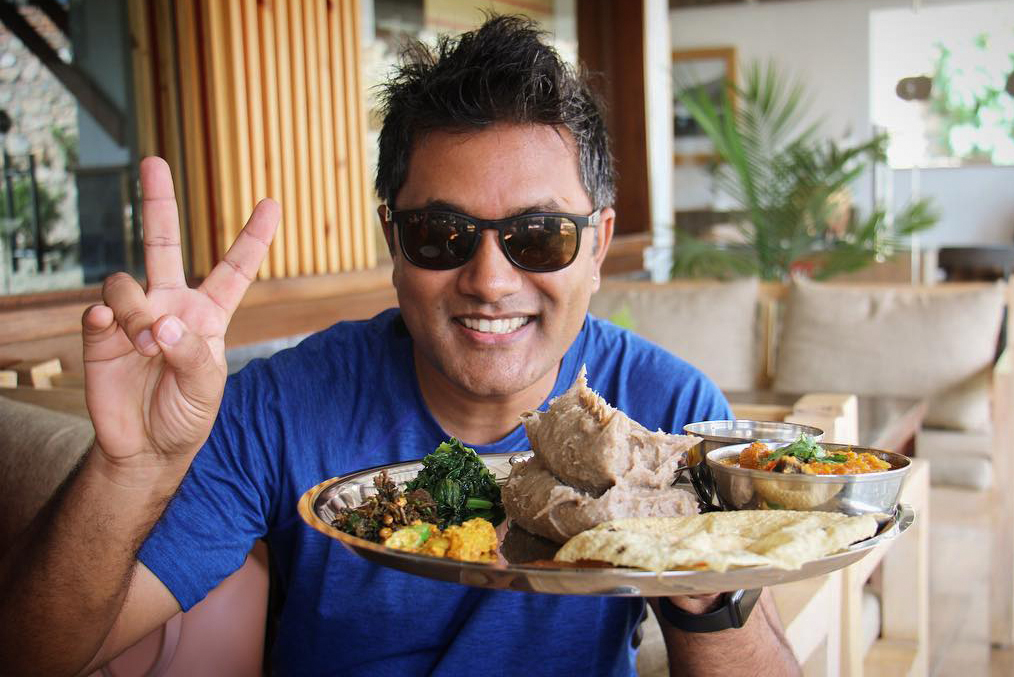
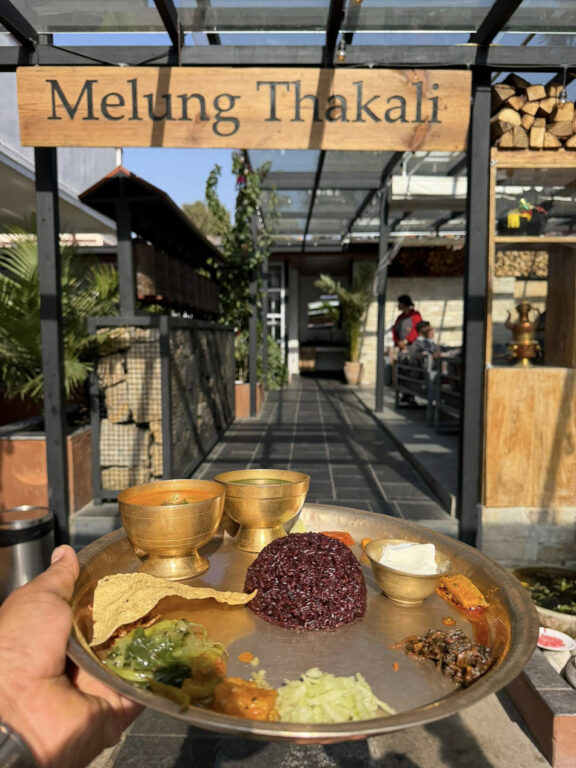
A Thakali thali includes at least 10 items. Initially, small portions are served with explanations of each dish, after which refills are generously offered upon request which is another hallmark of Thakali dining. According to Sharmila of Thak Khola Thakali, dishes are arranged sequentially on the plate, starting with small portions. At the center of a brass or steel plate sits steaming rice topped with aromatic ghee, accompanied by Himalayan-style lentil soup flavored with jimbu or ginger, seasonal greens and vegetables, tomato pickle, radish pickle, fermented greens (gundruk pickle), papad, yogurt, and mutton or chicken curry.
Today, alongside rice, millet or buckwheat dhindo has also become part of the Thakali brand. Snacks such as potato with jimbu, dried mutton or chyangra with potatoes, ghee-fried potatoes, and kanchamba are equally popular. Drinks like Marpha wine and Mustang brandy are also in demand.
Sharmila believes that while Thakali food resembles other Nepali cuisine, its distinct taste comes from its cooking methods and homemade spices.
“We cook slowly and with care. Perhaps cooking with time and heart brings out the flavor,” she says. “Everything such as how long to soak, how long to cook, is carefully calculated. We use very few spices, and only homemade ones, which makes the taste different.”
The method of cooking the much-loved Thakali dal is lengthy. First, the lentils are boiled, then cooked with turmeric and ghee in a pan, ground in an iron vessel to bring out a green hue, and finally tempered with jimbu, ginger, garlic, or timur (Sichuan pepper) depending on the desired flavor.
“We have our own style for everything we cook,” Arjun adds. “Taste reaches the eyes and nose before the mouth, so we pay equal attention to presentation.”
Serving food in Thakali restaurants also follows strict rules and thus each item placed on the plate and in bowls is carefully defined. Thee staff are trained in these traditions from the start, explains Dhatridevi Sherchan of Bagan Thakali. “We never break these rules,” she says.
Monalisa staff member Pooja Katwal Chhetri adds, “Even if it takes longer, we place each item exactly where it belongs.”
Thakkhola Thakali food
Using Himalayan herbs and spices, Thakali food is not only tasty but also nutritious and balanced, aiding digestion and providing protein. This is one reason people think of Thakali food when eating out. To maintain authenticity, early Thakali restaurateurs even brought potatoes, lentils, and other ingredients directly from Mustang. Even today, many prioritize jimbu (dried Himalayan leek), timur, lentils, and potatoes from Mustang, Jumla, Dolpa, Rasuwagadhi, and other highland regions.
The continuity of this Himalayan flavor across generations owes much to Thakali women, who play a decisive role in running kitchens and ensuring quality. Mahima says, “My mother manages the main Tukuche Thakali branch in Gairidhara, but she comes to Jhamsikhel every single day to check the taste and quality.”
Many kitchen staff and chefs are themselves from the Thakali community, often family members. “Skills from our grandmothers and mothers pass into our hands almost unknowingly,” says Dhatridevi.
Thakalis traditionally travel with timur, jimbu, and lentils wherever they go. “My grandmother carried timur even when traveling abroad. I didn’t understand why then but now I do the same,” Mahima says. “People are deeply attached to their taste, and Thakalis are especially so.”
By following the values of their elders that include careful cooking, cleanliness, hospitality, and customer satisfaction, Thakali women have ensured strong intergenerational transfer. Customers feel this; satisfied diners return, which explains the growing number of Thakali restaurants. From the elderly to Gen Z, Thakali food appeals across generations.
Seeing this popularity, many restaurants have begun adding “Thakali” to their names, even when not run by Thakalis. One such example is Basant Lama, who worked as a cook for nearly nine years, including nine months in Dubai. Promoting Nepali fusion cuisine, he opened Melung Thakali in Baluwatar last February, naming it after his home municipality in Dolakha. “In Nepal, there’s a psychology that good food is found where ‘Thakali’ is written,” he says. He learned Thakali flavors by working alongside Thakalis and plans to open another branch.
Marsi Thakali food
This year, Marsi Thakali opened in Jhamsikhel, named after high-altitude Marsi rice. It is also a non-Thakali brand. Operator Raj Aryal says they serve sets featuring Marsi rice, millet, buckwheat, maize, and dhindo (traditional Nepali porridge). Though the rice comes from Jumla, he admits using the Thakali name because of market trends. “Only our recipes are Thakali,” he says, “but our chef has 20 years’ experience in Thakali restaurants.”
The concern over authentic Thakali
As non-Thakali restaurants expand using the Thakali name, the brand spreads but confusion over what constitutes authentic Thakali also grows.
“Because the name and brand are being misused, customers can no longer easily distinguish where genuine Thakali taste is found,” says Arjun. “That’s why we are compiling a list of authentic Thakali restaurants.”
For this purpose, the Thakali Bhanchaghar Association has developed an app listing only authentic Thakali establishments. Around 80 Thakali kitchens are currently registered, and only entrepreneurs from the Thakali community can be members, though non-Thakalis may receive training.
Thakali cuisine has made an unparalleled contribution to introducing Thakali culture and tradition not only to foreigners but also within Nepal.
Its emphasis on authenticity and identity has made Thakali food the most powerful medium for promoting the Thakali community nationally and internationally.
By presenting food as an inseparable part of tradition and culture, Thakali restaurateurs display artifacts linked to Mustang and Thakali life such as wooden items, water pots, jars, stone spouts, photographs, and ornaments, inside their hotels and restaurants. These elements familiarize visitors with Mustang’s environment while also demonstrating how a community can preserve and promote its identity, contributing positively to tourism and the economy.
The walls of Monalisa Thakali showcase many such items, along with photographs of renowned artists, singers, politicians, and foreign high-profile visitors, from members of Mustang’s royal family to popular folk singer Amrit Gurung. There is even a photograph documenting Indian actress Shabana Azmi dining there during her Nepal visit, sharing a frame with Anup Baral, Dayahang Rai, Bijay Baral, Diya Maskey, Sirjana Subba, and Biplav Pratik.
All this underscores one fact: the taste of Thakali food appeals to people of all backgrounds, which is why the name has become such an attractive brand.
Rice needs no season, and as an evergreen business, Thakali cuisine is expected to expand further in the future. “Every tourist visiting Nepal has Thakali food on their must-try list,” says Arjun. “And Nepalis need rice at least five days a week. So, Thakali cuisine is bound to keep growing.”