Kathmandu
Friday, February 27, 2026





Illegal drug seizures by the police over the past couple of years reveal an interesting geographical link between production and trafficking
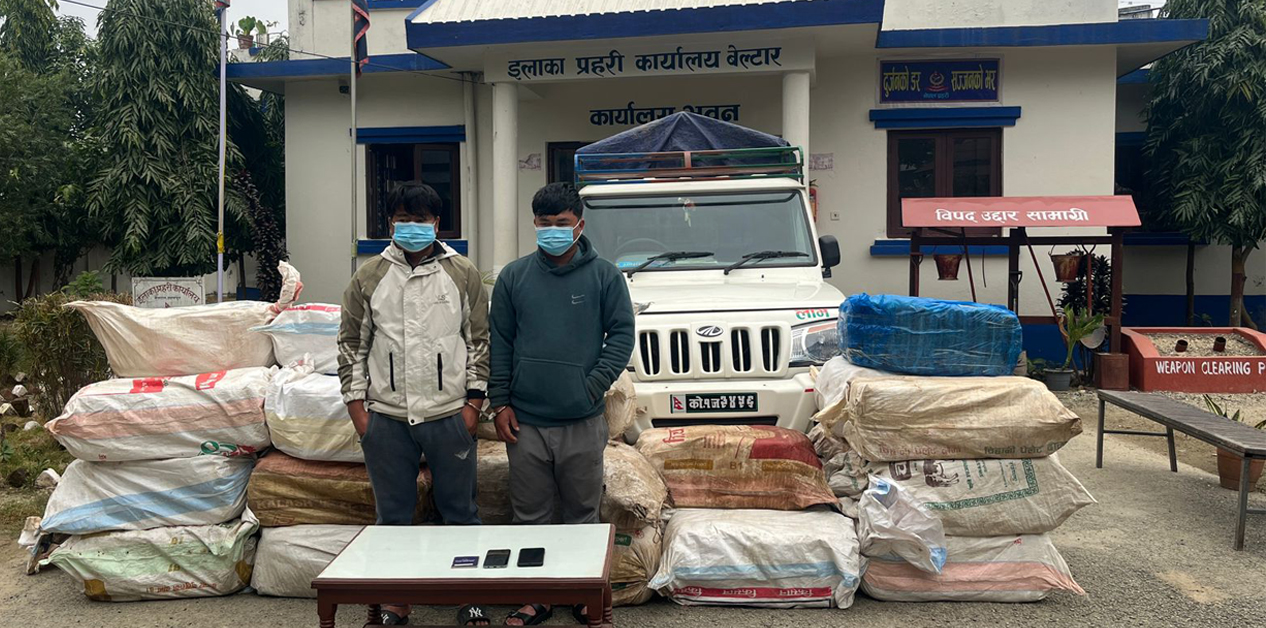
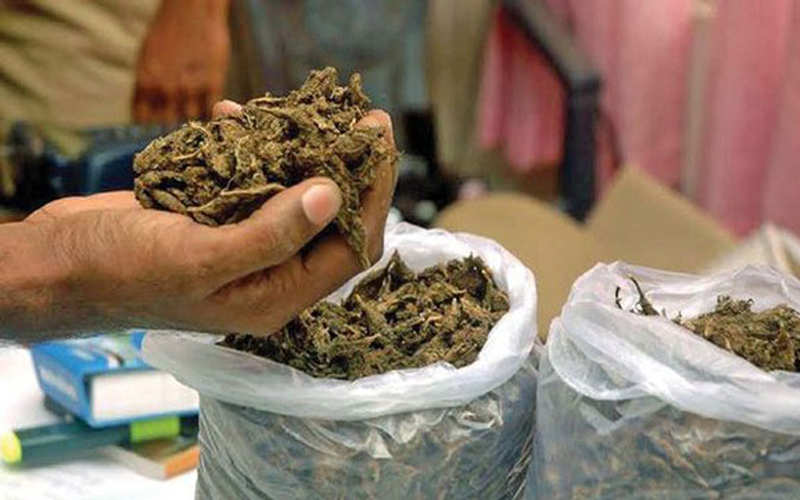
On 8 December 2025, police arrested two individuals along with 678 kilograms of marijuana from Hatiyadanda, Ratuwamai Municipality–1 in Morang district. The marijuana was discovered during a check of a truck traveling from Aambari toward Sonapur. Those arrested were Samel Rai of Shahidbhumi Rural Municipality–2 and Bikram Bishunkhe of Shahidbhumi–1 in Dhankuta district.
A week earlier, on 12 December, police seized 104 kilograms of marijuana from Rangpur Tadi in Paterwa Sugauli Rural Municipality of Parsa district. The arrested individuals were Bhim Syangtang of Bhimphedi Rural Municipality–3 and Kumar Syangtang of Makawanpurgadhi Rural Municipality–2, both from Makawanpur district. The marijuana, packed in ten sacks, was found while checking a vehicle traveling from Manwa toward Rangpur Tadi.
On 24 November 2025, police seized an even larger quantity of marijuana. From Traffic Chowk, Lahan Municipality–1 in Siraha district, 1,400 kilograms of marijuana was confiscated and two individuals were arrested. The arrestees were Tanka Bishwakarma of Dharmadevi Municipality–9 in Sankhuwasabha and Khem Rana Magar of Chhathar Jorpati Rural Municipality in Dhankuta.
The marijuana, 31 sacks in total, was hidden in a false compartment behind the truck’s cabin and was discovered while the vehicle was being checked en route from Mirchaiya to Rupani.
On 26 June 2025, police seized 319 kilograms of hashish from Parwanipur Chowk in Birgunj Metropolitan City. The hashish was concealed inside metal castings in a truck heading from Parwanipur toward the dry port. The truck driver, Buddh Bahadur Syangtan of Thaha Municipality in Makawanpur, was arrested along with Rs 192,000 in cash.
Earlier, on 5 May 2025, police arrested two individuals carrying 21.5 kilograms of opium on a motorcycle in Chepang, Bansgadhi Municipality–1 of Bardiya district. Those arrested were Bhakt Bahadur Shahi of Nalgad Municipality in Jajarkot and Kumar Tamang of Rapti Municipality in Chitwan.
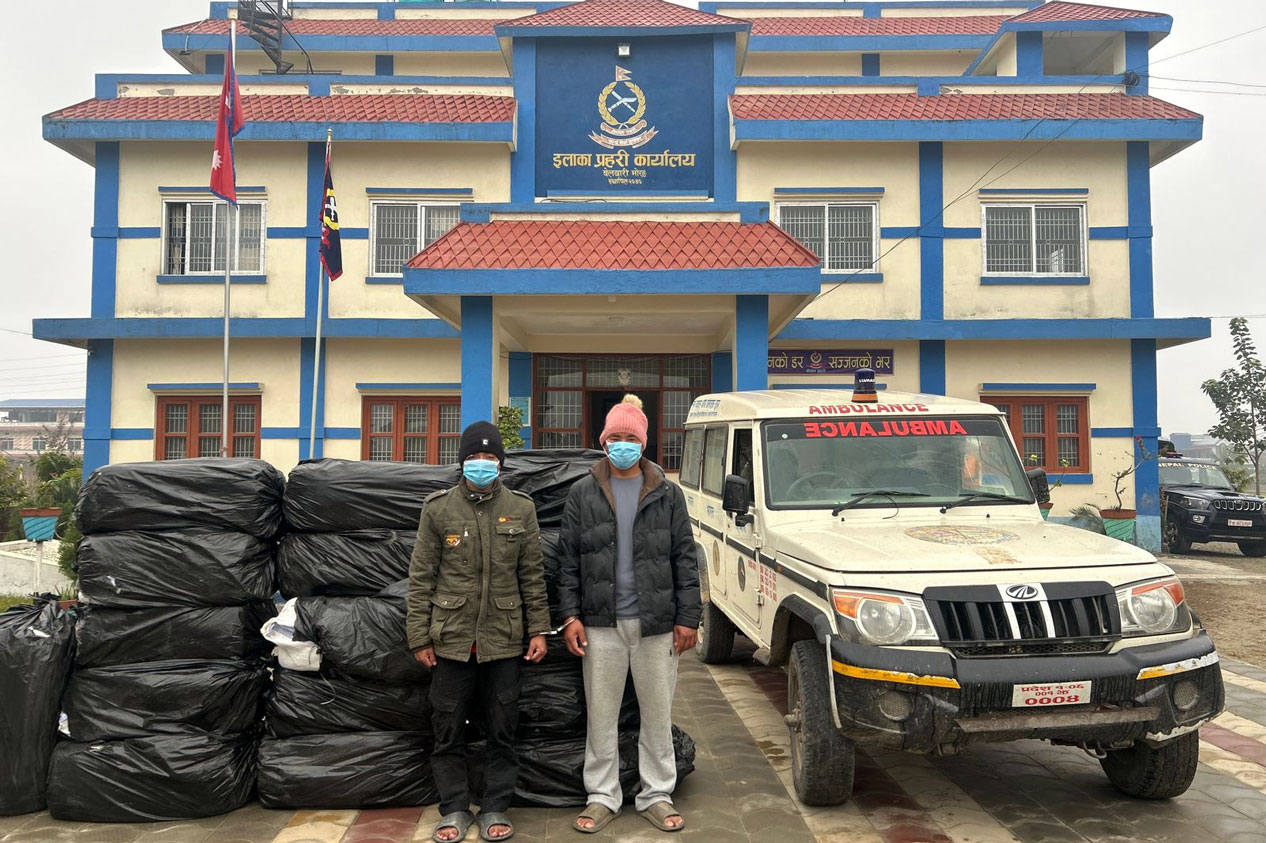
The incidents above are only a few examples of prohibited narcotics seized in the current fiscal year. An analysis by Nepal News of drug seizure data from 13 April 2024 to 15 December 2025, covering 19 months, clearly shows which types of drugs are cultivated and trafficked in different regions of the country.
The data indicate that marijuana cultivation and trade are concentrated in eastern Nepal, while opium and hashish trafficking is prevalent in central and western Nepal. Marijuana and opium cultivation also occurs in parts of central and western Nepal.
According to experts, small quantities of brown sugar and pharmaceutical drugs are smuggled into Nepal from India, whereas Nepal primarily exports marijuana, hashish, and opium in large quantities. Nepali marijuana reaches Bihar, hashish goes to Delhi and other western Indian states, and opium is trafficked to Uttar Pradesh.
Former Deputy Inspector General Hemant Malla, who worked for over 15 years at Nepal Police’s Narcotics Control Bureau, says that marijuana smuggling from Nepal to India continues even today by following long-established trafficking routes.
“Marijuana from Nepal is collected in Bihar and distributed to different parts of India from there,” he says. “The number of arrests during drug transportation in Nepali districts bordering Bihar is significantly high.”
Marijuana east of the Narayani River
A study of more than 5,000 police bulletins issued between 13 April 2024 and 15 December 2025 shows that seizures of more than 100 kilograms of marijuana at a time occurred on 101 occasions. Of these, 60 incidents occurred in 2081 BS (13 April 2024 to 12 April 2025) and 41 in the first seven months of 2082 BS (mid-April to mid-November 2025).
All of these incidents took place in 15 districts east of the Narayani River, including Morang, Sunsari, Dhankuta, Udayapur, Siraha, Saptari, Dhanusha, Mahottari, Sarlahi, Sindhuli, Bara, Parsa, Makawanpur, Chitwan, and Dhading. In 2081 BS alone, 70 percent of the total seized marijuana was confiscated in Sunsari, Dhankuta, Mahottari, Bara, and Makawanpur. In the first seven months of 2082 BS (mid-April 2025 to mid-November 2025), Sunsari recorded the highest number of large seizures – nine incidents involving more than 100 kilograms.
Morang, Sunsari, Saptari, Siraha, Dhanusha, Mahottari, Sarlahi, Bara, and Parsa share borders with India’s Bihar state. The frequent large seizures in these districts indicate interception during attempts to export marijuana to India.
West of the Narayani River, marijuana seizures are generally small and sporadic. In the 19-month period studied, only one major seizure was recorded west of the Narayani. On 30 July 2024, police seized 769 kilograms of marijuana from Hamal Chowk in Devchuli, Nawalparasi (Bardaghat Susta East) during a vehicle check. The driver, however, was Madan Lama of Rapti Municipality–2 in Chitwan, an area east of the Narayani and bordering Makawanpur.
Among the 15 eastern districts with large marijuana seizures, Makawanpur, Dhading, Dhankuta, and Udayapur are production areas, while districts such as Sunsari, Bara, and Mahottari serve as export corridors to India.
Former DIG Malla notes that since the 1970s, Nepali marijuana has been trafficked to Bihar, India, for collection. “At that time, Kamdev Singh was a major trafficker in Bihar. That tradition of smuggling appears to have continued even today,” he says.
Kamdev Singh, who was killed in an Indian police operation in the 1980s, is often referred to in India as the “Pablo Escobar of Bihar.” Pablo Escobar was the notorious Colombian cocaine trafficker.
From the late 1960s through the 1980s, Kamdev had a stronghold over drug and goods smuggling across the Nepal–India border. According to the 2022 book Kamdev Singh: The Original Godfather of Indian Politics by Indian Express journalist Santosh Singh, Kamdev’s influence stretched from Pithoragarh to Siliguri, and no smuggled goods could pass without his involvement.
Kamdev, a resident of Lavagaon in Begusarai, Bihar, mobilized youths from his own village to smuggle marijuana from Nepal.
The book describes how the youths would travel by bus from Begusarai to the Nepal border, enter Nepal posing as laborers, collect marijuana from traders, and then walk overnight back to Lavagaon.
Although Kamdev was killed in 1980, former DIG Malla says the marijuana trade he established has continued through generational transfer. “Like any other business, this too passes from one generation to the next. Even if not to one’s own children, relatives or close associates carry it forward,” he says.
Hashish and opium in the central and western hills
After marijuana, hashish and opium are the drugs most frequently seized in large quantities in Nepal. While marijuana production and export dominate east of the Narayani River, hashish and opium are more commonly seized in central and western regions.
According to data from the 19-month period since mid-April 2024 to mid-December 2025, opium has been seized in central and western districts including Makawanpur, Dhading, Rupandehi, Dang, Salyan, Bardiya, Kailali, Kanchanpur, and Darchula. During the year 2081 BS alone, a total of 323 kilograms of hashish was seized from these districts. Dang accounted for the highest amount, with 100 kilograms seized, followed by Makawanpur with 58 kilograms, Parsa with 51 kilograms, and Bardiya with 27 kilograms.
In the current year of 2082 BS, police data show that 391 kilograms of hashish had already been seized within just seven months up to the end of mid-December 2025. On 26 June 2025, as much as 319 kilograms of hashish was seized near the Birgunj dry port in Parsa. Subsequently, 24 kilograms were seized in six incidents in Kailali, about 18.5 kilograms in a single seizure in Dhading, and nearly seven kilograms in two incidents in Darchula.
According to former DIG Malla, Bhairahawa is the main route for hashish trafficking, with the drug collected in Delhi.
“From Delhi, it is distributed to surrounding areas. Not only in Nepal, but Nepali traffickers are also arrested in places like Delhi in India,” he says.
Recently, on 5 January 2026, Indian news agency PTI reported that a Nepali national was arrested in Delhi’s Amar Colony area with 11 kilograms of hashish worth more than 10 million Indian rupees. A day earlier, on 4 January, The Indian Express reported that a student from Bihar with links to a Nepali hashish trafficking network was arrested with 15.2 kilograms of hashish.
In the Nepali month of Poush 2080 BS (mid-December 2023 to mid-January 2024), five people, including three Nepalis, were arrested in Delhi with 15 kilograms of hashish. On 5 March 2025, India’s border security force (SSB) arrested a man from Rolpa with nearly 10 kilograms of hashish in the Rupaidiha border area along the Nepal–India frontier.
Data also show that Nepalis make up a significant proportion of foreign nationals arrested for drug trafficking in India. According to India’s Narcotics Control Bureau, of the 606 foreign nationals arrested in 2024, as many as 203 were Nepali.
Krishna Prasad Koirala, Senior Superintendent of Police (SSP) and chief of Nepal Police’s Narcotics Control Bureau, says the police are prioritizing stopping production rather than only focusing on seizures and arrests. According to him, hashish is secretly produced in villages across Makawanpur, Dhading, and mid-hill districts such as Jajarkot, Surkhet, and eastern and western Rukum.
“From the Chure region extending eastward to Makawanpur and Dhading, cannabis grows naturally, and in some places, it is secretly cultivated commercially,” he says.
“In most locations, we conduct eradication drives and destroy plants at the seedling stage whenever discovered.” Despite efforts to stop production, SSP Koirala says it is difficult to control cultivation in remote and inaccessible areas, and some of the production is trafficked to India. “When the produced hashish is brought down to the Tarai for market, it is often seized in border areas,” he says.
Former DIG Malla estimates that seizure data suggest only about 15 percent of total drug trafficking is intercepted. “This is like fish flowing down a river. You cast a net at one place and sometimes you catch a big fish, sometimes a small one,” he says. “There is so much profit in drugs that even if one shipment out of four or five gets through, traffickers still earn well.”
Opium in the western hills
Opium produced in Makawanpur, Dhading, and western hill districts is often seized while being trafficked through Tarai districts and border areas. In 2081 BS, approximately 82 kilograms of opium was seized from Bardiya, Surkhet, Makawanpur, Bara, Dang, Jajarkot, Kailali, western Rukum, Kathmandu, and Parsa.
Former DIG Malla explains that stricter controls in India, where opium cultivation is legal under quotas, have created space for Nepali opium in the market. He notes that opium has long been legally cultivated in areas such as Barabanki and Gonda in Uttar Pradesh, which are close to Nepal’s western hills.
“Although licenses are issued for fixed quantities of opium, when market supply began exceeding government quotas, authorities tightened controls a few decades ago,” he says.
“To meet demand during periods of high production, organized opium cultivation expanded in Nepal’s mid-hill regions and Karnali.”
The opium seized in Bara and Parsa appears linked to production areas in Makawanpur and Dhading. On 6 March 2025, Sunil Moktan and Harka Rumba of Raksirang, Makawanpur, were arrested in Bara with 2 kilograms and 41 grams of opium. Two days earlier, on 4 March, Sanchalal Waiba of Kalika Municipality, Chitwan, and Hiralal Waiba of Hetauda, Makawanpur, were arrested in Bara with 2 kilograms and 5 grams of opium. A day earlier, Rajan Chepang of Gajuri, Dhading, was arrested in Jitpur Simara with 2.5 kilograms of opium. The list goes on.
In Makawanpur, individuals traveling from the Tarai and India to purchase opium have also been arrested. On 12 February 2025, three people, including Shashi Mukhiya of Simraungadh Municipality, Bara, were arrested in Raksirang Rural Municipality, Makawanpur, with 2 kilograms and 140 grams of opium. On 11 January 2025, Kunal Gothwal and Manish Kumar from Hisar, Haryana, India, were arrested with 21.6 kilograms of hashish and 3.5 kilograms of opium. They had constructed a false compartment in their car to traffic the drugs.
Opium seized in Dang also shows links to mid-hill districts. On 9 October 2024, three individuals were arrested in Masina, Ghorahi, Dang, with approximately 39 kilograms of hashish and 11 kilograms of opium. All were from eastern Rukum. The arrestees were Subindra Pun, Chetan Budha, and Bini Pun of Pyutha Uttarganga Rural Municipality, eastern Rukum.
Opium has also been seized in production areas themselves. On 5 October 2024, Bhim Bahadur Oli of Musikot and Ajay Yari of Syala, Aathbiskot Municipality, were arrested in Serigaun, Musikot, western Rukum, with 8 kilograms and 100 grams of opium.
Earlier, on 1 September 2024, Madan Prakash Giri of Kumakh, Salyan, was arrested with 5.5 kilograms of opium during a truck check while traveling toward Nepalgunj. The opium originated from Chhepare, Aathbiskot Municipality, western Rukum.