Kathmandu
Tuesday, February 10, 2026





A Gen Z protest fire left a former prime minister’s home in ruins and his wife severely injured, exposing the lasting human cost of political unrest
KATHMANDU: The main gate lay in ruins. Shattered glass clogged the windows, doors yawned open, and thick soot coated every wall.
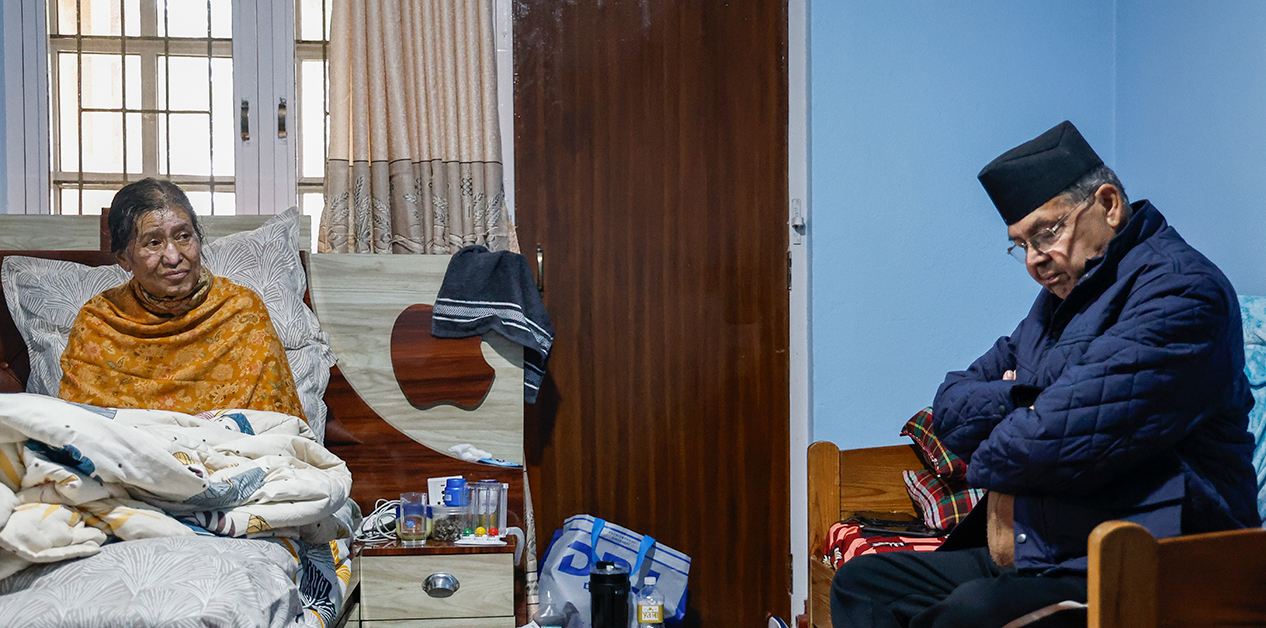
On December 24, at least 107 days after the Gen Z protest, when arriving at the house of former Prime Minister Jhalanath Khanal in Dallu, Kathmandu, the remains of vandalism and arson were seen fresh everywhere. During the protest, on September 9, protesters set fire to this very house, while Khanal’s wife, Rabi Laxmi Chitrakar, who is 71 years old, was inside the house.
She was seriously injured by the fire at her house set by the protesters. After receiving treatment in India for three months, she returned to Kathmandu only on Monday (December 22). Currently, the Khanal family is living in a rented house in Dallu, at a distance of a few hundred meters from their burnt residence.
The fire burnt 15 percent of Rabi Laxmi’s body. Initially, treatment was done at the Burn Hospital in Kirtipur. For further treatment, she was taken to Apollo Hospital in Delhi on September 22.
On the day the protesters burned their house, she was on the top floor of her house at that time.
“I lost consciousness because I couldn’t breathe amidst the thick plumes of smoke. Fortunately, I fell face down, which prevented damage to my eyes and other vital organs,” she told Nepal News while reflecting on the most agonizing day of her life. She added, “If I hadn’t been taken to India for treatment, I wouldn’t have survived.”
To such an extent, rumors also spread about her after the arson incident. Some media outlets in Nepal and India had published news that she had died.
Even after returning from her treatment, Rabi Laxmi’s suffering from the burns has not fully subsided. She explained that burn wounds require a very long time to heal: “It is slowly improving.” Sitting nearby, Khanal’s eyes were filled with the sorrow of witnessing his wife’s agony. He remarked, “A burn case is unlike any other injury. Just when you think it has healed, it begins to swell again.”
The arson not only gave Rabi Laxmi the pain of burning, but she also had to lose a body part. Her left arm has been amputated after an infection occurred in the burnt area.
According to Khanal, Rabi Laxmi was not fully conscious before being taken to India for treatment. Even 15 to 20 days after going to India, she did not know that the house and everything had already burnt. “She would say, ‘Specific items are kept in this cupboard, and others are in that place, and be sure to look after them,'” Khanal shared. It was only after some time had passed that she was finally told the truth: the house and all the belongings had already been destroyed in the fire.
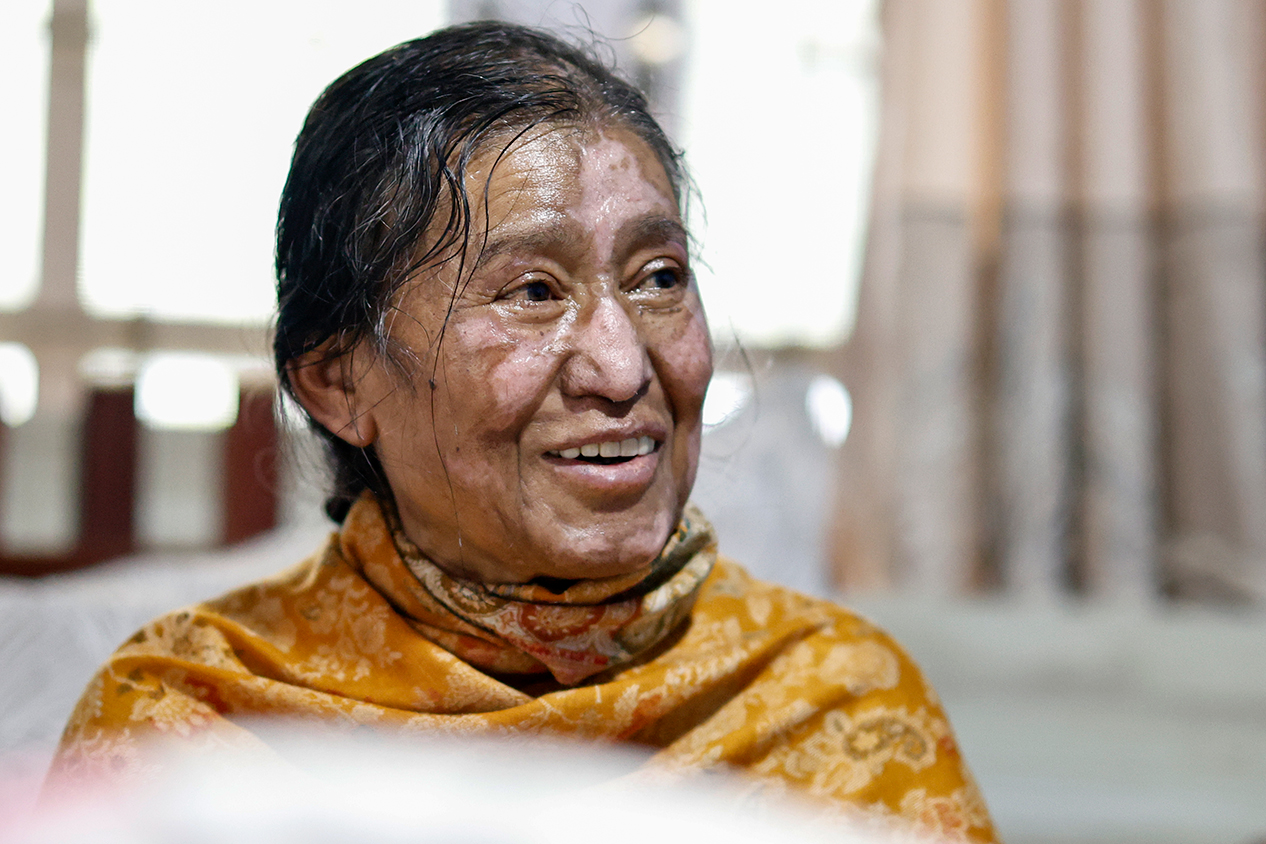
Rabi Laxmi Chitrakar. Photo: Bikram Rai
In the destruction of September 9, the houses of many leaders, including former Prime Minister Khanal, were vandalized and set on fire. Protesters had targeted the residences of leaders, saying that corrupt leaders looted the country and added to their personal property.
Similarly, Khanal believes that his house was burnt due to rumors and political revenge. “Some people say it was built by taking commissions. Such rumors and prejudices played a role in burning our house,” he said.
However, Khanal shared that he had no hand in corruption of any kind and had used the money to build the house except for using some of the remuneration saved while being a minister and member of parliament.
Rabi Laxmi’s house, her home
The Khanal family built the house in Dallu 28 years ago. At that time, it was the first house built in that area.
It is fresh in Rabi Laxmi’s memory that she received the land from her parents’ home and then worked very hard to build the house.
“We used to live uncomfortably in a rented room. After my father gave the land, I worked very hard to build the house and cover household expenses. I used to give tuitions and teach college classes from 6 AM to 6 PM,” she remembered those days.
Why Rabi Laxmi had a special attachment to the house built by earning through so much running around was also because she had made the map of the house herself.
“After looking at 2 to 4 maps, I drew the map, pulling lines with a pen and scale; the engineer looked at it, said it was fine, and signed it,” she said.
The construction of the house started in the fiscal year 1995/96. She remembers the prices of construction materials at that time by heart, which were Rs 600 for 1 truck full of sand, Rs 26 per kilo for iron rods, and Rs 250 per bag of cement. “There was no such hard time like this, like now. The house was built for Rs 2.2 million,” she shared.
The house was built in two years; after that, the Khanal family moved from the narrow rented room to their own residence on January 24, 1998.
The house was built, but it was surrounded by suspicion and questions from the beginning about what resource it was built from. According to Rabi Laxmi, an investigation regarding the house was conducted during the reign of the then King Gyanendra. She said, “During the King’s rule period, they tried to frame us regarding the house. Bhakta Bahadur Koirala, the chairman of the Royal Commission for Corruption Control, asked how I built the house. After I said I am a person who teaches from 6 AM to 6 PM, he became silent.”
Leader Khanal had entered politics during his student days, since the year 2020/21. Although Rabi Laxmi later made the academic field her workplace, she was also in politics before that. The thread of politics joined these two and led to marriage.
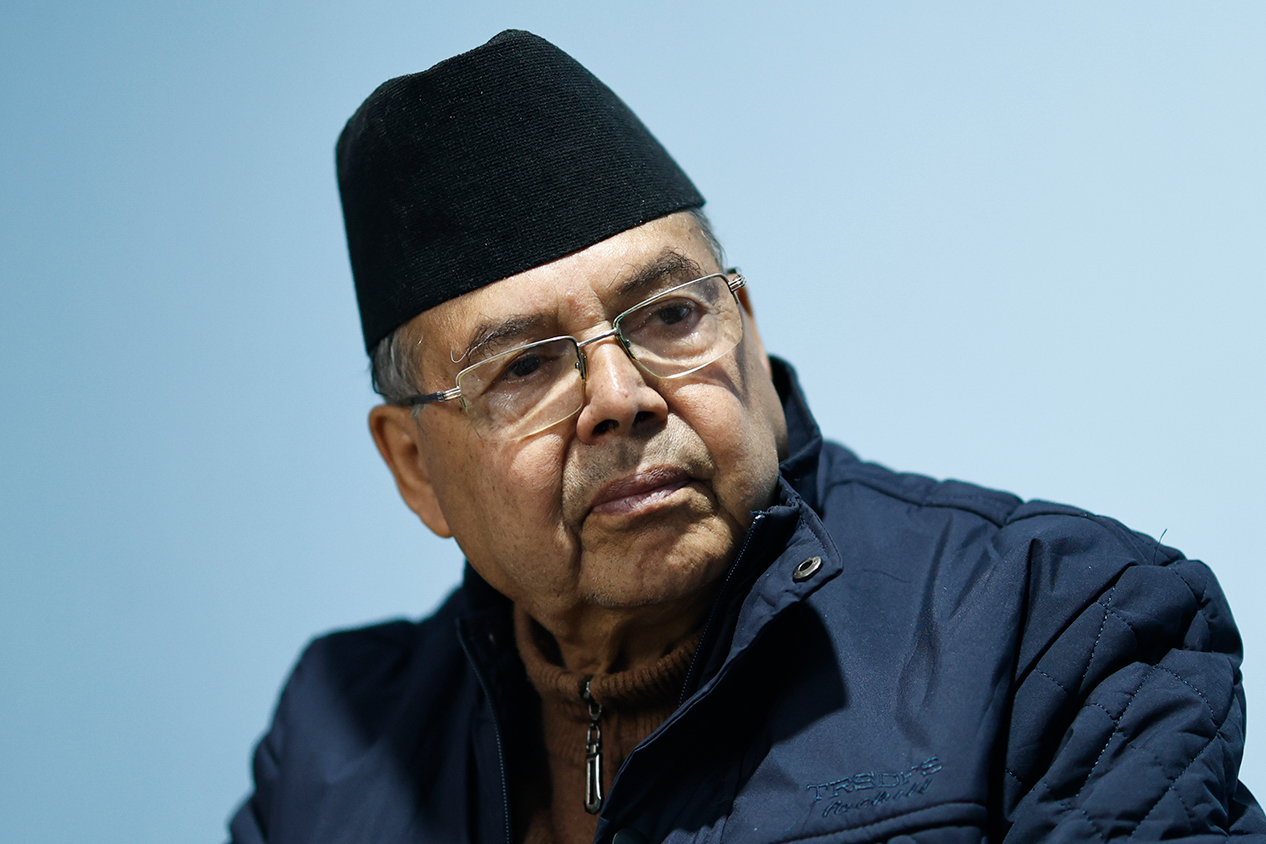
Former PM Jhalanath Khanal. Photo: Bikram Rai
The Jhapa Rebellion of 1971, considered the first incident of armed revolt in the communist movement of Nepal, attracted Rabi Laxmi to politics. Besides, there was a political atmosphere in her family itself. Her elder brother was also in politics. “There used to be conversations on political subjects at home; I got drawn by that atmosphere and joined politics,” she said.
While active in the All Nepal Revolutionary Coordination Committee, Khanal was arrested in the fiscal year 1976/71. After the announcement of the referendum in the year 1979, the Panchayat government started releasing political prisoners. In that process, Khanal was released from Jhapa jail on April 13, 1980. He came straight to Kathmandu. After that, his meeting with Rabi Laxmi took place.
They got married in the year 1982. At that time, Khanal was the General Secretary of the CPN (ML), which was conducting underground activities, while Rabi Laxmi was also associated with the CPN (ML) and was teaching in college.
According to Khanal, his marital relationship is like what is said in philosophies: incomplete without each other. “I am not without her, and she is not without me. I have saved her many times, and she has also saved me many more,” he said.
In Khanal’s assessment, the political consciousness and analysis capacity of him and his wife are equal. However, after the arrival of the multi-party system, Rabi Laxmi changed her path from politics. Her priority became household management and the teaching profession.
“When both people are active in politics, there would be difficulty in running the family; therefore, she got involved in the home and academic field, and I remained in active politics,” Khanal shared.
Khanal, who was the General Secretary of the CPN (ML) from around 1982 to 1989, became the Chairman of the CPN (UML) in the year 2008. He became a Member of Parliament five times, a minister two times, and prime minister once. He is currently a third-ranked leader of the Nepali Communist Party.
Rabi Laxmi, on the other hand, started teaching science to bachelor students at Tribhuvan University, Kirtipur, in the fiscal year 1979/80. She became permanent in the year around 1983 and was posted at Amrit Science College, Lainchaur. She retired from there in the year 2018. To run the house, she also taught in private colleges and gave tuition at home.
Having taught for 39 years, she established an identity as a skilled professor of physics. She was dear among students. Those who knew her as a professor and teacher wrote on social media only after the incident of September 9 that she was the wife of former Prime Minister Khanal. She shared that after being burnt, many students she had taught inquired and searched about her health. “While I was staying in India for treatment, doctors told me that students in various countries had called.” She expressed happiness about the love earned from the teaching profession.
Complaint against the government
While in Delhi during the treatment, Indian politicians and Members of Parliament came to inquire about her health condition. However, Khanal is hurt that his own government ignored them. “The government has offered no assistance, lacking even the decency of an inquiry or a gesture of simple sympathy. This is an administration devoid of humanity,” he said. He further added that politicians and friends are the only ones who helped them during the treatment.
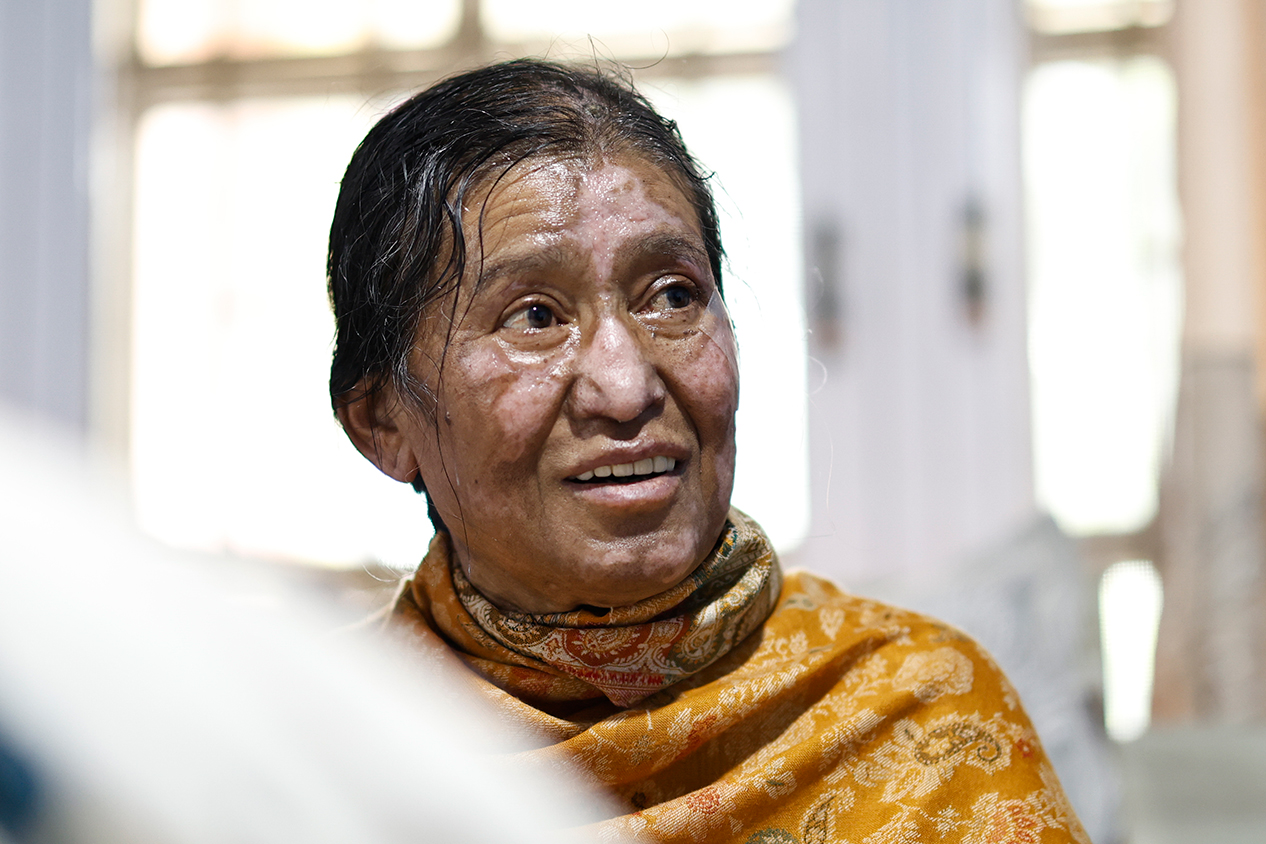
Rabi Laxmi. Photo: Bikram Rai
After the death of 21 people from government suppression in the Gen Z protest on September 8, the Khanal couple had a premonition that something was about to happen in the country, but they did not estimate destruction to this extent. Both had never felt scared and unsafe before that.
Rabi Laxmi also said that because of her faith in the government, she never thought such a day would come. “If I had distrusted, then there would have been suspicion, and I would have been alert myself. I felt that there are so many army and police, national investigations, and administrations, but on September 8 and 9, the governing bodies failed in their duty to protect citizens and property from destruction on such a large scale,” she said. “Because of not being able to run the nation well, such a condition has come to our beautiful country.”
She demands that the government should investigate who was behind the incidents of arson and looting of public and private property on September 9, find the guilty, and take action.
She questioned whether the government was willing to conduct a credible investigation into who orchestrated the incident, warning that the youth must also recognize how they are being turned into pawns. If those pulling the strings are themselves in positions of power, she asked, how can the problem ever be resolved?