Kathmandu
Friday, February 20, 2026





In Panchkhal Municipality’s Shikharkateri, farmers struggle to survive without irrigation as nearly a third of Kavre’s water sources dry up, and election hopefuls stay silent
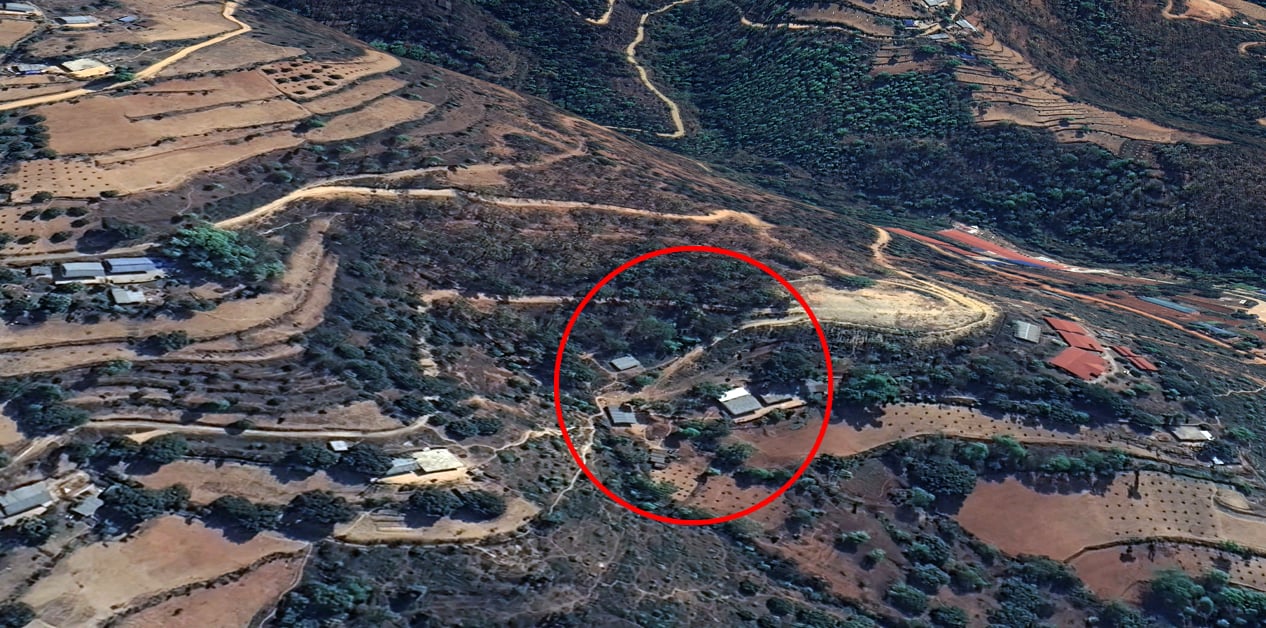
Saptamaya Tamang and Kumar Tamang of Shikharkateri in Panchkhal Municipality–11, Kavre, worked as daily wage laborers as long as their bodies allowed. Through sheer physical effort, they raised and educated their children. They rebuilt their house after it was destroyed in the 2015 earthquake.
Now in their early 50s, the Tamang couple have turned to commercial vegetable farming to earn a living. However, due to the lack of irrigation facilities, they have been unable to produce vegetables properly. They complain that it is difficult even to recover their investment. On the foggy morning of 11 February, the couple shared the hardship of farming without irrigation.
This year, they spent 12,000 rupees cultivating Akabare chili in the field below their house. The crop failed to thrive. They earned only 4,500 rupees from selling it. They planted tomatoes, spending 35,000 rupees on two tunnels, seedlings, and fertilizer. The tomatoes suffered the same fate. They earned only 7,000 rupees from selling them.
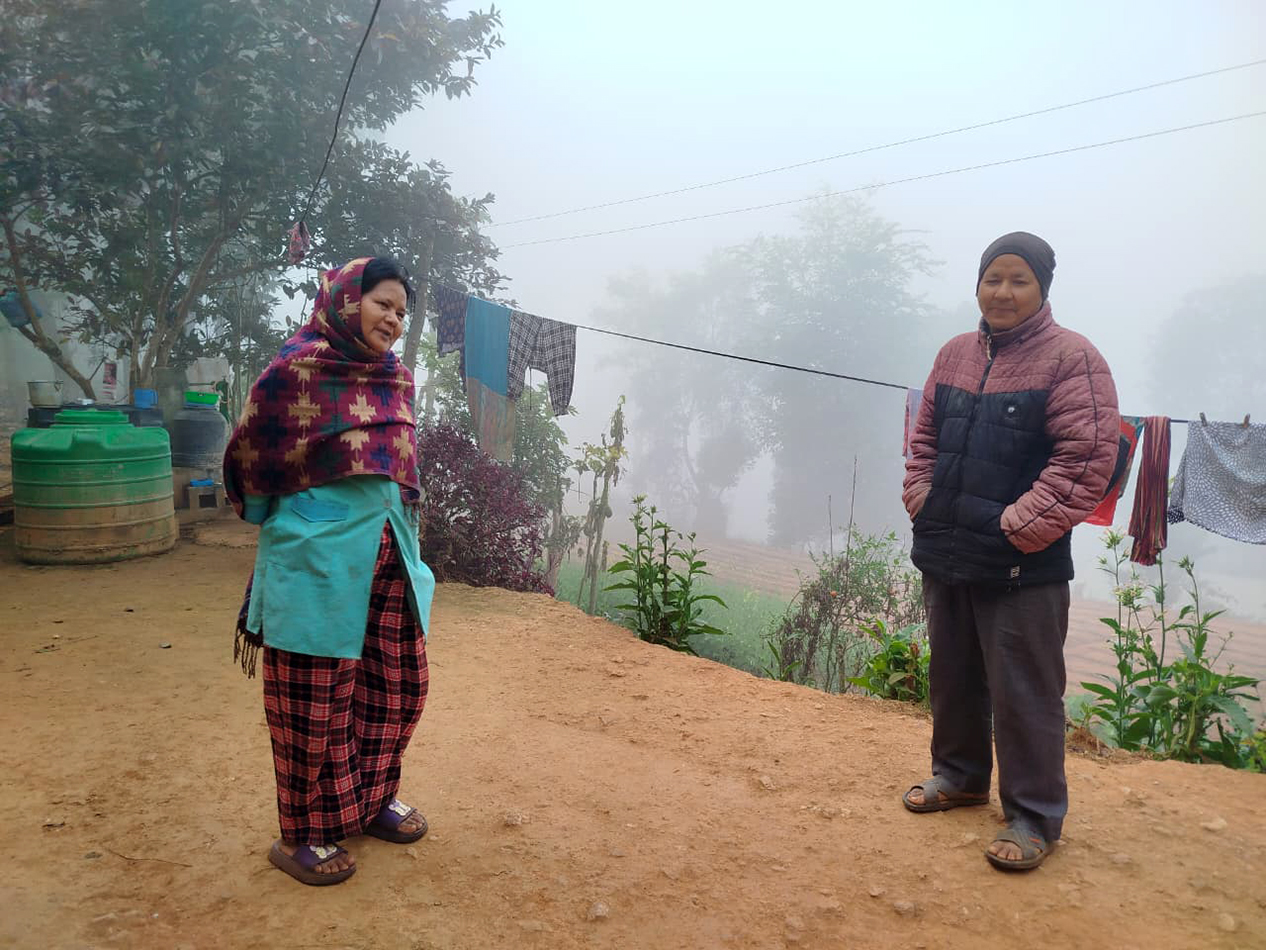
Saptamaya Tamang of Shikharkateri and her husband, Kumar Tamang Photo: Bidhya Rai
“We can’t even recover our investment. If there had been sufficient irrigation, the yield would have been good,” Kumar says. Pointing toward Jhigu River below the village and the Sunkoshi River across, he adds, “So much water from the river is going to waste. If we could bring it here, we could grow a hundred sacks of potatoes.”
After traveling about 45 kilometers from Kathmandu along the Araniko Highway, one reaches Shikharkateri. The village has around 60 households, and agriculture, passed down from their ancestors, is their primary livelihood. Those with lowland fields (for paddy cultivation) somehow manage to produce enough food for the year. Families with only upland fields depend on rain-fed maize and millet, which barely sustain them for six months. For the remaining six months, they must work as laborers—carrying gravel and sand, building houses, bridges, and roads—to earn money to buy food.
Like the Tamang couple, agriculture is the main occupation of Panchkhal residents. According to the Panchkhal Municipality Profile (2080 BS), out of the municipality’s total area of 102.93 square kilometers, 54.35 percent is cultivable land. The profile states that if irrigation facilities are expanded and scientific farming methods adopted, the municipality could become self-sufficient in food production. However, irrigation facilities are not available in all areas.
Despite being determined to sustain themselves through farming, the farmers of this village, located about nine kilometers from the Panchkhal municipal office, lack even minimum irrigation facilities.
The Tamang couple have repeatedly complained to local representatives about irrigation. Two years ago, they received one and a half coils of pipe, but it did not last due to sand and silt blockage. Although water from the Sunkoshi Drinking Water Project was supplied to Shikharkateri a month ago, water does not flow regularly from the taps.
Even without a proper irrigation system, they have not given up vegetable farming. They have planted mustard greens, cress, onions, garlic, and other vegetables. They built a plastic pond near their house to collect tap water. This is their strategy to irrigate their crops using the water that occasionally trickles from the tap.
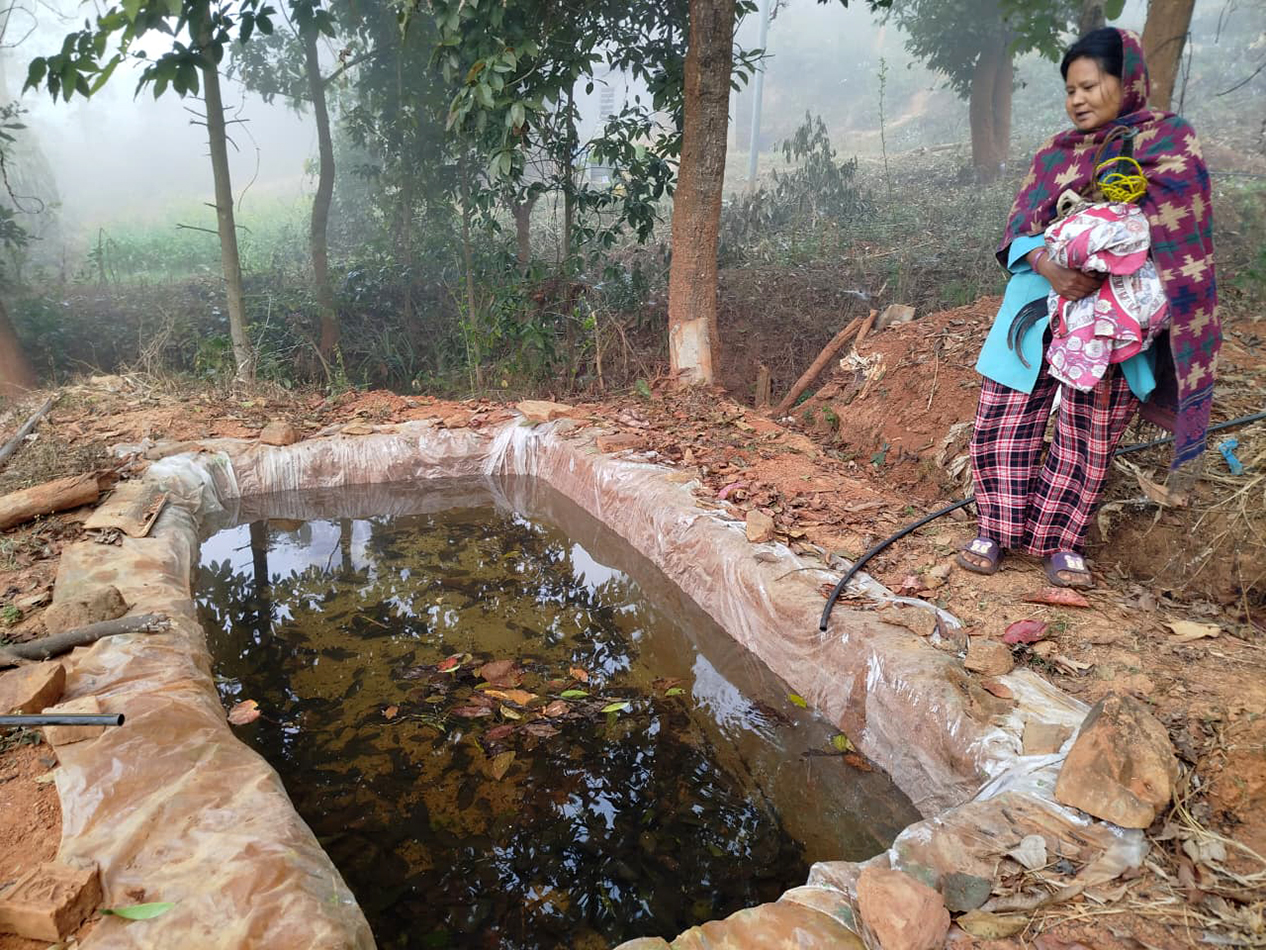
The plastic pond built by Saptamaya and Kumar Tamang Photo: Bidhya Rai
As the winter fog over Panchkhal began to clear, Sudina Tamang, an upper-house neighbor of Saptamaya, returned from her field carrying dried maize stalks for her buffalo. The harvest from her upland field barely feeds her family for six months. For the remaining months, they must buy food. Her two children study at the local school.
Sudina’s husband has been working in Greece for the past two years. Before leaving abroad, he used to work in house construction to support the family. “We had to rebuild our house after the 2015 earthquake destroyed it. On top of that, I fell ill and had to take loans for treatment. He went abroad to repay those debts,” Sudina says.
The responsibility of managing the household and community obligations rests on Sudina’s shoulders. She walks downhill for half an hour to deliver milk to a collection center. With that income, she buys salt and oil. The tap, which supplies water every other day, stops before even filling two pitchers.
Since the old tap water supply was insufficient, a new tap under the Sunkoshi Drinking Water Project was installed a month ago. But it too does not provide regular water. Instead, it has added another monthly fee. The old tap costs 350 rupees per month. She has heard that the new tap will cost 450 rupees per month.
There is no income. I want to farm on the upland to earn, but there isn’t enough water,” she says.
The issue has been worsening. According to a research article titled “Community Driven Assessment of Springs and Ponds: Status, Dependency and Utilization in Kavre District, Central Nepal,” published last December on ResearchGate by five authors including Anju Pandit and Sirjan Thapa, the water crisis is deepening. The study, prepared after mapping 5,168 water sources and 521 ponds across the district, states that around 27 percent of water sources and ponds in Kavre have already dried up. Over the past decade, the water volume in about 58 percent of active sources has been gradually declining.
Even as drinking water and irrigation problems continue to intensify in Kavre, candidates in the upcoming House of Representatives election have not included the issue in their agendas. The residents of Shikharkateri are frustrated with candidates who enter the village only to ask for votes. Kumar says that although the water problem has existed for years, leaders who were elected with their votes never return to understand the hardships faced by farmers. “What’s the point of voting now? Once they reach their chairs, they don’t come back. All leaders are selfish,” he says.
Sudina has also decided not to vote. “Whoever wins, if something happens, we have to handle it ourselves,” she says. “We suffer this way or that way. I’ll just stay home this time.”
Kavre district has two electoral constituencies. Altogether, there are 326,611 registered voters in the district. Panchkhal Municipality falls under Constituency No. 2.