Kathmandu
Thursday, January 8, 2026





Experts advise using electric stoves where possible, or improving ventilation in traditional kitchens
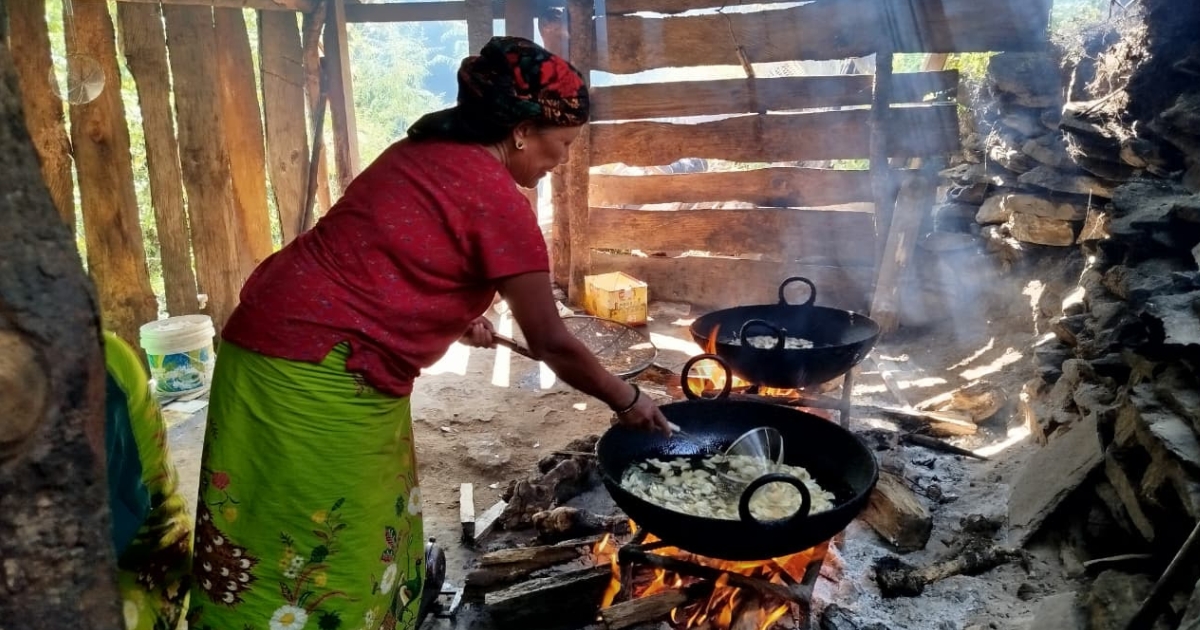
KATHMANDU: When 45-year-old Sita Rai of Bhojpur’s Hatuwagadhi Rural Municipality–2 suddenly began suffering last September from persistent coughing, chest pain, burning and itching in her eyes, and blurred vision, she went for a check-up at the BP Koirala Institute of Health Sciences in Dharan.
After the examination, doctors did more than prescribe medicines; they also warned her to avoid smoke inside the house. “The doctor said my problems were caused by smoke, and that they would keep recurring if I didn’t protect myself from it. But I can’t avoid kitchen work. So, how am I supposed to escape the smoke?” Rai asks.
Health problems caused by smoke released from kitchens or inside homes are a compulsion faced by most Nepali women. According to a study report made public by the World Health Organization (WHO) on 16 December 16, 2025, the use of traditional fuels such as firewood, cow dung cakes, kerosene and coal – whether for cooking meals and snacks or for preparing animal feed – generates indoor smoke that has added to the suffering of homemakers worldwide.
Indoor air pollution contains toxic particles, carbon monoxide, benzene and formaldehyde. These are substances that cause serious harm to human health. In homes without proper ventilation systems to expel smoke, these poisonous fumes and dust enter the body through the respiratory tract.
Women, who remain busy in the kitchen throughout the year, bear the greatest burden of indoor air pollution. Infants carried by their mothers are also exposed to toxic kitchen smoke, the WHO report notes.
Often neglected, the impact of household air pollution is alarming. WHO data show that in 2021 alone, nearly 2.9 million people worldwide died due to household air pollution, including more than 309,000 children under the age of five. About 9.5 million people are living with disabilities caused by household air pollution.
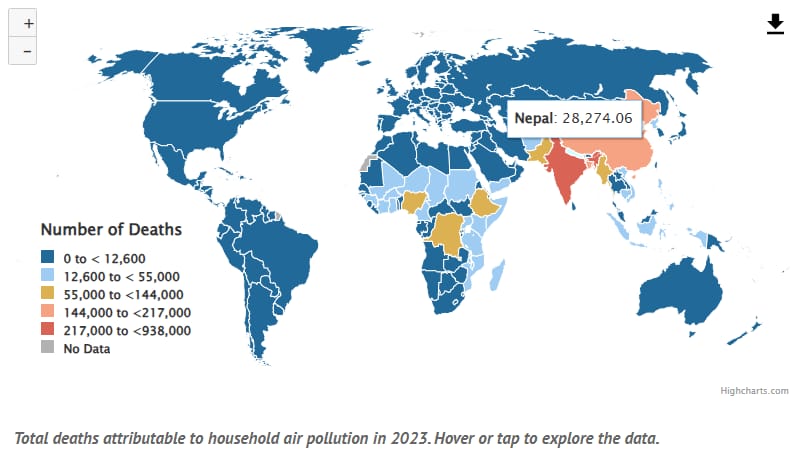
Deaths caused by household air pollution in Nepal in 2023. Photo: State of Global Air
According to a WHO report from 2009, around 8,007 women and children in Nepal die prematurely each year due to polluted indoor air produced by burning firewood.
WHO reports further state that household air pollution increases the risk of non-communicable diseases such as stroke, heart disease, chronic respiratory illnesses and lung cancer. Among women, especially pregnant women, it raises the likelihood of low birth weight, miscarriage and uterine cancer. There are also higher risks of respiratory infections, asthma, ear infections, tuberculosis, cataracts, nasal infections and various cancers.
Public health expert Dr Sharad Onta stresses that to reduce the impact of household air pollution, priority should be given to using electric stoves wherever possible. “If cooking has to be done on fire, kitchens must be equipped with proper ventilation to allow smoke to escape, and cooking responsibilities should be shared among family members,” he says.
According to the WHO, more than two billion people worldwide still rely daily on firewood to cook their food. The practice is far more common in rural areas than in cities.
Nepal’s National Census 2021 also shows that more than half of the country’s households – around 3.4 million – primarily use firewood for cooking. Another 193,000 households use cow dung cakes, while about 3,400 families rely on kerosene. Karnali Province has the highest dependence, with 82.2 percent of households using firewood for cooking.