Kathmandu
Sunday, February 1, 2026





The government’s school midday meal program now prioritizes locally available indigenous and nutritious food for students

KATHMANDU: Unique Mehta, an 8-year-old fourth grader at Rudramati Basic School, lives near the Dhobi Khola corridor, Baneshwor. Since his mother leaves for work at 5 AM, the 8-year-old often goes to school without a home-cooked meal. Thanks to the midday meal provided by the school, his mother can go to work without worrying about her child’s nutrition.
“I get some snacks or leftover food in the morning before going to the school. At the school we usually get milk, vegetable curry, and eggs along with beaten rice or bread (roti), all made from scratch and fresh. Almost every day, the meal menu is different,” said Mehta.
Similarly, Aryan Karki, a Grade 5 student at the same school who lives in Ghattekulo, also comes to school without eating much at home in the morning. His parents work as wage workers. Karki explains that due to the rush of going to work early, his parents do not get enough time to cook snacks or meals, so he comes to the school after eating only a light meal. He says, “I like coming to school; the lunch is delicious, and I like to study too.”
The school has a 45-minute lunch break at 1 PM. Last Wednesday, when a Nepal News correspondent visited the school, it was lunchtime. That day’s meal was egg and beaten rice. Mehta, Karki, and all the students were enjoying the meal. Principal Manju Shrestha explains that the school feeds the students various nutritious snacks by creating a weekly menu.
Rudramati School has 49 students from Early Childhood Development (ECD) to Grade 5. For the midday meal, the Kathmandu Metropolitan City (KMC) provides Rs 35 per student to the school. Principal Shrestha states that this amount is used to provide food like lentils, rice, vegetables, bread, yogurt, milk, grams, eggs, beaten rice, and rice pudding, among other edibles. This midday meal has become the main meal of the day for most students.
Shrestha says, “Due to the weak economic condition of families, parents leaving for work early in the morning, and the lack of nutritious and balanced food at home, the school lunch is a complete meal for many children. This meal is also what keeps the students in school with almost hundred percent attendance.”

Principal Manju Shrestha of Rudramati Basic School
There are 89 public schools, including Rudramati Basic School, within the KMC. The government provides free midday meals to children from ECD up to Grade 5 attending these and other public schools across the country.
From junk food to nutritious meals
The history of the midday meal program in government schools in Nepal dates back to nearly six decades. The program was initiated in 1967. Starting in schools attended by children from backward communities in 37 districts, the program showed a positive impact on increasing children’s enrollment rates, continuation of studies, and learning achievements. Consequently, it was expanded to more districts. The midday meal program was implemented in public schools across the country starting from the fiscal year 2019/20.
However, certain irregularities began to appear in the program. Specifically, government studies and monitoring showed that the quality of food provided by some schools was poor, and many schools were providing packaged, low-nutrition ‘junk food’ like noodles and biscuits. To end this problem, the Ministry of Education, Science and Technology approved and implemented the ‘Nutritious School Midday Meal Format, 2024’ through a ministerial-level decision.
The format was issued with the objective of facilitating the management of nutritious snacks based on local agricultural products according to specified standards. It holds the local government or the local unit responsible for managing such meals. Accordingly, public schools receiving funds from the federal government and local governments are preparing and serving healthy and nutritious midday meals from local produce and locally available food items. Schools that previously served junk food in their midday meals have now reformed and started serving indigenous and nutritious snacks.
Various studies have shown that junk food increases the risk of malnutrition and obesity. Such unhealthy foods particularly affect children who are in the phase of physical and mental development. Junk food is generally considered harmful to health because it lacks nutrients, contains various chemicals, and is excessively salty, sweet, and oily. The midday meal program was implemented with objectives including improving the existing health and nutritional status of students and improving education for children in special areas lacking nutritious food. However, schools implementing the program did not just undermine the core objective by serving packaged and unhealthy snacks; they also jeopardized the health and physical/intellectual development of young children.
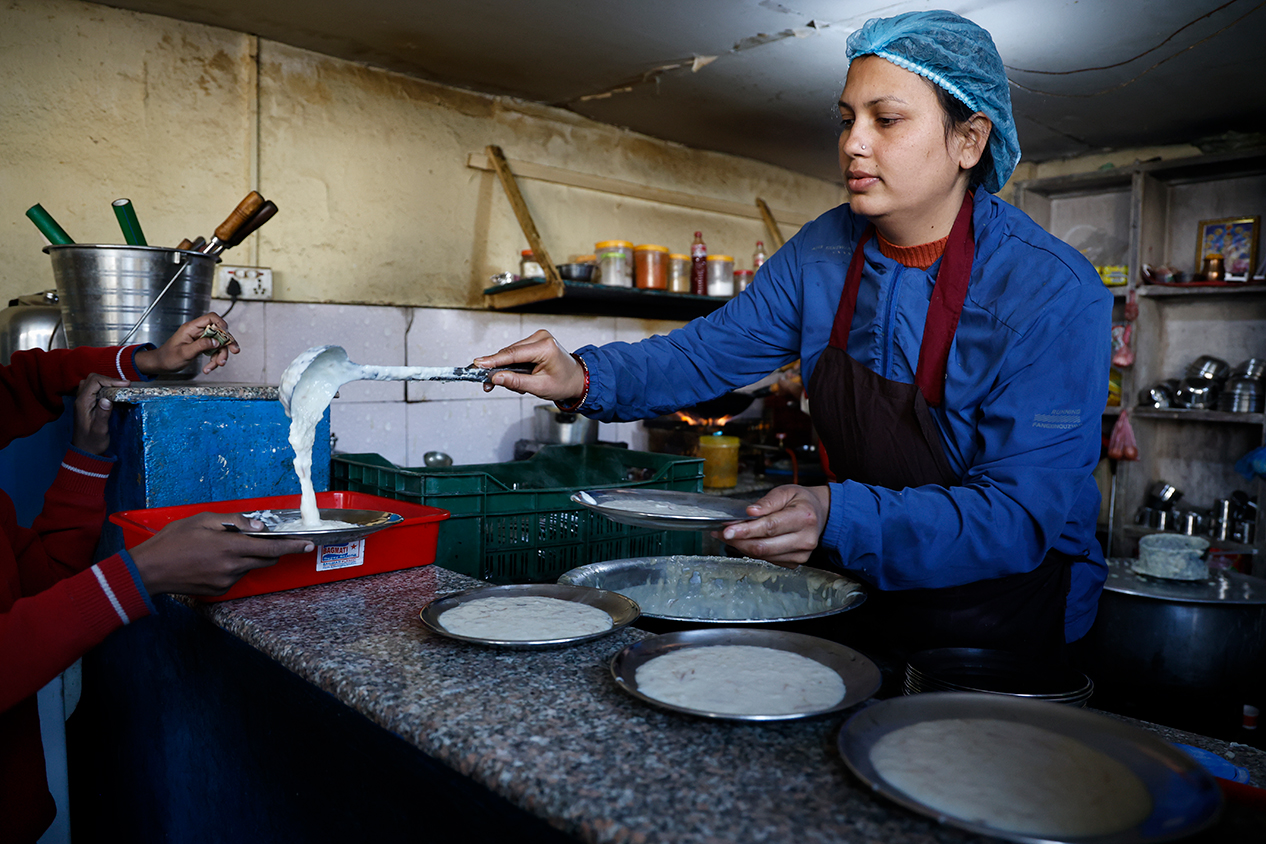
Fresh, nutritious meals served at Padmodaya Secondary School’s canteen. Photo: Bikram Rai/Nepal News
The midday meal format issued in 2024 clearly states that the ‘midday meal program should proceed not just as a hunger-alleviating program but as a nutrition-sensitive program.’ It mentions that school-going children need required amounts of carbohydrate, protein, vitamins, minerals, and fat for their physical and intellectual development, according to their age. Providing locally-produced midday meal according to the format offers twin benefits. One, children receive nutritious and balanced meals from local produce. Two, increasing the use of indigenous agricultural products to prepare midday meals expands the local agricultural market.
Hari Prasad Paudel, director and information officer at the Centre for Education and Human Resource Development (CEHRD), states that many schools have recently begun utilizing local agricultural produce for midday meals.
The ‘Community School Midday Meal Standards and Program Facilitation Booklet 2020’ published by the CEHRD outlines various standards to ensure food safety and hygiene while preparing locally produced snacks. These standards mandate measures such as clean cooking utensils, food preparation materials, food storage baskets, kitchen cleanliness, prohibition of processed foods, and banning the use of plastic containers for eating snacks.
While preparing the midday meal, a balanced use of cereals, pulses, vegetables, fruits, and animal products is mandatory. Accordingly, every meal must contain 50-60 grams of grains, 40-50 grams of pulses, 30-50 grams from fruits and green vegetables, and 20-30 grams from animal products, totaling 150 to 200 grams. The average has been set at 175 grams per student by combining all four food categories.
The ‘School Midday Meal Management Helper’s Guide 2020’ details the preparation of snacks according to the midday meal standards. Madhu Ghimire, undersecretary and information officer at the Ministry of Education, states that snacks can be managed according to the menu provided in the booklet.

Ready to eat vermicelli for the students
It is expected that managing the midday meal to promote local production will boost the market for local agricultural produce. Some schools have started growing vegetables on their own premises. Ghimire states that this reduces the cost of snacks while also providing agricultural education to the students.
Nutritious meals cooked at school
A total of 291 students from ECD to Grade 5 study at Sitaram Secondary School located in Nagarjun Municipality-6, Kathmandu. The school provides snacks worth Rs 30 per student. Assistant Headmaster Saroj Bohora states that six days a week, the school prepares and serves varied meals on-site, including mixed pulses and beaten rice, rice pudding and grams, pasta, semolina pudding and vegetables, rice cooked with ghee/oil, vegetables and eggs, and vegetable fried rice, among other food items.
Padmodaya Secondary School at Ramshah Path serves midday meals to 566 students. One of the goals of the midday meal program is to ensure regular student attendance in class. Accordingly, based on 180 days of school operation attendance, this school receives Rs 20 per student from the federal government and Rs 15 from the KMC.
“The attendance of students, especially up to grade five, is regular, and one of the main reasons is the delicious and nutritious midday meals provided by the school,” said Sharmila Pokharel, principal of Padmodaya School.
According to the ‘Community School Midday Meal Standards and Program Facilitation Booklet 2020,’ nutritious food is extremely important for the growth, development, and learning of children. International standards dictate that a child must receive at least 30 percent of their daily required nutrition from the midday meal. It is on this basis that the government provides midday meals to students from ECD up to Grade 5. According to the Ministry of Education, Science and Technology, at least 618,825 students are enrolled at the ECD level in public schools across the country. There are 27,298 public schools nationwide.
The ‘Operational Procedure for Student Snack Program in Community Schools, 2017’ issued by the Department of Education lists various objectives of the midday meal program. These include improving the existing health and nutritional status of students, improving education for children in special areas identified as lacking nutritious food, increasing the enrollment rate of school-age children to enhance access to education, reducing student repetition and dropout rates, increasing student class attendance rates, and increasing student learning achievement.
“The attendance of students, especially up to grade five, is regular, and one of the main reasons is the delicious and nutritious midday meals provided by the school,” said Sharmila Pokharel, principal of Padmodaya School.
Shiv Kumar Sapkota, spokesperson for the Ministry of Education, Science and Technology, says that the midday meal program has helped attract students to school and contributed to raising the children’s education levels. “The government implemented this program because students who are provided midday meals can learn better than students who attend the school on empty stomachs all day,” he says. “The elimination of junk food is also a part of the midday meal program. It is our belief that providing locally available, indigenous food items in the midday meal improves students’ health and nutrition.”
A 2012 study in China investigated the impact of the school meal program on anemia (blood deficiency) and academic performance among rural students. The study, which included 3,600 students, concluded that the meal program improved hemoglobin levels in children’s blood and significantly increased learning achievement in mathematics.
A study conducted in Nepal in 2018 showed that students who were provided midday meals stayed in school for an average of 0.88 years longer than others.
According to Under Secretary Ghimire of the Ministry of Education, the country has been divided into 10 zones based on Nepal’s agricultural production and eating habits, and 60 types of menus have been prepared for the midday meal. Schools receive Rs 20 per student daily to prepare and serve snacks according to this menu. While the government used to provide Rs 15 per student, it has increased the budget for this program to Rs 20 starting from the current fiscal year 2025/26. Government officials expect this will make the program more effective than before.
The government allocates approximately Rs 8.5 billion annually for the midday meal program. At least Rs 8.45 billion was allocated in the fiscal year 2022/23, Rs 8.39 billion in 2023/24, and Rs 10.19 billion has been allocated for the purpose in the current fiscal year 2025/26. This time, the budget was increased by an additional Rs 5 per student.
However, many schools have complained that even with the increased funds this year, they are unable to fully implement the prescribed menu. Dhan Man Shakya, principal of Sunkhani Secondary School in Dhading, says it is difficult to provide nutritious snacks like eggs, fruits, and milk with the daily Rs 20. “The limited budget received does not allow us to provide the nutritious diet specified on the government’s menu,” she states.
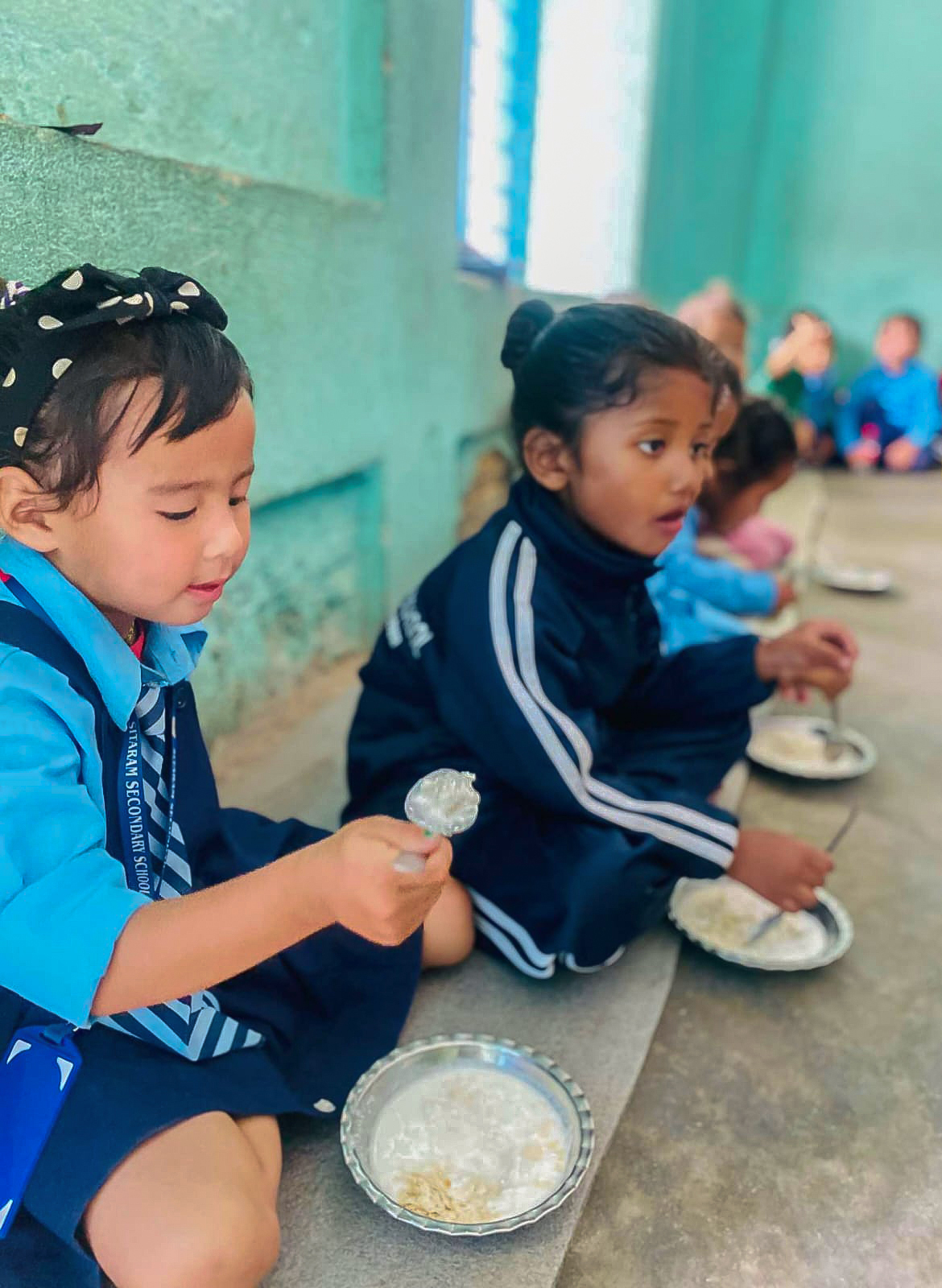
Students of Sitaram Secondary School enjoying midday meal
Director Paudel of the CEHRD says that schools are trying to raise additional resources by collaborating with local governments and parents.
Challenges
The responsibility of monitoring the school midday meal program lies with the local governments. However, the lack of regular monitoring in schools raises the risk of compromising nutrition, a sensitive issue connected to children’s health and development. Teachers themselves admit that there is no regular inspection of the midday meal. Principal Shakya of Sunkhani Secondary School notes, “Due to limited physical infrastructure in schools, there is a problem of kitchen and management, including storage and utensils, besides the lack of regular inspection.”
The Ministry of Education also lacks data on the overall status and impact of the program.
Nepal can learn from other countries to make this program more effective. In neighboring China, the midday meal program is strictly enforced. A 2012 study showed that the program is effective due to joint investment by the central and local governments, a menu created by nutritionists, safe kitchens, daily monitoring, and a system for regularly informing parents.
Bandita Nepal, secretary of the Rural Health and Education Service Trust, an organization working in nutrition and health sectors, suggests that Nepal could adopt the China model to make the midday meal more effective. She states that the delay in budget allocation and complex physical geography also pose challenges to the program’s effectiveness in Nepal. She says, “Especially in remote and rural schools, there is a problem with the budget not arriving on time and difficulties in transporting food materials.”
Assistant Headmaster Bohora of Sitaram Secondary School states that the midday meal program has become a lifeline for the poor and children at risk to stay in school. He further adds, “This program is crucial for keeping the students in school and enabling them to access education. Adequate budget and regular monitoring are essential to make it sustainable.”