Kathmandu
Tuesday, January 27, 2026





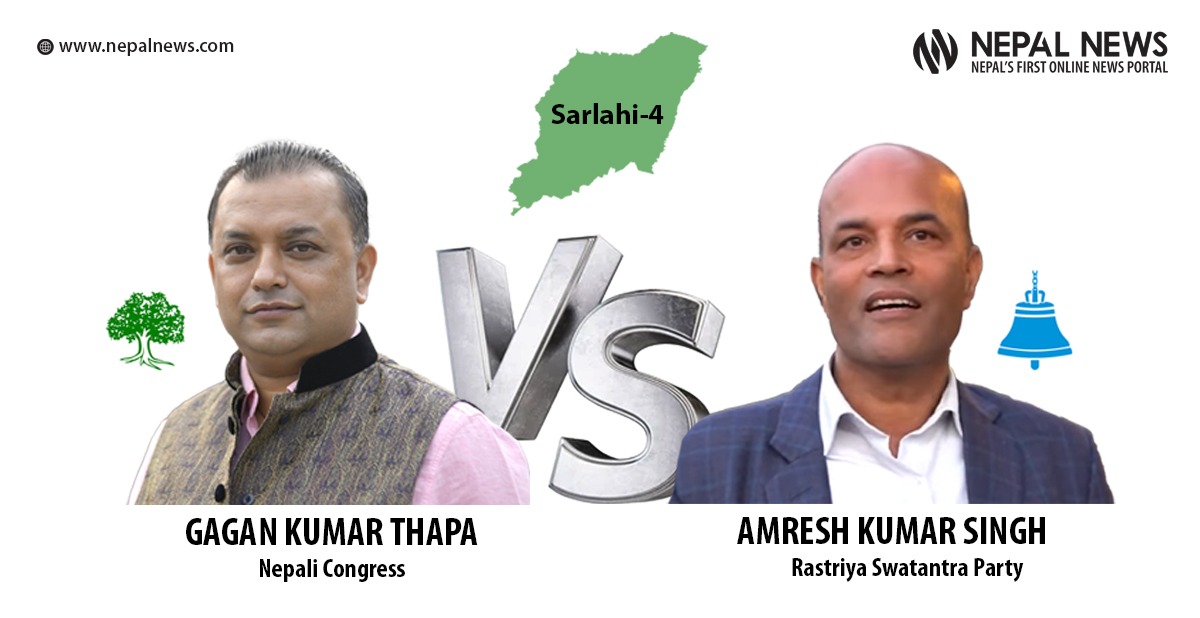
KATHMANDU: The electoral contest in Sarlahi constituency number 4 is shaping up to be one of the most closely watched battles in the upcoming House of Representatives elections on March 05. Once considered a routine stronghold, Sarlahi-4 has now emerged as a high-stakes political epicenter, where personal credibility, party loyalty, and national ambition intersect.
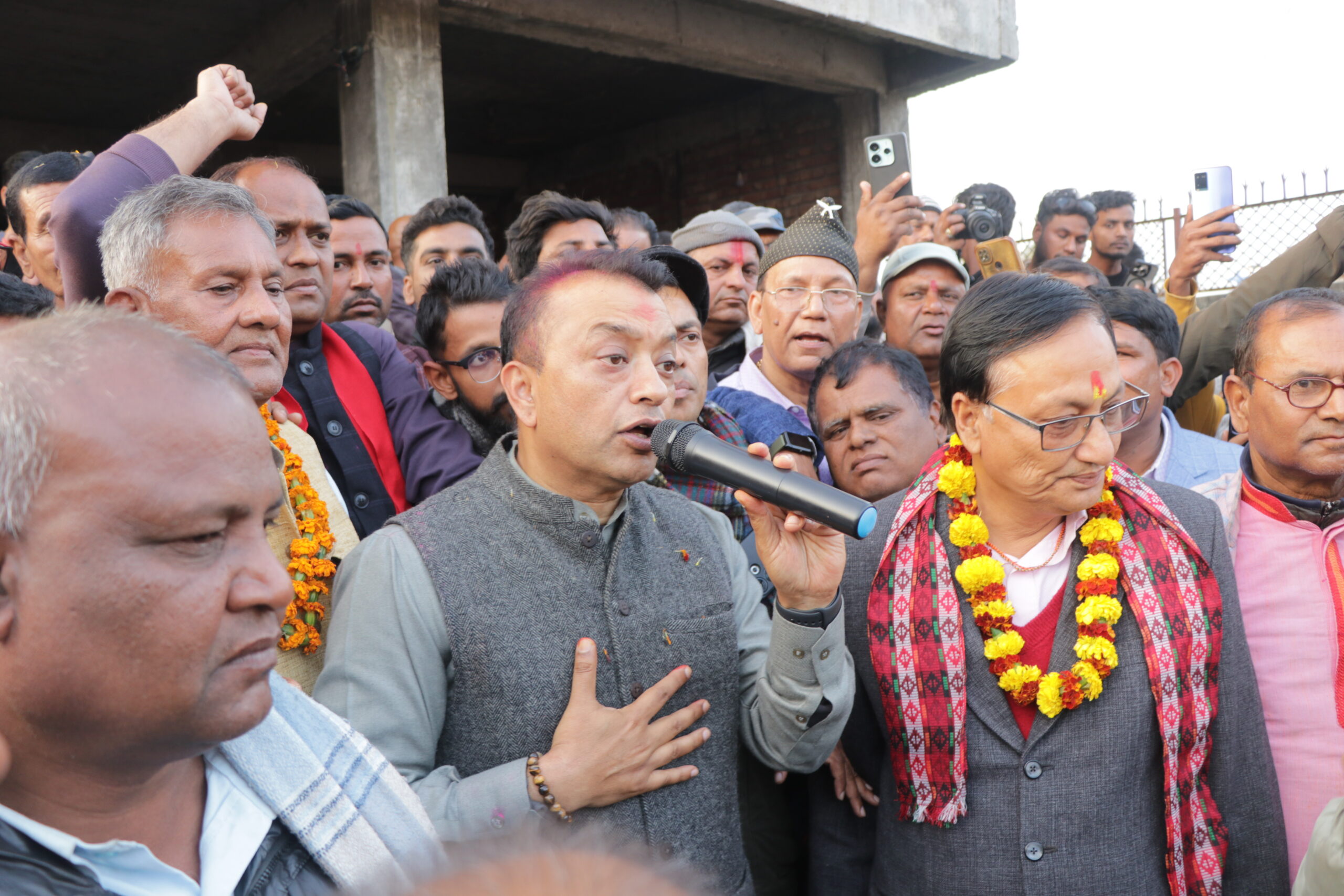
At the center of this contest is Gagan Thapa, who rose to the presidency of the Nepali Congress through a special general convention and is widely viewed as the party’s poster boy for the future. For Thapa, the road to the prime ministership is inseparable from electoral success—not only across the country but, crucially, in his own constituency. In that sense, Sarlahi-4 has become more than just another seat; it is a referendum on his leadership and political momentum.
The question that now dominates political discussion is straightforward but loaded: if Gagan Thapa is to lead the Nepali Congress into a new era, what does his own electoral test in Sarlahi-4 reveal? The answer carries implications far beyond district boundaries.
Standing opposite him is Amresh Kumar Singh, the independent candidate who won the 2022 HoR election from this very constituency. This time, Singh has entered the race under the banner of the Rastriya Swatantra Party(RSP), transforming what might have been a conventional party contest into a direct clash between institutional power and anti-establishment appeal.
The dynamics of the race have been further complicated by developments in Madhesh politics. The RSP’s decision to project senior leader Balen Shah as its prime ministerial candidate has generated visible enthusiasm across the region. In 32 constituencies spanning eight districts, there is a growing sense of loyalty toward Balen Shah due to his Madeshi roots, a sentiment that inevitably spills into Sarlahi-4. For Gagan Thapa, this represents an additional layer of challenge—one rooted not in party rivalry alone, but in shifting voter emotions and expectations.
Yet history weighs heavily in Thapa’s favor. Sarlahi-4 has long been understood as a Nepali Congress stronghold. Amresh Kumar Singh himself won this constituency twice as a Congress candidate, a reminder that the party’s organizational roots and voter base here run deep. The present contest, therefore, is not just about personalities, but about whether long-standing party allegiance can withstand the pull of new political identities.
In this sense, Sarlahi-4 stands as a microcosm of Nepal’s evolving political landscape. It reflects the tension between continuity and change, between party legacy and new party charisma. For Gagan Thapa, the constituency offers both opportunity and risk: a chance to consolidate his claim as a national leader, and a reminder that leadership aspirations are ultimately tested at the ballot box.
As election day approaches, Sarlahi-4 is no longer just watching the national race—it is shaping it.
Defined by the past, decided in the present
Sarlahi constituency number 4 has long been regarded as a traditional stronghold of the Nepali Congress, shaped by decades of political continuity and shifting allegiances. From 1991, 1994 to 1999, Mahantha Thakur secured three consecutive electoral victories from this constituency under the Nepali Congress banner, firmly establishing the party’s dominance in the area. However, Thakur’s eventual departure from the party marked a turning point in Sarlahi-4’s political trajectory.
Following that shift, Amresh Kumar Singh emerged as a central political figure in the constituency. Contesting from the Nepali Congress, Singh won the 2013 Constituent Assembly election and the 2017 general election, reinforcing the party’s hold on the seat. In 2022, however, the political landscape changed again when Singh contested as an independent candidate and won, signaling a gradual but significant transformation in voter behavior.
Sarlahi-4 has not always remained within the Nepali Congress fold. In the first Constituent Assembly election of 2008, Shiva Pujan Raya of the then Madhesi Janadhikar Forum secured victory from this constituency, illustrating that regional and identity-based politics have also found resonance here at critical moments.
The upcoming election has brought Sarlahi-4 into the national spotlight. Nepali Congress President Gagan Kumar Thapa contest from this constituency, marking a notable shift as he leaves Kathmandu-4 to enter a more politically complex and symbolically charged arena. Opposing him is Rashtriya Swatantra Party leader Amresh Kumar Singh, who represented Sarlahi-4 as an independent member of parliament in 2022.
In the last election, Singh defeated Nepali Congress candidate Nagendra Kumar by a margin of 1,764 votes, a result that underscored both his personal influence and the constituency’s growing openness to alternatives beyond traditional party lines. This time, the contest is expected to be even more intense.
Adding to the complexity of the race, as many as 39 candidates—representing various political parties and independent platforms—have filed their candidacies in Sarlahi-4. Yet despite the crowded field, attention remains firmly focused on the principal contenders. With heavyweight candidates in the fray and a history that reflects both loyalty and change, Sarlahi-4 is poised to become one of the most closely watched constituencies in the election.
Singh, who had earlier contested as an independent after being denied a ticket by the Nepali Congress, has now formally joined the Rashtriya Swatantra Party (RSP). The shift has added a sharp political edge to the contest in Sarlahi-4, where Congress President Gagan Kumar Thapa is set to face Dr. Amresh Kumar Singh—a Congress figure turned rival.
The roots of this rivalry go back to the 2022 House of Representatives election. That year, after failing to secure a Congress ticket, Singh entered the race as an independent candidate. His decision was accompanied by public accusations against Thapa, whom he blamed for blocking his candidacy. Even then, there was widespread speculation about Thapa’s possible move to Sarlahi-4, though he remained in Kathmandu at the time.
The 2022 results fundamentally altered the political reading of the constituency. Singh won the election with 20,017 votes, defeating Congress candidate Nagendra Kumar, who secured 18,253 votes. Another independent candidate, Madhumala Kumari Yadav, finished third with 14,622 votes, while Rajesh Kumar Mishra of the Janata Samajwadi Party (JSP) Nepal placed fourth with 5,813 votes. Dhiraj Thakur, representing the RSP party—which Singh has now joined—finished ninth with just 318 votes.
At the party level, the proportional representation vote told a more complex story. In 2022 election, Nepali Congress led with 16,029 votes, followed by the Janmat Party, the then Maoist Center, and the CPN-UML. The contrast between the direct and proportional results highlighted a key trend in Sarlahi-4: while parties retain organizational support, voters increasingly prioritize individual candidates when casting their decisive ballots.
In the current race, the field remains crowded. From Sarlahi-4, the CPN-UML has nominated Ravi Singh Kushwaha, while the Nepali Communist Party has fielded Dr. Ragnish Rai Yadav. Yet despite multiple contenders, the contest is largely framed as a direct battle between Thapa and Singh.
Traditionally regarded as a Congress constituency, Sarlahi-4 has shown clear signs of political transition in recent elections. Voting patterns suggest that voters are increasingly prioritizing candidates over party affiliation. Singh has worked steadily to cultivate the image of a “local leader,” rooted in constituency-level engagement. Thapa, by contrast, enters the race with a national profile, campaigning on leadership, policy direction, and internal party reform.
The Nepali Congress is deploying its full organizational strength to secure a victory for Thapa. Older voters and long-time Congress loyalists are seen as leaning in his favor. Singh, however, remains a formidable challenger. His visibility in Parliament and his alignment with the RSP have strengthened his appeal among younger voters, with the influence of the party’s bell symbol working to his advantage.
With 121,120 registered voters, Sarlahi-4 stands at the intersection of legacy politics and emerging electoral behavior—making it one of the most politically revealing contests of the election.
Singh victory came despite an electoral alliance between the Nepali Congress and the then Maoist Center along 5 coalition parties, underscoring a clear setback for the Congress in what had long been considered favorable terrain.
The political equation has shifted once again ahead of the upcoming election. Nepali Congress President Gagan Kumar Thapa has now entered the race from Sarlahi-4, transforming the constituency into a high-profile battleground. Singh, meanwhile, has filed his candidacy this time under the banner of the National Independent Party, formalizing his departure from independent politics while retaining his local political base.
The contest features a wide range of candidates representing diverse political forces. Amanish Kumar Yadav is contesting from the CPN-UML, while Rajnish Rai represents the Nepali Communist Party. From JSP Nepal, Rameshwar Rai Yadav has entered the race, alongside Rakesh Kumar Mishra of the Janmat Party. Ramcharitra Sahni is the candidate from the Progressive Democratic Party, and Pitambar Kushwaha is contesting from the Ujjalyo Nepal Party. The crowded field reflects both the constituency’s political diversity and its growing national significance.
Geographically, Sarlahi-4 lies in the southwestern part of the district and is characterized by a majority population of voters of Madhesi origin. The constituency has a total of 121,121 registered voters, making it a substantial electoral unit with complex demographic dynamics.
Administratively, Sarlahi-4 comprises seven wards of Barhathawa Municipality—wards 1, 2, 3, 4, 13, 14, and 15—along with wards 1 to 12 of Godaita Municipality. It also includes wards 1 to 7 of Dhankaul Rural Municipality, wards 1 to 11 of Balara Municipality, wards 1 to 3 of Basbariya Rural Municipality, wards 1 to 7 of Ramnagar Rural Municipality, and wards 1 to 4 of Bishnu Rural Municipality.
Together, these areas form a constituency where electoral outcomes are shaped by local identity, candidate credibility, and evolving political loyalties. As national leaders and regional actors converge on Sarlahi-4, the constituency stands as a revealing test of how far Nepal’s voters are willing to move beyond traditional party alignments.
Party position at the local level
The Sarlahi-4 constituency encompasses multiple local governments, creating a politically diverse and competitive landscape. The constituency includes Balara Municipality; Ramnagar Rural Municipality; Dhankaul Rural Municipality; Godaita Municipality; wards 1, 2, and 3 of Basbariya Rural Municipality; wards 1, 2, 3, 4, 13, 14, and 15 of Barhathawa Municipality; and wards 1 to 4 of Bishnu Rural Municipality.
Electoral outcomes at the local level reveal a fragmented political structure rather than dominance by a single party. In Balara Municipality, both the mayor and deputy mayor were elected from the then Maoist Center (now the CPN), followed by the Loktantrik Samajwadi Party (LSP) in second place and the Nepali Congress in third. A similar pattern was seen in Ramnagar Rural Municipality, where both the chair and vice-chair were won by the Maoist Center, with the Nepali Congress finishing second.
Dhankaul Rural Municipality, however, presented a contrasting picture. Both the chair and vice-chair positions were secured by the Nepali Congress, with the Maoist Center finishing second. In Godaita Municipality, the mayor and deputy mayor were elected from the Loktantrik Samajwadi Party, while the Nepali Congress again placed second.
Basbariya Rural Municipality, which includes three wards within this constituency, was won by the Janata Samajwadi Party (JSP), with the Nepali Congress finishing second in both executive positions. In Barhathawa Municipality—seven of whose wards fall under Sarlahi-4—the CPN-UML won both the mayor and deputy mayor positions. The Maoist Center placed second in the mayoral race, followed by the Nepali Congress in third, while in the deputy mayor race, the Nepali Congress came second and the Maoists third.
In Bishnu Rural Municipality, both the chair and vice-chair positions were won by the Nepali Congress, with the JSP finishing second.
Overall, among the 19 wards within Sarlahi-4, the Nepali Congress secured victory in 19 wards, the then Maoist Center in 12 wards, the CPN-UML in 10 wards, the Loktantrik Samajwadi Party in 8 wards, and the Janata Samajwadi Party in 2 wards. This distribution highlights a constituency marked by competitive pluralism rather than clear partisan consolidation.
Voter distribution across wards
Sarlahi-4, one of the key constituencies in the district, is made up of a combination of municipalities and rural municipalities, each contributing a distinct voter base. Barhathawa Municipality alone has seven wards within the constituency, with Ward 1 registering 3,447 voters, Ward 2 at 2,895, Ward 3 with 3,393, Ward 4 at 1,178, Ward 13 at 2,332, Ward 14 at 2,202, and Ward 15 with 2,405 voters. In Godaita Municipality, the twelve wards within the constituency collectively account for a large portion of the electorate, including 1,252 voters in Ward 1, 3,626 in Ward 2, 2,834 in Ward 3, 1,855 in Ward 4, 3,414 in Ward 5, 2,096 in Ward 6, 2,151 in Ward 7, 2,281 in Ward 8, 2,070 in Ward 9, 3,012 in Ward 10, 3,476 in Ward 11, and 2,523 in Ward 12.
Dhankaul Rural Municipality contributes seven wards, with Ward 1 having 2,923 voters, Ward 2 at 2,316, Ward 3 at 1,853, Ward 4 at 2,151, Ward 5 at 1,708, Ward 6 at 1,496, and Ward 7 at 2,256 voters. Balara Municipality adds eleven wards, including 2,028 voters in Ward 1, 2,568 in Ward 2, 1,861 in Ward 3, 2,441 in Ward 4, 2,340 in Ward 5, 2,431 in Ward 6, 2,858 in Ward 7, 2,522 in Ward 8, 2,302 in Ward 9, 2,820 in Ward 10, and 1,985 in Ward 11.
Basbariya Rural Municipality includes three wards within Sarlahi-4, with Ward 1 accounting for 2,919 voters, Ward 2 at 2,449, and Ward 3 at 2,405. Ramnagar Rural Municipality is one of the largest voting blocks, with Ward 1 alone having 4,010 voters, Ward 2 at 2,782, Ward 3 at 1,593, Ward 4 at 2,638, Ward 5 at 1,492, Ward 6 at 2,641, and Ward 7 at 1,956. Finally, Bishnu Rural Municipality contributes four wards, including 1,620 voters in Ward 1, 1,538 in Ward 2, 2,086 in Ward 3, and 1,582 in Ward 4.
Taken together, Sarlahi-4 has a diverse and substantial electorate. Certain wards, such as Ramnagar-1 with 4,010 voters, Godaita-2 with 3,626, and Barhathawa-3 with 3,393, hold significant weight in shaping the election outcome. Meanwhile, smaller wards like Barhathawa-4 and Bishnu-2, with fewer than 1,600 voters each, carry less numerical influence but remain crucial for local-level mobilization and grassroots campaigning. The distribution underscores the strategic importance of both large and small wards, reflecting the complex demographic and electoral landscape of Sarlahi-4.
The current electoral contest
At present, the main contest in Sarlahi-4 is shaping up as a direct confrontation between the Nepali Congress and the Rashtriya Swatantra Party (RSP). Nepali Congress President Gagan Kumar Thapa, projected as a future prime ministerial contender, is contesting from the constituency. Opposing him is Amresh Kumar Singh, fielded by the RSP, who previously won the seat as an independent candidate.
Thapa enters the race with the image of a reformist leader within his party and a strong national profile built on policy advocacy and political restructuring. His principal strength lies in the organizational machinery of the Nepali Congress, which remains deeply rooted across the constituency.
Singh, on the other hand, draws his political identity primarily from local-level engagement in Sarlahi. His electoral strength has historically rested on personal votes and constituency-level recognition rather than party backing, a factor that continues to work in his favor.
Other political parties in the race—including the CPN-UML, JSP Nepal, the Nepali Communist Party, and a large number of independent candidates—are expected to influence the outcome largely by dividing votes rather than emerging as decisive contenders. Madhesh-centric parties retain some traditional support bases, while the organizational reach of the UML is assessed as comparatively limited in this constituency.
Voter priorities and local concerns
Local voters in Sarlahi-4 remain primarily focused on basic development needs. Access to drinking water, irrigation facilities, road infrastructure, education, healthcare, and reliable electricity dominate public expectations. The deteriorating condition of the Manusmara River dam, which is on the verge of collapse, has emerged as a major local concern, with residents demanding immediate reconstruction.
Agricultural issues also feature prominently in voter priorities. Sugarcane farmers continue to raise concerns related to pricing and payments, while the availability of fertilizers remains a pressing issue for the wider farming community.
As the constituency moves toward the March-05 election, these local demands—more than ideology or party labels—are likely to play a decisive role. The results will ultimately reveal whether national leadership narratives or grassroots credibility carry greater weight in Sarlahi-4.