Kathmandu
Wednesday, January 28, 2026





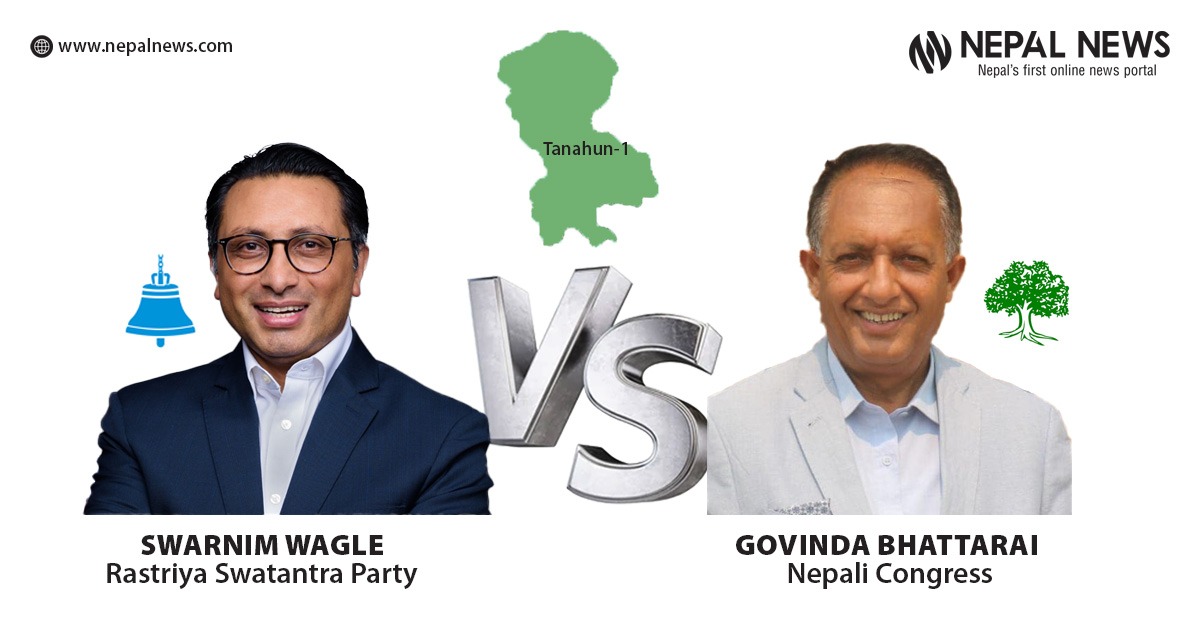
KATHMANDU: Tanahun 1 has emerged as one of the Nepal’s most closely watched political battlegrounds ahead of the 5 March 2026 House of Representatives election. A constituency of 126,882 voters, It has become a barometer of Nepal’s shifting political landscape.
Tanahun 1 voters will decide one of the 165 House of Representatives seats contested under the first-past-the-post system, offering a window into the fortunes of established parties, insurgent newcomers, left-leaning factions, and local heavyweights vying for influence in a rapidly evolving political situation.
This election has drawn a total of 12 candidates, representing both major parties and a host of independents, each seeking to test their strength in a district known for its political volatility and historical swings.
At the forefront is Rastriya Swatantra Party (RSP) Vice-President Swarnim Wagle, a former Nepali Congress (NC) economist who resigned citing years of personal humiliation under NC President Sher Bahadur Deuba. Wagle’s move to the RSP and his decisive victory in the 2023 by-election have positioned him as a formidable force in Tanahun 1.
The RSP projects him as not just a local candidate but a potential future Finance Minister, leveraging his credentials as the country’s “world-class economist” to galvanize voters, particularly the youth. His campaign will receive an added boost from Balendra Shah (Balen), the RSP-nominated Prime Ministerial candidate, who is scheduled to address a key rally in Damauli, aiming to further energize young voters.
Facing him is Congress candidate Govinda Bhattarai, a veteran local leader whose decades-long work in Tanahun as well experienced of student politics has left a tangible imprint on the community. Bhattarai’s record includes establishing over 60 drinking water projects, providing clean and reliable water to thousands of households—a gesture that has earned him deep-rooted goodwill. After narrowly losing to Wagle in the previous election, Bhattarai has embarked on a persistent campaign, visiting villages and mobilizing local support. Sympathy for his previous defeat, a recurring dynamic in Nepali politics, may now work in his favor.
Meanwhile, the CPN-UML has fielded Bhagwati Neupane, a politician from Bhanu Municipality with national-level experience. Neupane’s trajectory is notable: who defeated in municipality turn to a former National Assembly member and Minister of Federal Affairs and General Administration, she has long been a UML’s dedicated cadres rose from student politics. Her deep local roots, combined with the influence of Krishna Kumar Shrestha (Kisan), who had defeated Nepali Congress (NC) senior leader Ram Chandra Paudel in 2017, a local UML stalwart who recently rejoined the party, are expected to consolidate votes that previously fragmented the left-leaning electorate. Neupane’s candidacy also sidesteps the “outsider” label that plagued previous UML candidates like former police chief Sarbendra Khanal.
The Nepali Communist Party (NCP) has put forward Bidya Nath Dhakal, a veteran leftist leader with a strong foothold in Bhanu Municipality. Historically, Tanahun has been fertile ground for Maoist influence, particularly in Aanbukhaireni and Bandipur local areas, where the Maoists have previously secured victories even without alliances.
NCP, the successor of the former Maoists, is aiming to regain the foothold it first established in the historic 2008 Constituent Assembly election. That year marked a turning point: the Maoists broke through what was considered a NC bastion, claiming one of Tanahun district’s three parliamentary seats—a remarkable achievement in a constituency long dominated by Congress.
In the 2008 election, Maoist candidate Suresh Ale Magar secured a decisive victory in Tanahun 1, winning 17,744 votes (45.75%), surpassing the UML’s Bahadur Rana, who received 10,566 votes (27.24%), and NC’s Govindra Raj Joshi, who garnered 10,477 votes (27.01%). The result underscored the Maoists’ ability to disrupt traditional political strongholds.
Historically, NC had dominated Tanahun 1, with Govindra Raj Joshi defeating UML’s Ek Bahadur Rana Magar by about 8 thousand.
Ram Chandra Poudel won the Tanahun-1 constituency in the 1991 general election, securing victory by a margin of 4,409 votes—around 13 percent more than his closest competitor. In the 1994 election, the Nepali Congress again retained the seat, with Govinda Raj Joshi defeating his CPN-UML rival by a margin of about 8,000 votes. Joshi secured 19,086 votes, while UML candidate Ek Bahadur Rana Magar received 11,322. Historically, before political shifts in 2006, Tanahun-1 was considered a stronghold of the Nepali Congress, which consistently won the constituency in successive elections.
After suffering defeat in the first Constituent Assembly election in 2008, the Nepali Congress reclaimed Tanahun-1 in the second Constituent Assembly election in 2013, only to lose the seat again in the 2017 general election to the Left Alliance. The party made a comeback in the 2022 parliamentary election, but that victory proved short-lived, as the Nepali Congress was defeated within six months in a by-election by the newly formed Rastriya Swatantra Party (RSP). Overall, since the 1991 elections, the Nepali Congress has won the Tanahun-1 constituency five times and lost it three times—once to the Maoists, once to the CPN-UML, and once to the RSP.
Today, the NCP seeks to reclaim this lost ground. With a renewed strategy and its own candidate, the party hopes to rally its base in former strongholds and capitalize on any fragmentation among its rivals. For the NCP, Tanahun 1 is more than just a seat—it is a symbol of its historical rise and a test of its current relevance in the evolving political landscape.
In past elections, dissatisfaction and the fragmented left-wing vote funneled “floating votes” to the RSP, benefiting Wagle. Now, with the NCP fielding its own candidate, the electoral dynamics are expected to shift significantly, potentially eroding RSP’s previous advantage.
Tanahun 1 is not just a contest of personalities but a microcosm of Nepal’s evolving political landscape. The constituency encompasses Devghat, Anbukhaireni, Bandipur, Bhanu Municipalities, and parts of Byas Municipality (wards 1–4, 7–11), a patchwork of traditional party strongholds and historically contested areas. In earlier elections, alliances often forced parties and their workers to compromise, sometimes voting for rivals like the Maoists or Congress due to tactical arrangements. This election, however, marks a departure: every party is contesting under its own symbol, ending a decade-long pattern of inter-party vote transfers.
Other candidates add layers of complexity. Independent Deepak Raj Joshi, son of a former Congress joint general secretary and narrowly defeated in the Byas mayoral race, could siphon votes from both Congress and UML. Rastriya Prajatantra Party’s Ram Dutta Joshi, Sharm Sanskriti Party’s Kashiram Gurung, and a slew of smaller parties—from the Mongol National Organization to the Nepal Majdoor Kisan Party—further fragment the electorate. The crowded field underscores how local prominence, historical alliances, and personal narratives play a decisive role in Tanahun politics.
Analytically, the 2026 election in Tanahun 1 is about more than just numbers; it’s about strategic positioning and voter psychology. Wagle’s previous landslide victory leveraged cross-party “floating votes” from dissatisfied Maoists, UML and Congress supporters, a bonus that may now be curtailed with all parties running independently. Bhattarai’s long-standing social work and repeated village engagements suggest a well-cultivated sympathy vote, while UML’s Neupane seeks to consolidate traditional leftist votes, now bolstered by Kisan Shrestha’s return to the party fold. The NCP aims to reclaim its historical base in former Maoist strongholds, potentially reshaping vote distributions in critical wards.
Ultimately, Tanahun 1 represents the collision of national ambition, local loyalty, and party legacy. The results here will not only determine a seat in the House of Representatives but may serve as a bellwether for the broader realignment of Nepalese politics. Every campaign strategy, candidate background, and local intervention counts—making this race one of the most analytically fascinating contests in the country.
Whether Wagle consolidates his outsider-turned-strategist image, Bhattarai capitalizes on enduring local trust, or Neupane channels leftist cohesion,
Tanahun 1 is poised to deliver a decisive, and possibly unpredictable, verdict in Nepal’s evolving democratic experiment.
Whether Wagle consolidates his outsider-turned-strategist image, Bhattarai capitalizes on enduring local trust, Neupane channels party cohesion, or the NCP (former Maoists) reclaims its once stronghold, while smaller parties and independents aim to chip away at established vote banks, Tanahun 1 is poised to deliver a decisive, and possibly unpredictable, verdict in Nepal’s evolving democratic experiment.
Ward by ward, math upends the race
In the April 2023 by-election in Tanahun-1, the local wards numbers told a story of dramatic shifts in voter behavior. While the 2022 local elections provided a baseline, the by-election results revealed widespread realignment, as traditional party support eroded across the constituency. The by-election became a laboratory for understanding the volatility of local-level ward politics, highlighting how voter loyalties can fracture even within historically predictable wards.
Looking at the aggregate numbers from the by-election, the Rastriya Swatantra Party (RSP) candidate secured 34,911 votes, while the Nepali Congress candidate received 20,122 votes, and the UML candidate managed only 8,488 votes.
Compared with the 2022 HoR election, where the difference between the Congress candidate Ram Chandra Paudel with UML candidate Ek Bahadur Rana had been 5,375 votes, the 2023 by-election margin of 14,789 votes underscores a sharp swing in voter alignment. In the 2022 HoR election, the Rastriya Swatantra Party’s candidate, Bikash Sigdel, had finished a distant fourth, securing just 6,044 votes. Ramchandra Poudel of the Nepali Congress claimed victory with 25,361 votes, while CPN-UML’s Ek Bahadur Rana Magar trailed in second with 19,981. Yet, less than six months later, the by-election delivered a stunning reversal: the RSP swept to victory in a decisive landslide, toppling the traditional powerhouses and upending the political landscape in Tanahun-1.
Ward-level data illustrates the scale of the shift. In Aanbukhaireni-1, out of 1,458 votes cast, Wagle received 1,065 votes, the Congress candidate 265, and UML 54. In Aanbukhaireni-2, of 1,392 votes, the distribution was 881 for RSP, 336 for Congress, and 108 for UML. In Aanbukhaireni-3, of 2,173 votes, 1,515 went to RSP, 401 to Congress, and 191 to UML. In Aanbukhaireni-4, of 694 votes, RSP received 332, Congress 237, and UML 85. In Aanbukhaireni-5, out of 570 votes, the breakdown was 371 for RSP, 149 for Congress, and 28 for UML.
A closer analysis of vote losses reveals the magnitude of the shift in by-election. UML’s support eroded dramatically, with candidates losing between 42 and 90 percent of votes previously captured by ward chairmen. In Aanbukhaireni-5, UML’s candidate received only 28 votes, compared with 1,646 in the local elections in 2022. Three wards lost between 81 and 90 percent, nine wards lost between 71 and 80 percent, eight wards lost 61 to 70 percent, and thirteen wards experienced 51 to 60 percent declines. Even in wards where UML had not fielded candidates in 2022, the vote share remained negligible.
Congress also experienced substantial declines. In Devghat-5, votes fell from 1,805 in the local election to 695 in the by-election. Across seven wards, Congress lost 51–60 percent of previous votes, and in twelve wards, 41–50 percent. In Aanbukhaireni-1, the combined votes for ward-level Congress and Maoist candidates had been 1,274 in 2022, but the by-election saw the Congress candidate receive only 256 votes, a reduction of over 80 percent when measured against previous local totals including allied votes.
Municipal-level trends reinforced the ward-level picture. In Byas, where voter turnout had previously favored traditional parties, UML lost up to 90 percent of votes in certain wards. Across Devghat, Bhanu, and Aanbukhaireni, the pattern was repeated: wards that had provided hundreds or even thousands of votes to Congress and UML in local elections now contributed overwhelmingly to the RSP candidate Wagle. For example, in Aanbukhaireni-3, out of 2,173 votes, RSP alone secured 1,515, while Congress received 401 and UML 191. In Aanbukhaireni-1, RSP’s 1,065 votes were vastly higher than Congress’s 265 and UML’s 54, highlighting both the consolidation and the scale of vote transfer.
In Bhanu municipality, similar trends were observed. In Bhanu-3, of 1,574 votes, RSP received 716, Congress 418, and UML 351; in Bhanu-4, 1,675 votes were cast with 759 for RSP, 482 for Congress, and 394 for UML. In Bhanu-7, RSP secured 655 of 1,281 votes, Congress 312, and UML 270. In Bhanu-8, out of 1,794 votes, the split was 856 for RSP, 458 for Congress, and 437 for UML. Bhanu-10 saw RSP at 846 of 1,758 votes, Congress 551, and UML 329. Across these wards, traditional parties consistently lost significant shares of votes compared with local election baselines.
The overall impact is clear: across Tanahun-1’s 42 wards, voters dramatically reshaped the electoral landscape. Traditional parties lost support in every significant municipality, with margins collapsing in wards that had previously delivered safe victories. Bhattarai of Congress led in only a handful of wards, while UML candidates found themselves pushed to third place across much of the constituency. Even small wards like Aanbukhaireni-5, with only 570 votes cast, reflect the same underlying pattern: steep losses for traditional parties and overwhelming dominance by the RSP.
Comparing local-level results in 2022 with the by-election in April 2023 reveals not only the scale of vote loss but also the fragility of assumed loyalties. Across Tanahun-1, voters in Devghat, Bhanu, Byas, and Aanbukhaireni redistributed their support, dramatically inflating margins for the RSP while diminishing both Congress and UML. Where Congress ward chairmen had previously secured over 32,000 votes across the constituency, and UML over 22,000, the by-election figures show a clear collapse, signaling that local-level votes are increasingly volatile and susceptible to realignment.
In sum, the April 2023 Tanahun-1 by-election demonstrates that historical totals from local elections, once considered predictive, are no longer reliable. Across wards and municipalities, traditional parties experienced significant erosion, margins widened dramatically in favor of the new entrant, and the constituency’s vote arithmetic was fundamentally transformed. The local numbers alone, from ward-level shifts to municipal-level totals, tell the story of a political landscape reshaped entirely within the span of a single by-election.
The Joshi factor in Tanahun-1
As Tanahun-1 emerges as one of the most closely watched contests in the March 5 HoR election, one variable stands out: the Govinda Raj Joshi group. Its presence makes this race far less predictable than past results might suggest.
Joshi’s network represents a distinct current within Congress politics, often described locally as the Swatantra Congress Abhiyan. Though rooted in the Nepali Congress, it has operated independently after split from mainstream Congress or in tactical alliances outside the Congress line. In electoral terms, it is widely believed to command a bloc of more than 6,000 votes in constituency No. 1—enough to tilt a close contest.
This is significant for the Rastriya Swatantra Party (RSP). During the April 23 House of Representatives by-election in Tanahun-1, Swarnim Wagle secured the Joshi group’s endorsement and organisational support—a factor widely seen as critical to his political success.
In the 2022 general election, Govinda Raj Joshi himself finished third with 6,886 votes. In this election, the Joshi camp is backing its own candidate, Govinda Raj Joshi son’s Deepak Raj Joshi, rather than consolidating behind Swarnim Wagle of the RSP. The likely effect is vote fragmentation—reducing the RSP’s ceiling even if its core support holds.
Govinda Raj Joshi’s influence is not merely electoral arithmetic. A veteran politician with decades of organisational depth, he built his base long before Nepal’s current political churn.
Govinda Raj Joshi was elected to Nepal’s parliament in 1991, 1994 and 1999. Although he lost in 2008 Constituent Assembly elections, his organisational structure and loyal grassroots following endured. His long-running rivalry with current President Ram Chandra Paudel weakened the Nepali Congress at the local level in Tanahun, even as Joshi was gradually sidelined from central party politics. Yet Joshi’s grip on the ground has remained largely intact. Credited by supporters for delivering development projects—schools, roads, hospitals, electricity and employment—he continues to command respect locally, with followers often aligning their electoral choices with his direction.
His record as a former Congress heavyweight—multiple times a lawmaker, chief whip, and holder of key ministries including home, education, water resources, and tourism—has translated into durable local loyalty, reinforced by thousands of jobs to his committed cadres and tangible development projects in Tanahun.
Equally important is his social capital. Joshi’s roots as a teacher, educationist, lawyer, and founder of key institutions in the district have embedded him in civic life beyond party politics. Even after being sidelined at the Congress centre, he retained local relevance—any parties can not underestimate.
In Tanahun-1, therefore, the election is less a straight fight between parties than a test of networks. And in that equation, the Joshi factor ensures that the margins—and the outcome—remain open until the last vote is counted.