
Kathmandu
Wednesday, January 7, 2026





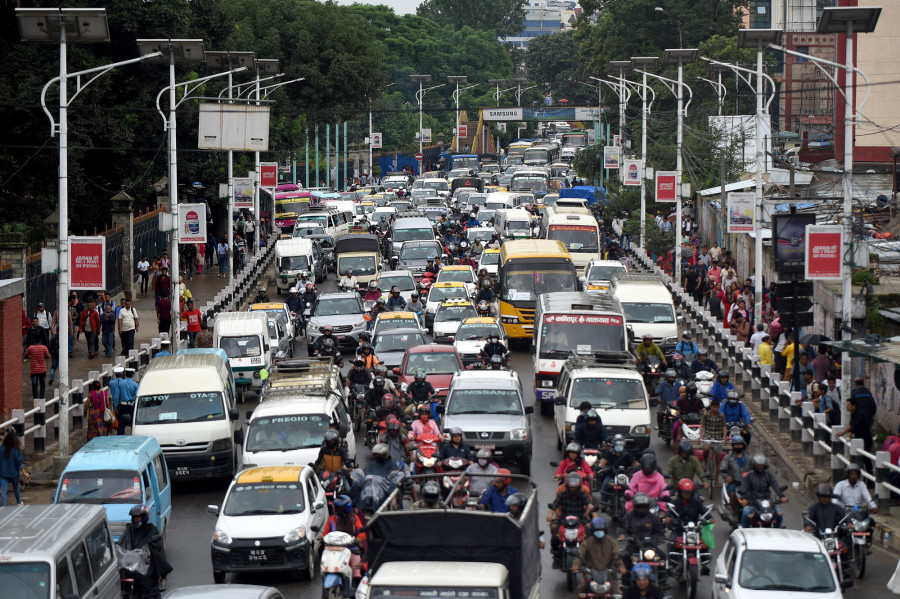
1994. The winter mist in Lagankhel is already saturated by truck and bus fumes as I put the key into the ignition at eight thirty in the morning. Surgical masks, fast becoming fashionable these days, buffer passersby from the choking diesel excreta.
Visible as the smoke is from my vehicle, together with back-up and flashing indicator lights, few take notice as the Nissan Patrol 4×4 starts moving. Even the horn goes apparently unheard, certainly unheeded. Pedestrians usually stop; but bicyclists and motorcyclists, ever impatient, try to squeeze past the progressively narrower road surface remaining between the reversing vehicle and the ditch next to Patan Hospital.
Nearing Jawalakhel, the paved road is profusely pockmarked with potholes. Suddenly, 10 meters in front of me in my own lane, a blue Isuzu bus hurtles towards me, having avoided a deep rut and a rambling cow in its own lane. No matter: I just depress my horn and veer over to what remains of the road, that fuzzy boundary-less strip between vehicular and pedestrian traffic. Some get scared and jump, others could not care less, and how they avoid getting run over I can never understand. It reminded me of driving around with Sharad Chandra Shah 11 years earlier; he calmly explained to me that “bolder driving with affirmative technique is essential for safety and sanity; the smaller vehicles will (or should) always get out of the way”.
On the other side of the roundabout by the Jawalakhel (Central) Zoo, the street narrows somewhat and is chain-linked from side to side by bicycles. Grudgingly they roll over a bit to let me pass and soon Pulchowk hill is before me. Picking up speed, I start passing quite a number of Toyota taxicabs, cyclists and a few yellow-plated corporation cars. A nice-looking family of five (2 adults and 3 children) is casually driving along……….on an Enfield motorcycle, oblivious to protection beyond a red plastic, strapless construction cap for Buwa (father).
As usual, at the Bagmati bridge the bottleneck requires astute maneuvering. If I try to keep a respectable distance—say, even 1 meter—distance from the vehicle in front of me, some motorcyclist is sure to squeeze in, much like liquid oozing into a void by capillary action; so I sit tight on the fender in front. Commuter buses further down the avenue are double parked, forcing one to either wait and suck in the muck or pass in the oncoming lane. Most people decide to pass. So do I.
Past Thapathali, nearing the Parliament at Singha Durbar, cars are permitted to angle park, leaving scant space for oncoming traffic to stay on its own side; thus, inevitably and unavoidably, they hurtle towards me on my side. I used to just slow down and even stop by the centre line, forcing them to remain on their side or else plow into me. I did this with motorcyclists and passenger cars, or any other vehicle smaller than mine, save the Tatas, which driven by fatalistic fanatics were off limits! But then I have, more or less, stopped this ruse. It is so much easier, free-flowing and less aggravating to just weave in and out, sometimes letting them come in my lane…. I will move over on the inside of the cycle rickshaw and back out again….after a while there is even a mellifluous rhythm to all this.
Ah yes, the traffic light at Bagbazaar and Ram Shah Path: while one policeman is authoritatively hand-signaling for vehicular traffic to flow through the green light, Flying Pigeon bicycles are crossing diagonally and a couple of other cops are waving pedestrians across the red light. Is this coordinated in order to test restraint and patience? The colors rarely make a difference; pedestrians and cars come and go as they please—for the police tend to catch only hapless bicyclists and cycle rickshaw drivers.
Off the mark, the minibus in front of me speeds up to 40km/hr, the weight of its free-climbing passengers (I counted 9) hanging on to the back door tilting it 10 or 15 degrees? I am entranced by a trio of energetic boulderers: left finger tips pinching the roof gutter, right hand white-knuckling the open door’s upper hinge, left foot barely on what space remains on the tail light, and right foot dangling in space. Without any forewarning, the bus stops to let off and pick up someone. And I am abruptly reprogrammed both verbally and physiologically.
Around the Narayanhitti Palace and up Lazimpat hill is like running the gauntlet. On my left, a couple of motorcycles are sputtering towards me on the extreme wrong side of the street. From an alley, unannounced, invisible, uncaring, a Mitsubishi Pajero careens out into the main traffic, causing a chain reaction near-pile up. Signaling left, the van in front of me abruptly turns right; perhaps he reasoned that as his right indicator was not working, some signaling is better than none. Figuring this may have been an exception, I sped up the next time a yellow-topped taxi signaled right. I was not wrong! He did in fact pull out towards the right, but the cow which now lay directly in front of me stopped me in my tracks!
Flashing my brights, honking my horn, I pull past the two-wheeled haate tyaktar (hand tractor) utility cart and a series of black/yellow Tempos (three-wheelers): See You, Namaste, Good Profit, Go Slowly, and Hail Shiva, and finally arrive at the Teaching Hospital, my destination in Maharajgunj.
Epilogue
Traffic, I have come to realize, can be as clear as a lens –exhaust aside— through which to view a culture as other relevant methods. It is predominantly foreigners who get overtly disconcerted in an unfamiliar system. But friction with the established norm serves to frustrate even Nepalis coming from a variety of urban and rural ethnic and cultural backgrounds who likewise face ambiguity in understanding and adhering to rules and signs.
It dawns upon one – eventually – that, barring exceptional missionary or intellectual zen, even for normal people it is less stressful to “go with the flow”, resist one’s own resistance as it were. Transformation of attitudes and behaviors rarely comes about through brief, direct confrontations. Displacement of cows aside, would the experience today, in 2026, be any different? Could the reader extrapolate some of the observations from traffic to politics?
(The author is the director of ETHNOBUREAUCRATICA http://ethnobureaucratica.weebly.com)