Kathmandu
Thursday, January 8, 2026





There are widespread concerns that contract terminations will slow the economy and further disrupt construction activities
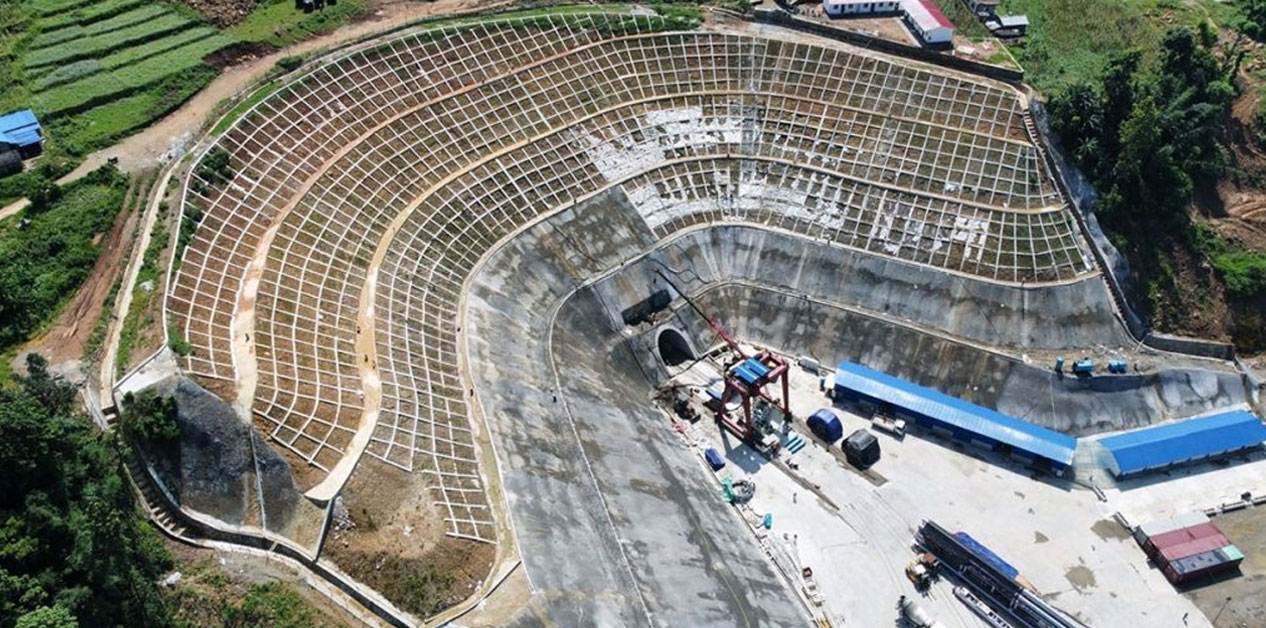
KATHMANDU: Following the termination of the construction contract for the Sunkoshi–Marin Diversion Multipurpose Project, a project of national pride, a reassessment is underway of the work completed so far at the project site.
The contract covered construction of the dam (headworks), the powerhouse and other civil structures, as well as the supply and installation of hydromechanical equipment. The project authority terminated the contract with the Patel–Raman JV on 24 November 2025, citing failure to perform as per the contract.
The contractor had begun work in Jan/Feb 2023 and was required to complete construction by mid-July 2027. However, when nearly 61 percent of the contract period had elapsed, physical progress stood at only around 10 percent.
The project authority stated that the contractor showed no urgency in accelerating progress and ignored notices issued to improve performance in accordance with contractual provisions, prompting the decision to cancel the contract.
The project aims to divert water from the Sunkoshi River through a 13.1-kilometre tunnel to the Marin River in Sindhuli district to provide irrigation to districts in the Tarai-Madhesh region.
Following the cancellation, bank guarantees worth Rs 3.6 billion – Rs 2.4 billion deposited as performance security and Rs 1.2 billion as advance payment – are in the process of being forfeited from Patel–Raman JV. The company had secured the contract for Rs 14.08 billion (including taxes). By the time the contract was terminated, the government had already paid the contractor Rs 2.14 billion, or roughly 15 percent of the total contract amount.
On 17 November 2025, the Department of Roads published notices cancelling contracts for 25 road projects in a single day. Separately, 22 irrigation-related contracts worth Rs 14.23 billion were scrapped after being deemed “sick” due to years of abandonment. These include six contracts under the Babai Irrigation Project, 15 contracts under the Irrigation and Water Resources Management Project in Janakpurdham, and one contract related to the Sunkoshi–Marin project. In addition, a contract worth Rs 17.6 million under the Bheri–Babai project has also been terminated.
Contracts worth Rs 131.7 million under the Janakpurdham office have been cancelled as well. According to Mitra Baral, director general of the Department of Water Resources and Irrigation, the department is currently overseeing 215 contracts, of which 33 are classified as problematic. Of these, 22 contracts have already been terminated.
Following the Gen Z movement, Kulman Ghising, who was entrusted with three infrastructure-related ministries in the interim government, issued directives to terminate all contracts that had stalled without progress. Acting on this instruction, concerned agencies have been publishing notices and cancelling contracts. Agencies under the Ministries of Physical Infrastructure and Transport, Energy, Water Resources and Irrigation, and Urban Development have been rapidly issuing clarification notices asking why contracts should not be terminated, followed by formal announcements ending the contracts.
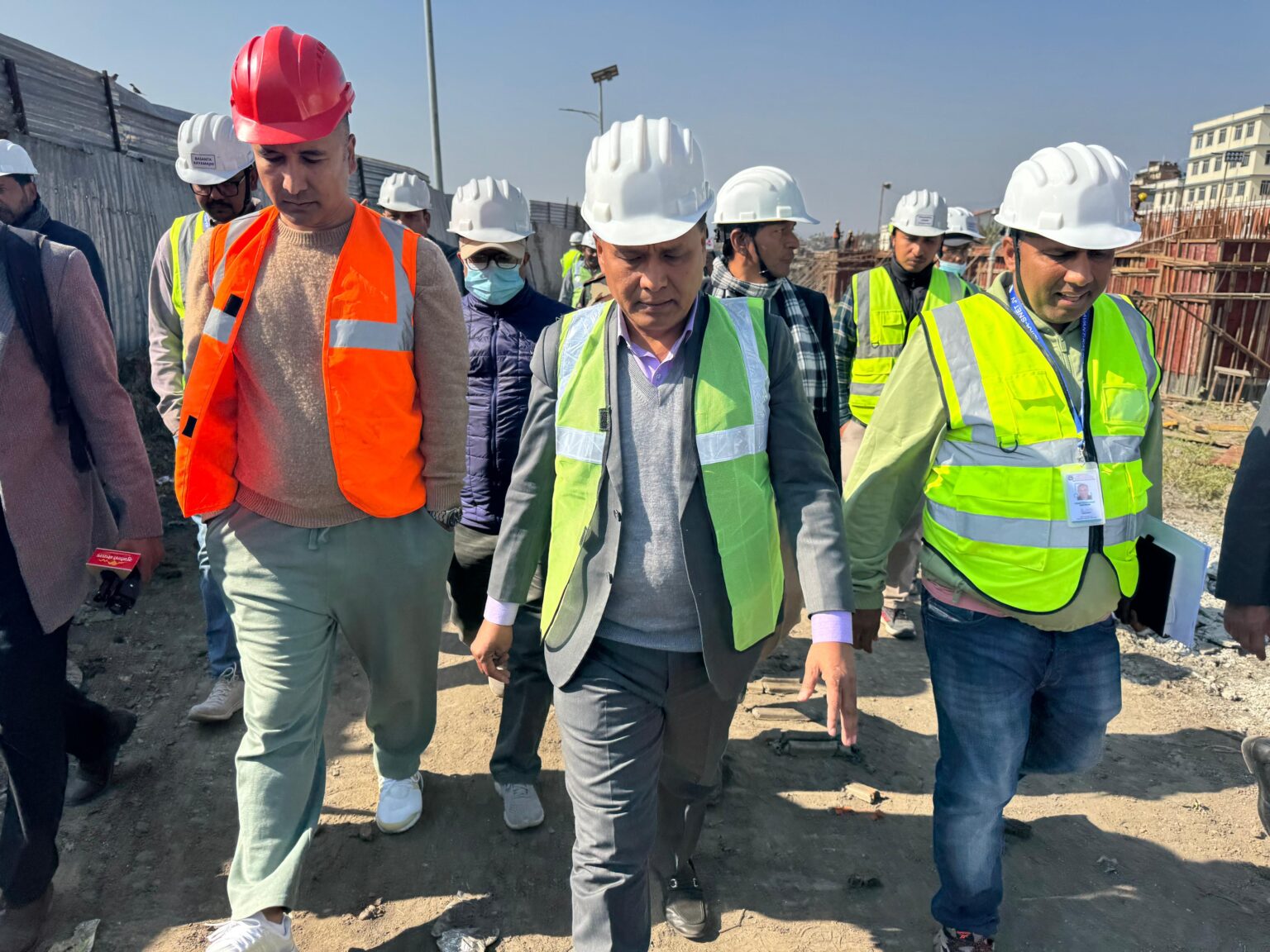
Minister for Energy and Physical Infrastructure, Kulman Ghising, visited the project to monitor its progress.
Government officials themselves acknowledge that the rapid termination of contracts in this manner could create systemic problems in the economy. Physical Infrastructure and Transport Ministry Secretary Keshav Kumar Sharma admits that cancelled contracts may reduce government capital expenditure and slow the momentum of the economy that is driven by the sale of construction materials.
“Contract cancellations can reduce the government’s capital spending and create problems in the economic ecosystem,” Sharma says. “When construction companies are blacklisted, there may come a situation where there are no capable contractors left to carry out future construction projects.”
Once a contract is terminated, the law provides for recovering the remaining cost of completing the project from the concerned contractor. Section 59(8) of the Public Procurement Act, 2007 states: “If a contract is terminated, the entire performance security deposited for that work shall be forfeited. Any amount required to complete the remaining work in accordance with the contract shall be recovered as government dues from the bidder who failed to perform the work as per the contract.”
In line with this legal provision, re-evaluation of work is currently underway in projects where contracts have been cancelled to determine the amount to be recovered.
The sums that contractors must pay the government after contract termination are often very large. To avoid this liability, contractors are preparing to file writ petitions in court. Since court verdicts take time, the construction of the concerned projects is pushed further into uncertainty.
Following contract termination, construction companies are blacklisted, their bank accounts may be frozen, and contracts they are executing in other projects are also affected. Under the Public Procurement Act, companies that fail to fulfill their responsibilities can be blacklisted for one to three years. The law allows for blacklisting for a period ranging from one to three years.
As per the Act, when the cost of completing the remaining work is recovered from the contractor and bank guarantees are also confiscated, companies whose contracts are terminated can become virtually non-functional. This, in turn, affects other contracts they have undertaken. When physical infrastructure construction stalls, the government fails to spend its development budget. On the other hand, the market for construction materials, such as steel rods, cement, gravel, and sand, also suffers.
Former secretary Arjun Jung Thapa says that re-tendering cancelled projects will require higher budgets and that procedural hurdles will delay new agreements, further affecting construction work. “Had the government facilitated projects instead of indiscriminately terminating contracts, the economy would have remained more dynamic and development work would have progressed,” he says.
Why do contracts become ‘sick’?
Although agencies under three ministries are cancelling contracts one after another, the government has yet to compile an integrated national record of how many contracts have been terminated. Under the Ministry of Physical Infrastructure and Transport alone, the process to terminate more than 200 contracts had begun, and decisions to cancel most of them have already been made.
Secretary Sharma says the ministry oversees around 2,800 contracts, of which nearly 300 have become “sick.” “Contracts have become sick due to weaknesses on both sides – contractors and the government,” he says.
According to former secretary Thapa, many contracts become problematic because agreements are signed under political influence without adequate project preparation. “Many contracts awarded since 2003 have become sick. Problems arise because contracts are awarded without proper preparation, largely to serve political interests,” he says.
Thapa adds that contracts become sick due to the lack of budget continuity, frequent changes in government, new governments deprioritizing projects initiated by previous administrations, and failure to clear project sites. In some cases, he says, construction work becomes ineffective because contractors hand projects to joint ventures with weak capacity.
“For internal political benefits within their organizations, and assuming they would earn some profit anyway, contractors formed joint ventures with weak-capacity companies. As a result, construction work has been slow or abandoned,” he says.
Thapa argues that government agencies are equally responsible for contracts becoming sick.“The agencies responsible for appointing contractors have failed to work on time, leaving contracts stranded. Some officials have deliberately harassed contractors. Work may be completed in the field, but if an official’s personal interest is not fulfilled, the paperwork still shows the construction as incomplete,” he says.
However, Rabi Singh, president of the Federation of Contractors’ Associations of Nepal, claims that contractors will challenge all terminated contracts in court and that verdicts will favor them. “So far, in about 90 percent of cases, court decisions have come in favor of contractors. The government bears the greatest responsibility for contracts becoming sick,” he says.
Singh argues that Minister Kulman Ghising is trying to gain political advantage by portraying all contractors as incompetent, and that his impulsive decisions to terminate contracts are putting the entire economy at risk. According to Singh, even contracts where problems arose due to government failures – and where mutual settlements had been reached through dialogue – have been cancelled with malicious intent.
“When the government fails to resolve site issues after signing a contract, it should seek amicable settlement with an apology. But now, even such contracts are being targeted for termination, with notices issued asking why they should not be cancelled,” he says.