Kathmandu
Friday, January 9, 2026





Even hospital waste is dumped on roads, posing serious public health risks
JANAKPURDHAM: Entering the Madhesh Province capital of Janakpur from Dhalkebar, one passes through Mujelia, crossing an imposing gate adorned with a grand arch and an image of Lord Ram. Those arriving from India must pass through a gateway resembling the reflection of Janakpur’s Janaki Temple at the border.
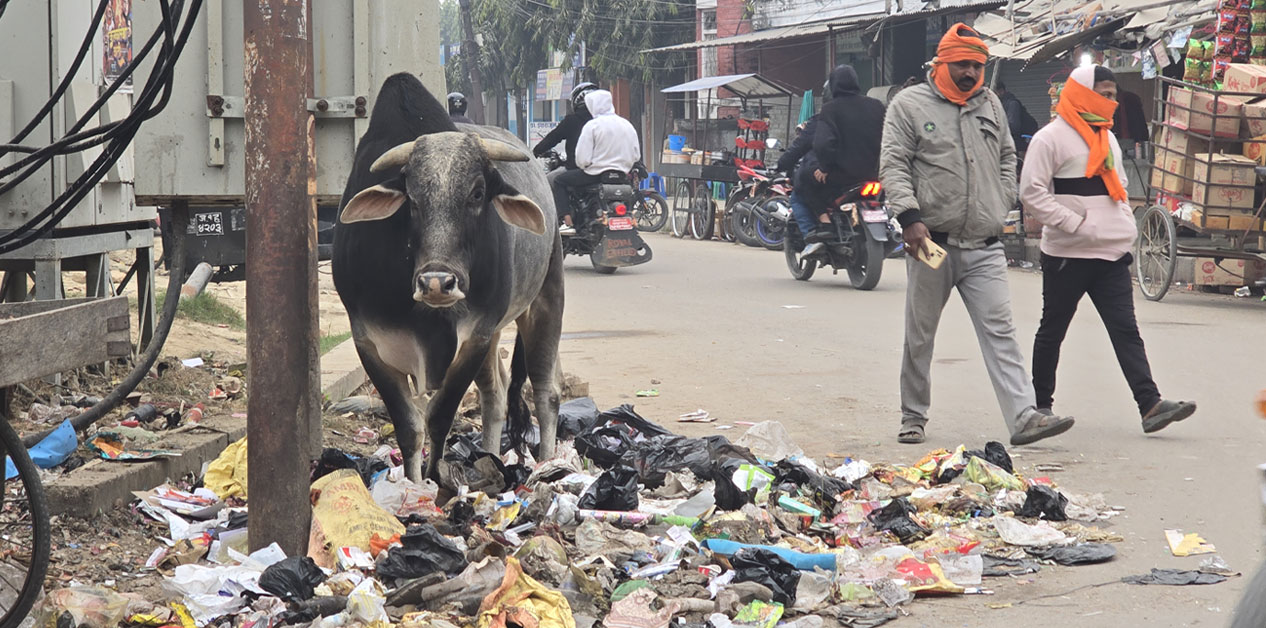
These structures reflect the historical and cultural significance of Janakpurdham. But once past them and into the urban area, anyone is likely to be alarmed by the piles of garbage scattered everywhere.
From Mujelia to Ramanand Chowk, rubbish can be seen lining both sides of the road. This is the result of a widespread habit among locals, tourists and even passengers traveling in vehicles leaving Janakpur of dumping waste indiscriminately.
Deepak Chaudhary of Janakpurdham Sub-Metropolitan City–8 says the vacant plot in front of his house has never looked clean. He has repeatedly gone to the sub-metropolitan office with complaints about the stench of rotting garbage and flowing sewage, but the problem remains unchanged.
The vacant land in front of Chaudhary’s house was once a pond. Over time, heaps of garbage erased all traces of the pond.
“Years have passed, but the situation is the same,” he says. “Even though this is close to the Janaki Temple area, no one seems to pay attention to it.”
At Janak Chowk as well, local hotel operators are seen dumping garbage in the mornings, making Janakpurdham look ugly from the start of the day. Neither the sub-metropolitan city nor the general public appears serious about waste management.
The tendency to pile garbage on the streets reflects a lack of even basic awareness that household waste should be managed when collection vehicles arrive. “The municipality cleans the area, but before the cleaning is even complete, people dump garbage again,” says local youth Sushil Karna. “From the neighborhood improvement committees to us locals, everyone seems to have given up. People simply lack awareness about how to keep their neighborhoods clean.”
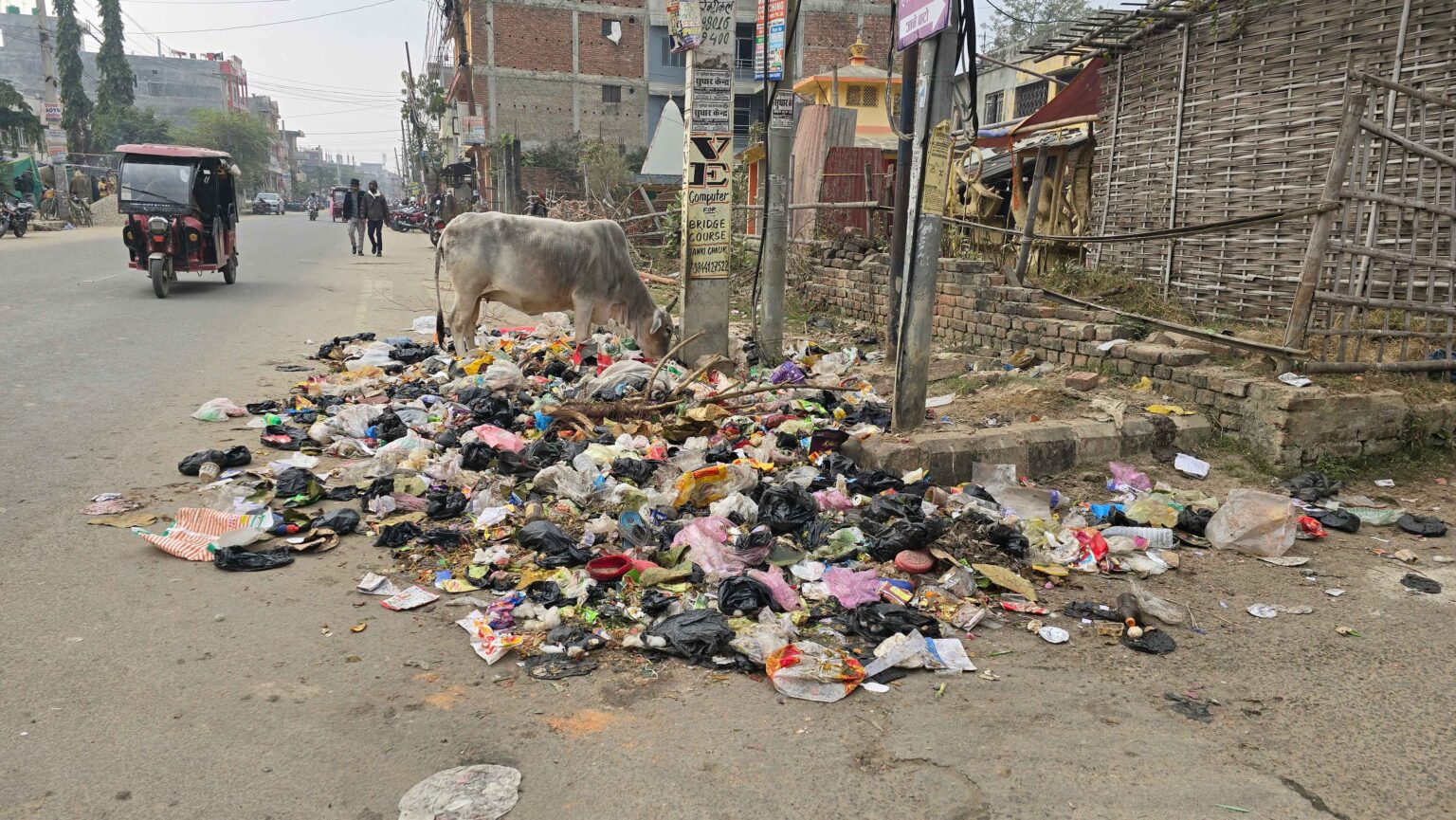
Garbage dumped on the streets of Murali Chowk. Photo: Birendra Raman
Karna adds that when he asks neighbors not to throw garbage indiscriminately, he is often abused in return. According to him, along with illiteracy and ignorance, an arrogant mindset of ‘what can anyone really do to us?’ has encouraged people to dump waste openly on the streets.
Local businessman Ajay Chaudhary says that even though dustbins have been placed at various locations, people still choose to throw garbage here and there on the roads instead of using the bins.
Because of the garbage, Janakpur is also developing a negative image among tourists. Shyam Goenka, who visited Janakpur from Rajasthan, India, said he was deeply saddened to see such filth in “Sita’s city.” “I think people here lack awareness. When I went to the temple, I saw garbage all around it. This is not good,” he said.
Ward Chairman Dipendra Sah of Janakpur-3 says that unless there is a system of fines and punishment for those who litter, waste management will remain a challenge in Janakpur. “We clean the streets in the morning. Shops open after 8 am and dump garbage on the roads. All the morning’s effort goes to waste. The garbage remains as it is,” he said.
Ward Chair Mithilesh Karna of Ward No. 10 shares a similar complaint. “Unless there is a change in the mindset of locals toward cleanliness, the garbage problem of Janakpurdham cannot be solved, no matter how much we want to,” he said.
Mayor’s decision failed to improve the situation
After being elected, Janakpurdham Mayor Manoj Kumar Sah made waste management his first decision, assigning responsibility to individual wards and instructing them to manage waste within their own areas.
Tractors and sanitation workers were also placed under ward-level responsibility. However, even after three and a half years, the situation has not improved.
Mayor Sah claims the Guthi Sansthan has become a major obstacle to resolving the garbage problem. “Most of the land in Janakpurdham belongs to the Guthi Sansthan. For any work, we are forced to acquire land, which takes time and faces various obstacles. Because of this, we have been unable to move development forward as desired,” he said.
According to sanitation chief Shyam Thakur, the sub-metropolitan city currently has 150 drivers and sanitation workers, 21 tractors, eight tipper trucks, two JCB machines, two water tankers and two Tata Magic vans, all of which are being used for waste management.
Disputes prevent construction of a landfill site
Since the promulgation of the constitution, waste management has been a major political issue in Janakpur during two local-level elections. But after being elected, leaders have tended to forget their commitments.
Mayor Sah’s pledge to immediately begin construction of a sanitary landfill site has also not been fulfilled. He had also committed to adopting modern and scientific waste management systems to generate energy for household use and produce compost fertilizer.
These promises, too, have remained largely rhetorical. Mayor Sah says local obstruction has prevented these commitments from being realized.
“We have made efforts. Even when we tried several times to lease land and build a landfill site, local resistance kept the problem exactly as it is,” he said.
According to sub-metropolitan spokesperson Parmesh Jha, around 2018, land was leased at Maniyari Deeh in Phulgama of Nagarain Municipality for waste management. However, the issue has remained unresolved after Nepali Congress leader Bimalendra Nidhi obstructed the project, saying the land was reserved for Rajarshi Janak University.
Jha says similar disputes arose in other locations as well, forcing the authorities to retreat. He said that even after reaching the final stages of land acquisition in areas such as 52 Bigha, Mahuwa in Ward No. 18, Basahiya in Ward No. 24, and parts of Laxminiya Rural Municipality, the process was halted due to local opposition.
Currently, according to Jha, waste is being temporarily dumped on vacant private land, with owners paid between Rs 200,000 and Rs 500,000, after which the garbage is buried under soil.
Hospital waste dumped on roads
It has also been found that some health institutions in Janakpurdham are failing to safely manage their waste. Medical waste is often dumped around the Bahra Bigha ground, while some private clinics throw it directly onto the streets.
Even waste generated by Madhesh Institute of Health Sciences hospitals has been found dumped on roads. This poses a serious threat to public health in Janakpur.
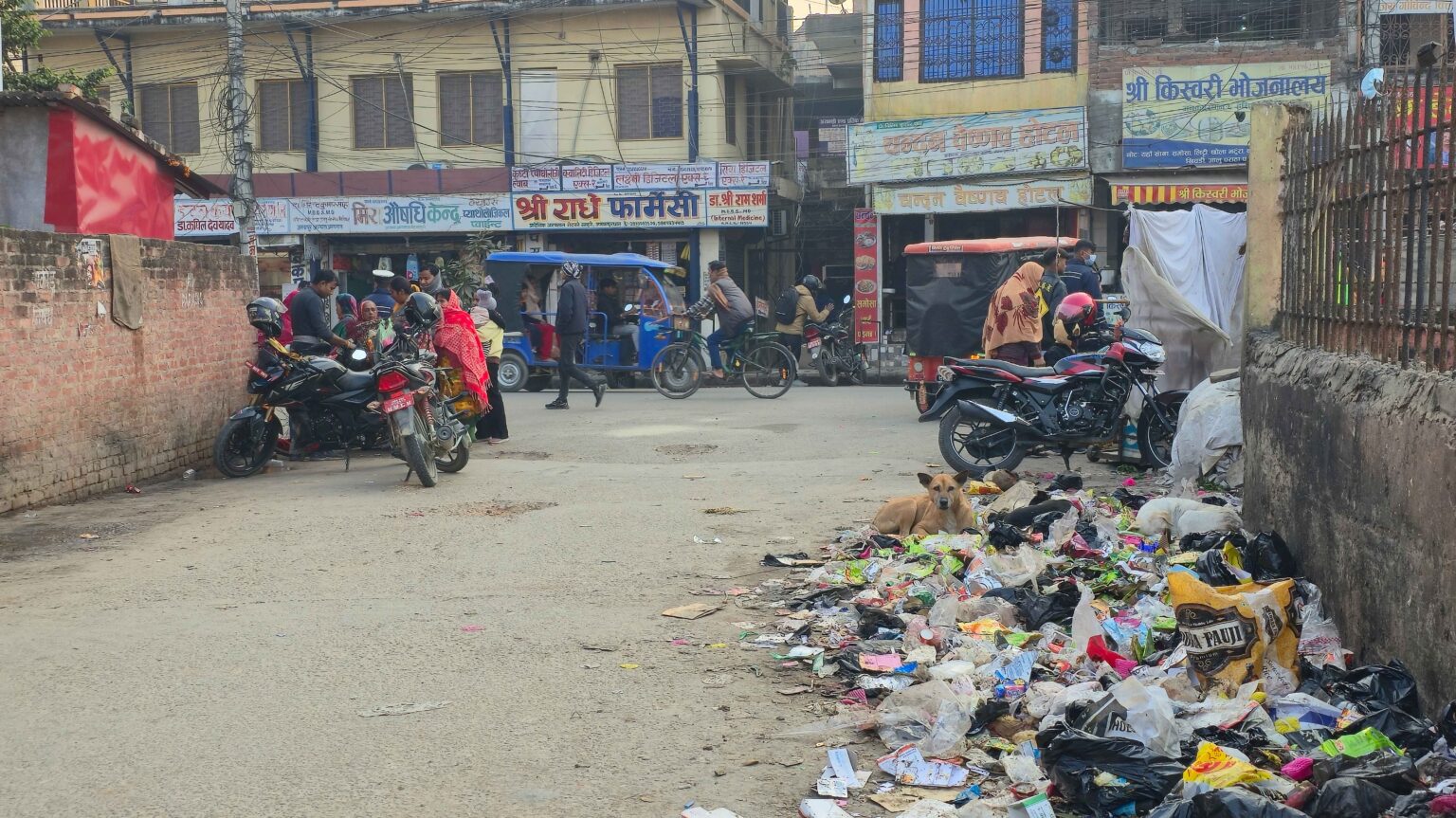
Hospital waste in Janakpur. Photo: Birendra Raman
Doctors warn that openly dumped waste significantly increases the risk of diseases such as diarrhea, typhoid, skin diseases, dengue and malaria. Local health worker Sanjay Kumar Chaudhary says dumping hospital waste into drains and open areas has heightened the risk of dengue and malaria.
Doctors also warn that burning hospital waste releases various toxic gases, causing serious harm to both human health and the environment. Physician Bijay Kumar Singh says that sanitation workers handling such waste, children, and pedestrians are particularly vulnerable to its effects.
Along Hospital Road in Janakpurdham alone, there are around 25 small and large hospitals, along with more than 200 private clinics and pathology centers. Some of them are seen dumping waste directly on the streets.