Kathmandu
Saturday, January 31, 2026






KATHMANDU: Nepal News presents today’s snapshot of Nepal’s economic activities. Get quick updates on major market movements, policy shifts, and financial developments shaping the economy of Nepal. Here are the key economic highlights for today:
NEPSE Slips Slightly Amid Pre-Election Uncertainty; Turnover Surges 84%:
Nepal Stock Exchange (NEPSE) edged down by 0.56 points (0.02%) last week, closing at 2,714.05 amid pre-election sentiment and the release of second-quarter corporate reports. The index fluctuated between 2,702.56 and 2,788.09 points. Hydropower led sector gains with a 2.93% rise, while the ‘others’ group fell 1.75%. Top company performers included Ankhukhola Hydropower (Rs 2.74 billion turnover) and Trishuli Jal Vidhyut, which surged 28.73% in market value. Total turnover rose sharply by 83.92% to Rs 70.36 billion, though market capitalization slightly declined by over Rs 1 billion to Rs 4.556 trillion.
Nepal Unveils Ambitious Five-Year Financial Sector Development Strategy:
The government of Nepal has launched a five-year strategy to modernize the country’s financial sector, targeting digital transformation, neo-banking, AI integration, and central bank digital currency (CBDC). The plan introduces “Neo Banks” and open banking to enable fully digital services and secure data sharing. Capital market modernization will include ETFs, derivatives, P2P lending, and crowdfunding. Insurance coverage is set to rise to 60%, with microinsurance and green bonds promoted. Cooperatives will face stricter regulation, while FinCERT will tackle cyber risks. By 2086/87 BS, the sector aims to contribute 7.5% to GDP, triple digital transactions, and increase agricultural loans to 15%.
Capital Expenditure Drops 22% in Second Quarter of Current FY:
Capital expenditure contracted by 22 percent in the second quarter of the current fiscal year, according to the Ministry of Finance’s latest report. Government capital spending stood at Rs 47.54 billion, down from Rs 58.18 billion in the same period last fiscal year. In contrast, recurrent expenditure and financial expenses increased, pushing overall government spending higher. Total expenditure so far has reached 46.06 percent of the annual allocation, compared to 10.75 percent in the previous fiscal year. Recurrent expenditure rose to 40.82 percent, while financial expenses surged to 99.93 percent. Total second-quarter spending amounted to Rs 904.64 billion.
Commercial Banks Post Strong Profits in Second Quarter, Nabil Leads:
Nepal’s commercial banks recorded significant profits by the end of the second quarter of the current fiscal year, with total net earnings of Rs 30.59 Arba (billion), up 11.5 percent from Rs 27.44 Arba in the same period last year. Among 20 banks, 11 saw profits rise while nine reported declines. Nabil Bank led with Rs 4.76 Arba net profit, followed by Global IME Bank at Rs 3.25 Arba and Kumari Bank at Rs 2.72 Arba. Other major earners include Everest Bank (Rs 2.11 Arba), Prime Bank (Rs 2.04 Arba), and Rastriya Banijya Bank (Rs 1.77 Arba). Laxmi Sunrise Bank reported a loss of Rs 0.27 Arba. Profit differences reflect varying success in managing loans and operational costs.
Excess Liquidity Weighs on Nepal’s Banking System Amid Weak Credit Demand:
Nepal’s banking system is grappling with excess liquidity as deposits hit record highs, with around Rs 900 billion remaining idle. Despite low interest rates, weak investment sentiment, political instability, and policy uncertainty have limited credit demand. Rising remittances continue to swell deposits, increasing pressure on banks’ profitability due to higher interest expenses. Although Nepal Rastra Bank has introduced concessional loans and refinancing schemes, lending remains sluggish. Economists warn prolonged excess liquidity could lower savings returns, encourage unproductive investment, raise imports, and strain inflation and external balances. Experts stress the need for political stability, policy clarity, and coordinated action to channel funds into productive sectors and revive economic momentum.
Nepal’s Insurance Sector Tops Rs 1.2 Trillion in First Half of FY:
Nepal’s insurance industry collected over Rs 1.2 trillion in premiums during the first half of the current fiscal year, including Rs 964.64 billion from life insurance and Rs 243.02 billion from non-life insurance. Life insurance accounted for nearly 80 percent of total business. Bagmati Province dominated both segments, contributing Rs 426.44 billion in life and Rs 165.98 billion in non-life premiums, followed by Lumbini and Koshi provinces. Other provinces contributed smaller shares, with Karnali and Sudur Paschim recording the lowest premiums. The market includes 14 life insurers, 3 micro-life, 14 non-life, and 4 micro non-life insurers, reflecting steady sector growth.
328MW Semi-Reservoir Hydropower Project Planned in Dolpa:
A 328-megawatt semi-reservoir hydropower project is set to be developed in Dolpa district, marking a major boost to Nepal’s high-altitude energy potential. The Bharbung–Tatu Khola Hydropower Project will be built in Chharka Tangsong Rural Municipality, with feasibility and environmental impact assessment studies already completed. Government-funded studies conducted over four to five years are now awaiting final approval from the Ministry of Forests and Environment. Once approved, the government will decide on public investment or private sector participation. The project will also generate additional power from Tatu Khola and impact parts of two rural municipalities.
Non-Performing Loans Rise in Nepal’s Commercial Banks:
Non-performing loans (NPLs) in Nepal’s commercial banks increased during the second quarter of FY 2082/83 (Shrawan–Poush). The average NPL across 20 banks rose to 5.08 percent from 4.49 percent in the same period last year. During the review period, 12 banks saw NPLs rise, while 8 banks recorded declines. Four banks reported NPLs between 7–8 percent. Everest Bank had the lowest NPL at 0.68 percent, followed by Standard Chartered Bank at 1.88 percent and Nepal SBI Bank at 2.64 percent. Himalayan Bank recorded the highest NPL at 7.96 percent, with Nepal Investment Mega Bank and Prabhu Bank close to 8 percent, and NIC Asia Bank at 7.5 percent.
Locals Urge Resumption of Stalled Phukot Karnali Hydropower Project:
Local residents in Kalikot have urged the District Administration Office to intervene and resume construction of the 480-MW Phukot Karnali semi-reservoir hydropower project, which has been stalled for two years. Although land acquisition is complete and over Rs 450 million has been paid in compensation, work halted after a court case challenged the allocation of a 51 percent stake to India’s NHPC. While the case has been dismissed, officials say construction cannot restart until the full verdict is received and pending issues between Nepali and Indian partners are resolved. The Rs 92 billion project remains in limbo despite local pressure.
Vehicle Imports Surge at Birgunj, Boosting Customs Revenue:
The Birgunj Customs Office recorded motor vehicle and spare parts imports worth Rs 18.15 billion in the first half of fiscal year 2082/83 (2025/26), nearly Rs 6 billion higher than the same period last year. The surge generated Rs 13.98 billion in customs revenue, up from Rs 10.21 billion previously. Imports included 434 jeeps, cars and vans; over 32,000 unassembled motorcycles; 380 trucks and mini-trucks; and nearly 10,800 tractors and trailers. Electric vehicle imports also rose, with 456 electric jeeps, cars and vans worth Rs 1.36 billion, reflecting growing demand for EVs.
Private School Enrollment and Household Spending Rise in Nepal:
Nepal has recognized basic education as a fundamental right for seven decades, yet private school enrollment continues to rise due to declining quality in public schools. Census 2078 data show 36% of students from grades 1–12 now attend private schools, with pre-primary levels exceeding 50%. Over the past 16 years, private enrollment in grades 1–5 jumped from 13.3% to 40.8%, and grades 6–8 from 14% to 31%. Families bear most educational costs—72% of schooling expenses come from households—reflecting growing private investment despite government promises of free education. Rising household spending in education, food, housing, and transport keeps many Nepalese in a lifetime financial deficit.
Jamunaha Border Reopens for Third-Country Nationals After Six Years:
The Jamunaha border point in Banke has officially reopened for the arrival and departure of third-country nationals, easing cross-border movement after nearly six years. The Immigration Office, Jamunaha, confirmed that full immigration services have been operational for the past week, with two foreign tourists already using the route via India. Officials say the reopening will boost tourism, activate local hotels, and increase economic activity. Tourists entering through Jamunaha can now easily visit destinations in Banke and Bardiya, including national parks. Stakeholders believe the move will benefit both Nepal and India by improving regional tourism flows.
Study Flags Labour Shortage and Logistics Woes in Nepali Apparel Industry:
Nepal’s apparel industry is struggling with labour shortages, high worker turnover, rising costs, and weak export logistics, a joint study by SAWTEE and the Garment Association Nepal has found. Over three-fourths of firms cited high land costs, labour scarcity, and poor logistics as major constraints, alongside skill gaps, low productivity, delayed raw material imports, limited finance, and inadequate water supply. Despite these challenges, the sector shows strong growth potential, driven by unique designs and craftsmanship. The study estimates exports could rise by 87.4 percent if key bottlenecks are addressed, urging urgent action ahead of Nepal’s graduation from LDC status.
Remote Makawanpur Settlements Get Electricity for the First Time:
Electricity has reached Deujar and Gadhansir in eastern Makawanpur for the first time, ending decades of hardship for local residents. The power line was extended to 79 households in Bagmati Rural Municipality–3, with the Nepal Electricity Authority providing technical materials and the rural municipality supporting infrastructure. Inaugurating the project, Chairperson Sakesh Ghalan said the new connection would help secure a better future for local children. The Tamang-majority settlements, established over 80 years ago after families fled malaria in the plains, had long lacked basic services. Despite difficult terrain, local labour and municipal investment made the long-awaited project possible, raising hopes for improvements in education, health, and livelihoods.
Nepal’s Finance Companies Post Profit Recovery in Second Quarter:
Nepal’s finance companies have shown significant improvement in the second quarter of the current fiscal year. Collectively, 15 companies earned a total net profit of Rs 32.77 crore, compared to a combined loss of Rs 73.02 crore in the same period last year. Only three companies remain in loss, down from six previously. Manjushree Finance led with Rs 13.53 crore net profit, followed by Goodwill Finance at Rs 11.17 crore. Gorkhaj Finance, Central Finance, and ICFC Finance earned Rs 6.16 crore, Rs 3.91 crore, and Rs 3.20 crore, respectively. Profit growth ranged from 14% to 2,472%, with Gorkhaj Finance showing the highest turnaround. Nepal Finance, Janaki Finance, and Progressive Finance remain in loss.
Parsa Customs Records Slight Drop in Food Imports via Birgunj:
In the first six months of the current fiscal year, Birgunj customs recorded food imports worth Rs 11.57 billion, a slight decrease of Rs 21 million compared to Rs 11.78 billion in the same period last year. Rice imports totaled 15.43 million kg, valued at Rs 5.68 billion, down from Rs 6.09 billion previously. Maize imports reached Rs 3.41 billion, while pulses such as rice, malt, buckwheat, and millet accounted for Rs 1.61 billion, Rs 33 million, and Rs 23.73 million, respectively. Uday Singh Bista of Birgunj Customs noted the marginal decline reflects stable food trade through this major entry point.
Bhairahawa Revenue Office Surpasses Half-Year Target, Collects Rs 8.17 Billion:
Bhairahawa’s Inland Revenue Office has exceeded its revenue collection target in the first six months of FY 2082/83, collecting Rs 8.17 billion against a target of Rs 6.63 billion, marking a 23.1% surplus. Compared to the same period last year, collections increased by 47.4%. Effective taxpayer outreach, local coordination, market monitoring, and arrears recovery campaigns contributed to the rise. Special initiatives allowed partial waiver of penalties for VAT and excise defaulters, encouraging compliance. The office’s jurisdiction covers over 110,000 taxpayers across multiple municipalities in Rupandehi and Nawalparasi districts, and the government aims to collect Rs 15.5 billion for the full fiscal year.
Nepal Bans Construction and Tree Plantation Along MCC Transmission Line Corridor
The Government of Nepal has prohibited construction and tree plantation within 23 meters on either side of the MCC-funded 400kV transmission line corridor. Publishing a notice in the Nepal Gazette, the Ministry of Finance said the restriction applies to around 1,381 hectares of land across multiple districts. The decision aims to facilitate the construction of 315 km of high-voltage transmission lines under the Millennium Challenge Compact. While land use is restricted, the government has stated that affected landowners are entitled to compensation as per prevailing laws.
Election Campaign Sparks Local Economic Uptick Across Districts:
With the March 5, 2026 House of Representatives elections approaching, economic activity has begun picking up across several districts. Stakeholders report increased business in tea shops, hotels, transport, fuel, printing, and local products following the start of election campaigning. In Butwal, Nepalgunj, Ghorahi, Gulmi, and Eastern Rukum, higher footfall, vehicle use, and campaign-related spending have boosted daily transactions, with some markets seeing up to a 10 percent rise. Tea sales have doubled in places, benefiting dairy farmers, while demand for campaign materials and vehicle rentals has surged. Business communities remain optimistic as voter movement increases closer to polling day.
Baglung’s Orange Production Reaches Rs 270 Million This Year:
Baglung district recorded orange production worth around Rs 270 million this year, driven by growing farmer interest and improved orchard management. Production increased by Rs 4.4 million compared to last year, aided by effective pest control and timely rainfall. According to the Agriculture Knowledge Centre, 4,169 metric tons of oranges were produced and sold at a minimum of Rs 65 per kilogram. Orange cultivation has expanded from 585 hectares in 2019 to 664 hectares, including previously barren land. Farmers are shifting from traditional crops due to higher returns and lower labor requirements, even in migration-affected villages.
Untimely Rainfall Damages Millions of Bricks in Banke:
Continuous rainfall over two days has caused massive losses to brick entrepreneurs in Banke district, damaging millions of raw bricks across all operating kilns. The Banke Brick Entrepreneurs’ Association said rain destroyed bricks that were prepared and laid out for drying at around 70 kilns. Lumbini Brick Entrepreneurs’ Association Vice-President Deepak Adhikari estimated losses at nearly Rs. 100 million, with each kiln losing between 100,000 and 1 million bricks. Entrepreneurs claim over 20 million bricks were damaged district-wide. As kilns operate only after mid-January, the untimely rain has disrupted production and may lead to future brick shortages.
Nepal Stock Exchange Restructuring Proposed: 25% Stake for Strategic Partner, Paid-Up Capital to Reach NPR 3 Billion:
A study on restructuring the Nepal Stock Exchange (NEPSE) proposes increasing its paid-up capital from NPR 1 billion to NPR 3 billion and allocating 25% shares to a strategic partner. The plan reduces government ownership to 15.73%, retains 43.66% for banks and insurance companies, and 15% for the public. The report highlights the need for capital expansion to strengthen NEPSE’s long-term business viability, autonomy, human resources, infrastructure, and service development. It also recommends restructuring the board to include more independent experts, addressing conflicts of interest arising from direct government and central bank representation that hinder capital market growth.
Audit Office Faces Dilemma Over EV Motor “Underpowered” Tax Claim:
The Auditor General’s Office has flagged Rs 3.77 billion in potential revenue loss, claiming that electric vehicles (EVs) were imported with lower declared peak motor power (pike power). However, Nepal lacks technical equipment to independently verify EV motor capacity, and the Department of Transport relies on manufacturer-provided documentation for import approvals. Customs and transport authorities report that double-checks using official manufacturer specs confirm declared capacities. With no legal or technical basis to assert higher motor power, the Auditor’s demand for arrears remains unsubstantiated. Importers could challenge this in court, leaving the audit office in a procedural and legal dilemma.
Why Smartphones Are Getting More Expensive in Nepal:
Smartphone prices in Nepal are rising due to a combination of global supply chain disruptions, currency fluctuations, and advanced technology costs. Components like chips, memory, and displays face high demand, amplified by AI and data center expansion worldwide. Modern phones also include features like 5G, fast charging, high-refresh-rate displays, and multi-lens cameras, which increase production costs. Nepal’s import dependence and weak currency further add to retail prices through shipping, insurance, and customs duties. Despite higher prices, smartphones remain essential for digital banking, online classes, and communication, making it crucial for consumers to balance cost with quality and functionality.
Heavy Snowfall Brings Relief—and Challenges—to Upper Mustang Farmers:
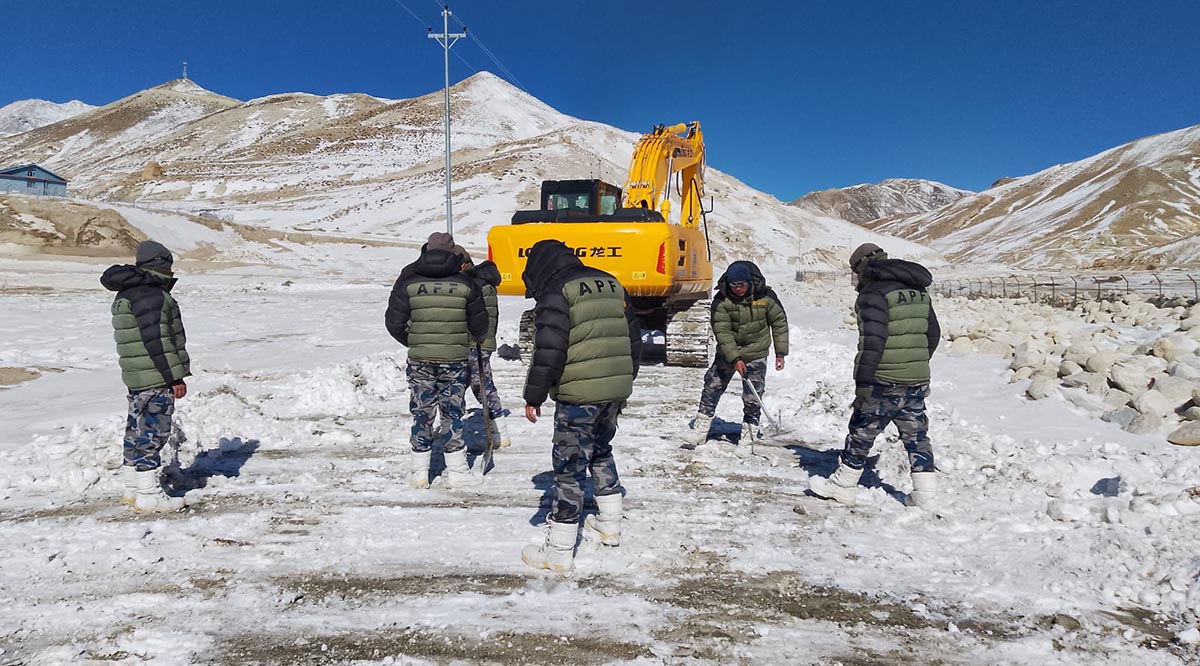
After nearly five years, heavy snowfall has returned to Upper Mustang, bringing both hardship and hope for local farmers. Chyangra rearer Angyal Gurung of Chhoser has moved more than 700 animals to high-altitude sheds at 4,700 meters to protect them from the harsh conditions. While safeguarding livestock has become difficult, farmers are optimistic. The snowfall is expected to improve pasture grass, create favorable conditions for yaks and chauri, and boost agricultural output. Experts say the snow will benefit apple farming, reduce pests, improve pollination, and enhance crop yields after years of climate-driven decline.