Kathmandu
Saturday, January 17, 2026





Pabitra Guragain/RSS
KATHMANDU: Preparations are in full swing for a three-day International Learning Conference on Dignified Menstruation, commencing on December 8 to coincide with the 7th International Dignified Menstruation Day.
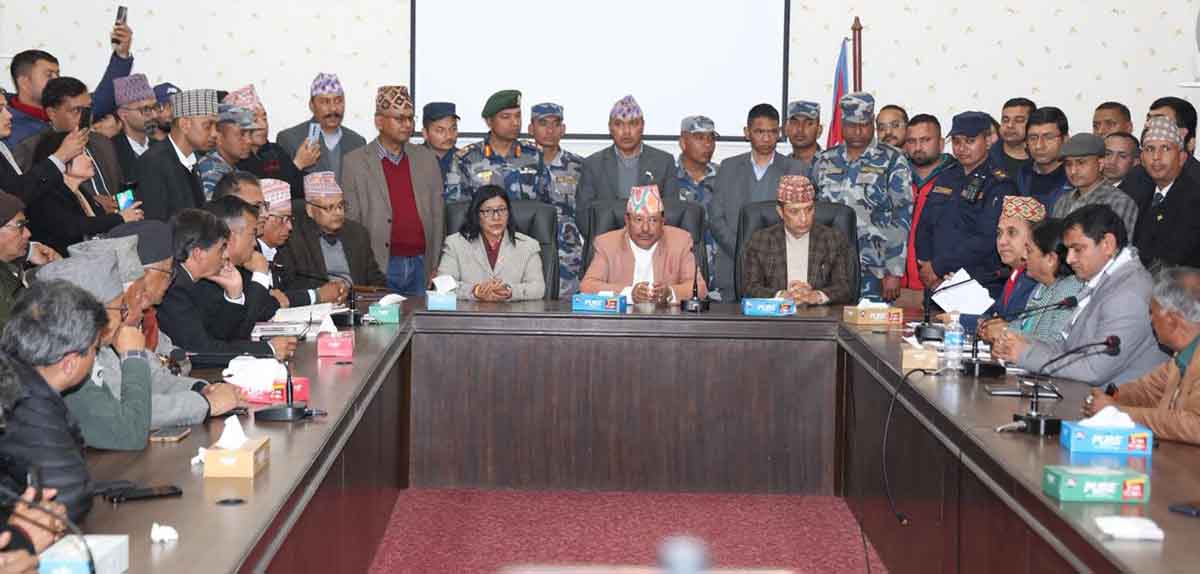
At a press meet organized here today, it was announced that the Conference organised by the Global South Coalition for Dignified Menstruation and the Radha Paudel Foundation will be attended by over 140 representatives, including experts, policymakers, youths, and other stakeholders from 21 countries.
The National Youth Council, Ministry of Youth and Sports and MenEngage Alliance (Global) are co-partners of the event, which will feature 13 thematic sessions with presentations, panel discussions, plenary sessions, strategic workshops along with launches of books, researches, songs, and theatre performance.
According to Gobinda Khadka, Media Advisor for the Global South Coalition for Dignified Menstruation, representatives will attend from Australia, Bangladesh, Benin, Bhutan, Bulgaria, Cameroon, Congo, France, Germany, Guinea, India, Italy, Ivory Coast, Mexico, Nepal, Nigeria, Pakistan, Spain, Togo, and the United States of America. The Conference will include a video message from Prime Minister Sushila Karki and the participation of ministers, National Assembly members, government representatives, youth, and media.
The event is expected to help steer a global discourse by linking menstruation with dignity, sharing menstruation-related experiences, exploring evidence-based solutions, and strengthening collaboration to combat menstrual discrimination and build an equity-based society.
It is being held under the theme: “Dignified Menstruation: Reclaim Inherent Dignity, Equity, and Inalienable Rights.”
What is Dignified Menstruation?
Speaking to the media, Dignified Menstruation expert and Madan Prize-winning writer Dr Radha Paudel said that the term Dignified Menstruation, coined in Nepal, is “an innovative, holistic, human rights, life cycle based, decolonised approach to changing the landscape of gender-based violence (GBV), human rights, and feminism through redefining the power and patriarchy.”
She argued the Dignified Menstruation campaign is a movement led by survivors of menstrual discrimination from global south. She asked, “When menstruators are denied entry into the kitchen, forbidden from sharing the dining table, face mobility restrictions, and endure many other forms of exclusion, how can they claim their place in political leadership?” She argued that the marginalisation of menstruators begins in the household and expands into political and public life from school management committee to parliament to the table of peace, politics, climate talk, head of corporate, the UN and everywhere.
Identifying menstrual discrimination as a root cause of unequal power relations and a re-enforcer of patriarchy, Dr Paudel added that an equitable society remains merely a utopian concept unless menstrual discrimination is dismantled.
Sharing the personal experience that motivated her lifelong fight against menstrual discrimination and her advocacy for dignified menstruation, she recalled learning at age seven upon seeing her mother bleeding that menstrual blood was considered “dirty” and “impure,” and that menstruators were treated as “inferior, controlled” and forced into exclusion and marginalisation. The incident deeply disturbed her; feeling marginalised, sidelined, dominated, and oppressed, she even attempted suicide. It was only after beginning her nursing studies following the School Leaving Certificate (SLC) examination that she came to understand the facts surrounding menstruation.
Menstrual Discrimination is everywhere
As an academic, scholar, researcher, and lecturer with experience across global universities, Dr Paudel has found that menstrual discrimination persists everywhere whether in the East or West, in Asia or America, or in Achham or Kathmandu. The difference, she said, lies only in its intensity, forms and visibility: “Some forms are highly visible, while others are not.”
What troubles her deeply is the widely circulated “false narrative” that in Nepal, menstrual discrimination exists only in the mid- or far-western regions. “We have ample research that explicitly shows menstrual discrimination is everywhere,” she said.
Her view is that menstrual discrimination should never be excluded when discussing any form of gender-based violence, climate justice, or broader human rights issues—it must be integrated into all related advocacy. “But that is not happening at all,” she said.
Not lonely in the fight against menstrual discrimination
Although Dr Paudel was initially alone in her fight against menstrual discrimination, the agenda of dignified menstruation has gradually become a crucial global issue. The French government has already implemented programmes on dignified menstruation in nine countries in global south where Global South Coalition for Dignified Menstruation plays a role as a learning partner. Society and media are increasingly discussing the topic, and people are becoming more comfortable, breaking the silence surrounding menstruation. Historically, on March 21, the National Assembly unanimously endorsed the Resolution Motion on Dignified Menstruation.
This year, the 7th International Dignified Menstruation Day is being observed globally, with technical support from the Global South Coalition and the Radha Paudel Foundation. Through the Global South Coalition for Dignified Menstruation alone, more than 95 organisations are marking the Day.
“Through this deeply decolonised campaign, we are capable of challenging the world to end menstrual discrimination,” she declared.
Gehanath Gautam, Chief Administrator of the National Youth Council one of the Conference’s co-partners said that menstruation, which is the foundation of human existence and reproduction, must not be discriminated against and should always be treated with dignity.
He added that the Council had embraced the issue and is committed to institutionalising Dignified Menstruation.