Kathmandu
Tuesday, February 24, 2026





BERLIN: Ahead of his highly anticipated trip to Beijing, his first as German chancellor, Friedrich Merz offered a frank assessment of China’s international role. According to Merz, China systematically fosters dependencies, seeks to reshape the international order, and could reach military parity with the United States. Moreover, as German policymakers have increasingly pointed out, Russian President Vladimir Putin would not be able to sustain his war in Ukraine, which has lasted for four years and broken Europe’s post-Cold War security order, without China’s support.
This candid diagnosis of a systemic rival cannot hide the fact that Germany faces a conundrum: Despite the security and economic challenges that China presents, pressure on the German economy could suggest a conciliatory approach to the country. But rather than seeking concessions and deals for Germany, Merz should focus on organizing European power in ways that effectively meet the challenges posed by China, as well as by the US.
The deep economic interdependence that has developed between Germany and China over the past four decades has now turned to Germany’s disadvantage. In 2025, China was again Germany’s most important trading partner, with bilateral turnover reaching approximately €252 billion ($297 billion). But imports of electronics, computer equipment, and industrial components from China have pushed the bilateral trade deficit to record levels – €89 billion in 2025 – as shrinking Chinese demand for Germany’s precision machinery, vehicles, and chemical products has caused exports to China to fall by almost 20% in just three years, to €81 billion.
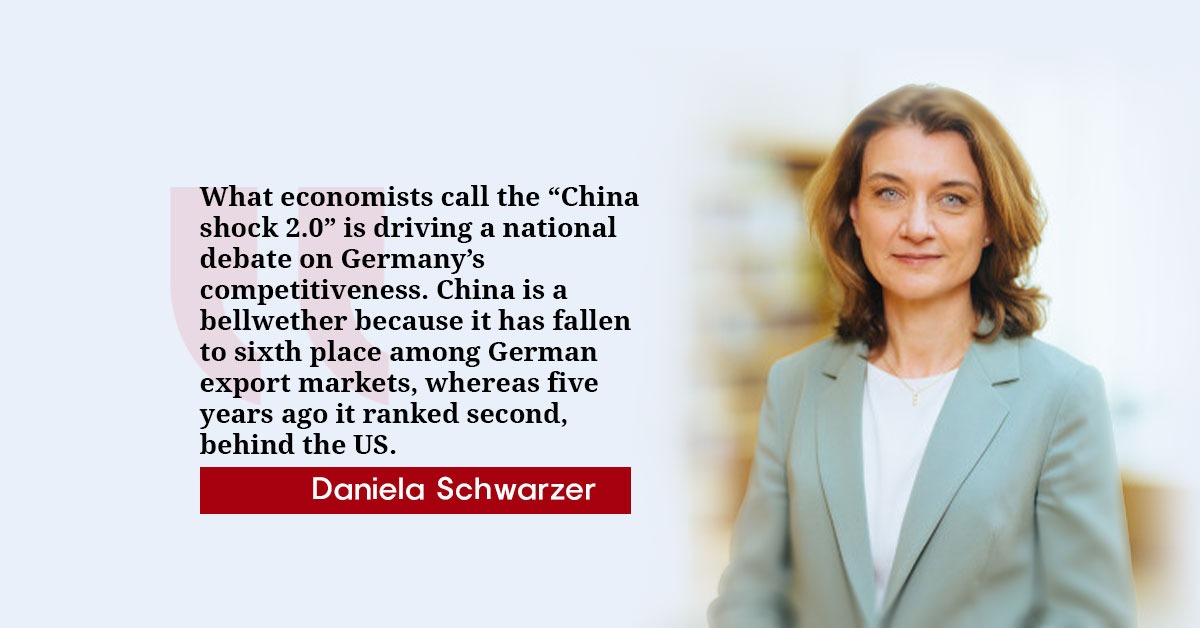
What economists call the “China shock 2.0” is driving a national debate on Germany’s competitiveness. China is a bellwether because it has fallen to sixth place among German export markets, whereas five years ago it ranked second, behind the US.
The causes of this downturn are manifold. Chinese companies have become more capable of manufacturing higher-value and more technologically complex products, and therefore no longer depend on more expensive imports. At the same time, some German companies have largely localized their business activities in China, meaning they produce in China for China. Making matters more difficult, China’s ongoing economic weakness and severe real-estate crisis have squeezed domestic demand. In short, the decline in German exports to China is set to continue.
The core challenge for Germany, and for Europe, is to reconcile geopolitical imperatives with economic practice, and balance short-term business interests with long-term structural tensions – including not only massive industrial overcapacity and distorted market access, but also export controls on critical materials. China’s manufacturing overcapacity is not simply a market phenomenon; it is an instrument of power. Chinese industry is flooding the market with state-subsidized overproduction, which fuels deflation in China and puts pressure on European prices.
If China strategically instrumentalizes interdependence, it is not enough merely to acknowledge this fact and issue appeals for “fair competition.” A European strategy must respond concretely to the logic of the Chinese economic system.
For starters, Europe should act quickly to boost economic growth by increasing investment in innovation, clean technologies, and digital infrastructure, while deepening the single market – especially in services, capital markets, and energy. Reducing regulatory fragmentation and streamlining permitting processes would unlock private investment, especially in tandem with targeted European industrial policy that supports strategic sectors without undermining competition. At the same time, Europe must expand trade partnerships beyond traditional markets, and mobilize joint financing instruments to crowd in private capital.
If China strategically instrumentalizes interdependence, it is not enough merely to acknowledge this fact and issue appeals for “fair competition.” A European strategy must respond concretely to the logic of the Chinese economic system.
Second, critical dependencies in raw materials, key technologies, and digital infrastructure must be systematically reduced. This means establishing clearly defined diversification targets, promoting a European circular economy, and embracing joint European procurement.
Third, Europe has started shifting from free trade to a more defensive stance. But export controls, investment screening, anti-subsidy investigations, and industrial policy tools must be coordinated even more strategically at the European level. National unilateralism weakens everyone’s leverage. Europe must use its market power to develop a unified approach to industrial overcapacity, industrial alliances, and agendas in multilateral forums. China could be invited to invest in Europe under clear rules in exchange for market access.
As China treats economic policy as a geopolitical instrument, Merz’s trip to China will be an important test of European credibility. Passing that test will require self-binding commitments. If the German chancellor calls for European unity, the German government cannot simultaneously pursue national industrial exceptions. China carefully observes where European cohesion falters and systematically tests the European Union’s consistency. A unified European strategy requires strategic discipline.
While China is pursuing technological and industrial dominance, a growth model that produces overcapacity and rising social tensions is not invulnerable. The EU possesses significant assets it can deploy in its competition with China: the power of the single market, regulatory capacity, and technological excellence. But these assets generate influence only if Europe acts cohesively.
At the same time, systemic competition must not eliminate the space for cooperation. On climate policy and global financial stability, for example, pragmatic engagement remains necessary. But cooperation can be sustainable only if it rests on clearly defined interests and reduced vulnerabilities.
To meet the scale of the challenge posed by China, Merz must be willing and able to mobilize the power of Europe. Strategic rivalry requires strategic action. Merz’s visit will amount to more than symbolic economic diplomacy only if it conveys European unity externally and European discipline internally.
Daniela Schwarzer, a member of the Executive Board of the Bertelsmann Stiftung, is a former director of the German Council on Foreign Relations, former executive director for Europe and Central Asia at the Open Society Foundations, and the author of Krisenzeit: Folgen Sicherheit, Wirtschaft, Zusammenhalt – Was Deutschland jetzt tun muss (Piper, 2023).
Copyright: Project Syndicate, 2026.