Kathmandu
Friday, February 20, 2026





The air in the corridors of Singha Durbar, the seat of Nepal’s government, has grown notably colder toward the north. For decades, the relationship between Nepal and China was characterized by a comfortable, if somewhat lopsided, predictability. Beijing contributed to the infrastructure, while Kathmandu gave a ‘one-China’ commitment. But as 2026 approaches, that framework exhibits severe fundamental injuries.
The shift is not merely diplomatic; it is generational. The ‘Gen Z’ protests of late 2025, which saw the spectacular fall of the KP Sharma Oli administration, didn’t just change the prime minister; they changed the national psyche. The interim government, led by former Chief Justice Sushila Karki, now finds itself caught between a suspicious Beijing and a domestic population increasingly wary of ‘debt-trap’ diplomacy.
The Pokhara Ghost Town: A Case Study in Collusion
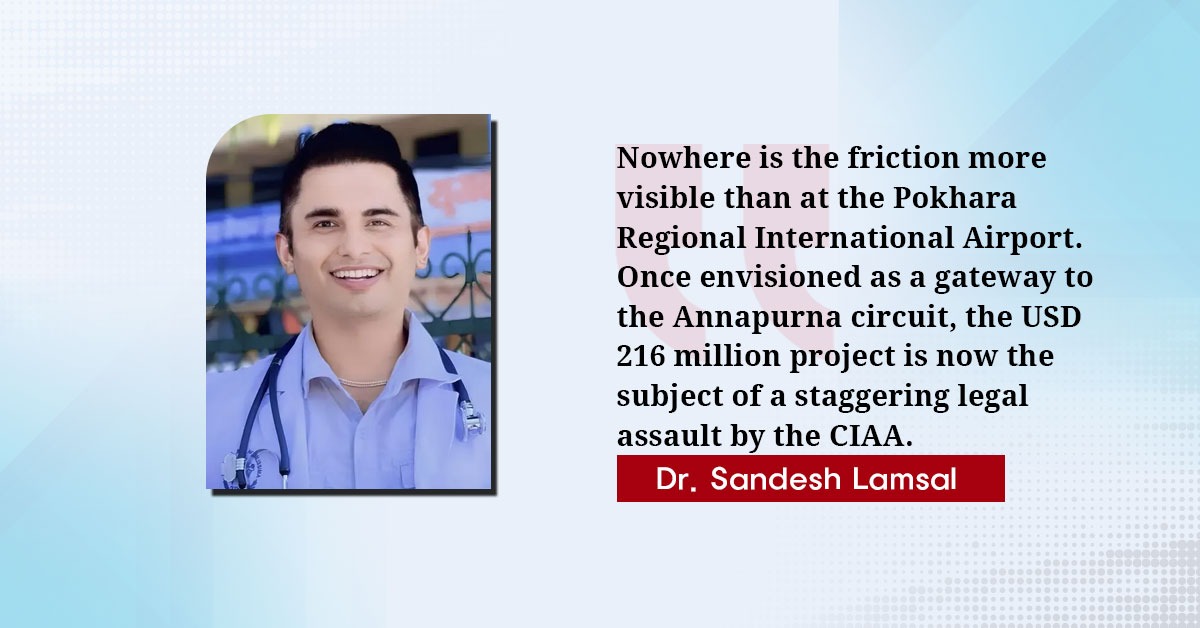
Nowhere is the friction more visible than at the Pokhara Regional International Airport. Once envisioned as a gateway to the Annapurna circuit, the USD 216 million project is now the subject of a staggering legal assault by the Commission for the Investigation of Abuse of Authority (CIAA).
The investigation has moved beyond mere administrative oversight. The charges filed against 55 individuals, including five former cabinet ministers, allege a sophisticated ‘kickback’ culture. The core of the CIAA’s argument is that the project’s cost was inflated by nearly 50% through a series of ‘technical adjustments’ that benefited both Nepali middlemen and the Chinese contractor, CAMC Engineering.
For Beijing, the optics are disastrous. China has long taken pride in its ‘Clean Silk Road’ policy; the Pokhara incident reveals that Chinese state-owned enterprises (SOEs) may be functioning with the same opacity as the local regimes they collaborate with. The outgoing Chinese Ambassador, Chen Song, took the rare step of publicly defending the SOE, claiming it adhered to strict internal anti-corruption laws. This move was viewed by many in Kathmandu as an infringement on Nepal’s sovereignty, although corruption is widespread in Nepal, and Nepal is on the FATF gray list, with a risk of moving to the black list.
The Trans-Himalayan Pipe Dream?
While news about the airport dominates headlines, the ‘Trans-Himalayan Multi-Dimensional Connectivity Network,’ particularly the railway, which was supposed to connect Kerung to Kathmandu, has been delayed due to financial constraints.
Instead of “when” the railway will be constructed, the question now is “who” is covering the cost of the project. Nepal will no longer take out expensive commercial loans for tasks that don’t have a certain, swift return on investment, according to a sharp move foreshadowed by the Karki cabinet.
The Nepali position is 100% grant-based or soft-interest loans from multilateral agencies. But the Chinese position is a preference for ‘Policy Bank’ loans (Exim Bank of China) tied to Chinese contractors.
This stalemate has left the project in a “feasibility loop.” While Chinese survey teams have been seen on the cliffs of Rasuwa, the lack of a signed funding agreement means the project exists only on paper.
The Nepali position is 100% grant-based or soft-interest loans from multilateral agencies. But the Chinese position is a preference for ‘Policy Bank’ loans (Exim Bank of China) tied to Chinese contractors.
Climate Shocks and the ‘Friendship’ Bridge
Nature has further complicated the diplomacy. The July 2025 glacial lake outburst flood served as a reminder that the Himalayas are an active partner. The torrent of water that destroyed the Friendship Bridge at Rasuwagadhi not only halted the main land route for Chinese electronics and apparel into Nepal but also claimed more than nine lives.
The ensuing delay in reconstruction became a diplomatic sore point. Kathmandu accused Beijing of being hesitant to transmit upstream hydrological data, which could have served as an early warning. Beijing, in turn, grumbled about Nepal’s lack of “security readiness” at the border. Even after the bridge was patched together, the ‘Tatopani’ border pass remains a shadow of its former self, with traders complaining that Chinese customs officials use security inspections as a tool for political signaling whenever Kathmandu tilts toward New Delhi or Washington.
The ‘American Ghost’ in the Room
One cannot discuss China-Nepal relations without mentioning the ‘MCC factor.’ The USD 500 million Millennium Challenge Corporation grant from the United States remains a thorn in Beijing’s side.
In the eyes of the Communist Party of China (CPC), the MCC is not about electricity transmission lines; it is about the ‘Indo-Pacific Strategy.’ When the Karki administration stood by its commitment to the MCC in early 2026, Beijing issued a series of modest “security advisories” on the actions of Tibetan refugees.
The message of Beijing is clear as crystal. If Nepal serves as an incubator for rising American dominance or backs the Dalai Lama and his allies, China will reinforce its dominance on the northern border. The 20,000 Tibetan refugees in Nepal, most of whom have been stuck in a legal darkness for a long time, now find themselves facing an uncertain situation. Reports of increased CCTV surveillance in the Bauddha and Swayambhu areas, funded by “policing aid” from China, suggest increased Chinese concern about stability and a decline in trust with the Karki Government.
The Zhang Maoming Era: Reset or Retreat?
The arrival of Zhang Maoming as the 23rd Ambassador to Nepal is a tactical move. Zhang has experience with difficult jobs and is regarded as having a gentler argumentative style than his predecessor. His first task is to manage the fallout of the 70th-anniversary celebrations, which were largely overshadowed by the corruption probes.
The reality of 2026 is that the romantic phase of China-Nepal relations is over. The relationship has entered a “transactional” phase. Nepal’s elite are no longer dazzled by the promise of mega-projects; they are worried about the balance sheet.
“We are not anti-China,” a senior official from the Ministry of Foreign Affairs stated at a private briefing. “We are simply pro-Nepal. We have seen what happened in Sri Lanka and Pakistan. We want the infrastructure, but we do not want to lose keys to the sovereignty of Nepal in the process.”
Conclusion: A Sovereignty of the Middle Ground
As the snow melts on the Himalayan peaks in the coming months, everybody will witness Zhang Maoming’s debut ‘Greenfield’ initiatives throughout his term. Will China offer the grants that Nepal demands? Or will Beijing quietly observe the temporary administration being replaced by a more “reliable” ally in the next general election?
Nepal’s role as a buffer state has traditionally been both troublesome and beneficial. In 2026, the goal is to show that Nepal can accept Chinese investment without jeopardizing its sovereignty. Beijing’s objective is to demonstrate that the Belt and Road Initiative can withstand investigation by independent governments.