Kathmandu
Tuesday, July 21, 2026





Citizens have high expectations of the near two-thirds majority government led by Balendra Shah – systemic change and good governance. It is too early to evaluate delivery, though the government has already shown a somewhat different governing style from its predecessors. Whether this will be sustained, and how its announced agenda will be implemented, will become clear in the days ahead.
Government plays a crucial role in a country’s progress, but the legislature and judiciary matter equally. A country cannot be built by policy reforms or government programs alone without building a good culture through the conscious role and creative contribution of every citizen. Active civic participation is an indispensable condition for progress, and much will depend on what kind of order we can establish in this country.
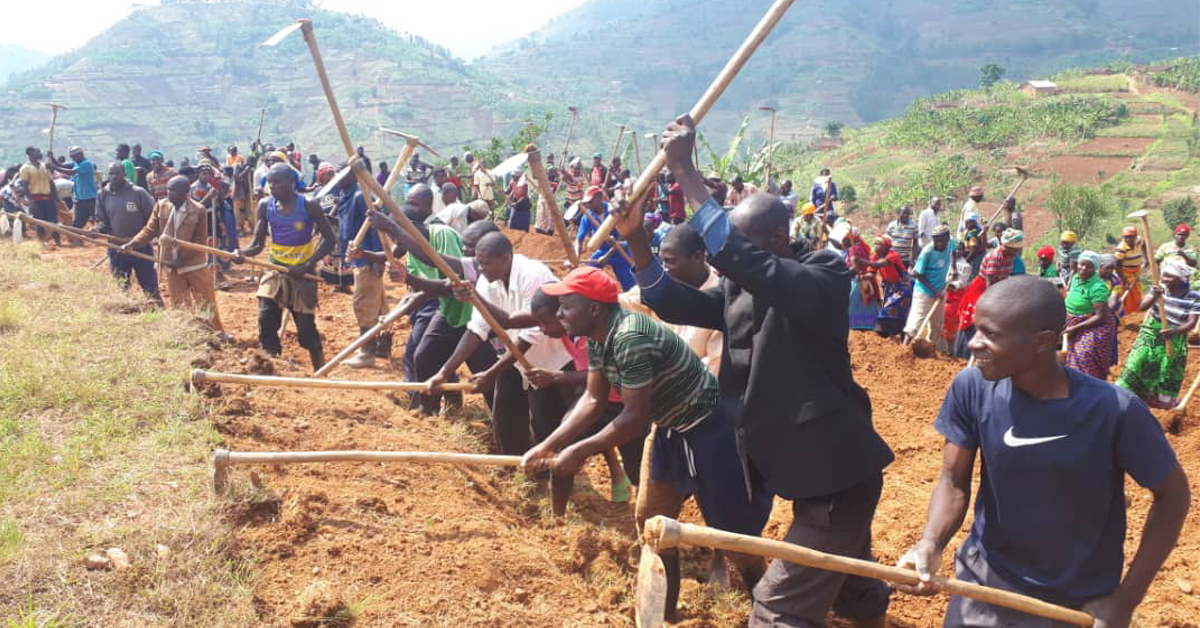
People participating in community work in Rwanda. Photo courtesy: KT Press
Those who reach power carrying a change agenda can play a leading role in systemic reform. As long as the tendency persists of waiting for government budgets for every task, and parties out of power lurking to capture it, the country cannot be built. Every individual, group, and political party can contribute to change through new cultures, practices, and initiatives. No matter which leader or party is in government, the country cannot be built without continuous active citizen participation – the activism that shows up only on election day is not enough. In this context, it seems timely to discuss the role of Rwanda’s labor culture in its progress, which this article briefly attempts.
Introducing Rwanda
Most of Africa’s 54 countries endured three to four centuries of European colonization. More than 30 still struggle with poverty, hunger, and inequality. Despite all this, Rwanda stands out as a country that has made genuine progress on human, social, cultural, and economic fronts.
Small but rapidly developing, this landlocked East African country – like Nepal – covers 26,328 square kilometers of hilly terrain and shares borders with Uganda, Tanzania, Burundi, and the Democratic Republic of Congo. Rwanda endured a devastating genocide in 1994 and has since charted a path of national reconciliation, good governance, and unity to achieve remarkable progress. Today it is held up as an example for clean cities, firm law enforcement, expanding digital services, high women’s participation in policymaking, and good governance.
Rwanda’s Umuganda program has become the bridge between civic responsibility and the community-state relationship. On the last Saturday of every month, everyone from the President to ordinary citizens contributes around three hours of voluntary labor.
With a population approaching 15 million, Rwanda’s economy is rooted in agriculture, with coffee and tea as its main exports. Practices such as education, healthcare, environmental protection, and Umuganda are driving it toward sustainable development. Rwanda demonstrates how transformation becomes possible through community ownership, clear state direction, and civic responsibility.
Corruption control, tax reform, and effective public service delivery have supported Rwanda’s economic growth. Community health insurance, improved school enrolment, and women’s empowerment are among its major achievements. Rwanda’s parliament today has the highest proportion of women of any in the world. Despite a constitutional guarantee of only 30 percent, women make up 63.8 percent of the Chamber of Deputies and 46.2 percent of the Senate.
An unimaginable genocide and the rise of Pasteur
In 1994, Rwanda endured a genocide. In conflict between the Tutsi and Hutu communities lasting nearly three months, more than 800,000 people lost their lives. Most families and communities were shattered, and the state apparatus was rendered inactive. On 6 April 1994, a plane carrying Burundian President Cyprien Ntaryamira and Rwandan President Habyarimana was shot down by a missile near Kigali airport, killing both presidents and all passengers on board.
The then-President of Rwanda was from the Hutu community. The Hutus assumed the Tutsis had shot down the plane, and violence spread between the two communities. Within an hour of the attack, Hutu militia had seized all roads in Kigali and the residences of the Prime Minister and ministers. Killings took place in churches, schools, hospitals, and across villages. Violence occurred even between those who had worked together, studied together, and stood by each other through good and bad times. Neither children, the elderly, women, men, nor family members were spared.
Pasteur Bizimungu became President after the genocide, with a government formed jointly by Hutu, Tutsi, and Twa communities. But after a while the government failed to maintain neutrality, and in 2000 then-Vice President Paul Kagame was sworn in as President. He was elected again in 2003 and a third time in 2011. In 2017 Rwanda’s people chose to continue with him by an overwhelming margin, giving him 98.79 percent of votes. In the 2024 election, he again received 99.18 percent. Under his skilled leadership and with citizens united, the country has been transforming itself.
Labor contribution
Rwanda’s Umuganda program has become the bridge between civic responsibility and the community-state relationship. On the last Saturday of every month, everyone from the President to ordinary citizens contributes around three hours of voluntary labor. The primary purpose of Umuganda is community-driven construction of public infrastructure, environmental protection, sanitation, road maintenance, tree planting, and water source conservation.
The collective labor campaign has connected communities not only through development but emotionally as well. After the labor session, community-level dialogue and discussion take place on local problems, development plans, social cohesion, and good governance. Umuganda has helped reunite a society that had been divided and weakened by genocide. Umuganda is not merely a labor program; it is civic duty, social discipline, and a culture of collective development that has strengthened mutual trust, a sense of responsibility, and national unity.
Nepal has had and still has traditional community labor practices – melaapat, parma, and others – but these have never been linked to the modern state structure. Instead, the tendency has grown of waiting for government budgets for even minor tasks, and then failing to use whatever budget is received properly.
Rwanda’s practice appears highly applicable to Nepal’s context for local development, social cohesion, and building accountable citizenship.
Nepal has had and still has traditional community labor practices –melaapat, parma, and others – but these have never been linked to the modern state structure. Instead, the tendency has grown of waiting for government budgets for even minor work and then failing to use whatever budget is received properly. What Rwanda’s experience tells us is that if community labor can be connected to policy and civic duty, the result is not just local development but stronger social cohesion as well.
When he was mayor of Dharan, Harka Sampang set an exemplary example of labor culture, and it was on that foundation that the Shram Sanskriti Party was established – a party that has now emerged into national politics from the March 5 election. How he continues that labor culture in the days ahead, and what support the government provides for developing it as the culture of the country, remains to be seen. If the country is to be built, active citizen participation in development work is essential, and labor culture is an important process for that.
Our path on land, agriculture, and food security
After the genocide, resettling displaced people was a primary challenge for Rwanda, as was the problem of informal land ownership. The state treated land management not merely as a technical matter but as the basis of social reconciliation and national stability, addressing land questions through community dialogue.
In Nepal, the questions of the landless, squatters, informal settlers, and small farmers have been entangled for a long time. Land policy changes repeatedly but implementation remains weak. Rwanda’s experience shows that social cohesion and sustainable development are impossible without proper land management.
Rwanda built the foundations of national reconciliation by prioritizing land registration, clear ownership, and dispute resolution. Nepal too should delay no further in enacting a new land law on the constitutional foundation, and political parties must reach minimum common ground on land reform.
Rwanda has placed agricultural reform at the center of national priorities, organizing small farmers, emphasizing cooperatives, market access, and environmentally friendly practices, and treating agriculture not merely as a livelihood but as a foundation of national stability.
Rwanda’s experience should not be blindly copied. Its core message must be understood: national transformation requires political will, clear direction, civic discipline, and continuous participation.
Farmers are the primary force that sustains a country, yet their labor and contribution have not been given adequate respect in policy and political debate. Concrete campaigns are needed to increase self-reliant farming, cooperative strengthening, organic practices, market access, and youth participation.
If we place farmers, laborers, youth, and communities at the center of development; re-establish labor contribution as a culture; prioritize land and agricultural reform; and make the governance system transparent and accountable – our own transformation is possible. Building a country is not the monopoly of any single leader, party, or government. It is possible only through collective resolve and continuous work.
Rwanda’s governance system is strict and disciplined; performance agreements extend to the local level, narrowing the gap between planning and delivery. There is zero tolerance for corruption. The substance of democracy is visible not just in process but in the quality of citizens’ lives. Rwanda demonstrates that when citizens unite behind national development, it does not take long to achieve results.
Transparency International’s report identifies Rwanda as the least corrupt of Africa’s 54 countries. Its government is visionary and dedicated to the nation and its people. Former critics are now supporters of the government. Whatever physical development has been achieved is of a solid and mature kind, and all those engaged in investment and production are encouraged.
Nepal lacks neither capacity, resources, nor potential. What it lacks is shared direction, results-oriented implementation, and the revival of its traditional labor culture.
Rwanda’s experience should not be blindly copied. Its core message must be understood: national transformation requires political will, clear direction, civic discipline, and continuous participation.
Nepal’s context differs from Rwanda’s in historical background, social diversity, federal structure, and political pluralism. Yet serious challenges such as landlessness, disorganized settlement, agricultural crisis, corruption, weak implementation, and the erosion of labor culture exist here too.
Nepal too could run community labor campaigns on a fixed day each month, centered on local government. This would deepen the sense of ownership over public assets, strengthen social cohesion, reduce the cost of small infrastructure projects, and strengthen the citizen-state relationship.
To narrow the gap between planning and delivering results, the performance evaluation system must be made effective. Transparency and accountability must be brought into practice from local to central government. The current policy of elected representatives drawing a monthly salary is not right. At a minimum, legislators should receive a daily allowance only for days engaged in policymaking, while all of them maintain their own professions.
Elections are only one aspect of democracy. Even after voting, citizens must hold the state accountable through oversight, participation, and constructive pressure. Rwanda’s core message is clear: where there is discipline, labor, clear leadership, and civic participation, development is possible. Nepal lacks neither capacity, resources, nor potential. What it lacks is shared direction, results-oriented implementation, and the revival of its traditional labor culture.