Kathmandu
Tuesday, February 24, 2026





Harka wave, Goma push: Old guards on back foot
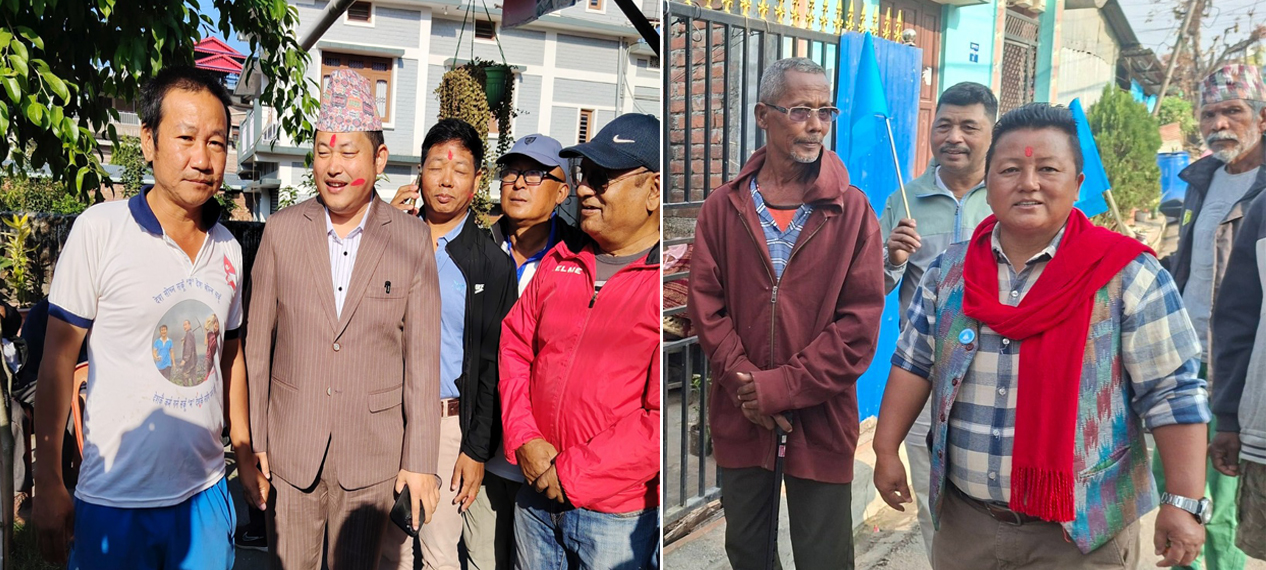
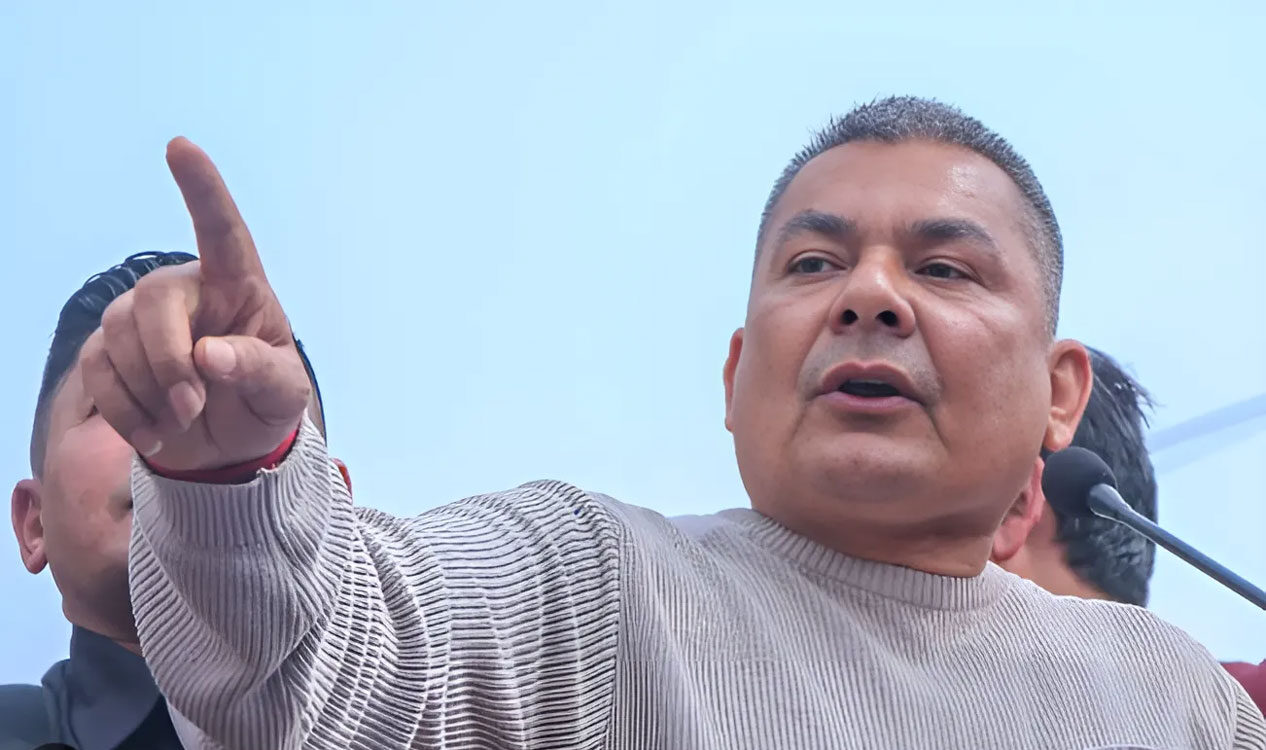
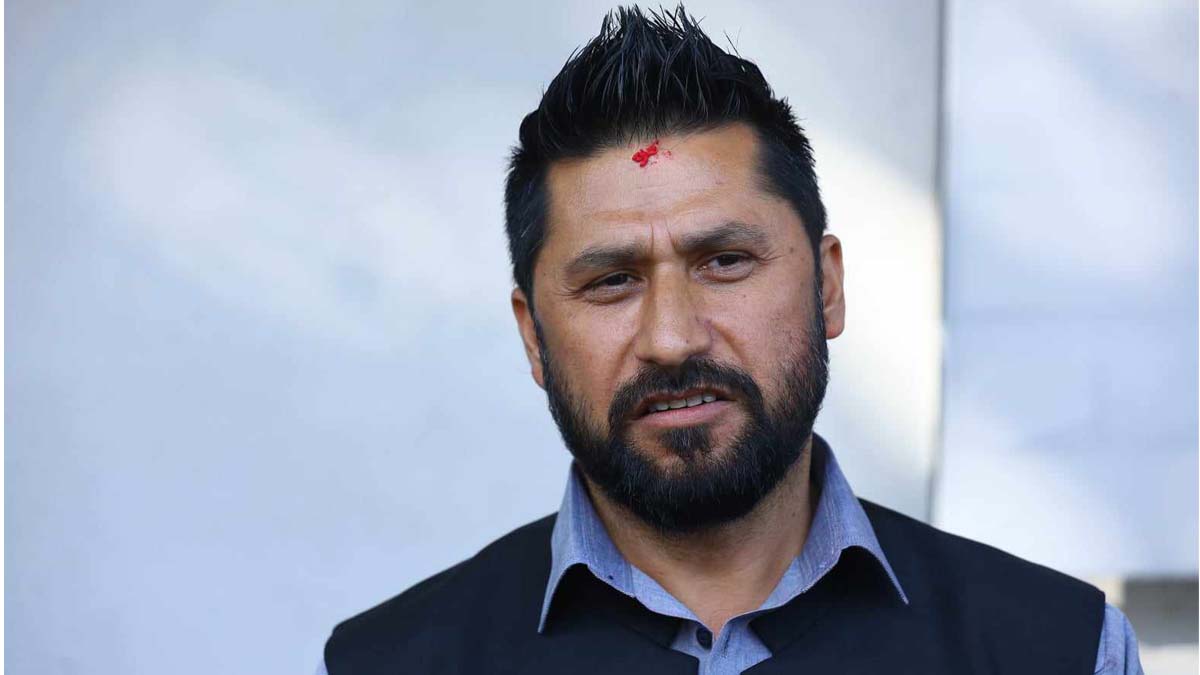
BIRATNAGAR: Among the constituencies drawing significant attention from both home and abroad in the general election to be held on March 5 is Sunsari Constituency Number 1. This region has become famous across the country due to the 41-year-old Harka Raj Rai (Sampang), who, after winning the mayoralty of Dharan Sub-Metropolitan City as an independent, launched the Shram Sanskriti Party with the ambition of becoming ‘Prime Minister’ and entered the election race.
Goma Tamang (Sarin), 52, of the Rashtriya Swatantra Party (RSP), who has made an identity for herself in national politics and lost by a slim margin of 453 votes to the CPN (UML)-supported Janata Samajwadi Party candidate Ashok Kumar Rai in the 2022 election, has presented her candidacy again. In that election, while Rai was elected by bringing 17,059 votes, Tamang had received 16,606 votes. This is another reason for the buzz.
Amidst the wave of powers called ‘new’ here, the Communist Party of Nepal (Unified Marxist–Leninist), abbreviated CPN (UML), is intent on reclaiming its ‘long-standing fortress,’ while the Nepali Congress appears to be making efforts to plant the flag of victory for the first time. In this constituency with 150,393 voters, even though 26 candidates are in the electoral field, the main clash appears to be between the new and the experienced. This constituency covers 27 wards, including 20 wards of Dharan Sub-Metropolitan City; wards 1-5 of Barahakshetra Municipality; and wards 6 and 7 of Ramdhuni Municipality.
Due to the efforts made by Sampang in the voluntary labor campaign and solving the drinking water problem as mayor, voters like Bhupal Tamang of Dharan-11 seem confident in him. “Harka has done a lot of improvement work compared to previous mayors. Therefore, he will get our votes,” says Tamang.
However, the candidacy of the 42-year-old Surya Bahadur Bhattarai (Manoj) of the Nepali Communist Party (NCP), who continuously opposed Sampang’s working style in the municipal executive meetings, has also turned the competition into a battle of ‘egos.’ Bhattarai, who won as the Chairman of Dharan-17 twice on behalf of the CPN (Maoist Center), is considered popular among squatter settlements and minority voters.
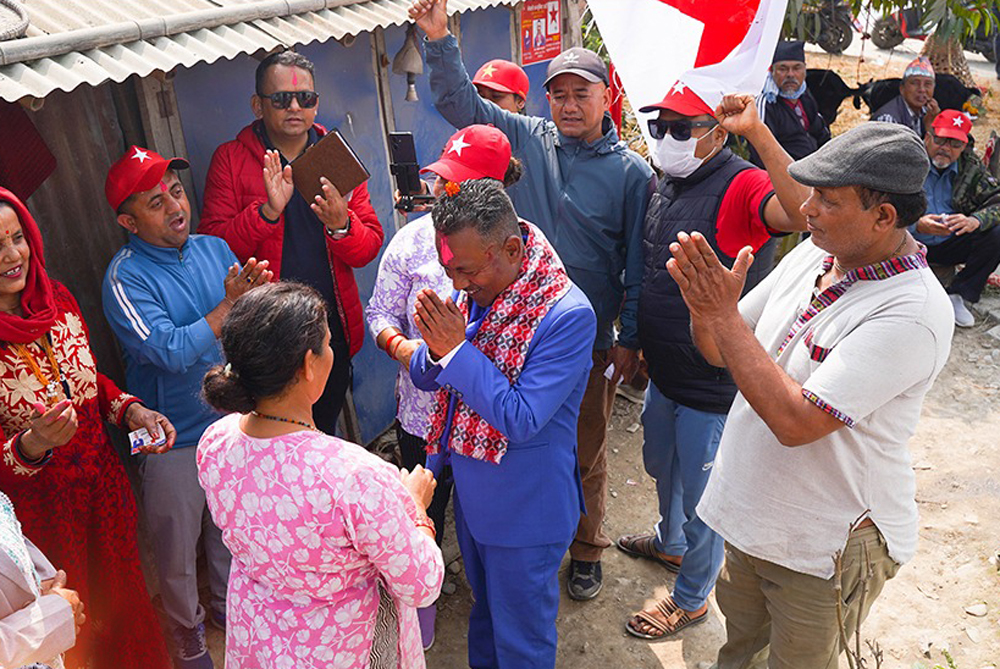
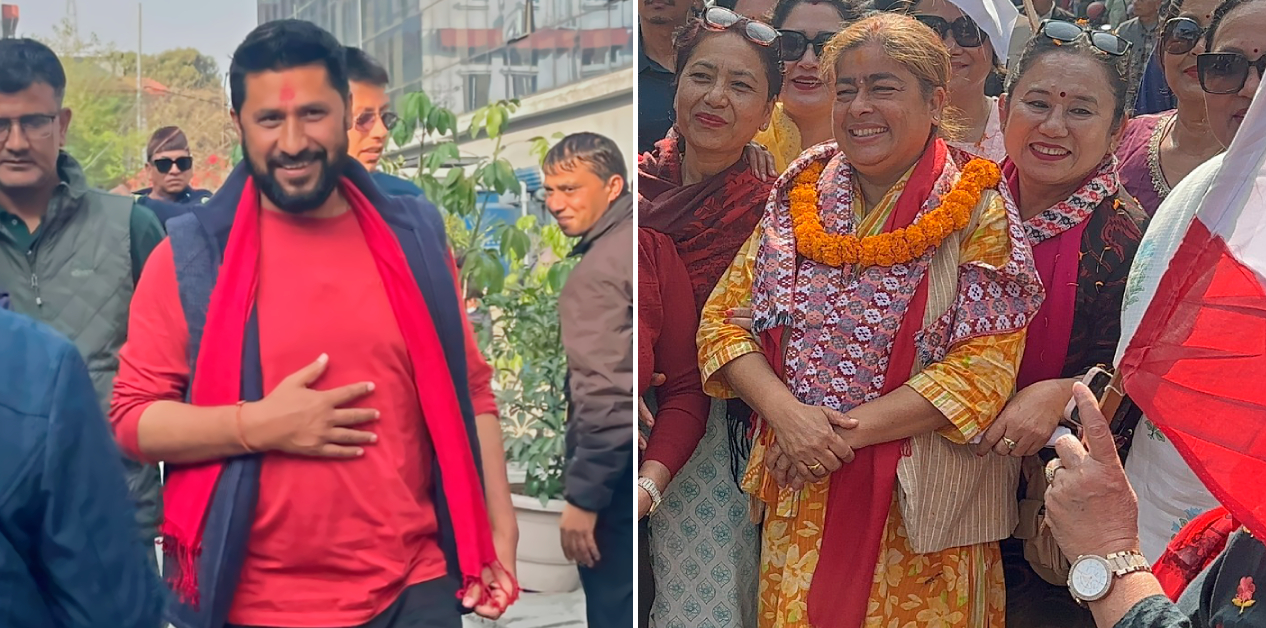
Nepali Communist Party candidate Surya Bahadur Bhattarai (Manoj) during an election campaign. Photo Courtesy: Bhattarai/Facebook
In Sunsari 1, which has been considered a leftist stronghold since the Panchayat era, the CPN (UML) has a history of electing everyone from Manmohan Adhikari to Lila Shrestha Subba, Kunta Sharma, Krishna Kumar Rai, and Jay Kumar Rai in elections since 1991. In 2008, Kiran Rai of the CPN (Maoist Center) also got the opportunity to become a Member of Parliament.
This time, the CPN (UML) has fielded 41-year-old Tikaram Limbu (Manglen). Limbu has great trust in the strong organizational structure and historical legacy of the party. He is the former president of the All Nepal National Free Student’s Union (UML) Sunsari.
The Nepali Congress has made Regional President Sujendra Tamang (41) its candidate. Known in local politics, he is aiming to create history in Sunsari 1 for the first time as the new face of the ‘New Nepali Congress’ after Gagan Thapa became president. Additionally, his expectation of receiving votes from the Tamang voters is natural.
Tamang of the RSP, who appears even more powerful after the Gen Z protest and the entry of Balendra Shah into the party, feels added energy this time. However, since the ‘vote bank’ of both Sampang and the RSP consists of proponents of alternative politics, the votes appear likely to split. Voters dissatisfied with the experienced parties seem confused about whether to choose the ‘Bell,’ which is the election symbol of RSP, or the ‘Soil,’ which is the election symbol of Shram Sanskriti Party. Furthermore, it is estimated that Dambar Lawati of the Ujyalo Nepal Party will also cut into the votes of both.
However, there is also anger among some voters of Dharan toward Harka Sampang for leaving his responsibility as mayor incomplete. In tea shops, there is even talk that some votes might decrease due to Sampang’s habit of giving snappy retorts.
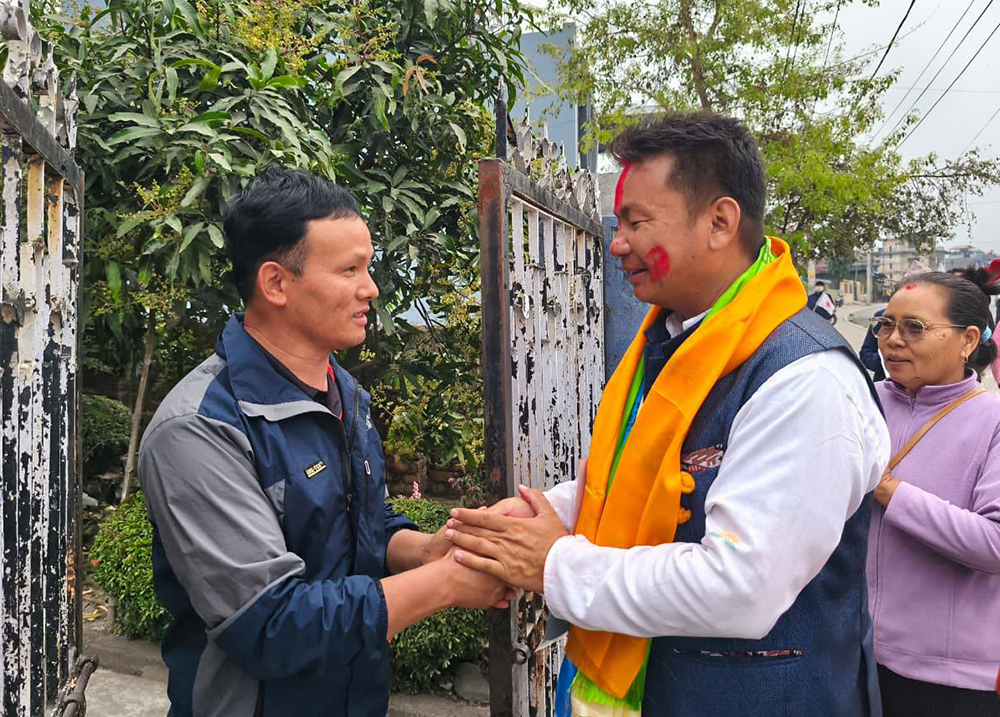
Tikaram Limbu with voters during the election campaign. Photo Courtesy: Limbu/Facebook
The buzz of the RSP and Sampang, which were previously more famous only in Dharan, is heard this time even in Ramdhuni and Barahakshetra Municipality, which are considered relatively less urban.
“We gave votes to the old ones so many times, but they did not work for the people. Therefore, this time we are thinking of choosing a new party,” says Shital Chaudhary of Ramdhuni-6, Detigaun. However, some voters in Dharan itself are negative toward Sampang. They claim that while being mayor, he did more room talk than work and spread rumors rather than facts regarding voluntary labor and drinking water.
In this constituency, where 76.92 percent are Indigenous Nationalities voters, the votes of the Rai, Limbu, Newar, and Tamang communities tend to be decisive. Because of this reality, all major parties have put forward candidates belonging to indigenous communities. Due to this, it is analyzed that ethnic votes will also split, and ultimately, the candidate’s personal personality and agenda will become the basis for victory.
Rajendra Sharma, a political analyst and former associate professor of Mahendra Multiple Campus, Biratnagar, also says that there are signs of traditional voting patterns breaking this time.
“The widespread influence of the RSP and the wave of Harka Sampang have put the old parties in a defensive position. Voices are rising against the old parties in almost every house,” Sharma further added.