Kathmandu
Thursday, February 26, 2026





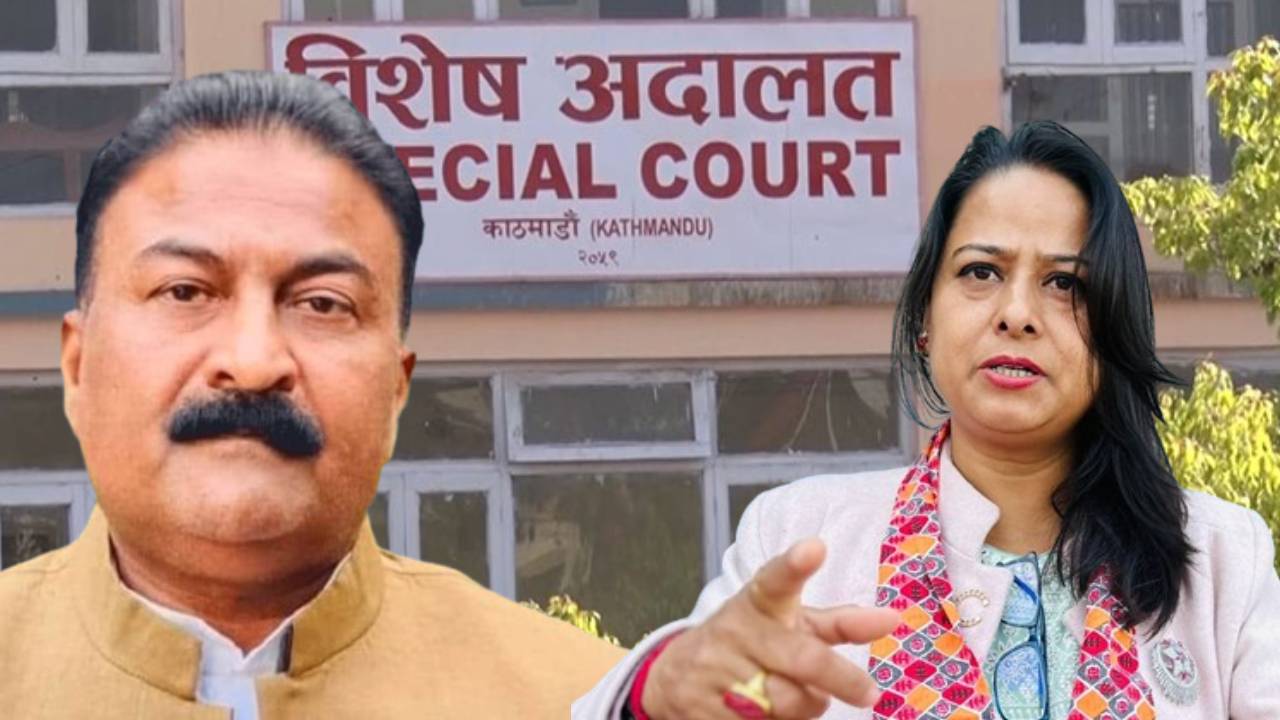
KATHMANDU: The Special Court has ordered pre-trial detention of CPN (UML) leader and former minister Rajkumar Gupta, who was once at the very center of power. Gupta, who was the Minister for Federal Affairs and General Administration in the erstwhile KP Oli-led government, was sent behind bars pending trial in a corruption case linked to a patch of government land known as Lichibari (litchi orchard) in Pokhara, Gandaki Province.
The Special Court’s decision marked a rare and dramatic turn in the long struggle of Nepal against high-priority corruption. The resignation of ministers is not new. Allegations have cropped up time and again. But the sight of a former minister being put behind bars over a bribery case sent a strong message: this time, the evidence had gone too far to ignore.
The story starts not from Kathmandu, but from Pokhara-16, Batulechaur, where about 134 ropanis of government land became the focus of a quiet but ambitious scheme. Investigators say that wasn’t an isolated land dispute but is tied to allegations of corrupt attempts to convert or manipulate the status of public or disputed land into private ownership through unlawful means rather than a legitimate land transfer process.
The ownership of the property, which was registered under plots number 25, 26, and 28 on the map, was to be transferred to Suraj Shah Thakuri, an heir of Durga Devi Shah, following a court verdict.
However, the procedural takeover was stuck at the Land Revenue Office in Kaski, due to which the delay was intentional, according to the accusations by investigators.
But when the documents did not progress, Suraj Shah Thakuri, representing the plaintiffs, decided to use a real estate broker, Sujan Lama. A report by the Commission for the Investigation of Abuse of Authority (CIAA), the constitutional anti-corruption watchdog, states that a bribe ring was formed to ‘fix’ the land problem in exchange for money and properties.
A web of power and middlemen
The ring is said to have been centered by Gupta and another cabinet member, Ranjita Shrestha, the former Minister for Land Management, Cooperatives, and Poverty Alleviation. A ring of brokers, government officials, and political appointees made up the circle.
It appears the agreement was not limited to the land. There were two other tasks that were incorporated in one negotiation. One of the goals was to halt the transfer of the Kaski Land Revenue Office head, Ramchandra Adhikari, who was accused of demanding bribes in exchange for postponing the official transfer of ownership of the disputed land plots.
In the charge sheet filed by the CIAA, Rs 53 million has been linked to stopping the land revenue office chief’s transfer, while Rs 25 million was tied to the Land Commission appointment. Together, they formed the Rs 78 million bribery claim that would later become central to Gupta’s downfall.
For months, these dealings remained behind closed doors. Then came the turning point when an audio recording surfaced. In the audio clip, then minister Gupta and broker Sujan Lama are allegedly heard discussing bribe transactions. Initially, the conversation pointed to Rs 32 million.
As investigators dug deeper, the scope widened to Rs 78 million. The audio did more than spark public outrage, forcing the CIAA to formally open an investigation.
Gupta, facing growing pressure, resigned from his ministerial post on July 15, 2025. At the time, he denied wrongdoing, insisting that the audio clip had been manipulated using technology. But his resignation did not stop the investigation. It merely marked the end of his political authority and the beginning of his legal vulnerability.
The CIAA moves in
On October 8, 2025, the CIAA filed a corruption case at the Special Court against seven individuals, naming Rajkumar Gupta and Ranjita Shrestha as the main accused. Others included broker Sujan Lama, Kaski Land Revenue Office chief Ramchandra Adhikari, and several alleged accomplices.
The charge sheet painted a detailed picture: government land targeted, bribes negotiated, appointments promised, and money allegedly counted and transported. For Gupta, the CIAA demanded Rs 78 million in claimed damages, six to eight years in prison for bribery and an additional three years for abuse of authority as a public office bearer. The same penalties were sought against former minister Ranjita Shrestha, who, notably, has yet to appear before the court.
When Gupta finally appeared before the Special Court, he took a firm stance. He denied knowing anyone involved in the case except former minister Shrestha. He rejected the allegations outright and claimed the audio was fabricated.
But this defense would backfire.
Judges Sudarshan Dev Bhatt, Dilliratna Shrestha, and Bidur Koirala of the Special Court did not rely solely on Gupta’s words. They examined call records showing repeated phone conversations among Gupta, Shrestha, and broker Lama. They reviewed forensic reports confirming the authenticity of the audio recordings. They scrutinized financial transactions, hotel bookings, and even photographs.
One image proved particularly damaging: money allegedly being counted at the official residence of the Kaski Land Revenue Office chief and loaded into a vehicle.
The court also noted inconsistencies in Gupta’s testimony. His claim that he did not know the other accused contradicted documentary and digital evidence. In legal terms, the judges concluded that Gupta had given false statements in court, further weakening his credibility.
In such cases of corruption and bribery, small details often expose big truths. In this case, hotel bills did exactly that.
During key moments of negotiation, Gupta and Shrestha stayed at a resort in Pokhara. Gupta’s hotel bill – Rs 79,000 – was paid by his ministry. Shrestha’s bill of Rs 59,000, however, remained unpaid even by the time the case was filed.
To the judges, this was not a trivial accounting issue. It suggested unofficial arrangements, informal dealings, and blurred lines between official duty and private negotiation.
Why Gupta was jailed, and not others
After the bail hearing, the court ordered Gupta into judicial custody under Rule 30(1) of the Special Court Regulations, 2023. The judges cited “immediate and sufficient evidence” requiring Gupta’s detention during trial.
Several factors worked against former minister Gupta, including direct evidence such as audio recordings and call logs, forensic confirmation of those recordings, contradictions in his court testimony, risk of evidence tampering, given his former position and the gravity of the alleged offense, involving public land and high office.
The court invoked Section 7 (e) of the Special Court Act, which allows detention when immediate evidence justifies it, even overriding general legal protections.
Other accused, including Ranjita Shrestha, remain outside custody, largely because they have not yet appeared before the court. Gupta, by appearing and testifying, placed himself directly under judicial scrutiny, and paid the price.
Former ministers being jailed for bribery is still uncommon in Nepal. That rarity is precisely why this case matters.
Gupta’s imprisonment is not a verdict of guilt yet. It is a recognition that the evidence is serious enough to warrant incarceration during trial. Symbolically, it suggests that political rank no longer guarantees immunity, at least not always.
For the public, the Lichibari case has become more than a land scandal. It is a mirror reflecting how public office, private greed, and weak institutions can converge, and how, occasionally, accountability can intervene.
Gupta now waits behind bars as the trial proceeds. The land remains contested. Other accused have yet to face the court. And the country watches closely.
Whether this case ends in conviction or collapse, it has already altered the narrative. A minister once trusted with managing the state’s administrative machinery now finds himself managed by the prison system.
In the end, the Lichibari land did more than expose corruption. It stripped power of its protection and sent a former minister to a jail cell.