Kathmandu
Monday, February 16, 2026





Not only advancing unconstitutional and illegal demands, but also provoking violence and spreading hate, Prasai’s relationship with the government remains mysterious
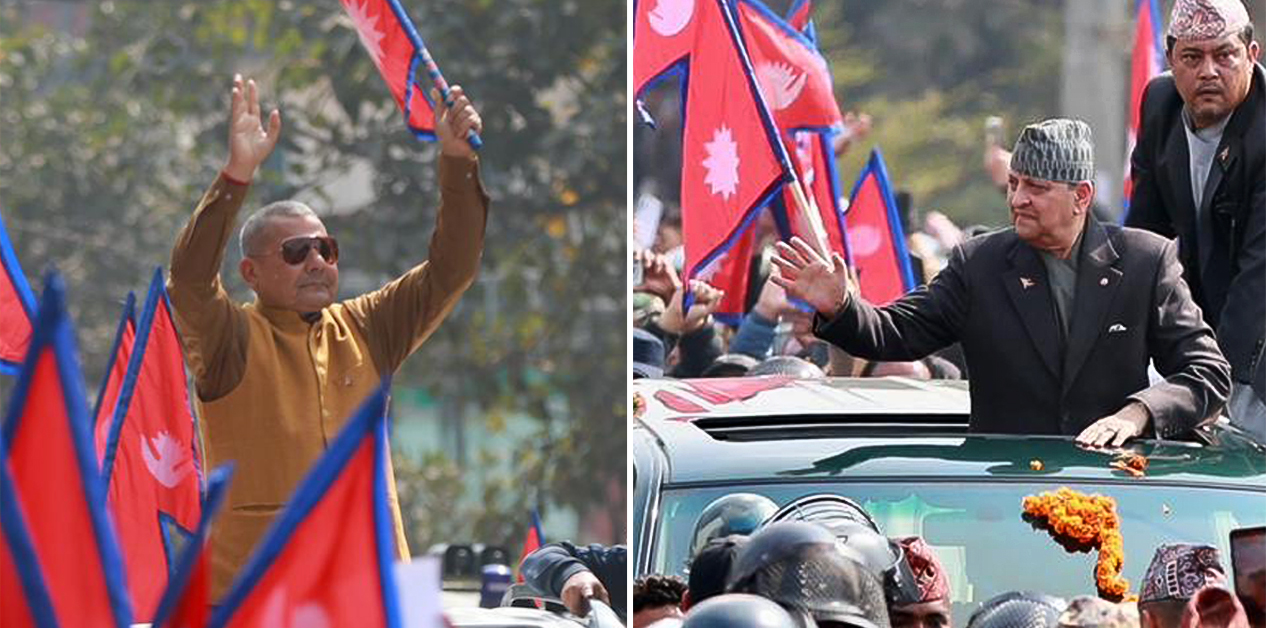
On 13 February 2026, members of the “Rashtra, Rashtriyata, dharma, sanskriti ra nagarik bachaau mahaabhiyan Nepal (Nation, Nationality, Religion, Culture and Citizen Protection Grand Campaign Nepal)” gathered in outside the gate of Tribhuvan International Airport (TIA) to welcome former king Gyanendra Shah. Campaign coordinator Durga Prasai entered the airport premises himself to receive the former monarch. Despite prohibitory orders imposed by the administration, the crowd chanted slogans calling for the restoration of the monarchy and opposing the election scheduled for March 5. In response, the former king stood up in his vehicle and expressed gratitude to the crowd.
After the 12-point agreement reached on 16 January, the government expected the Prasai group would not obstruct the elections. Instead, Prasai has become even more hardline in his stance against the upcoming polls.
On 6 February, he was arrested from Chobhar, Kathmandu, on charges of making anti-election remarks. He was released on bail two days later.
Earlier, Prasai had also been arrested on 19 January. On 17 January, during a press conference at his residence in Kamaritar, Bhaktapur, he alleged that Rs 520 million had been exchanged to settle disputes over the legitimacy of the new leadership of the Nepali Congress elected through a special general convention. “For Rs 520 million, friends got the tree and the four stars,” he had said, presenting a 23-second video as supposed evidence. After the Election Commission directed police to investigate him, he was arrested in Pokhara. However, he was released on bail the next day.
Prasai had earlier announced an indefinite nationwide shutdown from 23 November 2025 7 to push for the fulfillment of a 27-point demand, including restoration of the monarchy. Police detained him from his residence on 17 November as well. He was released on 24 November following a Supreme Court order.
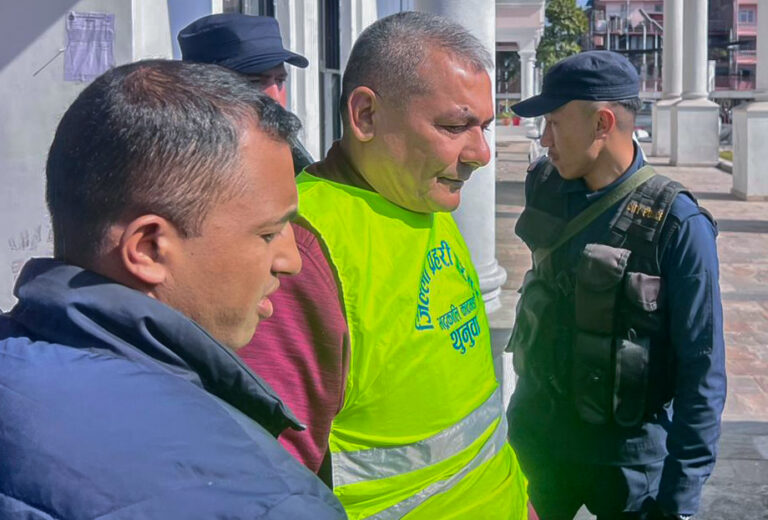
Prasai after his arrest following the violent incident in Tinkune on March 28, 2025.
Photo: Nepal Photo Library
It appears that arrest and release are neither unusual nor unexpected events for Prasai. For him, this too is politics. Yet it is difficult to understand why the government, by alternately arresting and negotiating with him, continues to elevate him into a figure capable of influencing national politics.
Although efforts to portray Prasai as a politically significant figure began nearly a decade ago, this reached its height around the time of government formation following the Gen-Z movement. Chief of Army Staff Ashok Raj Sigdel, who took initiative in government formation talks, reportedly engaged Prasai as a “stakeholder.” At the time, Prasai claimed he had even received an offer to become prime minister, despite having previously accused various individuals and business houses of corruption, and despite an arson attack at the same businesses and business houses on 9 September 2025.
However, following Discord discussions within the Gen-Z group, Sushila Karki became prime minister. Why the national army felt compelled to treat someone like Prasai, who demanded restoration of a Hindu state, monarchy, loan waivers for himself and others, and other unconstitutional and illegal provisions, as a “stakeholder” in the movement, remains an unanswered question.
Questions can also be raised about Prime Minister Karki. Until 27 December 2025, after becoming prime minister, she had refused to meet top leaders of UML, Nepali Congress, and other parties. Yet she met Prasai on 8 December, despite his earlier insulting remarks about her. During the meeting, Prasai apologized and presented her with a statue of Goddess Durga.
At a second meeting at Baluwatar on 30 December 2025, Prime Minister Karki gifted him a Buddha statue, saying Prasai was expected to act responsibly from all aspects. “We have brought the country back to peace and order from a very difficult situation,” she had said, adding, “The nation is fully in an election atmosphere, dispelling all doubts. At such a time, let us all act responsibly with the mindset that this country belongs to all of us.”
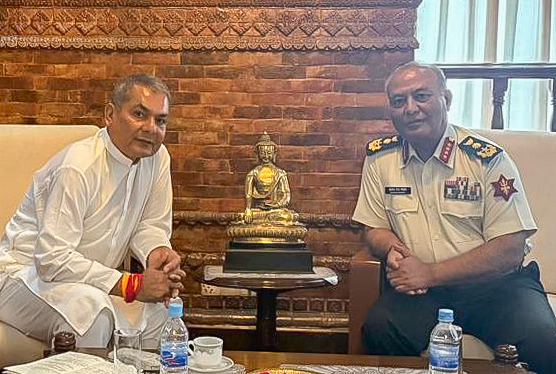
Meeting between Durga Prasai and Chief of Army Staff Ashok Raj Sigdel.
Photo source: Prasai’s Facebook
Earlier, on 12 Novembeer 2025, the Prasai group had submitted 27 demands to the government, including abolition of federalism, a directly elected executive prime minister, arrest and investigation of top leaders, and loan waivers below Rs 2 million. The government formed a negotiation committee led by then Minister for Communications and Information Technology Jagadish Kharel, with the Prime Minister’s chief advisor Ajay Bhadra Khanal and public relations advisor Govinda Narayan Timilsina as members. On 16 January 2026, a 12-point agreement was reached between the government and Prasai’s campaign, with the government stating that the current election government could not fulfill such demands but would form a high-level constitutional amendment recommendation commission.
These days, Prasai frequently says in interviews: “Those who understand things will not go to vote. And those who will go to vote cannot be said to have eaten grain.” He claims that voting over the past 36 years (since the 1990 political change) has achieved nothing. He argues that the election scheduled for March 5 has been forcibly imposed. “An election meant for 2084 is being held in 2082 to capture the country,” he says, alleging that a “deep state,” backed by Western powers, is trying to seize control. He also claims the Gen-Z movement was orchestrated to prevent Nepal from becoming a Hindu nation.
Whose strategy?
Some argue that by inviting him as a “stakeholder” and repeatedly engaging him, both the Army and the Karki government have sought to keep Prasai “engaged” as a strategic maneuver. But is the state engaging him – or is he engaging the state? Why has someone synonymous with controversy, inflammatory rhetoric, and divisive actions become a central concern of government functioning? Does the government believe he still possesses the power to disrupt elections, even when both new and established parties are fully engaged in campaigning?
Home ministry spokesperson Anand Kafle says the government has the patience to listen to all sides. “In a democracy, it is also the government’s responsibility to listen to and discuss demands,” he says, adding, “That is why the government held talks with Prasai.” He further says that talks should not be interpreted as special privileges. “However, the government is firm against illegal activities. Whoever it is will be brought within the bounds of the law.”
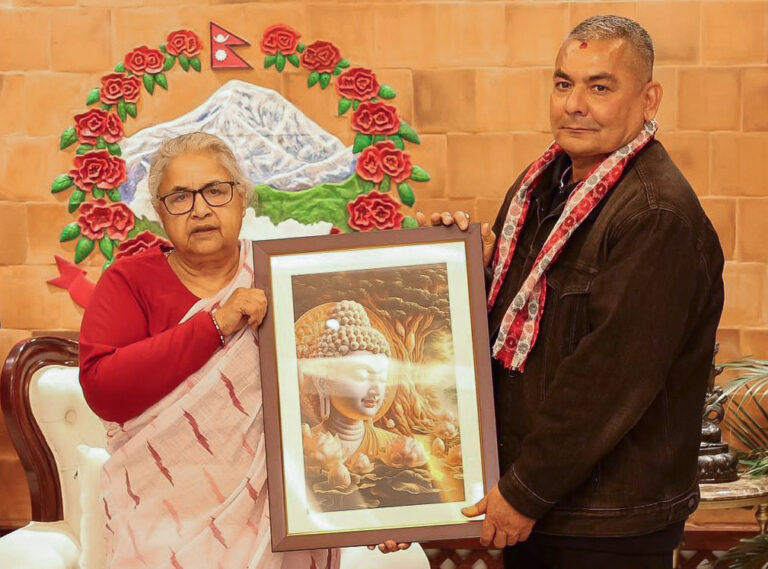
Prime Minister Sushila Karki presenting Durga Prasai with a Buddha image symbolizing peace on December 30, 2025.
Photo: Prasai’s Facebook
There are numerous instances of Prasai violating state law. Among them, the most tragic was the violence of 28 March 2025. As the designated commander of the Joint People’s Movement Committee formed under Nabaraj Subedi to restore the monarchy, a protest called by Prasai at Tinkune turned violent, resulting in the deaths of two people, including a journalist. After fleeing to India, he was arrested and brought back to Nepal. After spending four months in custody, he was released. The criminal disorder case against him remains under judicial consideration.
On 18 November 2024, during a press conference, Prasai accused UML Chair and then Prime Minister KP Sharma Oli of investing in a Cambodian telecommunications company, presenting certain documents. The following day, police arrested him for allegedly forging documents and misusing the prime minister’s name and signature. Police also arrested members of his group for allegedly extorting money from businesspeople by invoking the name of Indian criminal Lawrence Bishnoi.
International relations and security expert Indra Adhikari argues that given Prasai’s past, his demands – being against the constitution and system – do not warrant serious government attention. “It may be acceptable to involve figures like Prasai in the process to create an election atmosphere,” she says, “but no agreement should undermine the system.”
Adhikari believes Prasai thrives in murky waters. “He and others like him are not disciplined political actors seeking reform or development. Their role is to provoke and incite those who feel excluded,” she says. “Liberation, change, and reform are beyond the scope of their thinking.”
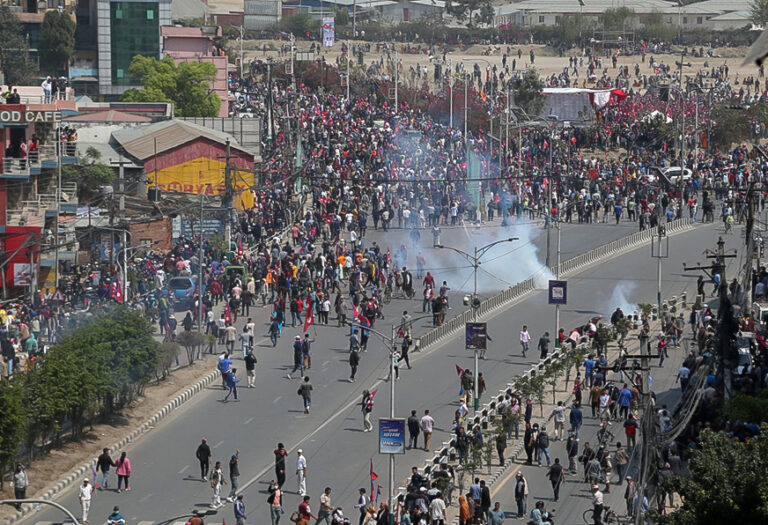
Protest organized by the Joint People’s Movement Committee at Tinkune, Kathmandu, on March 28, 2025.
Photo: Nepal Photo Library
Most of Prasai’s statements are not only controversial but also inappropriate, indecent, and misogynistic. He regularly spreads hostility toward business houses, entrepreneurs, banks, financial institutions, and civil society figures.
Social media scholar Ujjwal Acharya says Prasai exploits public frustration, anger and confusion to serve his own interests. “His activities are increasing polarization, and their impact will be long-term,” he says.
Maoist, UML, and then monarchist
Prasai, who runs B&C medical college in Birtamod, Jhapa, was initially close to the Maoists and served as a provincial committee member. He had direct access to the then Maoist Chair Pushpa Kamal Dahal.
On 18 February 2018, a photograph surfaced of UML Chair KP Sharma Oli and Maoist Chair Dahal eating Marshi rice with Prasai. The image brought him further attention, and he became popularly associated with “Marshi.” When UML and Maoists merged into the Nepal Communist Party, Prasai grew closer to Oli and remained with UML even after the party split.
Eventually, after the party’s 10th General Convention, Oli appointed him as a central committee member and deputy chief of the Industry, Commerce and Supplies Department of the party. However, after failing to receive a ticket from Jhapa-3 in the 2022 parliamentary elections, Prasai distanced himself from Oli and embraced monarchism. Launching the Mechi–Mahakali campaign for restoration of the monarchy and declaration of Nepal as a Hindu state, he subsequently developed closer ties with former king Gyanendra.