Kathmandu
Tuesday, July 14, 2026





Once the unchallenged center of the UML, KP Sharma Oli now confronts the gravest political crisis of his career as party insiders who empowered him for years demand his resignation.

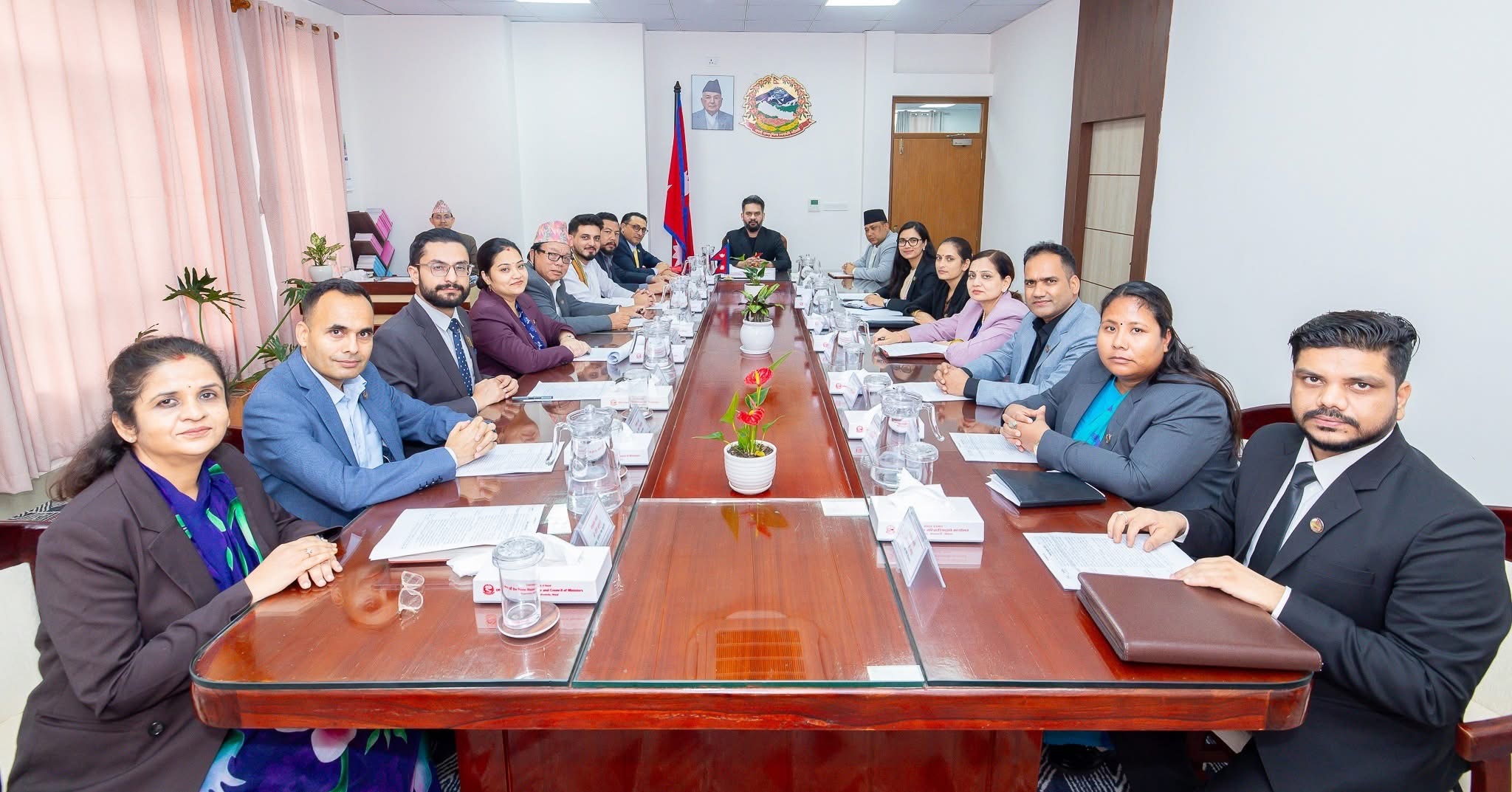
KATHMANDU: In the CPN (UML) secretariat meeting ongoing since May 22, a majority of the office-bearers have demanded the resignation of Chairman KP Sharma Oli. Their shared conclusion is—the party can no longer run under Chairman Oli, and he must step down from leadership.
By the time this report was prepared (Sunday evening at 8 PM), 12 out of the 14 members who spoke in the secretariat meeting stated that the Chairman should clear the way for the reorganization of the party. In response to the leaders demanding his resignation, Oli said, “You cannot convince me like this. I will not be convinced. I will not step down (from the post) this way.”
The office-bearers, who had backed Chairman Oli under all circumstances for a long time, have themselves reached the conclusion that the party cannot function under him. In the 11th General Convention of the UML held in December 2025, 17 out of 19 office-bearers were elected from Oli’s own team. However, Oli has now fallen into a minority among the office-bearers. This is a situation that Oli, who had always remained secure among his own loyalists, is facing for the very first time.
Oli has been at the helm of the UML since being elected as Chairman at the Ninth General Convention in July 2014. In these 12 years, Oli finds himself in the most difficult situation, both inside and outside the party.

The Secretariat meeting of UML. Photo: Oli’s Secretariat
From the time he was elected Chairman until he was ousted from power by the Gen Z protests in 2025, Oli remained at the center of national politics. Following the promulgation of the new constitution, he served as Prime Minister for a total of five years, seven months, and twenty days across various terms up until September 9, 2025.
During this period, he had the opportunity to lead governments with nearly a two-thirds majority. By merging the UML and the CPN (Maoist Centre) to form the Communist Party of Nepal (CPN), he led the third-largest communist party in Asia after China and Vietnam. He had amassed power by contesting parliamentary elections, distinct from the way communist parties reached power through armed rebellion in China and Vietnam.
Even during the split of the CPN and the subsequent division of the UML, Oli successfully maintained the party as a major political force in the country. Even during the five-party alliance in 2022, he proved himself to be a politician capable of making a comeback by securing UML’s position as the second-largest party.
Similarly, during the economic blockade imposed by India following the promulgation of Nepal’s new constitution in 2015, Oli, who led the government at the time, built the image of a nationalist leader.
The Gen Z protests on September 8 and 9, 2025 proved to be a turning point for Oli’s politics. Following the situation created after protestors were killed in the incident on September 8, Chairman Oli and the UML had to pay the heaviest political price. On September 9, to escape the wrath of the protesters, the then Prime Minister Oli had to flee in an army helicopter. The protestors went as far as attacking leaders of the then-ruling coalition partners, Nepali Congress and CPN (UML), and setting fire to their residences. The then Prime Minister Oli has not taken moral responsibility for the incident where young protestors were killed on September 8, and has been calling the entire episode a foreign conspiracy.
The operation of the UML was based on collective leadership and individual responsibility. However, throughout Oli’s tenure, it remained Oli-centric. Committee meetings were transformed into bodies that merely endorsed decisions already made by the Chairman, rather than serving as platforms for discussion.
Its impact was visible in the elections of March 5, 2026. Candidates faced a difficult situation as not only voters, but even party cadres and supporters raised questions regarding Oli’s role in the September 8 incident. Because of this, candidates did not invite Chairman Oli to their election campaigns. Most candidates did not even include the Chairman’s photo in their publicity materials. This was a stark contrast to the period since Oli became Chairman, where his photo was never omitted from any election, party or sister organization meetings, gatherings, and conventions.
Even that could not save the UML candidates from the wrath of the voters, and they suffered a crushing defeat. In the House of Representatives election, the UML won only nine seats out of the 165 first-past-the-post seats. In the 275-member House of Representatives, the UML holds only 25 seats, including 16 proportional representation (PR) MPs.
In the 2022 House of Representatives election, the UML had emerged as the second-largest party by winning 79 seats. It had become the largest party under the proportional representation category. In an election held after 1990, Oli was defeated for the second time in his hometown central hub of Damak, Jhapa-5 constituency. In this election, all office-bearers of the UML, including Oli, were defeated.
Oli, who was first elected Chairman in July 2014, was elected Chairman for a third term in December 2025. Most of the office-bearers who are now in favor of Oli stepping down from leadership to pave the way for party reorganization are the very ones who elected him as Chairman for a third term last year. Even when the party was in a difficult situation, Oli was indispensable to them. To make Oli the Chairman for the third time, the provisions in the party statute regarding a two-term limit for executive posts and the 70-year age limit were removed at their initiative. They had been supporting Oli to run the party exactly as he wished. However, after the party faced unpopularity following the Gen Z protests, lost the elections, and these leaders saw their own political futures turn dark, they finally reached a point where they opened their mouths to say they can no longer carry Oli.
While running the party, Oli used to adopt a harsh policy against those who disagreed with him. Former Prime Ministers like Madhav Kumar Nepal and Jhalanath Khanal, who were associated with the party since its early days of establishment and had led the party, could not be accommodated within the UML. Similarly, former Vice-Chairman Bhim Rawal, who competed against Oli for the chairmanship in the 10th General Convention, faced disciplinary action for writing against party policy. Furthermore, the constituency contested by former Deputy General Secretary Ghanashyam Bhusal, who used to criticize Oli’s working style, was given to the RPP in the 2022 parliamentary election. Deputy General Secretary Yogesh Bhattarai, who demanded party reorganization and Oli’s departure from the chairmanship after the Gen Z protest, was denied a ticket in the March 5 House of Representatives election.
Oli is facing a crisis not just due to party management, but also because of the actions and procedures carried out while running the government. The party and the government led by him have had to backtrack one after another from controversial decisions made in the past.
Oli has been a target of the governments formed after the September 8 and 9 protests. Government formed under the leadership of Sushila Karki after the movement had restricted his movement zone, alleging that he suppressed the movement. On March 27, 2026, the government formed under the leadership of the Rastriya Swatantra Party (RSP) arrested him, stating it was implementing the report of the high-level probe commission on the movement. Oli was released after spending 13 days in custody. However, the investigation against them continues.
The UML has returned Rs 40 million to the state treasury, which was given to former high-ranking officials for medical expenses against the rules during Oli’s tenure as Prime Minister. The amount was returned after the Commission for the Investigation of Abuse of Authority (CIAA) initiated an investigation into this matter. Experts have stated that although Oli returned the money, an investigation into corrupt acts can still be pursued against him.
The UML has started to backtrack on controversial decisions made in the past during Oli’s tenure. The secretariat meeting on May 22 decided to return the land taken from Min Bahadur Gurung, the operator of Bhatbhateni Super Store, to build the party office building. In October 2024, when Oli was the Prime Minister, the UML’s decision—made at his own proposal—to accept land donation from Gurung to build the party headquarters faced widespread opposition both inside and outside the UML. When they protested at that time, the then Standing Committee member Binda Pandey and Central Committee member Ushakiran Timsena were suspended by the party for 6 months. They had stated that the party office should be built on UML’s own land located in Balkhu.
During the 12 years that Oli led the UML, instead of running it through organizational methods, he placed himself at the center. The party’s statute and methods were defined to suit Oli. This weakened the structure of the UML and made the individual supreme. It projected Oli as synonymous with the UML.
The entire UML rank and file is currently paying the price for this. Because of this, Oli has now become a “burden” rather than an asset for the UML.