Kathmandu
Sunday, February 15, 2026





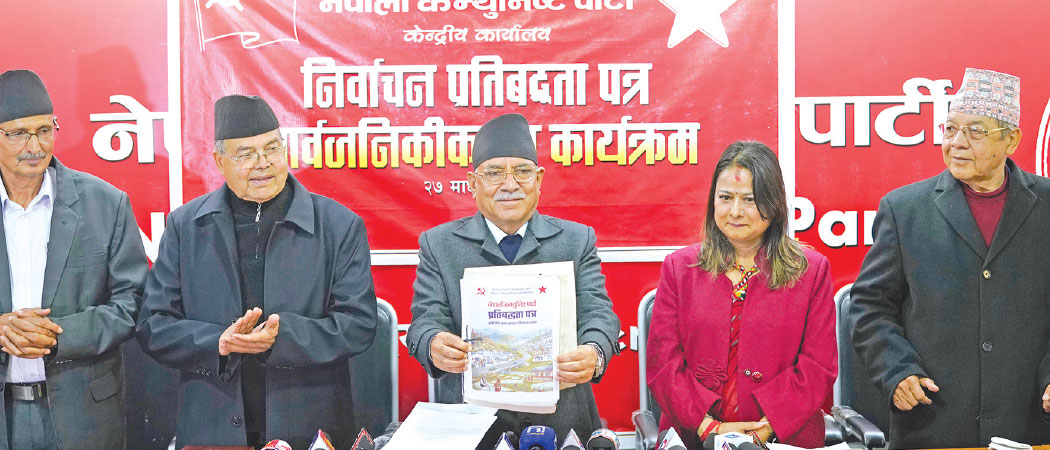
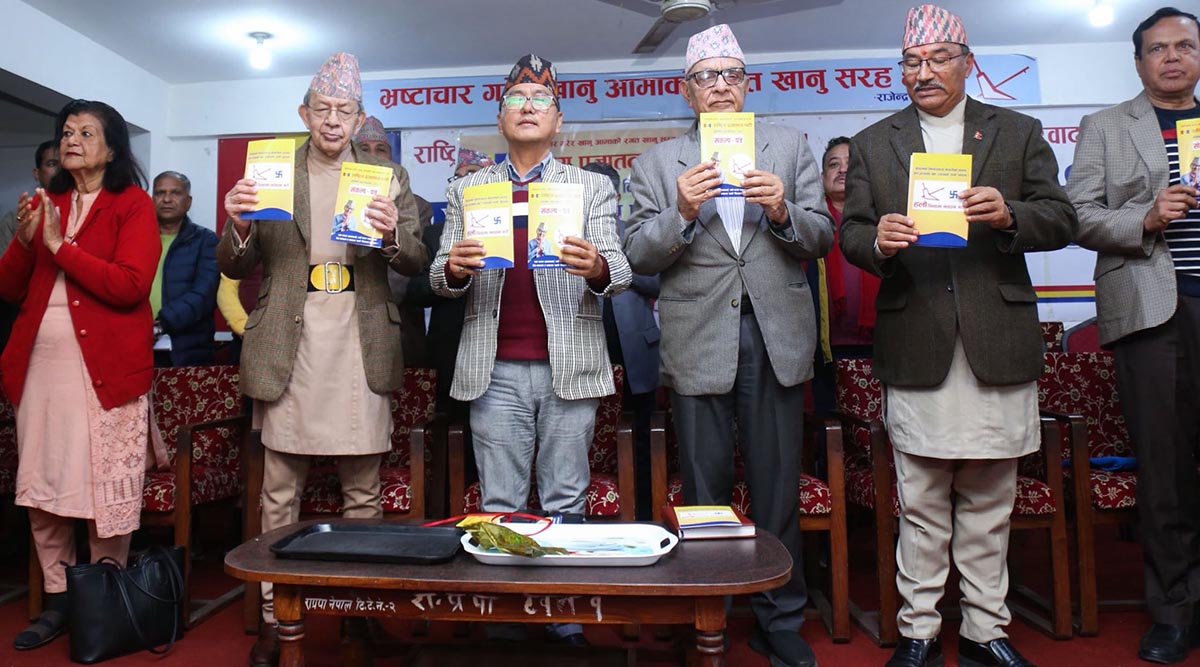
KATHMANDU: The Nepali Communist Party (NCP) became the first party in Nepal to unveil its manifesto for the upcoming House of Representatives elections on March 5. Spanning 57 pages, it outlines an ambitious, time-bound agenda covering political reform, economic growth, infrastructure expansion, social protection, and environmental sustainability.
The manifesto addresses sectors ranging from agriculture, tourism, and energy to urban development, labor, employment, and enterprise, and sets out headline targets such as double-digit GDP growth and the creation of hundreds of thousands of jobs. On paper, the commitments are expansive and forward-looking. In practice, however, their feasibility remains questionable given Nepal’s constrained fiscal space, fragile institutional capacity, and a historical pattern of underdelivery.
The party, formed from a merger of 22 communist factions and contesting under the ‘Star’ symbol, frames its campaign around two core slogans: “Good governance and employment, preparation for socialism” and “Protecting nationalism and democracy is our responsibility.” It proposes sweeping reforms to an electoral system it deems costly and prone to corruption, asserting that governance structures will be redesigned “in accordance with the spirit of the Gen Z generation and the needs of the country.” Such language signals both a generational appeal and an emphasis on institutional modernisation.
While the manifesto presents an integrated vision, analysts note a recurring tension between ambition and deliverability. Many promises—ranging from infrastructure megaprojects to employment creation—echo commitments from previous election cycles, raising questions about the party’s capacity to translate plans into outcomes. Nevertheless, the document provides a roadmap that, if implemented effectively, could reshape Nepal’s economic and political landscape.
To help readers navigate the manifesto’s breadth, Nepal News has distilled its commitments into area-wise, digestible analyses, highlighting both the objectives and the practical challenges inherent in the NCP’s agenda.
Nepal News has analysed the 57-page manifesto and summarises it here in accessible, area-wise explainer detail for our audience. Here is the major policy commitments and ambitions of the NCP:
What are the NCP’s plans for political stability, constitutional reform, and federal implementation?
The Nepali Communist Party (NCP) pledges to amend the constitution to ensure political stability and a balanced distribution of power, while reforming what it describes as a “costly and chaotic” electoral system. The party proposes forming a smaller, expert-inclusive federal council of ministers in place of the constitutionally allowed 25-member cabinet and promises to pass all necessary laws for the full implementation of federalism within one year of the formation of the new House of Representatives. A key fiscal commitment includes allocating 60% of the federal budget to sectors directly tied to fundamental rights, education, health, housing, drinking water, food security, and culture, with funds channelled through provincial and local governments. The manifesto also outlines plans to restructure constitutional commissions, eliminate overlaps, and strengthen institutions such as inclusion-related commissions, reflecting a broader agenda to improve governance, accountability, and institutional efficiency under the federal system.
What are the NCP’s foreign policy priorities?
The party commits to strengthening Nepal’s national sovereignty and self-reliance by reducing foreign dependence and maintaining a non-aligned foreign policy that prioritises national interests.
It states that border disputes, including those at Kalapani, Lipulekh, and Limpiyadhura, will be resolved through diplomatic negotiations, with national interests taking precedence. This approach is part of the party’s broader commitment to maintaining a non-aligned foreign policy while safeguarding Nepal’s sovereignty and strengthening its international standing.
It pledges to maintain an active role in multilateral forums such as the UN, SAARC, and BIMSTEC. Economic diplomacy is emphasised to attract investment, technology transfer, tourism, and employment opportunities.
What are the NCP’s plans for anti-corruption?
The Nepali Communist Party (NCP) pledges to establish an independent, high-powered commission within one year to investigate the assets of all past and present public office holders, alongside creating a unified Lokpal mechanism that integrates existing anti-corruption bodies. While the manifesto commits to investigating officials dating back to 1990 and maintaining a “zero tolerance” approach toward corruption, it does not clarify how far back certain investigations would extend or how investigations will be prioritised. The party also promises to nationalise corruptly acquired assets and create a powerful ‘caretaker’ authority by integrating the Commission for the Investigation of the Abuse of Authority (CIAA) with intelligence bodies. To strengthen governance, the manifesto emphasizes transforming government services into faceless, paperless, and digital systems. Additionally, the NCP commits to drafting all necessary laws within a year to ensure the effective implementation of federalism and to allocate 60% of the federal budget to provincial and local levels to promote transparency and service delivery.
What are the NCP’s plans for administrative reform?
The NCP promises to pass the federal civil service law and the federal police adjustment law, implement merit-based appointments with protection from political interference, and introduce performance-based evaluation systems. It also emphasizes digital governance through faceless, paperless, and cashless procedures, the introduction of time-card systems for public service delivery, and plans to expand the government workforce by 30% over five years, reflecting a broad agenda to professionalize public administration and strengthen institutional accountability.
What are the Nepali Communist Party’s plans for economic growth and job creation?
The Nepali Communist Party (NCP) has outlined sweeping and time-bound targets in its March 5 elections manifesto, promising economic growth and job creation that mirror earlier commitments from 2017 and 2022, when the party’s current leaders held significant political power.
The manifesto pledges to achieve double-digit GDP growth of above 10% within five years, reduce multidimensional poverty from 20.15% to 5%, and create 1.5 million formal jobs during the same period. It also aims to transform 100,000 returnee migrant youths into entrepreneurs. To drive this growth, the party highlights major infrastructure and development projects such as the construction of Nijgadh International Airport, the establishment of smart cities, and the provision of universal drinking water.
Economically, the manifesto focuses on expanding investment in priority sectors including agriculture, industry, tourism, information technology, energy, and services, while promoting provincial economic corridors and cooperative and collective production models to stimulate growth and employment. While the targets are ambitious, critics point out that similar employment-focused and growth-heavy commitments were central to the 2017 “Prosperous Nepal, Happy Nepali” platform and reiterated in 2022, raising persistent questions about the party’s capacity to implement them and the gap between projected targets and actual economic performance.
What are the NCP’s energy sector commitments?
NCP aims to significantly expand Nepal’s energy sector, setting a target to generate 15,000 megawatts of electricity within five years and to raise per capita electricity consumption to 750 kWh. The manifesto also emphasizes increasing energy exports under existing bilateral and regional agreements to enhance Nepal’s role as a regional energy supplier. While these goals are ambitious and intended to boost economic growth, energy expansion has been a recurring promise in previous election cycles, and past implementation has generally progressed incrementally rather than achieving transformative results.
What are the NCP’s plans for agriculture, land reform, and irrigation?
The Nepali Communist Party (NCP) has proposed an ambitious agenda for agriculture, land reform, and irrigation. In its manifesto, the party promises to enact the Integrated Agriculture Act and the Farmers’ Rights Act within one year of forming the government. It plans to establish integrated agricultural service centres in every ward, create a national agricultural disaster fund, and achieve self-sufficiency in staple crops within two years. In the irrigation sector, the party pledges to expand coverage to 60% of arable land within five years, aiming to significantly boost productivity. Regarding land reform, the NCP commits to distributing land titles to landless Dalits and informal settlers within two years and to digitise land administration systems to enhance transparency and efficiency. These measures reflect the party’s broader goal of strengthening rural livelihoods, improving food security, and ensuring equitable access to land and resources.
What are the NCP’s plans for large-scale infrastructure and urban development?
The Nepali Communist Party (NCP) reiterates its commitment to completing the controversial Nijgadh International Airport within five years, although the manifesto does not detail how the project would be financed. Critics have raised concerns that the airport could become a white elephant project, environmentally destructive, and too large for Nepal to implement independently. In addition to the airport, the party promises to expand the East–West Highway to four lanes, develop a metro rail system in Kathmandu, and ensure the timely completion of major national pride projects. The manifesto also pledges to develop 20 smart cities and 100 smart villages within five years, featuring planned settlements, digitised public services, organised housing, and modern infrastructure. However, urban modernisation and “smart” settlement initiatives have appeared in previous election cycles, and rapid urbanisation has largely continued in an unplanned manner, with persistent gaps in infrastructure and service delivery, prompting scrutiny over the feasibility of these ambitious targets.
What are the Nepali Communist Party’s plans for drinking water, housing, food security, health, and related sectors?
NCP promises to ensure clean drinking water access to every household within five years and to declare Nepal hunger-free within two years. It pledges to expand school meal programmes linked to local agricultural production and to implement housing security and organised settlement programmes. While universal drinking water access has long been a national objective, progress has been steady but incomplete across past political cycles. In the health and social protection sector, the party commits to achieving universal health insurance coverage within six years, guaranteeing free public health services as a fundamental right, and expanding community-based health infrastructure along with strengthened maternal and child nutrition programmes. The manifesto also outlines reforms to broaden financial inclusion, regulate informal financial practices, integrate digital fintech systems, and digitise land records, reflecting a continuation of earlier state modernisation agendas framed now in explicitly digital terms. On foreign policy, the party reaffirms a non-aligned stance and commits to resolving border disputes, including those at Kalapani, Lipulekh, and Limpiyadhura, through diplomatic dialogue, while also promising strengthened economic diplomacy and active engagement in multilateral forums.
What are the NCP’s plans for national pride projects and improving connectivity?
The Nepali Communist Party (NCP) has pledged to rapidly complete the construction of national pride projects that have historically seen little progress, as well as initiate new key projects. Priority projects include the East–West Highway, Postal Highway, Mid-Hill Local Highway, Kathmandu–Madhes Expressway, railway lines, and the Nijgadh International Airport, alongside expressways, local highways, and tunnel roads in various regions. However, these projects have faced long-standing delays due to political interference, forest and environmental disputes, and land acquisition challenges. While the manifesto promises “rapid completion,” it provides no concrete action plan to address these obstacles, including the environmental impact assessments and local opposition related to the Nijgadh Airport. Additionally, there is little clarity on the substantial resources, technology, and planning needed to implement ambitious urban infrastructure projects such as mass transit systems in major cities.
What are the NCP’s plans for tourism development?
The Nepali Communist Party (NCP) aims to make Nepal’s tourism sector more attractive, safe, and accessible while working to remove the country from the EU blacklist. The manifesto emphasises promoting eco-tourism, adventure tourism, health and wellness tourism, and herbal tourism. A notable initiative includes opening 97 lesser-known Himalayan peaks, known as the ‘97 Peaks’ project, to boost mountaineering and adventure tourism. While these measures could significantly increase revenue, concerns have been raised about their impact on the Himalayan environment and the sustainability of tourism practices. The party also pledges to ban single-use plastics and tighten environmental regulations in mountain, wildlife, and conservation areas, though the practical implementation of these measures remains a key challenge.
How does the NCP plan to create jobs and support returnee entrepreneurs?
The Nepali Communist Party (NCP) aims to implement a ‘Returnee Entrepreneurship Program’ to leverage the knowledge, skills, experience, and capital of 100,000 Nepalis returning from foreign employment. The party plans to provide special funds and training in sectors such as agriculture, tourism, and processing, while promoting collective and cooperative-based production systems. Job creation is a high priority, with a goal of generating 500,000 jobs over five years by adding an additional 150,000 jobs annually, utilising resources such as fallow land, rivers, forests, minerals, and biological assets. While these initiatives are ambitious and potentially transformative, the manifesto lacks clarity on how administrative challenges, market shortages, capital management issues, and psychosocial barriers faced by returnees will be addressed. Past programs often failed, forcing many returnees to seek work abroad again. Similarly, the manifesto does not provide detailed strategies for ensuring transparency, leadership development, and active participation in collective enterprises, or for practically creating the large number of jobs it promises.
What are the NCP’s plans for industrial development and smart manufacturing?
The Nepali Communist Party (NCP) has proposed an ambitious transition of Nepal’s industrial sector toward AI-based smart manufacturing. The manifesto promises special incentives for industries that substitute imports and promote exports, with a focus on agriculture, tourism, hydropower, and information technology as areas of comparative advantage to attract domestic and foreign investment. The party also plans to establish incubation centers to develop rural micro, cottage, and small industries, and pledges to strengthen private sector confidence through investment security, strict legal frameworks, and the formation of an industrial security force. However, given that Nepal’s industrial base is currently weak, technological infrastructure remains limited, and skilled manpower is scarce, the goal of AI-based smart manufacturing appears distant. The manifesto lacks a concrete framework for ensuring the large capital, competitive energy supply, stable market, and political stability required for industrial development. Additionally, while private sector morale is highlighted, it remains unclear whether the party’s socialist-oriented economic ideology could create uncertainty or suspicion among private investors.
What are the NCP’s plans for startups and IT enterprises?
The Nepali Communist Party (NCP) places significant emphasis on promoting startups and IT enterprises. The manifesto proposes free business registration, full tax exemption for the first five years, and progressive tax benefits thereafter. It also includes plans to develop special incubation centers and IT parks, establish an Innovation Fund, and provide mentoring and investment security for entrepreneurs. At the provincial level, the manifesto highlights initiatives such as developing Bagmati Province into an urban IT and innovation hub.
How does the NCP manifesto support entrepreneurship, especially for youth, women, Dalits, indigenous nationalities, and marginalized communities?
The Nepali Communist Party (NCP) places entrepreneurship at the center of its national development agenda, with a particular focus on youth, women, Dalits, indigenous nationalities, and marginalized communities. The manifesto states that projects will be developed according to the characteristics of each province. Specific programs include special grants, training, technical support, and market access initiatives designed to transform traditional skills—such as blacksmithing, leatherwork, and handicrafts—into modern commercial ventures. Ambitiously, the party promises loans of up to NPR 10 million at a 5 percent interest rate for ten years to encourage entrepreneurship among Dalits, minorities, and persons with disabilities. Similarly, women-led entrepreneurship will be supported through subsidized loans, mentoring, market programs, and the establishment of a ‘Women Enterprise Development Fund.’ The manifesto also emphasises quality control, branding, and export promotion to commercialize traditional skills of indigenous nationalities. While these measures appear attractive, implementation challenges remain significant, including managing large-scale subsidized loans, ensuring access for genuine entrepreneurs, and providing effective training, mentoring, and market support.
Are there concerns about the repetition of promises and their deliverability in the NCP manifesto?
Many of the Nepali Communist Party’s (NCP) 2026 commitments—including the Nijgadh International Airport, smart urban development, energy expansion, job creation, and large infrastructure projects—echo promises made in the 2017 and 2022 platforms, when the party’s current leaders held dominant or influential positions in government and were key political actors. While the 2026 manifesto provides more quantified targets and specific deadlines, its broad ambition largely mirrors past cycles, in which implementation frequently lagged behind rhetoric. The key political question is therefore not the scope of the promises, which are extensive and detailed, but whether institutional capacity, fiscal space, political stability, and environmental clearances will allow these commitments to move beyond manifesto language into tangible outcomes.
How does the NCP manifesto address inclusive democracy and social justice?
The party aims to strengthen the federal democratic republic, promote socialism with equitable prosperity, good governance, social justice, and public accountability. It pledges to eradicate hunger, disease, poverty, inequality, and discrimination, while safeguarding national unity, religious freedom, multicultural respect, and social harmony.