Kathmandu
Thursday, January 29, 2026





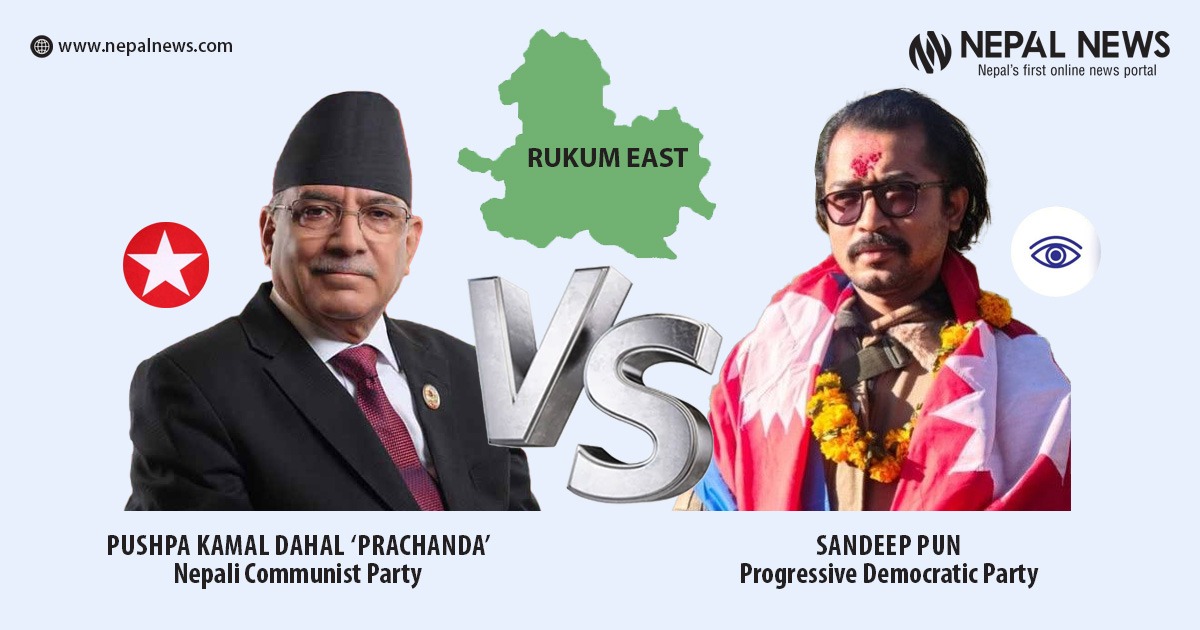
KATHMANDU: Rukum has long been synonymous with Maoist politics. Even after the party’s rebranding under the broader Nepali Communist Party (NCP) identity, the political psychology in constituency remains shaped by the Maoist era—its organization, its ideology, history, and its legacy of sacrifice. Loyalty here has historically followed structure rather than personalities alone.
Pushpa Kamal Dahal ‘Prachanda’, contesting from a fifth constituency since 2008, has chosen Rukum East as what was meant to be a safe seat. Yet the arithmetic is tricky: Maoist votes risk splitting, while the Progressive Democratic Party (PDP) and CPN-UML—once ally—has aligned against him.
In East Rukum, there are 34,772 registered voters. In the 2022 House of Representatives election, the Maoist Center’s Purna Bahadur Gharti Magar won decisively, securing 12,262 votes against the UML’s 5,211. That victory, however, was achieved under a now-defunct electoral coordination between the Maoists and the Nepali Congress—a critical factor absent in the current race.
The proportional-representation vote from 2022 further underlined Maoist dominance, but also revealed early signs of fragmentation. The Maoist Center received 8,271 votes, followed by the Nepali Congress with 5,692 and the UML with 3,659. Smaller parties—including the Rastriya Prajatantra Party (428) and the CPN-Socialist (375)—played marginal roles.
Since the last election, the Maoist Center has split. Janardan Sharma, once one of Prachanda’s most influential lieutenants, has formed the Progressive Democratic Party (PDP), fracturing the Maoist vote base. The split has strategic consequences: Maoist unity—long the party’s greatest electoral asset in Rukum—is no longer guaranteed.
Sharma has reached a agreement with the CPN-UML. The arrangement is mutually reinforcing: UML backs Sharma in Rukum West, where he has dominated for two decades, while supporting Sandeep Pun, PDP candidate in Rukum East, against Pushpa Kamal Dahal ‘Prachanda’. The alliance is designed not only to secure seats but to exert direct pressure on Nepal’s most experienced political survivor.
This time, Nepali Congress has fielded Kusum Devi Thapa, the UML has nominated Leelamani Gautam, and the Rastriya Swatantra Party (RSP) is represented by Lakhan Kumar Thapa. Unlike in 2022, there is no pre-poll alliance for Prachanda.
On paper, Prachanda still holds advantages: the Maoist organization remains strong, and his national stature continues to command attention. Yet the erosion of alliances, the division of the Maoist base, and the emergence of a challenger rooted in the movement’s own history have turned what was once a foregone conclusion into a genuine contest. Rukum East remains NCP (previous Maoist) territory—but for the first time in years, it is no longer politically effortless.
Prachanda’s electoral survival: from wide margins to narrow paths
Few figures have shaped Nepal’s post-war politics as decisively as Pushpa Kamal Dahal ‘Prachanda’. Since emerging from the underground in 2006, he has remained the system’s central pivot—indispensable, unpredictable and relentlessly focused on power. Yet the qualities that once made him dominant have increasingly eroded public trust.
The pattern is visible in his electoral behaviour. Since the end of the war, Prachanda has repeatedly changed constituencies—an implicit acknowledgment of declining confidence in any single voter base. Each move has carried the same calculation: minimise risk, avoid defeat. Safe ground has become a necessity rather than a choice.
Pushpa Kamal Dahal ‘Prachanda’ entered electoral politics from a position of overwhelming dominance. In the 2008 Constituent Assembly election, he won Rolpa-2 with 34,220 votes (72.2%), dwarfing his rivals—UML’s Shant Kumar Oli with 6,029 (12.7%) and Nepali Congress candidate Bhim Kumari Budha with 4,888 (10.3%). The same year, contesting Kathmandu-10, he secured 23,277 votes (49.0%), again finishing comfortably ahead of the Nepali Congress’s Rajan Kumar KC (25.6%) and UML’s Sanu Kumar Shrestha (18.0%). At this stage, Prachanda was electorally unassailable.
That dominance fractured by 2013. Pursuing a strategy of transforming the Maoists into a “hill–Madhes linking party,” the leadership fielded Prachanda across disparate geographies. He contested Kathmandu-10 and Siraha-5—with mixed and revealing results. In Kathmandu-10, he finished third, managing just 12,859 votes, behind the Nepali Congress’s Rajan KC (20,392) and UML’s Surendra Manandhar (13,619)—a humiliating reversal in an urban constituency he once controlled. In Siraha-5, he scraped through with 15,244 votes, narrowly defeating UML’s Lila Nath Shrestha (13,323). The message was clear: Prachanda could still win, but no longer on his own terms.
By 2017, contesting without alliances was no longer an option. After tactical cooperation with the Nepali Congress in local elections and a broader left alliance with the UML in the parliamentary race, Prachanda stood from Chitwan-3. He won with 48,276 votes, defeating RPP candidate Bikram Pandey (38,935) by around 10,000 votes. The victory restored parliamentary relevance, but it was alliance-enabled rather than personal.
The 2022 election underscored the shift from dominance to caution. Despite expectations that he would defend Chitwan-3—where his daughter Renu Dahal was mayor and he had established residence—Prachanda abandoned the seat at nomination time and moved to Gorkha-2. The decision followed an electoral understanding with Baburam Bhattarai’s Nepal Samajwadi Party, backed by the broader five-party Nepali Congress-led coalition. In Gorkha-2, Prachanda secured 26,103 votes, defeating RSP’s Kabindra Burlakoti (12,637) and UML’s Abdus Miya (7,393)—a comfortable margin made possible by coalition arithmetic.
With this win, Prachanda entered Parliament for the fourth time. But the trajectory is telling. From landslide victories rooted in personal authority to carefully managed contests shaped by alliances, geography and ticket distribution, Prachanda’s electoral history now reflects political survival through strategy, not mass confidence. Safe seats have become constructed, not inherited.
Prachanda was the architect of the Maoist insurgency, a leader revered without ever being seen on the battlefield. In electoral politics, however, authority depends less on command than on credibility. Over time, frequent coalition shifts, tactical reversals and an overt fixation on government power have dulled his revolutionary appeal. What once looked like political agility now appears as ideological drift.
Critics point to growing nepotism, policy incoherence and an inward-looking leadership style that prioritises survival over reform. The Maoist movement, once a vehicle for transformation, has struggled to define a governing vision beyond power-sharing.
Sandeep Pun could make Rukum East unsafe for Prachanda
For decades, Rukum East has been synonymous with Maoist (now NCP) power. It was here that the “People’s War” first took root, and here that the Maoist movement built not just armed insurgency but enduring political and ideological loyalty. For Pushpa Kamal Dahal ‘Prachanda’, the supreme commander of that insurgency (13 February 1996 – 21 November 2006) and later three-time prime minister, Rukum East has long been regarded as the safest constituency—an electoral refuge grounded in history, sacrifice and party discipline. That certainty is now fraying.
In the upcoming House of Representatives election, Prachanda faces an opponent who unsettles the NCP (Maoist) narrative from within: Sandeep Pun, the son of two Maoist leaders martyred during the ten-year insurgency. What might once have been dismissed as a symbolic challenge has, under changed political alignments and shifting voter sentiment, become a serious test—political, moral and electoral.
Public opinion in Rukum East continues to broadly align with the Maoist tradition. The language of struggle still resonates, and the memory of war remains vivid. Yet time has altered the emotional balance. The Maoist leadership, once revered as revolutionary, is increasingly viewed as distant, recycled and absorbed into Kathmandu-centric power politics.
Prachanda’s return to Rukum East is therefore less a homecoming than a search for secure political shelter. And it is precisely here that Sandeep Pun’s candidacy complicates the equation.
As the son of Maoist martyrs, Sandeep does not challenge the movement’s legitimacy from outside. He challenges it on its own terms—by asking what the revolution delivered to those who paid its highest price.
The son of the war
Sandeep Pun is the son of Suryakshay Pun ‘Sundar’ and Parampara Gautam ‘Vriksha’, senior Maoist leaders who were killed during the insurgency. They married during the war, lived underground, and raised their child from grand parents constant movement and secrecy.
When Sandeep was just 13 months old, his parents left him with his maternal grandparents and returned to full-time insurgency work—responding to a strategic directive issued under Prachanda’s leadership to expand the war from remote rural bases toward urban centres. Sandeep would never see them again.
At the age of four, his mother was killed in a Nepali Army operation in Bajhang. Ten days later, his father was killed in the same area. Sandeep became an orphan before he could understand the politics that had shaped his life.
Sandeep’s upbringing was marked by constant displacement. He moved with his grandparents and relatives from Shimla (India) to Kapilvastu, then Butwal, Dang, and Nepalgunj, studying wherever circumstances allowed. In Shimla, where his grandparents were posted by the party, his education was disrupted. In Kapilvastu, he lived with his grandmothers Yashoda Gautam and Lajana Gautam. Later, he completed his schooling in Nepalgunj.
Security pressure was a constant during his childhood. When military came to search his grand parents home in Kapilvastu, he was taught to repeat a single line: “My elder father has gone to Kathmandu due to illness.” He memorised it. The state did not ask about his parents. The party did not step in to support him in any way.
Sandeep has repeatedly stated that no Maoist leader or party institution financed his education. He was raised and educated by his family, particularly his grandmother—a fact that has become central to his critique of the post-war Maoist leadership.
Sandeep later studied engineering at Whitehouse College in Kathmandu, where he entered organised student politics. His rise was gradual: unit committee president, chief secretary of the national committee of Purbanchal University, and eventually central vice-chairman of Akhil Krantikari, the Maoist Centre’s student wing, elected at its 23rd national conference from Janardan Sharma backing. During a period of intense internal factionalism—where the establishment group faced off against a faction led by Sharma.
When Sharma broke away from the Maoist Centre, Sandeep followed. Joining the Progressive Democratic Party under the political leadership of Sharma, he became a central committee member and took charge of the party’s student organisation. From that moment, talk of a direct electoral contest with Prachanda began to circulate.
Recent political developments have significantly raised the stakes. An understanding between Janardan Sharma and the UML has brought organisational backing to Sandeep’s candidacy, placing Prachanda in an unusual position: facing a martyr’s son supported by forces outside—and partly opposed to—the Nepali Communist Party.
For Maoist cadres in Rukum East, the dilemma is acute. Supporting Prachanda means defending power and continuity. Supporting Sandeep means confronting unfinished promises of the revolution.
Sandeep is local; Prachanda is widely seen as returning only when politically necessary with opportunist wining motive. Sandeep represents loss; Prachanda represents command.
Sandeep’s campaign deliberately invokes emotion—but it is rooted in lived experience rather than rhetoric. Locally, Prachanda is increasingly described as a “tourist candidate”, while Sandeep presents himself as a son of the soil. In campaign speeches, he draws a direct line between history and accountability: “I am a son of this land. This soil is irrigated with the blood of martyrs—like my father and mother. He has come here to fight the children of martyrs. He should be ready to lose.”
The message resonates with younger voters and disillusioned cadres who believe Maoist MPs have failed to deliver governance commensurate with their sacrifices.
The political rupture has reached into families. Tej Bahadur Oli, once the Maoist Centre’s East Rukum district in-charge and Sandeep’s father-in-law, is now a central member of the Nepali Communist Party and remains influential locally. His attempts to persuade Sandeep not to contest against Prachanda were unsuccessful.
The generational divide is sharper than the organisational one.
On paper, this is an election in a NCP (previous Maoist) stronghold. In reality, it is something deeper.
Sandeep Pun is not merely another opposition candidate. He is a living consequence of the People’s War—born in it, orphaned by it, and now questioning its political outcomes. His challenge places Prachanda in an unprecedented position: defending power against the very legacy that once legitimised it.
Whether or not Sandeep wins, the meaning of Rukum East has changed. What was once the safest seat for the Maoist leader has become a space of moral and political reckoning. For the first time, Prachanda is not being challenged by rivals—but by the revolution’s own unfinished business.
NCP (Maoist) shrinkage under Prachanda
Under Pushpa Kamal Dahal ‘Prachanda’, the NCP (previous) Maoists have seen a dramatic decline in popular support. In the 2008 Constituent Assembly election, the CPN-Maoist emerged as the largest party, winning 120 of 240 constituencies and securing 3,144,204 proportional votes, or 29.28% of the total. By 2013, after merging with the United Jan Morcha, the party fell to third place with 1,439,726 votes (15.21%).
The decline continued in 2017, when the Maoists won 53 seats with a proportional representation vote of 1,303,721, and in 2022, when they captured only 32 seats and 1,175,684 votes (11.13%)—a loss of nearly 2 million votes in under two decades. Once a party that reshaped Nepal’s parliamentary politics, it now struggles to retain influence at the ballot box without coalition.
Despite shrinking popular support, the Maoists had remained central to Nepalese power politics. Since the peace process, there is 15 governments including two non political, Maoist led four, held six coalition stakes, and served as the main opposition in three. Over this period, the party has placed seven Deputy Prime Ministers, 97 ministers, and several parliamentary officeholders—including a Vice President, three Speakers, a Deputy Speaker, a Deputy Chairman of the National Assembly and a Chairman of the National Assembly.
The contrast is stark: electoral decline has not curtailed access to state power. Through alliances, coalition shifts, and institutional leverage, the Maoists under Prachanda continue to wield influence disproportionate to their voter base—a testament to their enduring, if diminishing, political clout.
Prachanda’s Unbroken Grip
From Ghanashyam to Chhabilal, Pushpa Kamal, Bishwas, and finally Prachanda, Nepal’s most durable revolutionary has personified constant change—beginning with his own name. Yet since taking the helm of the Communist Party of Nepal (Mashal), Dahal has exercised uninterrupted control for more than four decades, without a single genuinely competitive general convention or leadership election.
During the 1996–2006 Maoist insurgency, he was the undisputed supreme commander, even as murmurs of a cult of personality emerged. Party transformation was structural rather than democratic: names, alliances, and symbols shifted, but power remained centralized. Over time, the party evolved through multiple iterations—CPN (Mashal), CPN (Maoist), Unified CPN (Maoist), CPN (Maoist Centre), and the Nepali Communist Party (NCP) as of November 2025. Senior figures who questioned strategy or authority—Mohan Baidya, Baburam Bhattarai, Netra Bikram Chand, Janardan Sharma—all eventually departed.
The Gen-Z protests of September 8–9 thrust Nepal’s three dominant parties—the Nepali Congress, CPN-UML, and CPN (Maoist Centre)—into the same uncomfortable spotlight: the unresolved question of leadership succession and generational change. Compared with his peers, Prachanda has so far navigated that pressure with relative ease. He quickly neutralised internal demands by unifying with various small left parties and exploiting the legal one-year grace period after party unification to defer a general convention and freeze internal restructuring.
Rather than restructure the party, Prachanda reshaped his electoral geography, moving to Rukum East, where neither the Rastriya Swatantra Party, the UML, nor the Nepali Congress posed him direct serious competition.
Today, as the NCP faces electoral erosion and internal fragmentation, the crisis is no longer ideological. It is institutional: a movement forged in revolution that never learned how to replace its leader. This election is pivotal. A loss in Rukum East is one Prachanda and his party cannot afford.