Kathmandu
Sunday, March 1, 2026





Why Nepal’s political parties must stop selling dreams and start doing the math
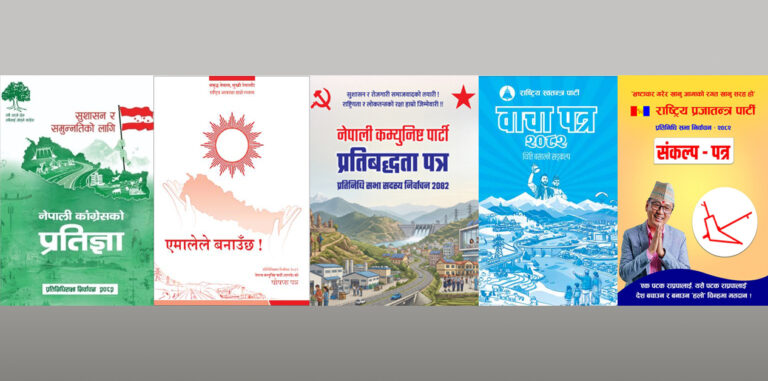
As Nepal prepares for the March 5, 2026 House of Representatives election, an all-too-familiar ritual is underway. Political parties from the Nepali Congress to CPN (UML), from the Nepali Communist Party to the Rastriya Swatantra Party have unveiled their manifestos, each painting a picture of a transformed Nepal within the next five years. The Nepali Congress promises to expand the economy to Rs 11.5 trillion (USD 80 billion) and raise per capita income to USD 2,500. The UML pledges one million jobs for youth. The RSP envisions an East-West electric railway connecting Nepal to Indian and Chinese networks and GDP per capita to USD 3000. The Nepali Communist Party targets double-digit GDP growth.
Nepal’s economy is currently valued at approximately USD 46 billion. The World Bank’s November 2025 Nepal Development Update projects real GDP growth to slow to just 2.1 percent in FY26, with a potential range of 1.5 to 2.6 percent, largely due to political uncertainty and the aftermath of recent unrest. Even in the relatively strong FY25, growth reached only 4.6 percent – a far cry from the 8–10 percent sustained annual growth that would be necessary to nearly double the economy.
Consider the historical baseline: Nepal’s compound annual growth rate (CAGR) over the past five years has averaged 4.7 percent, and over the past three years, just 3.4 percent. The government’s own target of 6 percent growth in FY24/25 was quietly missed, with actual growth coming in around 4.6 percent. Double-digit growth, as promised by the NCP, has never been achieved in Nepal’s modern economic history. For context, India with vastly superior infrastructure, a larger domestic market, and deeper capital markets has only occasionally touched 8–9 percent growth.
While the economy may naturally approach USD 80 billion over time, the extent of political parties’ role in that trajectory remains questionable. Large targets alone do not constitute economic strategy.
The political economy of overpromising
Why do parties continue this cycle? The answer lies in the political economy of electoral competition, explained well by Anthony Downs’ foundational An Economic Theory of Democracy (1957). Downs argued that in democratic systems, parties converge on policies that maximise votes, not necessarily welfare. When voters are rationally uninformed about fiscal constraints as is the case in any developing democracy the incentive is to outbid rivals with ever larger promises. The result is a manifesto arms race where economic feasibility is the first casualty.
Political economy offers a clear explanation. In the principal–agent theory, voters (principals) delegate authority to politicians (agents), but monitoring is imperfect. Without institutionalized costing and independent verification, candidates face incentives to over-promise before elections and recalibrate afterward. This time inconsistency problem has been central in macroeconomic policy theory for decades.
Populist cycles, documented extensively in comparative political economy, show a recurring pattern: expansionary promises before elections, fiscal stress afterward, and eventual retrenchment or under-delivery. The result is erosion of credibility not just for governments, but for the policy system itself.
Nepal’s history reflects this. Successive manifestos across ideological lines have pledged structural transformation industrialisation, export take-off, agricultural modernisation yet public capital expenditure execution rates remain weak, project delays are chronic, and regulatory bottlenecks persist. The issue is not ideology. It is implementation capacity and fiscal realism.
The market and investor confidence problem
Unrealistic manifestos do not merely mislead voters; they actively damage the economy. When parties promise sweeping tax exemptions, free universal healthcare, free education through secondary level, and massive infrastructure simultaneously without credible revenue plans, they create what macroeconomists call fiscal policy uncertainty. Businesses cannot plan investments when the policy environment changes every election cycle based on whichever party’s fantastical budget arithmetic gains power.
Daron Acemoglu and James Robinson, in Why Nations Fail (2012), demonstrated that inclusive economic institutions, rule of law, property rights, transparent regulation are the foundation of sustained growth. Nepal’s manifestos barely address institutional reform. They promise outcomes (GDP targets, job numbers) without addressing the extractive institutional dynamics that prevent those outcomes: political patronage in bureaucratic appointments, corruption in procurement (the World Bank has noted that approximately 51 percent of firms in Nepal report giving gifts to secure government contracts), and the chronic vacancy rates in provincial positions that exceed 30 percent.
The cost of pretending
Every election cycle, Nepal’s political class presents the electorate with a choice between competing fantasies. The tragedy is not that voters believe them; it is that the political system has made no space for honesty. When every party promises the moon, the discourse loses its capacity to distinguish between the feasible and the fanciful. Policy priorities become unmoored from reality. Post-election, no one is held accountable because everyone overpromised.
As economist Paul Romer has argued, the difference between rich and poor countries is not resources but rules the institutional rules that govern how resources are allocated and held accountable. Nepal’s manifestos promise resources. What the country desperately needs are better rules.
The voters of Nepal deserve manifestos that respect their intelligence. They deserve to know what is actually achievable within five years given the fiscal, institutional, and structural realities of this country. They deserve to be treated as citizens of a democracy, not consumers of political advertising.