Kathmandu
Tuesday, February 3, 2026





KATHMANDU: When the dust settled at Kathmandu’s Bhrikutimandap after the final day of the CPN (UML)’s 11th General Convention on Thursday, one truth stood out more starkly than any vote count or victory speech.
That truth is the convention heard nothing of the storm that had shaken Nepali politics just weeks earlier. The Gen Z revolt of September 8 and 9 that was deeply and seriously uncomfortable for the old political order might as well not have happened, at least judging by the political signals flagged by the party’s most important organizational event in five years.
This silence was not accidental; it was the central message of the convention itself. By not “noting” the Gen Z revolt, by refusing even symbolic acknowledgment, the UML delegates sent a clear signal about what kind of party they wanted to be—and who they wanted to listen to.
The Convention was less about renewal and more about reassurances. Reassurance to the old guard that nothing fundamental would change.

A gathering of youth at New Baneshwor in the midst of the Gen Z protest. Bikram Rai/Nepal News
Reassurance to KP Sharma Oli that his authority in the party remained intact. And, reassurance to the party’s entrenched power structure that the shockwaves from the streets would stop at the convention hall’s doors.
A hat-trick victory, stripped of context
On paper, the convention was historic. KP Sharma Oli secured a third consecutive term as party chairman, achieving an extremely rare hat-trick in Nepali politics. At 73, and into another election, Oli didn’t just survive the internal challenge, he demolished it.
He received 1,663 votes out of 2,227, and left his nearest rival, Ishwar Pokhrel, far behind with just 564 votes. The huge margin silenced critics who had said that Oli had lost his grip over the UML after months of public critique and protests, and questions about his leadership and governance style.
But raw numbers don’t say it all. This wasn’t a victory; it was a political statement. It only reinforced the trend that has defined UML for over past 10 years: the more challenges Oli faces-in and outside-the stronger he becomes within. Attempts to paint him as embattled or in isolation have boomeranged, actually strengthening his base.
The irony, however, lies in the timing. This convention was held a year earlier than scheduled precisely because Oli’s leadership had come under pressure after the Gen Z revolt raised uncomfortable questions about governance, accountability, and political stagnation. And yet, the very event convened in response to that pressure chose to behave as if the pressure did not exist!
In early September, when a wave of young protesters swarmed the streets of Kathmandu and other major places of the country, the message was crystal clear and cut across party lines. Their calls weren’t about sweeping ideological change; they were plainly foundational—better governance, dignity, an end to corruption, nepotism, favouritism and impunity.
They also demanded a political culture that would treat citizens as active participants rather than passive onlookers. For a moment, it seemed Nepal’s established parties might be nudged toward some serious self-reflection.
Inside the UML convention, however, that moment never arrived. Beyond the fact that leadership was re-elected after the Gen Z revolt, the convention had no deeper meaning. Delegates did not demonstrate independent political consciousness; they did not appear curious, unsettled, or even mildly alarmed by the generational anger simmering outside party structures. Instead, the message was unmistakable: “we are not wrong, and we will not correct ourselves.”
This refusal to self-interrogate may be the most consequential outcome of the convention. Societies can absorb protests, even uprisings, if institutions respond with adaptation. UML’s response was the opposite—organizational closure. In doing so, the party implicitly argued that transformation is optional, not necessary, and certainly not urgent.
Competitive elections, unchanged outcomes
To be fair, the 11th convention was not an exact replica of the 10th, held in Chitwan. There was one visible improvement: leadership positions were contested through panels rather than being announced from Oli’s metaphorical “pocket list.”Two panels competed, Oli’s and Pokhrel’s, and electronic voting was used. This procedural competition allowed some observers to claim that internal democracy had marginally improved.
But procedural competition without substantive change can be misleading. While Pokhrel’s vote count reflected certain suffocation, it did not translate into power. With the exception of Gokarna Bista as vice-chair and Yogesh Bhattarai as deputy general secretary, all other key positions went to Oli loyalists. At the secretary level, Oli’s panel swept clean.
Eight new faces entered the office-bearer team, including Raghuji Pant as vice-chair and seven first-time secretaries such as Mahesh Basnet, Khagaraj Adhikari, Bhanubhakta Dhakal, Yamalal Kandel, Rajan Bhattarai, Sherdhan Rai, and Hikmat Karki. Yet new faces did not mean new thinking. These debutants emerged not as challengers to the status quo but as extensions of Oli’s established power network.
Thus, the convention managed to look competitive while producing continuity—a familiar UML skill perfected under Oli’s leadership.
The continuity of Oli-garchy
To understand why this continuity matters, one must understand how Oli’s leadership evolved. When he first became chair at the 9th General Convention in 2014, narrowly defeating Madhav Kumar Nepal, Oli was far from dominant within the party. He faced a hostile Standing Committee and Politburo, both controlled by rival factions. His response was strategic rather than conciliatory.
Oli shortened debates, bypassed traditional committee-heavy decision-making, and pushed a politics of his own style. For some leaders, this was authoritarian; for many cadres, it was refreshing. Over time, Oli cultivated a loyal inner circle—leaders and activists who did not merely support him but internalized his worldview and defended his every decision.
By the time of the 10th convention, critics accused him of institutionalizing the tradition of handpicking leadership—and strangling internal democracy. At the 11th, Oli adjusted tactics but not outcomes. He allowed competition but ensured that loyalty prevailed.
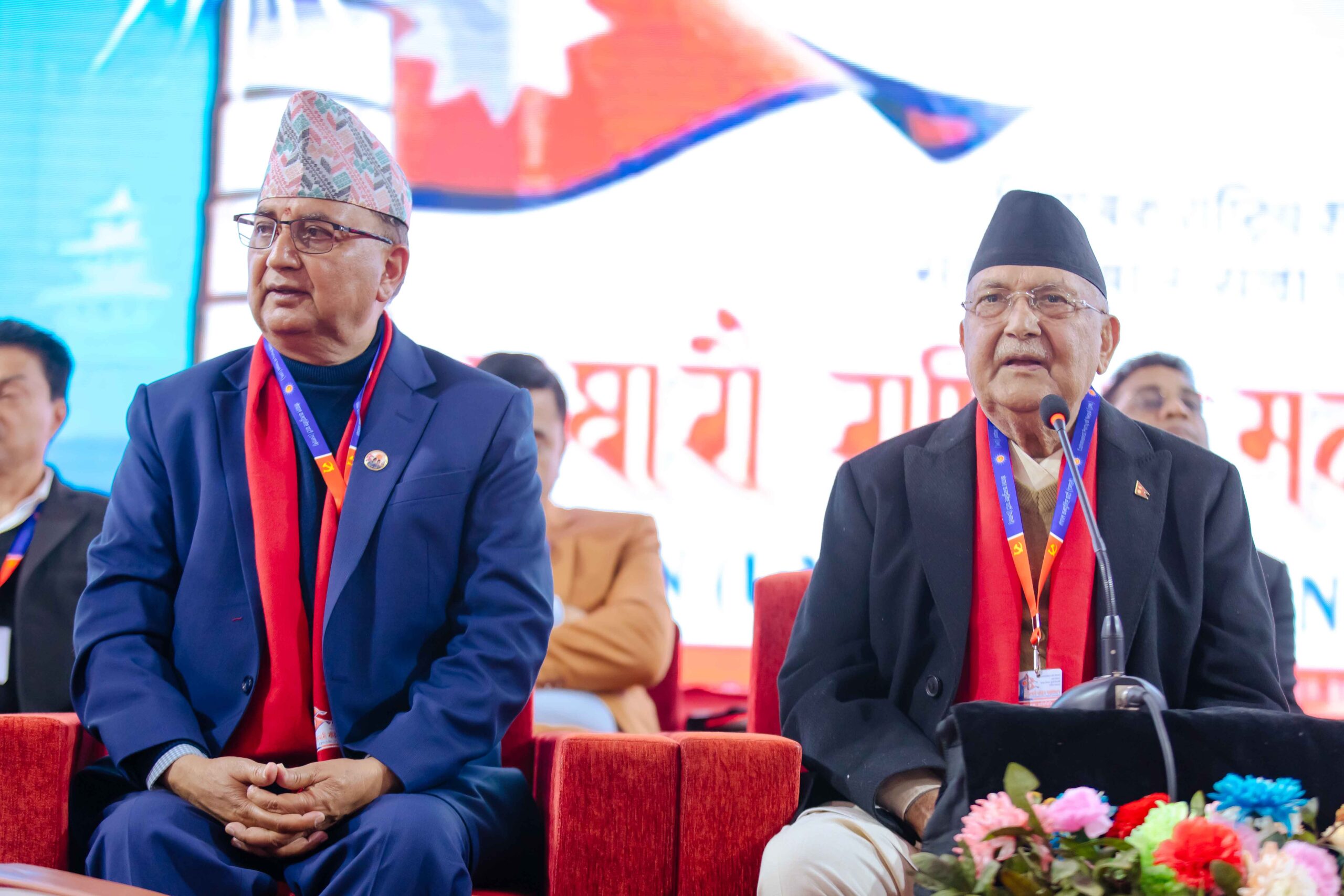
Ishwar Pokharel on the left and KP Sharma Oli on the right
This is the essence of the “Oli-garchy”: not a formal structure, but a political culture within UML where authority flows upward to one leader, dissent is tolerated only to a point, and survival depends on proximity to power.
Ironically, however, the UML people, at least the general convention representatives, have now learned to enjoy Oli-garchy!
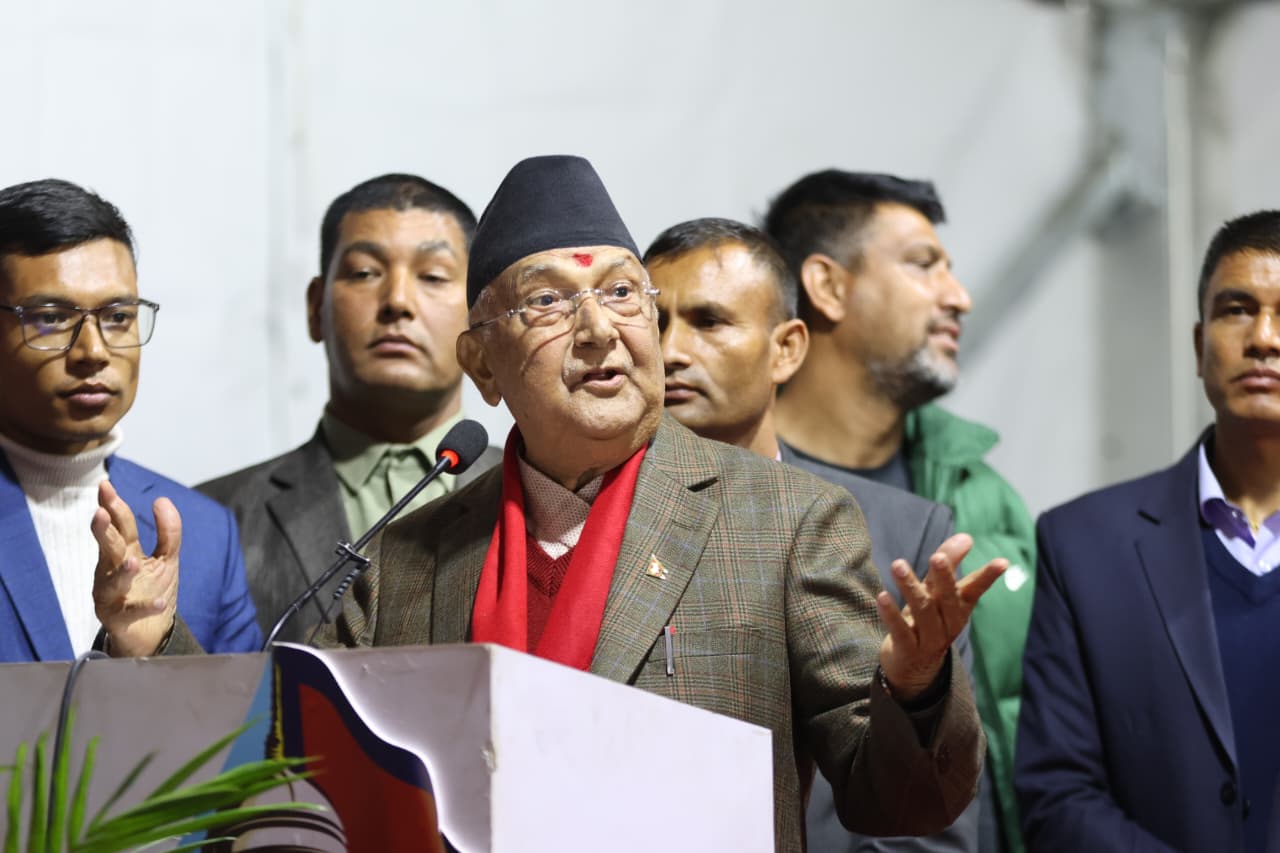
Nothing illustrated this culture more vividly than Oli’s post-victory speech. Gone was the written, restrained tone he adopted during the opening session at Bhaktapur’s Sallaghari. At Bhrikutimandap, buoyed by a landslide win, Oli spoke extemporaneously—and quite aggressively.
He did not lose time to lash out at the Gen Z movement, dismissing engagement with young protesters as “crude drama.” Oli criticized the recent agreement between the government and the Gen Z representatives in no uncertain terms. He declared that his party would reject the deal and not allow it to be implemented. He warned that if UML leaders were physically attacked or targeted through what he called fabricated cases, the country would be brought to a standstill. He instructed cadres to stop trusting state security mechanisms and to form neighborhood-level security teams within a week.
These were extraordinary statements, both in tone and implication. Yet inside the hall, they were met not with unease but applause. This reaction was telling. It showed how deeply Oli’s confrontational style has been normalized within the party—and how insulated the leadership has become from broader democratic anxieties.
The Gen Z revolt raised questions about accountability; Oli responded with threats of paralysis. The convention did not push back. It endorsed.
Arrogance as mandate
Every electoral victory reshapes a leader’s psychology. In Oli’s case, the third consecutive mandate is likely to harden traits already visible: confidence sliding into arrogance, decisiveness into inflexibility, authority into intolerance of dissent.
Oli is now more likely to push challengers further into the corner, of course depending on the posture the latter take. The fate of leaders who previously questioned his style— Jhalanath Khanal, Madhav Nepal, Bhim Rawal, Bamdev Gautam, Ghanashyam Bhusal—serves as a cautionary tale. Many left the party because of Oli; others were sidelined. UML paid a price for these ruptures, but Oli survived—and that survival has reinforced his belief that concentration of power is not a liability but strength.
The 11th convention, by overwhelmingly endorsing Oli’s panel, has legitimized this belief for another five years.
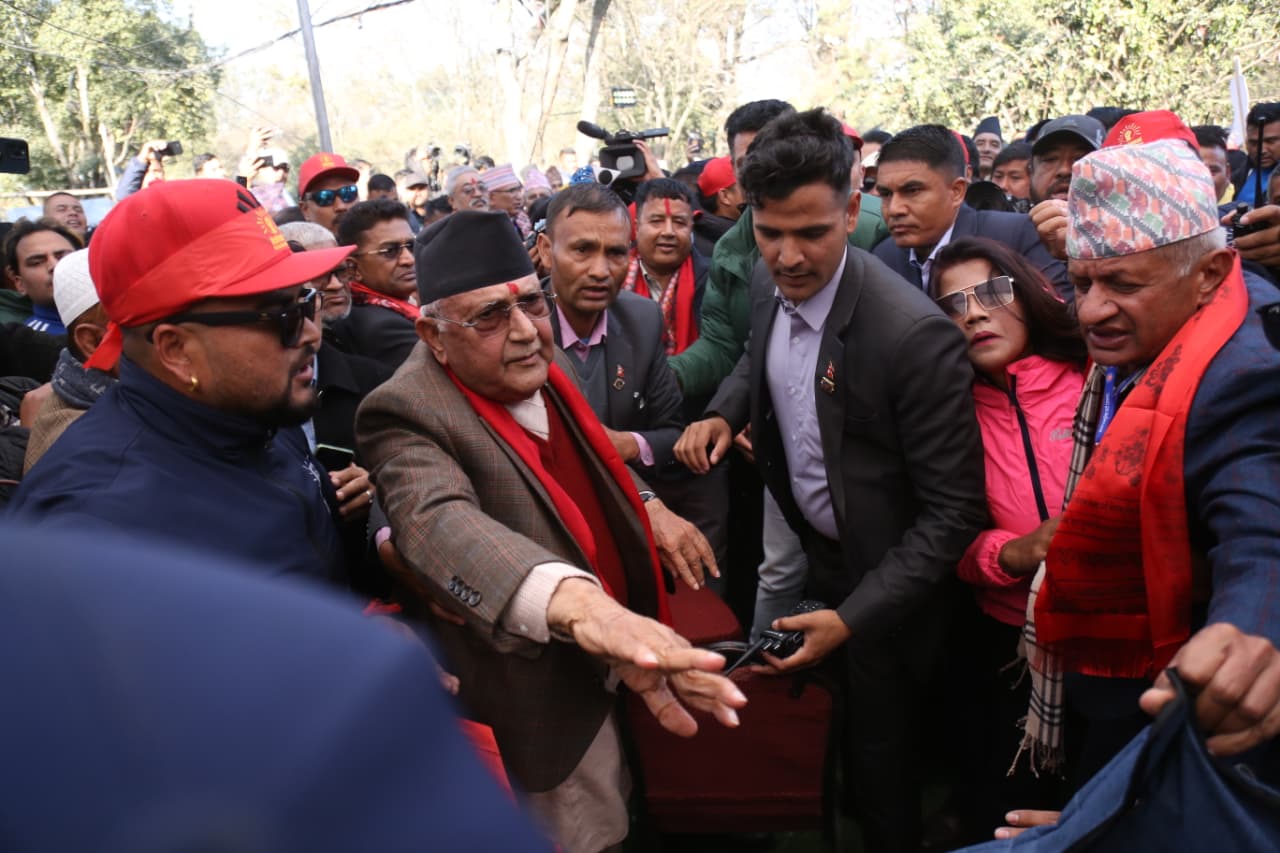
Perhaps the most troubling aspect of the convention is what it says about UML’s reading of society. Society was demanding significant change—not necessarily radical, but meaningful. How that change should occur is debatable; that it is needed is not.
Yet the convention showed no curiosity at all about that demand. The governance agenda raised by Gen Z protesters did not find reflection in leadership selection or political messaging. Instead, the party seemed to argue—implicitly but forcefully—that old parties need not change to remain relevant.
This is a risky wager. UML’s strength has historically lain in its organizational discipline and mass base. But discipline without adaptability can turn into rigidity. A party that mistakes applause inside convention halls for legitimacy outside them may find itself increasingly disconnected from the electorate it seeks to lead.
The road ahead: consolidation or contraction?
Formally, the 11th General Convention has given Oli full legitimacy to lead UML for five more years. Informally, it has placed the burden of consequences squarely on the party itself. If Oli succeeds—organizationally, electorally, politically—UML will reap the rewards. If he fails, UML alone will bear the cost.
The immediate future is not simple. The UML is out of power at the federal level. Its popularity has certainly gone down like that of the other old parties. So, the party is supposed to rebuild public trust, sharpen ideological clarity, and prepare for the next general election. None of these tasks can be accomplished through command alone; they require collective leadership and healthy internal debate.
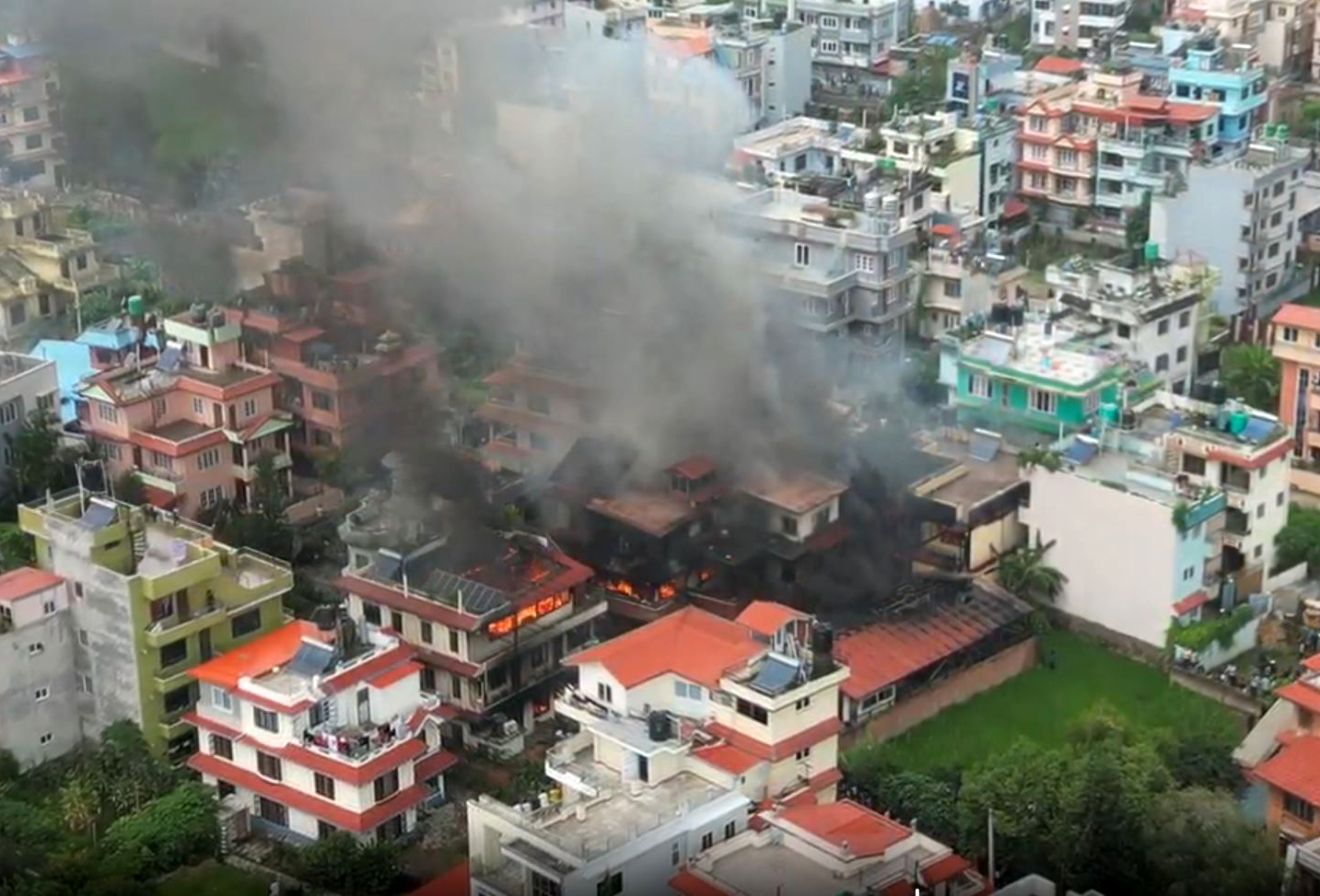
Oli’s Balkot residence in flames on the second day of the Gen Z revolt
Yet the convention’s outcome suggests that debate will remain constrained, and leadership highly centralized. Oli has won not just an election but an endorsement of his style.
The question now is not whether Oli can win—but whether he can listen. History suggests that excessive power concentration ultimately weakens parties, even those built on discipline. UML has now chosen continuity over correction, loyalty over reflection, and strength over sensitivity.
The Gen Z revolt may have been ignored inside the convention hall. But outside, it has not disappeared. And it is there—beyond the applause, beyond the votes—that the true test of the Oli-garchy will unfold.