Kathmandu
Tuesday, July 14, 2026





The average age of the newly elected members of parliament is 45.38 years, about eight years younger than the previous parliament

KATHMANDU: Manish Khanal (26), of the Rastriya Swatantra Party (RSP), elected this time from Nawalparasi (Bardaghat Susta East)-2, has had an interest in politics from the very beginning. He became a central member of Bibeksheel Nepali at the age of 20. In the March 5 election, he defeated former UML MP Til Bahadur Mahat by a margin of 25,592 votes to secure his place in parliament.
This parliament also has MPs younger than Khanal. The youngest are RSP’s Prashant Upreti, elected from Makwanpur constituency number 2, and Rubi Kumari, who entered parliament as a proportional representative from the Shram Sanskriti Party. Both are 25 years old.
Khanal says this election has demolished the assumption that only those who have contributed to a party for a long time are fit to become MPs. “We have been saying not just that young people should enter politics, but that capable young people should enter politics. In that spirit, the party gave opportunities to young people who had demonstrated ability and merit in other fields, and that is why the number of young MPs has grown,” he says.
The March 5 House of Representatives election returned 17 MPs under the age of 30, including Khanal – 15 from RSP and two from the Shram Sanskriti Party. A further 76 MPs are between 30 and 40 years of age, 88 between 40 and 50, and 94 above 50. Among the 93 MPs under 40 in the 275-member House of Representatives, RSP members are dominant – 78 from RSP, seven from the Nepali Congress, four from UML, and two each from the Rastriya Prajatantra Party (RPP) and the Shram Sanskriti Party.
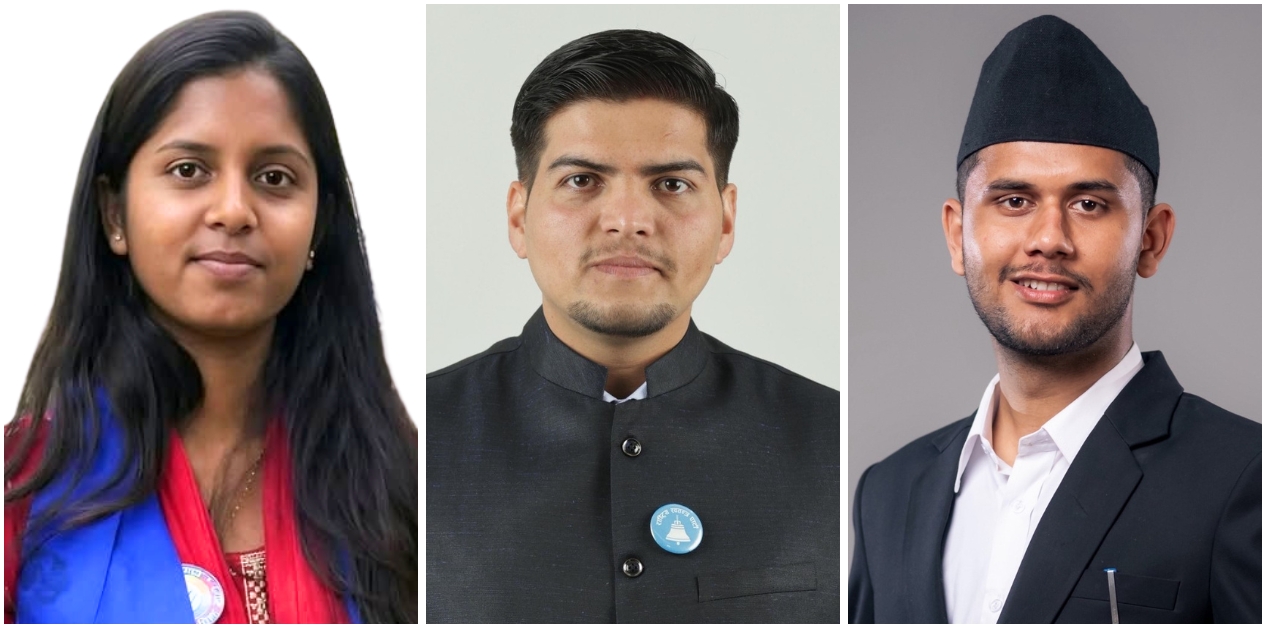
Shram Sanskriti Party’s Ruby Kumari (25 years), Rastriya Swatantra Party’s Prashant Upreti (25 years) and Manish Khanal (26 years). Photo source: their respective Facebook accounts.
With the rise in the number of young MPs, the average age of parliament as a whole has fallen compared to the parliament elected in 2022. The new parliament is eight years younger than its predecessor. The average age of the previous parliament stood at 53.76 years, while the newly elected parliament’s average age is 45.38 years.
By party, the picture is even younger. RSP MPs average 42.15 years and Shram Sanskriti 42.14 years. By contrast, Nepali Congress MPs average 51.94, UML 51.72, Nepali Communist Party (NCP) 54.23, and RPP 50.4 years.
With the rise in the number of young MPs, the average age of parliament as a whole has fallen compared to the parliament elected in 2079 BS. The new parliament is eight years younger than its predecessor.
With the notable influx of young MPs, a youth-led government is set to take charge of Singha Durbar. Thirty-six-year-old Balendra Shah (Balen), of RSP, which is poised to form a single-party government with close to a two-thirds majority, is set to become Prime Minister. There is talk that RSP, which received a mandate from the post-Gen Z movement election, will also send young people into the Cabinet.
Professor Yogendra Bahadur Gurung of the Central Department of Population Studies at Tribhuvan University says that because young MPs bring energy and motivation, the country stands to benefit in line with public aspirations. “People wanted change, and that was expressed in the election results – whether the work will follow accordingly remains to be seen,” he says.
The young faces that new forces bring
The rejuvenation of Nepal’s parliament has not come about through institutionalized leadership succession, that is, a regular internal party process. History shows that a surge in young MPs has only ever followed a movement, a pattern that repeated itself in the election held after last year’s September youth movement.
Since the political changes of 1990, Nepal has held eight general elections. Age analysis of those elected shows that meaningful youth participation in parliament has been secured only through movements. The data from the 2008S Constituent Assembly election and the 1991 general election and this year’s House of Representatives elections bear that out.
After the 1990 movement, many young MPs were elected on UML tickets in the 1991 House of Representatives election. Similarly, after the 2006 movement, many young people had the opportunity to become members of the 2008 Constituent Assembly through the CPN (Maoist). In the current landscape, a wave of young MPs has been elected from RSP, which won a single-party majority in the election that followed the Gen Z movement.
The current parliament’s average age is three years higher than that of the 1991 parliament, when it stood at 42.87 years compared to 45.38 today. What must be noted, however, is that Nepal’s average life expectancy in 1991 was only 55 years, compared to 71.3 years now. Although the new parliament appears older than the 1991 parliament in absolute terms, it is actually younger when measured against the rise in life expectancy; average life expectancy has increased by 16.3 years over this period, while the average age of parliament has risen by only 2.51 years.
Political scientist Karma Lama says that in the past, structural problems in the way old parties operated meant young people were denied opportunities. “Leadership development and succession is an institutional process, but the old parties’ failure to work on it means capable young people never get a chance,” she says. “A movement brings a new party, and that party establishes young people in politics. But in time, the party and its leaders grow old together.”
After the parliamentary election that followed the 1990 movement, UML established itself as the second force in national politics. At that time, it was UML that represented young people in parliament.
Professor Yogendra Bahadur Gurung says that the leaders of old parties who have become the dominant players in national politics also started out as young MPs, but having made politics their profession, they have blocked the path for the next generation.
The CPN (Maoist), which had transitioned from a decade-long armed insurgency to peaceful politics, contested elections for the first time through the 2008 Constituent Assembly. Voters, placing their hopes in the Maoists’ agenda of state restructuring and socio-economic transformation, made them the largest party in the 601-member Constituent Assembly. At that time too, the average age of members fell to 44.06 years compared to the 1999 parliament’s 44.38 years.
In the election that followed last year’s September youth movement against the misrule of old parties, RSP swept up the votes of those seeking change, bringing a significant number of young people into the policymaking level.
Professor Gurung notes that the leaders of old parties who have become dominant players in national politics were also young when they first became MPs, but having made politics their profession, they have blocked the path for the next generation. He believes the absence of clear provisions requiring leaders to step aside after a certain period or age has jammed the route for younger entrants. “In our political parties, there is a tendency to allocate tickets and responsibilities on the basis of a worker’s past contribution, so there is simply no path for young people to get opportunities. Parties should represent all age groups, classes, and regions, but that has not happened,” he says.
Gurung warns that if the leaders of new parties also remain in politics for a long time, the process of leadership succession and generational change will stall in the same way it has in the old parties.
Within the old political parties, discussions on transformation and leadership succession take place repeatedly, and some institutional provisions have been made. The Nepali Congress statute bars anyone from holding executive office for more than two terms. In accordance with this provision, Sher Bahadur Deuba stepped aside after completing his second term as party president. Led by Gagan Thapa and Bishwa Prakash Sharma, the Nepali Congress found new leadership last January through a revolt by the younger generation.
In the 1991 House of Representatives election, the Nepali Congress won a majority by taking 110 of the 205 seats. The average age of Nepali Congress MPs was 45 years, while the overall average age of all MPs stood at 42.87 years.
In UML, institutional decisions intended to regulate leadership were reversed. UML’s eighth general convention in 2009 had set a 70-year age limit for executive candidates. The ninth general convention in 2014 further restricted executive office to two terms. But a second statute convention held in March 2023 removed both provisions specifically to allow KP Sharma Oli to contest again, enabling him to become party president for a third time at the general convention held last December.
Although UML has not changed course on leadership succession, it has made some provisions to ensure youth representation within the organization following the Gen Z movement, reserving 10 percent of Central Committee seats for those under 40. The Nepali Congress, meanwhile, fielded new candidates in 108 of the 165 first-past-the-post constituencies in this election.
Though UML, Nepali Congress, and the Maoists (now NCP) have over time become parties of senior leaders, youth participation within them was once notable.
After the 1990 Movement
After the 1990 movement restored multiparty democracy, House of Representatives elections were held in 1991. The Nepali Congress won a majority, taking 110 of the 205 seats. The average age of Nepali Congress MPs was 45, while the overall average stood at 42.87 years. UML, which had emerged as a major force in the 1990 movement, played a key role in bringing that figure down. Having won 69 seats to become the main opposition, UML MPs averaged just 39 years of age. Without UML, the overall average would have been 44.82 years.
The 1991 election returned 85 MPs under 40, led by UML with 40, Nepali Congress with 35, and the United People’s Front with 6, the rest from other parties. The youngest MP at the time was UML’s Kul Prasad Sharma Fuyal, 26, elected from Khotang-2. Both UML’s then secretary-general Madan Kumar Bhandari and current party president Oli were under 40. Former Nepali Congress president Deuba, elected to parliament for the first time in that election, was 44.
In the 1994 mid-term election, UML became the largest party by winning 88 seats. Again, young UML MPs pulled the overall average age down to 42.67 years, even as both UML and Nepali Congress MPs aged slightly compared to 1991, averaging 39.39 and 45.16 years respectively. Without UML MPs, the average for that parliament would have been 45.11 years.
People wanted change, and that was expressed in the election results — whether the work will follow accordingly remains to be seen.
That parliament had 86 MPs under 40 – 51 from UML, 22 from the Nepali Congress, five from RPP, four independents, and two each from Nepal Workers and Peasants Party and Sadbhavana Party.
After five years of shifting coalitions in a hung parliament, House of Representatives elections were held in 1999. The Nepali Congress won a clear majority with 111 seats. Both Nepali Congress and UML MPs were older on average than in the previous election – UML MPs averaged 41.84 years and Nepali Congress MPs 45.86 years – and the overall parliamentary average rose to 44.38 years. UML won 71 seats in that election.
The number of MPs under 40 returned in that election fell to 63 – 30 from UML, 25 from the Nepali Congress, three each from RPP and Rastriya Jana Morcha, and two from Sadbhavana Party.
After the 2006 movement
Due to the Maoist armed insurgency and King Gyanendra’s direct rule, no election could be held on schedule after the 1999 polls.
After the 2006 movement, the reinstated parliament promulgated an interim constitution. Elections for the first Constituent Assembly were then held on 10 April 2008 to draft a new constitution. Under a mixed electoral system, the 601-member assembly was to comprise 240 directly elected members, 335 proportional representatives, and 26 members nominated on the government’s recommendation.
In the Constituent Assembly election, the CPN (Maoist), which had abandoned armed struggle and entered peaceful politics, emerged as the largest party. The new party born of the movement significantly lowered the average age of members, bringing the overall average to 44.06 years. Calculated for the Maoists alone, who won 120 directly elected seats and 100 proportional seats, the average age was even lower at just 39.45 years.
Without the Maoist members, the overall average would have been 46.86 years, since the old parties’ MPs were considerably older. The average age of Nepali Congress members, the second largest party in the assembly, was 49.4 years, and of UML members, the third force, 45.26 years.
The first Constituent Assembly had 203 members under 40, of whom 130 were Maoists, 11 Nepali Congress, and 18 UML. The Madhesi Janadhikar Forum Nepal, which had emerged from the Madhes movement, also had 21 members under 40.
Sher Dhan Rai of Bhojpur, who became an MP at 28 in 1999, stood and won again in the second Constituent Assembly election. UML Chairman Oli was 38 when he first became an MP but was 61 by the time of the second Constituent Assembly. Whether Sher Bahadur Deuba or Bimalendra Nidhi, the pattern is clear – as the same leaders are elected time and again, their advancing age has pulled up the parliamentary average along with them.
After the first Constituent Assembly was dissolved having failed to produce a constitution, a second Constituent Assembly election was held in 2013. The old parties returned to dominance – the Nepali Congress emerged as the largest party and UML climbed to second. As these old parties increased their representation, the average age of members rose by six years compared to the first assembly, reaching 50.22 years in the second Constituent Assembly.
By party, Nepali Congress and UML MPs averaged 53.64 and 51.17 years respectively. The rising averages for both parties reflect the same leaders contesting election after election. Sher Dhan Rai of Bhojpur, who became an MP at 28 in 1999, stood and won again in the second Constituent Assembly election. UML Chairman Oli was 38 when he first became an MP but was 61 by the time of the second Constituent Assembly. Whether Sher Bahadur Deuba or Bimalendra Nidhi, the pattern is clear — as the same leaders are elected time and again, their advancing age has pulled up the parliamentary average along with them.
After the new constitution
After the constitution was promulgated on 19 November 2015, House of Representatives elections were held in 2017. UML and Maoist Center, contesting in alliance, together secured close to a two-thirds majority – UML winning 121 seats and Maoist Center 53.
The average age of MPs elected in this election rose to 51.79 years. The Maoists, who had averaged 39.45 years in the first Constituent Assembly, now averaged 48.13 years. Nepali Congress and UML MPs averaged 55.96 and 50.54 years respectively.
During that parliament’s five-year term, UML and the Maoists went through party unification and then split apart.
The 2022 election brought new political parties into parliament – RSP, Janmat Party, and Nagarik Unmukti Party entered the national political arena. Despite their arrival, the dominance of old parties pushed the average age of MPs to a record high of 53.76 years. By party, the average age of Nepali Congress MPs, the largest party, was 54.35 years, UML MPs 54.17 years, and Maoist MPs 50.77 years. Among the new parties, RSP, Janmat, and Nagarik Unmukti MPs averaged 40.95, 38.5, and 40 years respectively.
Professor Gurung of population studies warns that if the young MPs now in parliament fail to address the concerns of all sections of society, the resulting disappointment will be even greater. “The new arrivals have come with an awareness of past failures and shortcomings, so it would be good if they moved forward addressing all sections of society. Otherwise, the mere arrival of young people does not mean everything will automatically fall into place,” he says.