Kathmandu
Sunday, January 18, 2026





Due to lack of information-technology-related infrastructure and a shortage of mathematics, science, and computer teachers in public schools, IT education itself has become weak
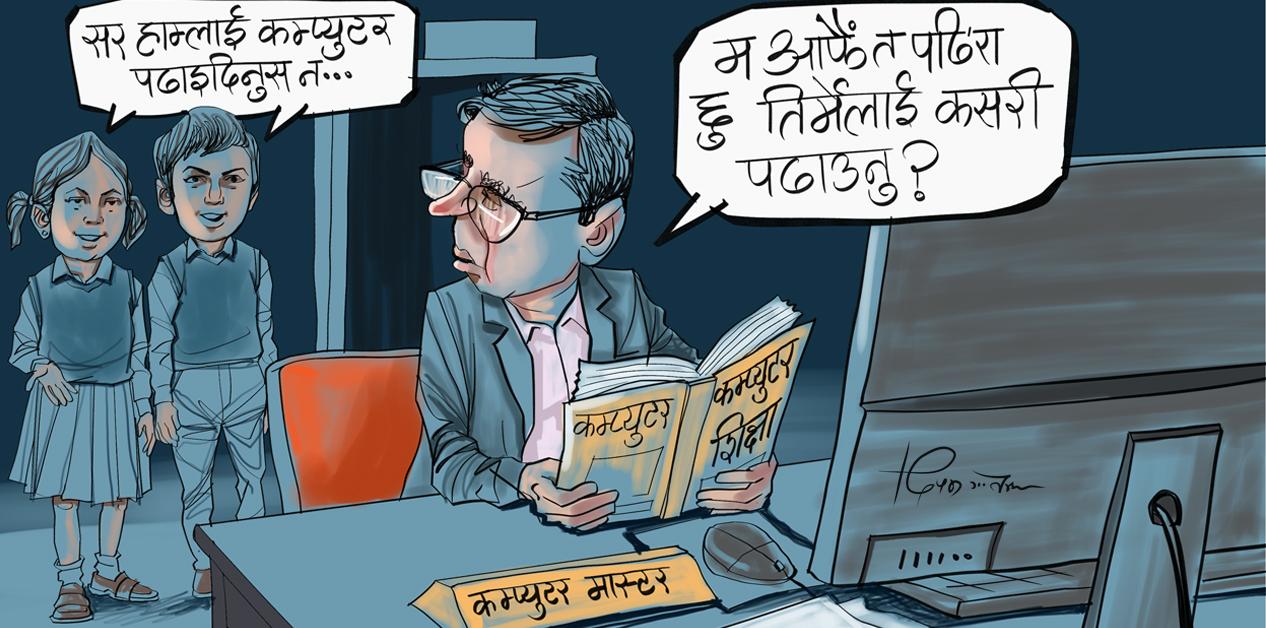
KATHMANDU: At Siddheshwar Secondary School located in Bhojpur Municipality–4, Dawa, arrangements have been made to teach information technology to students by procuring 10 computers. However, due to the absence of a computer teacher, those computers remain locked away in a room at the school. According to Principal Subas Dahal, two desktop computers were purchased through government grants 11 years ago, and eight more were bought seven years ago. He says that because of the lack of teachers, the students’ desire to learn computers has not been fulfilled.
He says, “The government itself should have understood the need and sent a computer teacher. But in the absence of a teacher, we have not been able to provide students with practical training in information technology.”
The school has repeatedly requested the District Education Coordination Unit to provide a computer teacher, but those requests have yielded no results.
Apart from occasional use for office purposes, the computers remain locked in a room. Until three years ago, theoretical classes were conducted to prepare students of grades 6–8 for examinations in the computer subject. At that time, practical classes were occasionally conducted in the computer lab as well. However, since Bhojpur Municipality made the local curriculum subject “Our Municipality” mandatory from fiscal year 2022/23, the teaching of the computer subject has been completely discontinued.

Computers Unused in IT Lab Due to Lack of Subject Teachers at Jalpa Singh Devi Basic School in Pathari Shanishchare, Morang. Photo: Gopal Dahal
On 22 September 2025, Mahabir Pun became the Minister for Education, Science and Technology. The very next day, he decided to add a mandatory post for one computer teacher in every public school. Principal Dahal, who learned about this news through the media, says, “If the government provides teachers through official posts as directed by the education minister, the available resources would be utilized, and our students would get the opportunity to learn information technology and computers.”
After the National Curriculum Framework 2006 envisioned ICT-based education, the government began providing grants to public schools for purchasing computers. On 15 November 2019, the Ministry of Education, Science and Technology, through the Education and Human Resource Development Center, approved the “Procedure for Establishing Information and Communication Technology Laboratories in Community Schools.” At that time, the government aimed to establish ICT labs in community schools, develop digital learning materials, and improve teachers’ learning capacity. However, due to the lack of computer teachers, ICT labs in most community schools have become ineffective.
Education expert Binay Kumar Kusiyait says that due to the shortage of teachers, the condition of many labs is no different from that of Siddheshwar Secondary School in Bhojpur. He says, “Most ICT labs have become warehouses for storing computer equipment. Due to the lack of skilled teachers, computer labs in many schools are unused.”
With the rapid development of information technology, demand for IT-skilled manpower in the global labor market has been increasing. According to a study report titled “IT Services Being Exported Abroad” published in 2023 by the Kathmandu-based Institute for Integrated Development Studies (IIDS), Nepal has an average annual demand for 23,000 IT professionals.
Despite the high demand for IT manpower, the subject is highly neglected in public schools, which are considered the foundation for producing IT human resources. There is neither adequate infrastructure nor teachers who can teach IT. To enter the IT sector, computer knowledge and skills are essential. However, even though ICT labs have been established in many public schools, there is a persistent shortage of the necessary teachers.
According to the Economic Survey 2024/25, out of 27,298 public schools operating across the country, 85.43 percent have access to the internet. However, only 29.43 percent of them have expanded ICT labs. Dipendra Chaulagain, a social studies teacher at Durbar High School in Rani Pokhari, Kathmandu, says that even running ICT classes by arranging teachers through private sources is challenging. “The government claims to provide free education, but to manage the salary and benefits of computer teachers, we are compelled to collect fees,” he says.
According to the Nepal Telecommunications Authority, broadband internet services had been expanded to 6,566 ward centers by mid-March 2025.
Weak foundation
Without developing knowledge, skills, and capacity in science, technology, engineering, and mathematics (STEM) along with computer education, it is not possible to produce skilled IT manpower. However, learning levels in these very subjects are weak in public schools. To such an extent that among students who fail to obtain grades (non-graded) in the Secondary Education Examination (SEE), the highest number are in mathematics.
In last year’s SEE, out of 167,597 non-graded students, the highest number – 128,215 – were in mathematics. Similarly, 79,271 students were non-graded in science and technology, and 80,672 were non-graded in English.
To produce skilled IT manpower, excellent results in these subjects are essential. However, results at the school level in these subjects are weak – not only in SEE, but also in lower grades, where learning outcomes are unsatisfactory. The 62nd Annual Report (2082) of the Office of the Auditor General pointed out that the targeted learning outcomes in mathematics, English, and science for grade 8 were not achieved. In fiscal year 2023/24, the target was to achieve a 63 percent learning outcome in grade 8 mathematics, English, and science, but actual outcomes were limited to 26, 25, and 28 percent, respectively.
According to last fiscal year’s report by the Education Quality Testing Center under the Ministry of Education, Science and Technology, many grade 5 students are struggling to achieve even minimum learning outcomes. The report states that learning outcomes in grade 5 mathematics in 2022 declined compared to 2018.
Similarly, learning in reading and mathematical skills among grade 3 students is weak, according to a research paper titled “Student Assessment Processes and Results of School Performance Testing,” published on 6 July 2025 in Nepal Journals Online (NepJOL) by Deviram Acharya, Director of the Education Quality Testing Center.
Due to the weak ICT foundation at the school level, the number of students pursuing higher education in this field is also low. According to data from the National Census 2021, a total of 3,972,664 people across the country have passed grade 11 up to postgraduate level or equivalent. Among them, only 7.1 percent (281,887 people) studied science and technology, and just 1.2 percent (45,880 people) studied computer and information technology.
Compared to public schools, ICT teaching appears relatively better in private schools. Private schools make effective use of their available infrastructure to teach students. “Private schools are naturally proactive – from administrative staff to teachers – about ensuring that computer labs are well-managed, staffed with competent teachers, and useful for students,” states a research paper titled “Challenges of ICT Use in Public and Private Schools” by Govinda Prasad Acharya, Head of the Information and Communication Technology Program at Surkhet Multiple Campus, published in the Surkhet Journal on 25 November 2025. The paper further states, “In community schools, the main issue is the absence of computer teachers, and there is a general lack of interest in ICT teaching – from administrative management to teachers themselves.”
Due to the shortage of subject-specific teachers, students’ learning outcomes in ICT subjects have become weak. According to last year’s Flash Report of the Education and Human Resource Development Center, there are 7,131 community schools across the country that offer secondary-level education (grades 9 to 12). Not all schools have subject-specific teachers. The center’s data show that about half of community schools lack teachers for mathematics, English, and science and technology subjects.
According to records provided by the center as of 14 January 2026, there are only 2,670 mathematics teachers, 3,371 English teachers, and 3,203 science and technology teachers teaching grades 9 and 10 in public schools nationwide. Shiva Kumar Sapkota, Joint Secretary and Spokesperson for the Planning and Monitoring Division of the Ministry of Education, says, “Some schools may have been excluded from this data if details of subject teachers were not reported, but the shortage of teachers in core subjects like mathematics, English, and science is a common problem in public schools across the country. This has affected ICT teaching and learning.”
Rule 77 of the Education Regulation, 2002, stipulates that the teacher–student ratio in community schools should be 40 in the Himalayan region, 45 in the hills, and 50 in the Kathmandu Valley and Terai. However, this ratio has not been maintained in IT-related subjects such as mathematics, English, and science. In these subjects, the student load per teacher is three to four times higher than prescribed.
Reliance on theoretical teaching
According to IT economist Amrita Sharma, who holds a PhD in information and communication technology employment, adequate skills and knowledge in this field are essential to enter and sustain a career in IT. However, she says the government has not paid enough attention to retaining IT professionals by providing them with greater opportunities. “Human resources are the backbone of the digital sector, and skilled manpower must be produced through the education system,” she says. “Although IT courses are included in the country’s education system, they are largely theoretical, with very few practical classes. As a result, skilled IT manpower in line with market demand has not been produced.”

Bhairav Tech Company in Kathmandu. Photo: Company Website
Sharma says that the lack of coordination between ICT education in schools and colleges and the manpower needs of the market creates difficulties for new entrants to the IT field. “Those who are currently working in IT are all self-motivated,” she says. “IT companies look for skilled manpower with market-relevant experience, but we have not focused on producing such human resources.”
Indeed, in an IIDS survey, 74.1 percent of IT company operators questioned the quality of Nepal’s education system. They said that Nepal’s educational institutions have failed to produce IT manpower capable of competing in the global market. Nearly 70 percent of respondents in the survey stated that the government lacks an appropriate policy framework for the development of Nepal’s IT sector.
Lack of ICT infrastructure
Sapkota, the Joint Secretary and Spokesperson for the Ministry of Education’s Planning and Monitoring Division, acknowledges that there is a shortage of both educational infrastructure and teachers needed to produce manpower according to market demand in the IT sector. “The current education system is designed only to provide ‘general education,’” he says. “Because the education sector’s share of the national budget has been declining compared to earlier years, a lack of resources has prevented adequate attention to infrastructure and human resources needed to produce ICT students.”
Despite the weak ICT foundation in school education, Nepali youth have been earning substantial income from the global IT market. According to “IT Market Analysis” by the Germany-based global survey portal Statista, demand for skilled manpower is increasing in areas such as software development, web designing, data science, digital marketing, artificial intelligence, and automation testing. As a result, according to 2022 data from IIDS, Nepali youth earn more than Rs 67 billion annually by exporting IT skills and services to IT companies in the United States, Europe, and Gulf countries.
In 2017, the number of IT professionals working in areas such as software development, sales and marketing, creative and multimedia work, and writing and translation for digital platforms was 27,560. By 2022, this number had increased to 66,500. In recent years, the number of IT companies has also increased. According to economist Sharma, the number of IT companies in Nepal rose from 106 in 2022 to 326 just a few months ago.
Sharma, who also led the IIDS research on “IT Services Being Exported Abroad,” says Nepalis are exporting services such as coding, programming, design, software development, social media management, video editing, animation, content creation and editing, gaming, and hardware production to foreign markets.
It is encouraging that, despite limited educational infrastructure and largely through their own efforts, young people are earning income by exporting IT skills and services. The number of youths seeking careers in IT in Nepal is increasing. Sudan Jha, Assistant Director of the Department of Computer Science and Engineering at Kathmandu University, identifies two reasons for the growing presence of Nepali youth in the IT sector in recent years. First, IT has become a preferred field for young people interested in internet technology. Second, young people are willing to work hard even for low salaries. Jha adds, “Regardless of the field, Nepalis are ready to do good work for low pay. These days, when foreign companies need IT projects done or IT staff, Nepali youth are the first choice.”
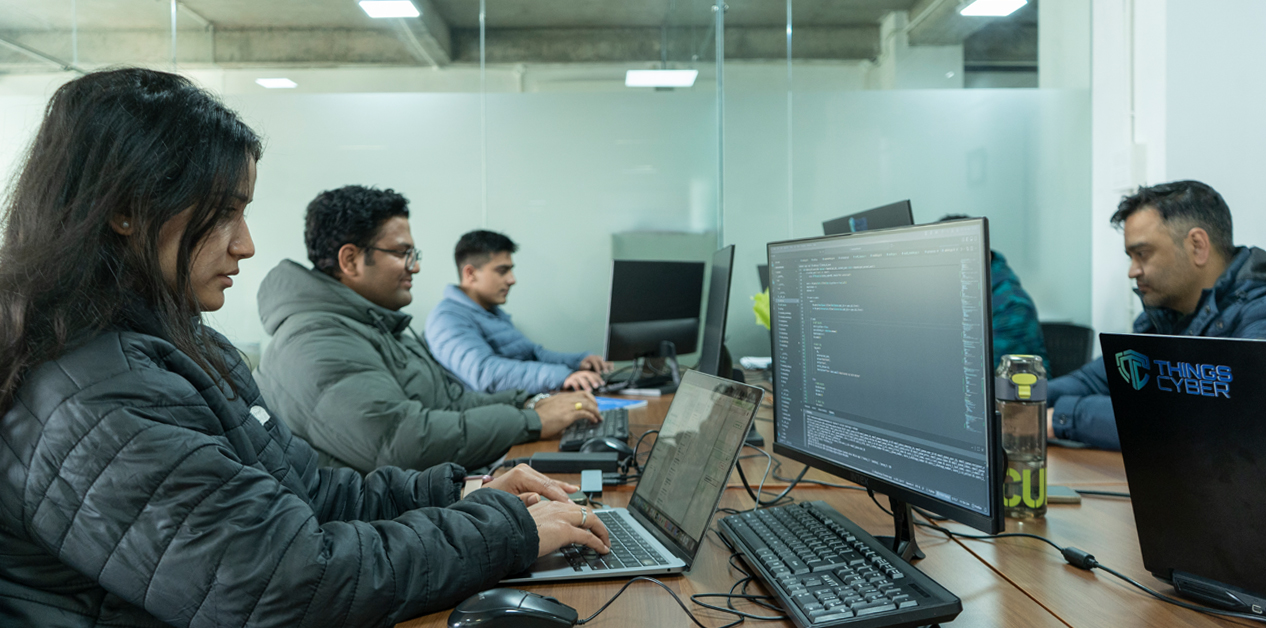
Things Cyber, an IT company that provides cybersecurity services. Photo: Bikram Rai
Jha further says that rapid technological development and expanding access will increase demand for cybersecurity and AI auditors. “College students are getting opportunities based on the small projects they do,” he says. “If the government systematically organizes this at the policy level, teaches ICT effectively from the school level, and creates an environment where universities can offer affordable education, the country can expand IT opportunities domestically.”
However, although the government has invested in internet infrastructure and expansion, it has not paid sufficient attention to producing skilled IT manpower. As a result, the country has not been able to supply IT professionals in line with global market demand. Because the ICT foundation is weak at the school level, producing manpower has become challenging. AI expert Dobhan Rai says, “ICT keeps evolving. To produce manpower that can sell and sustain itself in the labor market accordingly, the government must strengthen the ICT foundation starting at the school level.”