Kathmandu
Friday, January 23, 2026





From Remoteness to Riches: Local cooperation and infrastructure have transformed Mustang into an economic powerhouse, powered by tourism and agriculture

MUSTANG: Potatoes sourced from the Mustang district, widely known as Mustang potatoes or Mustang’s potatoes, remain one of the most frequently ordered items among Nepalis, especially anyone craving potato-based dishes or looking to enjoy distinct flavor and texture. Their popularity is so high that potatoes from other districts are deceptively passed off as Mustang potatoes in restaurants to attract customers. While genuine Mustang potatoes cannot meet the overwhelming market demand, fortunately the good news is that the production of the much-talked-about Mustang potato has increased in the current fiscal year.
According to the Agriculture Knowledge Centre, Mustang, this time, at least 9,665.16 metric tons of potatoes were produced. The lump sum value is estimated to be Rs 628.2 million. This figure is 13.76 percent higher compared to the previous year.
In the last fiscal year, 2024/25, some 8,496 metric tons of potatoes were produced in Mustang. According to the market price, this was equivalent to Rs 509.7 million.
Although the demand for potatoes produced in Mustang is high, 60 percent of the produced potatoes go to outside districts, and 30 percent are consumed in the district’s own hotels and restaurants. The remaining 10 percent of potatoes are saved by farmers for seeds. This story of the Mustang potato helps one understand the importance and demand for the agricultural produce of that district.
Indeed, Mustang, known as the district across the Himalayas, was once considered remote and underdeveloped. However, with the arrival of developmental infrastructure, Mustang is now prospering through agriculture and tourism. Despite its small geography, low population, geographical remoteness, and lack of skilled manpower, Mustang is generating an annual income of at least Rs 10 billion from agriculture, animal husbandry, and tourism. With Mustang connected to the road network, local products like apples, potatoes, and walnuts have easily found markets. The sale of animals like mountain goats and yaks has become easier.
District Coordination Committee, Mustang, chief Maya Gurung says that the face of Mustang changed after it was connected to the road network. According to her, up until a decade ago, apples grown in Mustang had to be transported to other places either by airplane or on mules. Transporting them by airplane was expensive, and transporting them by mules meant about half of the produce would spoil on the way.
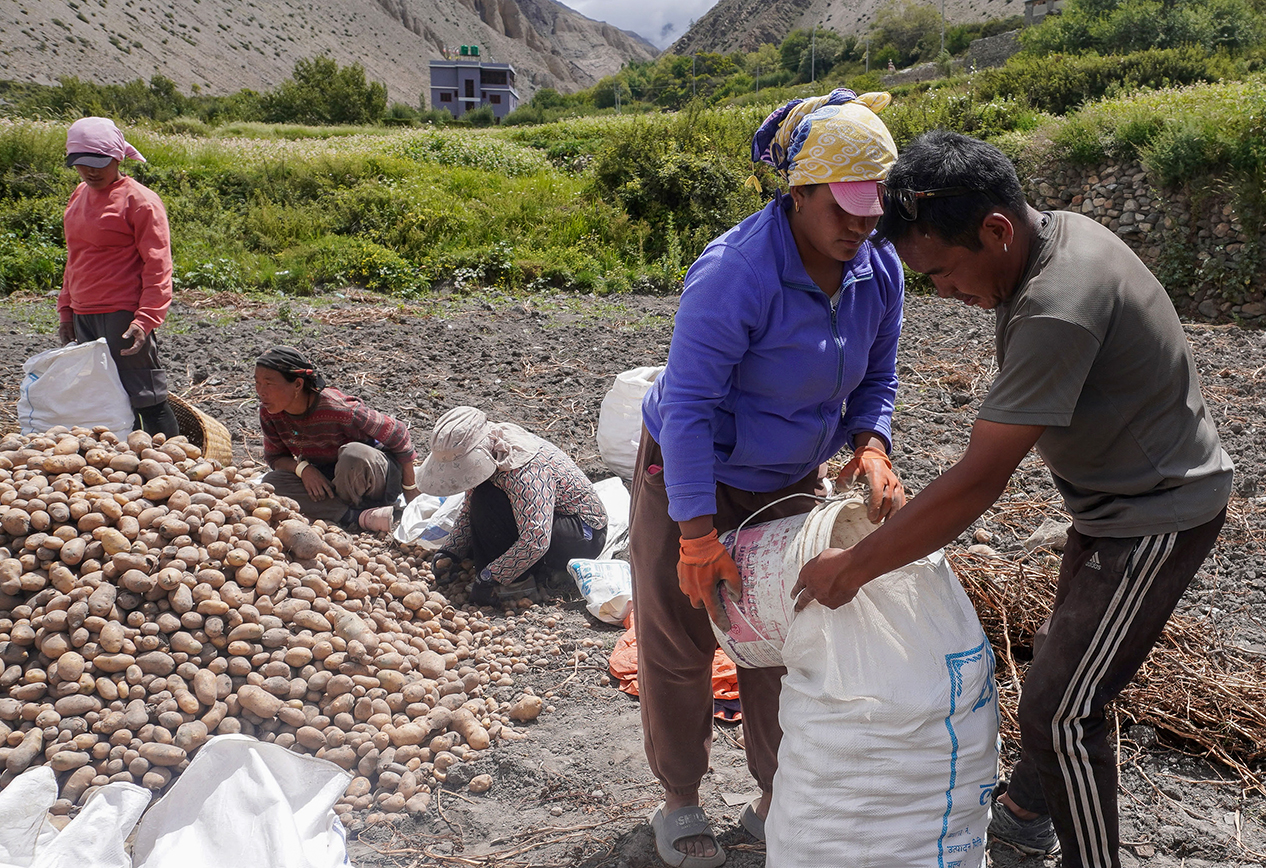
Farmers harvesting potato in Mustang. Photo: RSS
“Now, not only apples, but whatever is produced in Mustang, such as potatoes, walnuts, and vegetables, and nothing goes to waste; it has become easier to take them to the market for sale,” said Gurung.
At least Rs 1 billion Apple business
According to the Agriculture Knowledge Centre, Mustang, 6,684.30 metric tons of apples were produced in Mustang in the current fiscal year 2025/26, and the value of this production is Rs 1.102 billion. At least 90 percent of the apples produced in Mustang are exported outside Mustang. This year alone, Mustang exported apples worth Rs 992.1 million to other districts.
Similarly, in the last fiscal year, 2024/25, at least 7,328.84 metric tons of apples were produced, and this generated Rs 918.6 million for the district. Of this amount, Rs 826.8 million was exported to other districts. Although the production of local apple varieties has decreased, the production of high-density plantations of apple varieties has increased, according to the Agriculture Knowledge Centre, Mustang.
Apples produced in Mustang reach major cities across the country, including Pokhara, Kathmandu, Narayangadh, and Butwal. Rajesh Gurung, Chief of the Agriculture and Livestock Development Office, Mustang, says that the apple production achieved through the cooperation of the federal, provincial, and local governments has enabled Mustang to earn a good income.
“Excellent production has been achieved because we focus on three key strategies: finding solutions for problems seen in apples, cultivating according to new technology, and emphasizing production through cooperating with farmers,” Rajesh explained.
At least Rs 1 billion Mountain Goats business
Mustang supplies mountain goats to major cities across the country during the Dashain and Tihar festivals. The demand for mountain goats from the high-altitude Himalayan district is extremely high during Dashain and Tihar.
According to the data from the Veterinary Hospital and Livestock Service Centre, Mustang, this time, approximately 7,000 mountain goats were sent to other districts from Mustang during Dashain and Tihar alone.
Mountain goats from Karnali’s Mugu, Dolpa, and Jumla areas are also sent to other districts via Mustang.
Lal Mani Aryal, Chief of the Veterinary Hospital and Livestock Service Centre, Mustang, says that the Center certified 15,000 mountain goats from all areas combined for supply outside Mustang in a year.
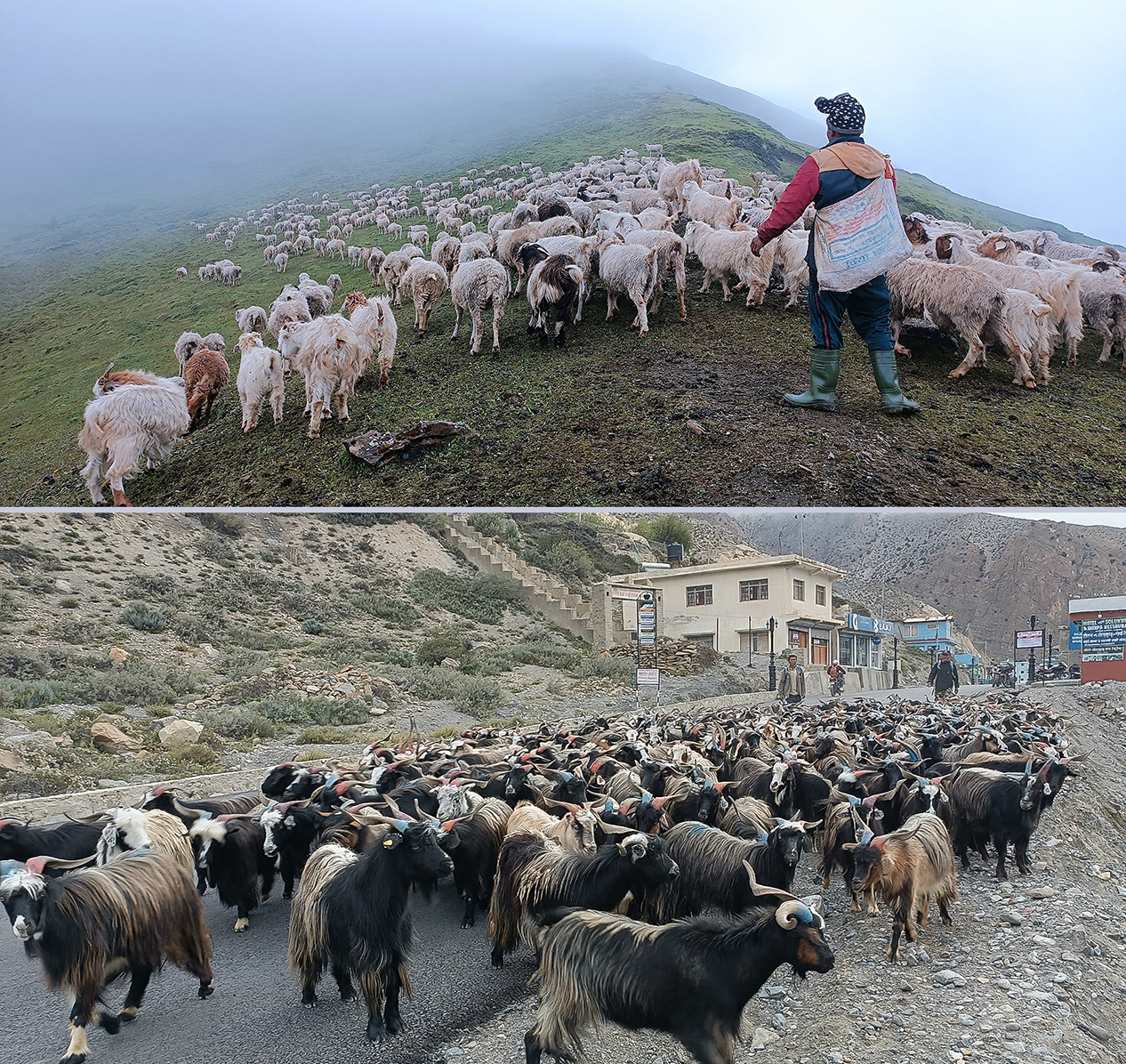
Sheep and mountain goats of Mustang. Photo: RSS
According to Aryal, some people take mountain goats to other districts for sale without certifying them. These uncertified goats are sent to various districts, including Pokhara, Chitwan, and Kathmandu.
Chief Aryal adds that mountain goats worth more than Rs 600 million are annually taken out of Mustang.
“Counting Mustang and other districts, more than Rs 1 billion worth of mountain goats are exported annually,” Aryal further added.
At least Rs 7 billion from tourism
Mustang has generated the most income from tourism recently. According to the National Census 2021, the population of Mustang is 14,452. Of this, only about 10,000 reside in the district. The rest engage in trade and business in places like Pokhara, Kathmandu, and others. However, during the tourist season, tourists equivalent to the population of Mustang enter the district daily.
“During the tourist season, 10,000 to 12,000 tourists come here daily,” said Subindra Gauchan, a local hotel operator of Hotel Sirjana and Thakali Kitchen in Mustang.
By November 2025, some 135,719 foreign tourists had visited Mustang. This is 14,411 people, or 10.61 percent, more than the previous year.
A few years ago, Mustang did not have good road facilities. The road network was opened in Mustang only in the fiscal year 2007/08. Since then, while external tourists started arriving, it was not easy for even four-wheeler vehicles and motorcycles to go until three or four years ago. Since then, the road has been upgraded, and the number of tourists visiting Mustang has increased.
Currently, almost 80 percent of the roads in Mustang are paved. It is now possible to reach the area by car and motorcycle from Pokhara and Kathmandu. Recently, the number of domestic tourists, along with foreigners, has increased in Mustang. Local tourism entrepreneurs say that domestic tourists visiting Mustang have increased by 40 to 50 percent.
Hotel operator Gauchan further says that domestic tourists have increased significantly over the last three years. Of the tourists who visit Mustang, 30 percent are foreign and 70 percent are Nepali.
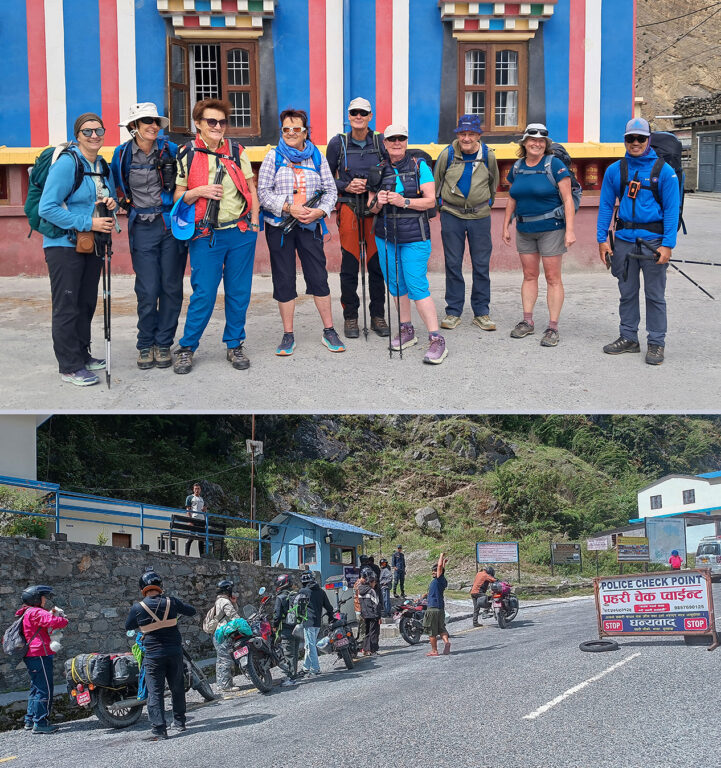
Foreign tourists arriving in Mustang and domestic tourists at the Ghansa checkpoint. Photo: RSS
To facilitate tourists, there are a total of 400 establishments here, including homestays, hotels, and restaurants. The time to visit Mustang is from mid-August to mid-January and mid-March to mid-June. During this time, foreigners visit Mustang for trekking and sightseeing, while Nepalis mainly go for pilgrimage to Muktinath. Recently, however, Nepalis have also started going for trekking and sightseeing.
The American media outlet ‘The New York Times’ listed Mustang as a must-visit destination in 2024. According to The New York Times’ list, Mustang was included at the 37th number among 52 must-visit global destinations.
According to the informal estimate of local entrepreneurs, tourism alone generates an annual income of Rs 5 to 7 billion in Mustang.
Kirtan Raj Paudel, Coordination Officer of the District Coordination Committee, Mustang, says that if the total spent by tourists on lodging, food, and buying local products as souvenirs is calculated, the annual income reaches around Rs 10 billion. He says, “A consolidated account is not maintained, but if you add everything up, the annual income is not less but more than Rs 10 billion.”
Moreover, chhurpi (dried cheese) and various herbs worth more than Rs 500 million are exported annually from Mustang. Similarly, locals say that Marpha wine and alcohol made from apples are also exported in the same range.
Padma Raj Atreya, former Chief of the Temperate Horticulture Development Center Marpha, Mustang, says, “The center itself produces wine. Private industries also produce it. Although there is no precise account, the trade amounts to millions of rupees.”
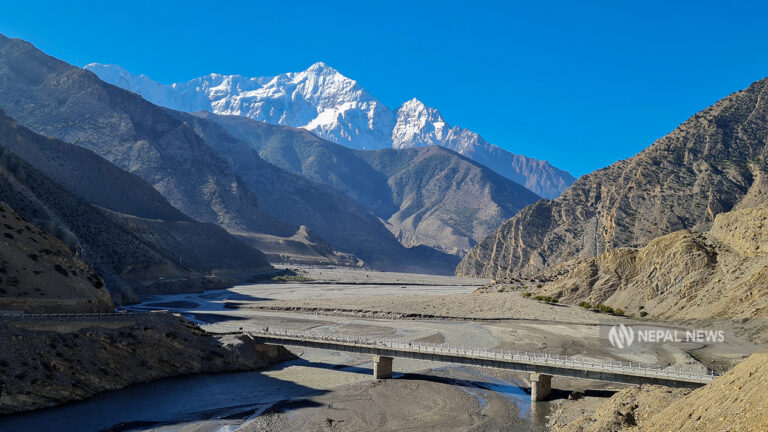
A magnificent view of Mustang. Photo: RSS
Strength enhanced by cooperation
With diverse problems like a small population, remote geography, and lack of skilled manpower, how did Mustang become prosperous? To understand this, it is necessary to study the hard work and cooperation of the locals.
Mustang, which lies at an altitude of 2,000 meters to 8,167 meters above sea level, has an area of 3,573 square kilometers. Mustang, which comprises Gharapajhong, Thasang, Lo Ghekar Damodarkunda, Lomanthang, and Varagung Muktichhetra rural municipalities, had been a victim of backwardness due to geographical remoteness and lack of roads. When the road network reached Mustang, the door to prosperity opened.
With the advent of road facilities in Mustang, which is located between the Dhaulagiri and Nilgiri mountains, other developmental infrastructures also arrived. Tourists began to flock. With easy access to transportation, Mustang’s products could reach across the country via Pokhara and Kathmandu.
Local hotel operator Gauchan adds, “Since the roads have improved, and it is possible to reach the area from Pokhara and Kathmandu in one or two days, tourists are increasing every year. This is expected to increase even further next year. The roads have also made it possible for products to easily go out.”
The cooperation of the locals is exemplary in boosting the economic strength of Mustang. The District Coordination Committee is often criticized in other parts of the country for not doing much work, but in Mustang, the District Coordination Committee facilitates bringing together the local units and farmers.
To solve the problems of the locals, District Coordination Committee Chief Maya Gurung is currently in Kathmandu, visiting various ministries and departments.
Maya says, “We are working in coordination with everyone for the development of Mustang. Mustang is moving forward because of everyone’s cooperation. It is not possible for one or two people or a single body to achieve this. If everyone works together, a lot can be done.”
Sabin Paudel, Information Officer of the District Coordination Committee Mustang, says that cooperation among the locals is important to make Mustang prosperous.
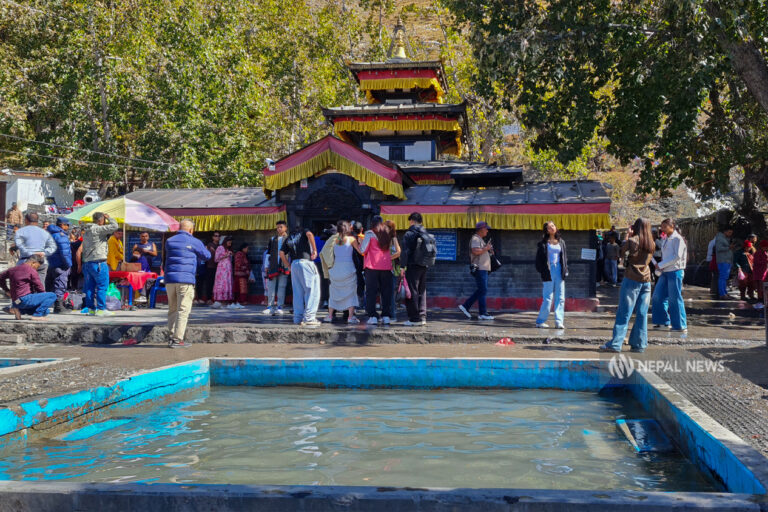
Muktinath, a famous religious site in Mustang. Photo: Prabhakar Gautam/Nepal News
According to Sabin, the District Coordination Committee meeting, which takes place every three months, is held alternately in all five rural municipalities. In these meetings, shared problems of all municipalities are identified, their solutions are sought, and issues like local produce and taxation are discussed. Decisions are also made through joint meetings of the municipalities on issues such as maintaining the quality of local products and sending them to the market.
Let’s look at an instance of this: This year, under the coordination of the District Coordination Committee Mustang, the Agriculture Office, and local apple farmers, they agreed on a new rule: no farmer may harvest or sell apples individually. Instead, farmers will pick and market their apples collectively on a fixed date determined for each variety.
“Picking and selling apples before they were properly sweet affected the quality of Mustang apples. In coordination with agricultural experts, permission was given only after visiting the orchards and confirming they were ready to be picked. This improved the branding of Mustang apples,” said Information Officer Sabin Paudel.
Discussions among local units take place not just on apples but on how to develop sectors like Mustang’s tourism, agriculture, and animal husbandry. In the alternating inter-municipal meetings, local farmers and experts share their views with representatives from other local units. There is an exchange of experiences between municipal representatives and farmers. Local units hold discussions on how to attract more tourists to Mustang. Participants include tourism entrepreneurs, farmers, and local-level representatives.
When the Ministry of Land Management, Cooperatives, and Poverty Alleviation analyzed data from 64 districts under the Poverty Identification Program last year, Bajura was listed as the poorest, and Mustang as the district with the wealthiest families. According to that data, the poverty rate in Mustang is only 5.03 percent.