Kathmandu
Saturday, July 18, 2026





In the Maiyung area of Bhojpur, farmers engaged in chauri rearing, which is shifting from the Sherpa to other communities, are in need of encouragement and support

Namchhong Rai (30) of Temkemaiyum Rural Municipality-1, Pangkhang, Bhojpur, felt seven years ago that his life was at a difficult crossroads. Some of his peers had already gone abroad, while others had moved to cities. Some had even returned after earning abroad for three or four years. Others would commute to neighboring villages to carry logs, or work in road and other infrastructure construction to earn money.
Namchhong had no interest in any of those things. He was also unable to figure out what he should do. While doing household chores, managing the cowshed, and working the fields, an idea suddenly popped into his mind—what if I rear chauris! Neither his lineage, clan, neighbors, nor relatives had ever reared chauris.
He shared his idea at home. It was discussed in the family. Approval was granted. However, there was no money. Borrowing a small amount from home and a larger sum from relatives, he built a shed in Mattim, Maiyung. He reached Gadelu in Solukhumbu and purchased and brought back 14 chauris.
He had no prior experience in chauri rearing. From the language used to call the chauris to how to handle them, he learned and understood everything gradually. He invested around 1.6 million rupees in purchasing chauris, constructing the shed, and managing the necessary equipment for the shed. By now, he has recovered his investment and become debt-free. Currently, he owns 19 chauris. Inspired by him, his neighbor Abilas Rai also tried his hand at chauri rearing. They became neighbors in the cowshed area as well.
Govinda Bishta of Shadananda Municipality, Dingla, Kerabari, also in Bhojpur, has been rearing chauris for seven years now. His shed is located in Jogimara, Maiyung. 10 to 15 years ago, his elder brother Shyam was the first person in their entire lineage to rear chauris. He has sold them by now. Govinda, however, has 22 mother chauris.
None of the ancestors of these three youths had ever reared chauris. Their ancestors also had sheds in the pasturelands around Maiyung, but for cows and buffaloes, not chauris. Chauris had been reared in that region since ancient times. However, whenever chauris were mentioned, they were viewed in connection with the Sherpa community. This was because whatever chauris existed belonged entirely to the Sherpas. People from other communities reared cows, buffaloes, and a small number of sheep and goats. It was the Gurungs who reared large flocks of sheep.
With the development of human civilization, any traditional occupation or business established as belonging to a specific caste or community has been shifting to other castes or communities. In this process, chauri rearing is also shifting from the Sherpas toward non-Sherpa communities. Currently, there are 11 chauri sheds in Maiyung. Among them, only four sheds belong to the Sherpas. Six sheds belong to the Rais, while one belongs to a Chhetri. Similarly, among the seven sheds in the Salpa region, six belong to the Sherpas and one belongs to a Tamang.
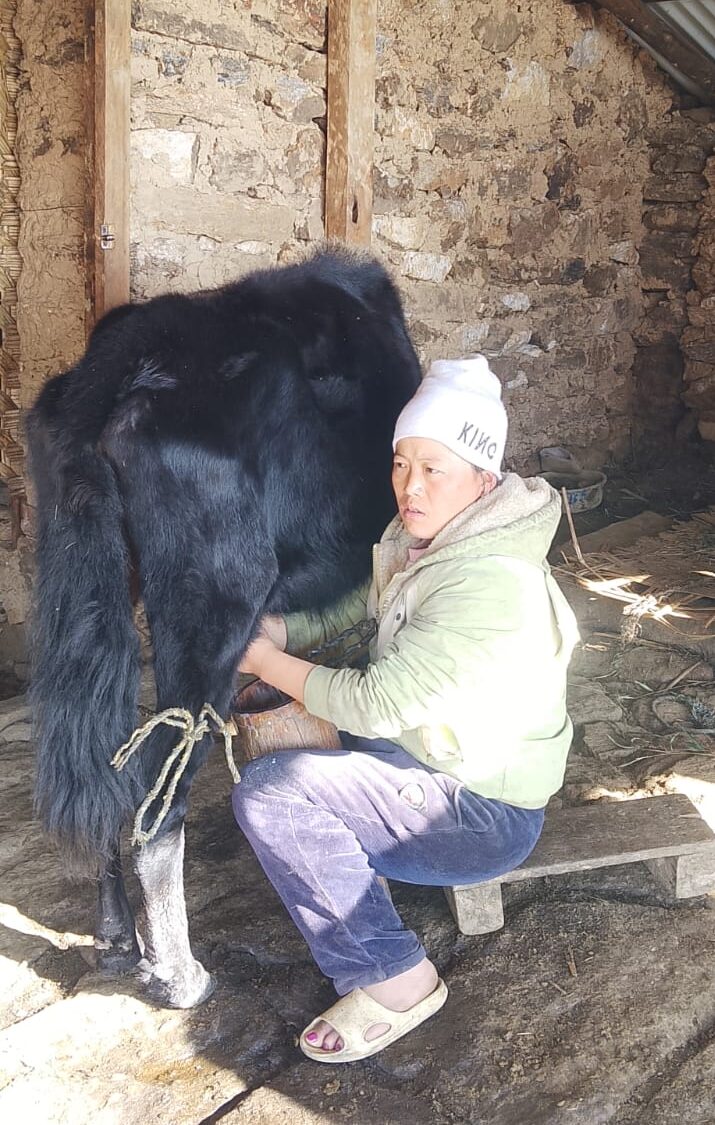
Pramila Rai milking a chauri
Until a decade and a half ago, all the chauri sheds here belonged to the Sherpas. Currently, the number of Sherpas rearing chauris is decreasing, while the number of Rais, Chhetris, and Tamangs is increasing. The largest chauri shed in Maiyung belongs to Bimal Rai of Phongla. He has 50 mother chauris in his shed.
Why are the Sherpas moving away from chauri rearing then? To this question, the new chauri rearers say, “They already made their earnings. They built houses in Kathmandu, Bhojpur, and Khandbari and moved there. Others realized the earnings to be made from chauris quite late.”
Numerous Problems
There are various problems and difficulties within chauri rearing. Almost all chauris give birth between February-March and May-June. They all become milch animals during the rainy season and dry up in the winter. Because chauris usually become accustomed to only one handler, if the person milking them falls ill or is unable to milk them for any reason, it goes to waste.
Chauris reared for milk are crossbreeds of Himalayan yaks and lowland (local) cows. Chauris, however, are bred by local bulls.
Last year, when Namchhong’s wife Pramila fell ill and had to go to Dharan for treatment, seven mother chauris were spoiled because others could not milk them. When the cold increases, the shed must be shifted downward. The shed must be shifted obligatorily to three locations within a year. Three locations means the shed has to be shifted five times during the round trips. Everything—from the fire tongs to tolongs (large wooden containers) larger than humans, bedding, and foodstuffs—has to be moved solely on the strength of one’s head/forehead (carrying with a strap).
Chauris reared for milk are crossbreeds of Himalayan yaks and lowland (local) cows. Chauris, however, are bred by local bulls. The offspring born from a chauri and a local bull is called a Pamu. Pamus face difficulty in conceiving and usually remain barren. Because breeding yaks are more aggressive, they are difficult to rear. Therefore, it is difficult to produce chauris. In the past, attempts were made to bring yaks from the high Himalayas and cross them with local cows to produce chauris right in Maiyung. However, since those attempts were not successful, new chauris are still brought from Solukhumbu to this day.
If the chauris fall ill, there is no treatment and no insurance. Herders do not have the luxury of falling ill. Festivals and entertainment are all confined to that same chauri and that same shed. For the past decade, the menace of leopards in the grazing areas has suddenly surged. Horses are also kept alongside the chauris. Leopards tend to target horses more than other animals. Chauri herders stated that last year alone, leopards killed 30 horses in the Maiyung area.
The offspring born from a chauri and a local bull is called a Pamu. Pamus face difficulty in conceiving and usually remain barren. Because breeding yaks are more aggressive, they are difficult to rear.
The behavior of community forests is not encouraging for chauri-rearing farmers; rather, there is a tendency to extract money. It is said that from Maiyung to Salpa, there are around two dozen community forests registered in Bhojpur, Khotang, and Solukhumbu. The chauris of one forest area easily wander into another forest area. Therefore, Govinda Bishta of Dingla, Bhojpur, explains that a single chauri shed has to pay money to up to five community forests. Thus, depending on the number of chauris, a single shed has to pay between 10,000 to 30,000 rupees in tax per season. Chauri herders mention that while taxes did not have to be paid in the past for cows, buffaloes, or the one or two sheep or goats reared alongside chauris, there are now talks of collecting head-count taxes on them as well.
When shifting the shed up to three places a year, such taxes have to be paid at various places. In winter, grass is not available everywhere. The animals are not milking either. The chauris wander far off in search of grass. If they happen to enter a forest where tax has not been paid or permission has not been obtained, a fine must be paid at a rate of 500 to 1,000 rupees per head. The only job of the community forests is to take money from the herders under various prepositions; they do nothing else.
Opportunity through shed-stays
The mountainous pastureland chain from Maiyung to Salpa falls within the main sector of the Mundum Trail. After the government published the list of 100 destinations to promote tourism across the country in 2018, tourist activity increased in the Maiyung area. Long-distance trekkers keep arriving. Around the time the rhododendrons bloom and near the New Year, the pastures become crowded. This has benefited the herders of that area.
Since the area is naturally beautiful, many people come to visit. Because it is highly remote and far from villages, visitors and trekkers faced problems regarding food and accommodation. With the concept and development of ‘Shed-stay Tourism’, traditional sheds began to be made tourist-friendly. This has benefited both the tourists and the herders. Tourists have received food and shelter. Currently, efforts have been made to make every shed in this region tourist-friendly. In these sheds, rooms have been built with warm bedding, spacious kitchens, and toilets. Durgadhan Rai, a chauri rearer and shed-stay operator from Dhungakharka, states that he can accommodate up to 300 people in his shed.
As the arrival of tourists at the sheds increased, chhurpi (hard cheese) and ghee do not have to be given to contractors at cheap rates. Contractors try to take chhurpi and ghee for 600 to 700 rupees per kilogram. Now, these products are sold directly from the sheds to visitors at nearly double that price.
Currently, efforts have been made to make every shed in this region tourist-friendly. In these sheds, rooms have been built with warm bedding, spacious kitchens, and toilets.
However, there is no support for chauri rearing from the state. Apart from minor, one-off assistance—such as some corrugated zinc sheets provided by a few organizations and local governments at times to change the roof of a shed, or a small mold to press chhurpi at other times—chauri-rearing farmers have received no real support.
Community shifting in a traditional and arduous occupation like chauri rearing can, to some extent, stem the tide of youth migration. However, because the groups and institutions established in the name of conservation fail to encourage the chauri-rearing farmers, obstacles to its commercialization continue to persist.