Kathmandu
Saturday, February 14, 2026





Koshi Assembly lags as lawmakers use Gen Z vandalism and arson as an excuse to avoid sessions
BIRATNAGAR: The Koshi Provincial Government Cabinet meeting on December 11 decided to grant conceptual approval for the creation of a separate health-related act. Health Minister Bhupendra Rai enthusiastically stated, “A separate act is essential to make health services effective in the province, and we will soon take it to the Provincial Assembly.”
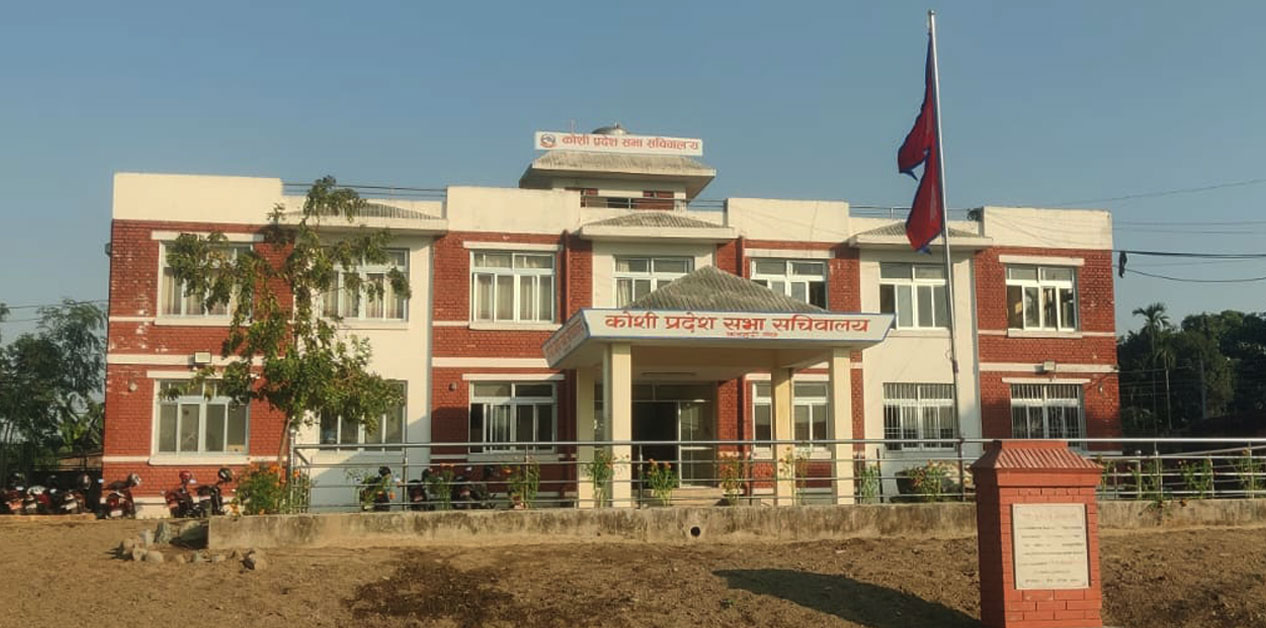
However, there is no immediate indication that Minister Rai’s enthusiasm or the government’s decision will be implemented. The reason is the Koshi Provincial Assembly has been shut down since it was set on fire during the Gen Z protest on September 9. Even after three months, reconstruction has not gained momentum, nor is there any sign of a parliamentary session resuming. Consequently, discussions on essential lawmaking and public interest issues have ceased.
This is the second term of the Koshi Provincial Assembly. In the first term, 64 bills were registered, and 62 were passed. In the second term, 34 bills were registered, with 27 passed, four becoming inactive, and two remaining under deliberation.
Meanwhile, Koshi province Chief Minister Hikmat Kumar Karki was busy running around Kathmandu, not for provincial work, but for the CPN (UML) General Convention yesterday. Not just the Chief Minister, but ministers leading important government ministries are also preoccupied with party work. Minister for Internal Affairs and Planning Rewati Raman Bhandari, Minister for Social Development Panchakarna Rai, Minister for Water Supply, Irrigation, and Energy Ekraj Karki, and State Minister Sirjana Rai are busy selecting representatives and calculating votes.
Political analyst Professor Krishna Pokharel warns that the government risks becoming arbitrary due to the inactivity of the Provincial Assembly and parliamentary committees. He says, “Parliamentary subject committees are ‘mini-parliaments’; when these become inactive, there is no one to hold the government accountable. That is exactly what is happening in Koshi Province now.”
On the other hand, Indra Angbo, the leader of the main opposition party, accuses the government of deliberately trying to avoid the parliament by not showing interest in reconstructing the damaged structure. “The current government’s actions confirm that this coalition, formed by two large and competitive parties, is inherently unholy,” Angbo says. “The Chief Minister has become so helpless, caught between the coalition partners, that the government’s presence appears weak and ineffective. The entire provincial government is currently wandering aimlessly, like a sheet of paper in the fog.”
Angbo warned that the opposition will not sit idly by, pointing out that the time to start the winter session has already passed without any government recognition.
Uncertain awaiting of session
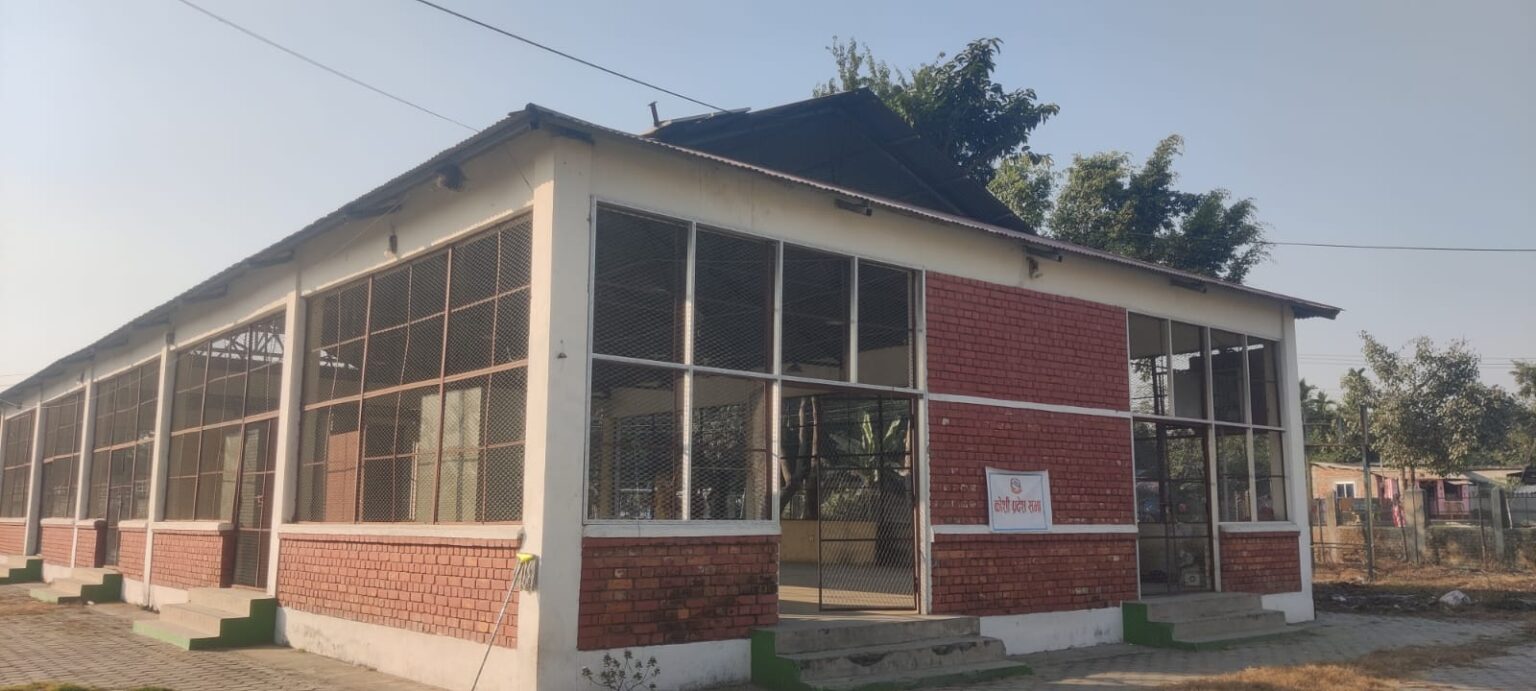
The Provincial Assembly Secretariat, damaged by arson, has been relocated from Biratnagar to the wholesale market in Katahari Rural Municipality-1, Morang. This building, constructed with Rs 137.6 million of federal government investment, was inaugurated by then-Prime Minister KP Sharma Oli in the fiscal year 2018/19. Since then, it had been abandoned for a long time. The Ministry of Physical Infrastructure Development has now requested Rs 54 million for the construction and repair of the assembly hall there. However, work has not started because the Ministry of Economic Affairs and Planning has not yet assured the funding source.
According to the details prepared by the Ministry, the largest budget allocations proposed are Rs 28.5 million for the repair of the committee halls and Rs 21.3 million for the construction of the main meeting hall.
Interestingly, the government and the Parliament Secretariat are waiting for ‘chairs’ to be provided through the Parliament Support Project (PSP) grant. Ambar Bahadur Bista, Speaker of the Koshi Provincial Assembly, suggests that a meeting will only be held after the chairs arrive, stating, “We are not in favor of buying the chairs; we are waiting for the PSP assistance. The chairs from them should arrive by December 30 to 31, and only after that is a session possible.”
Speaker Bista admits that the Assembly sessions have been postponed not only due to the lack of physical infrastructure but also because of the general conventions of the major parties. He says, “The CPN (UML) convention was yesterday, and the Nepali Congress is also preparing. A session cannot be held without their convenience; the next session now seems likely to be pushed to a month or two.”
In contrast, government spokesperson and Minister for Internal Affairs and Law, Rewati Raman Bhandari, claims the delay is not due to the general conventions. He says, “We were in favor of starting the winter session in this very month itself, but it was delayed due to the lack of a Provincial Assembly hall. Even though the hall construction process has started, it takes time to go through the technical stages like cabinet decisions, agreements with the municipality, design, DPR, and tendering. If it were due to the general convention, we could have postponed the session for four or five days and still run it. After the CPN (UML) general convention concludes and we return, we will make an immediate decision. If we wait for a properly organized hall, it looks like it will be March. Therefore, we are in the final discussion about whether to start the session by next month, even if it means sitting on plastic chairs and running it as a makeshift operation.”
‘Mini-parliaments’ also shut down
Since the Gen Z protest, the functioning of the subject committees, which act as ‘mini-parliaments,’ has also been halted. Most committee chairpersons argue that meetings have not been held because they lack a physical space.
Rajan Kirati, Chairperson of the Public Accounts Committee, constantly stresses the lack of resources and means. “The discussions in the meeting need to be recorded. The infrastructure for the meeting has not been built, and there is no immediate environment for a meeting,” he says.
Ramdev Yadav, Chairperson of the Tourism, Forest, and Environment Committee, states that the CPN (UML) general convention is the reason for the lack of meetings. “All the honorable members are in Kathmandu. A meeting will be held after they return from the general convention,” he says.
Among the seven subject committees of the Koshi Provincial Assembly, a few have shown partial activity. According to Binod Rai, Chairperson of the Finance Committee, the committee has met three times and decided to donate 30 percent of the members’ salaries for reconstruction.
Similarly, Kamala Darnal, Chairperson of the Justice, Administration, and Legislation Committee, says they held one virtual meeting and decided to ask the government for details of the damage. However, no result-oriented discussions requiring physical presence have taken place.
The 93-member Koshi Provincial Assembly has representation from six parties: the CPN (UML), the Nepali Congress, the CPN (Maoist Center), the CPN (Unified Socialist), the Rastriya Prajatantra Party, and the Janata Samajwadi Party.
Rs 79.9 million damage from fire
The arson and vandalism at the Koshi Provincial Assembly building during the Gen Z protest caused damage estimated at nearly Rs 80 million. According to Niraj Dhakal, Information Officer at the Provincial Assembly Secretariat, the total physical damage from the incident was some Rs 79.9 million.
In the fire at the assembly building and secretariat in Devkota Chowk, Biratnagar, nine secretariat vehicles and two security vehicles were completely gutted. Furthermore, furniture, electrical equipment, and important records were also burned and destroyed.