Kathmandu
Tuesday, February 24, 2026





As Lumbini Lions’ rise from last place to champions lit up the NPL, questions over CAN’s transparency and management lingered in the background
KATHMANDU: In cricket, the power of team belief often outweighs the results on the scoreboard. In the second edition of the Nepal Premier League (NPL), the Lumbini Lions utilized their unwavering confidence as their most effective weapon.
The Lumbini Lion’s victory, which saw them defeat the Sudurpashchim Royals by six wickets in the final to become champions, was the result of the strong leadership of captain Rohit Kumar Paudel, team unity, and persistent confidence.
Rohit’s statement after winning the title sums up this essence: “It takes belief to be a champion. We had the belief that we would stage a comeback.” Lumbini, which finished at the bottom of the table in the first edition of the NPL, delivered an incredible performance this time and secured the winning title.
Lumbini started with a spectacular six-wicket win over the Chitwan Rhinos but then suffered losses against the Karnali Yaks, Kathmandu Gorkhas, and Sudurpashchim. Following three consecutive losses, Lumbini supporters were already frustrated with captain Rohit Paudel. Furthermore, club owner Ishwar GC, disheartened, even posted a message on social media asking, “Is it not enough now!”
After the continuous poor performance, he was also accused on social media of playing a slow, defensive style. However, his mother, Paljesh Paudel, was completely confident in her son’s ability. To boost his morale, she traveled from Bardghat, Nawalparasi, to the capital and suddenly appeared on the field before the match against the Pokhara Avengers.
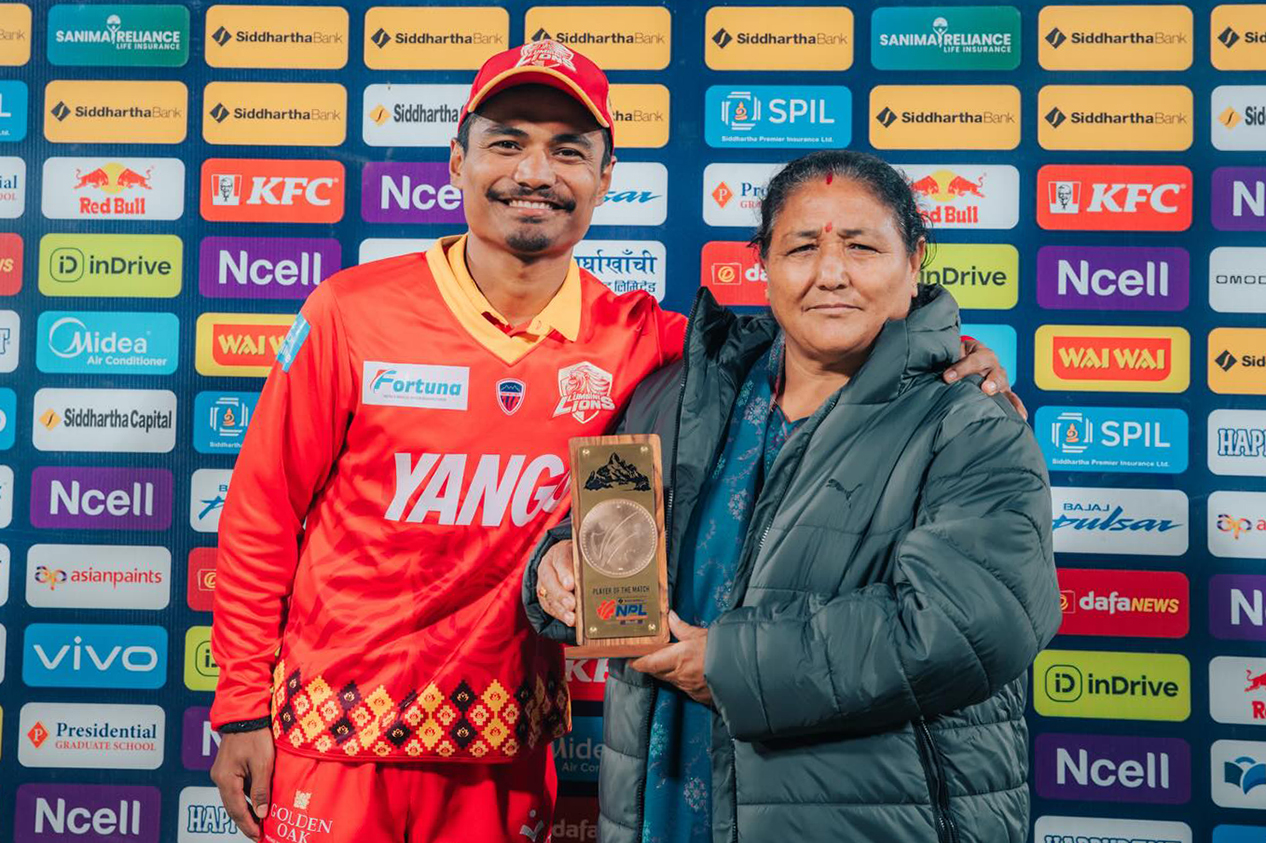
Rohit with his mother after winning the Man of the Match award. Photo: NPL
In a situation where they were almost eliminated from the tournament, Lumbini pulled off a three-wicket victory with two balls remaining. That match was the true ‘turning point’ in Lumbini’s title journey.
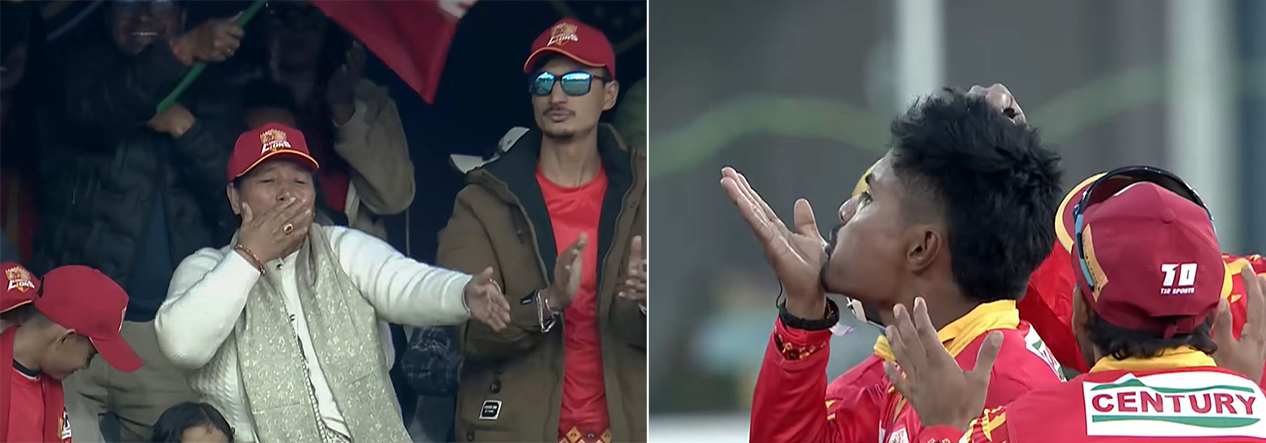
After this, Lumbini won five consecutive matches and established themselves as the winners. “This journey itself felt like a mysterious movie,” Rohit Paudel said. After winning the title, he did not forget to call his mother his ‘lucky charm.’ In the final, he took a hat-trick of wickets against Sudurpashchim. Following the wickets, he gave a ‘flying kiss’ to his mother from the field. In international sports, players often dedicate such ‘celebrations’ to their girlfriends, wives, or children. But the 23-year-old unmarried Rohit dedicated the greatest moment of his cricket career to his family.
“That was for my entire family. Mom, Dad, my sister, my brother-in-law, and everyone in the stadium who came to watch. I had wished to take my mom and dad in the car. That wish was fulfilled,” he said, looking emotional. Although his mother was the ‘lucky charm’ for Rohit Paudel in this year’s NPL, the performances of three players were decisive in winning the title for Lumbini.
The three game-changing players
In the title journey of the Lumbini Lions, three players stand out, whose presence laid the foundation for victory, with Captain Rohit Paudel at the center.
It’s not that Rohit performed poorly in the first edition. In seven innings, he scored 279 runs, including two half-centuries. Even then, he was the third-highest run-scorer overall and the top among Nepali players. However, he did not receive strong support from other players, which is why the team finished at the bottom, winning only one game.
This time, he was not alone. He was supported by former Australian opener D’Arcy Short and Sher Malla, who is waiting for his international cricket debut.
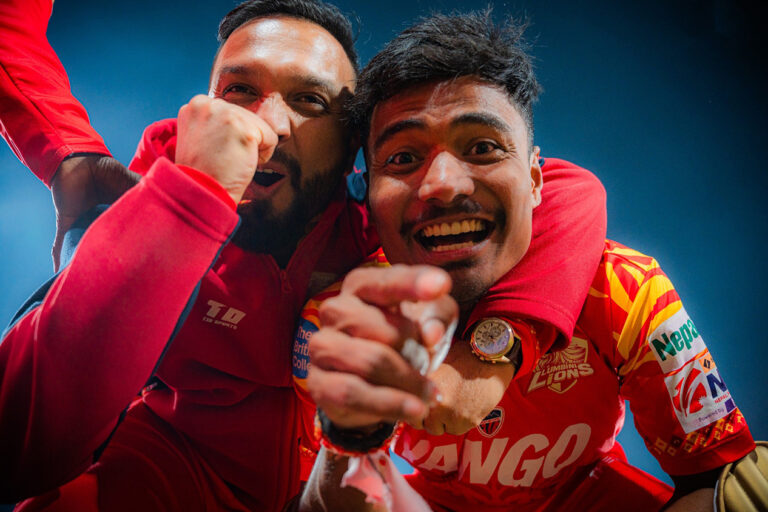
Rohit celebrates after winning the title. Photo: NPL
Rohit, who was effective with both bat and ball, delivered a captain’s performance. He scored 276 runs with the bat, placing him second on the list of highest run-scorers. In bowling, he took 10 wickets. Furthermore, in the final, he completed a hat-trick by taking the wickets of Sudurpaschim’s captain Dipendra Singh Airee, Deepak Bohara, and Puneet Mehra. He became the second bowler after Kathmandu Gorkhas spinner Sahab Alam to take a hat-trick in the tournament. Due to this consistency, he was also declared the ‘Player of the Tournament’ and was awarded a car. He also won a bike for the awards of Best Batter and Highest Run Scorer.
Short also played innings befitting his name for Lumbini. In a must-win match against the Janakpur Bolts, he scored 30 runs. In Qualifier-2 against the Biratnagar Kings, he played a 45-run inning, guiding the team to the final. Although he didn’t fire in the final, his overall performance throughout the tournament elevated Lumbini to a new height. Short scored 256 runs, including one half-century, which is the fourth highest individual score of the tournament.
Along with these two players, the 23-year-old bowler Sher Malla also played a decisive role. He is not an unfamiliar name in domestic cricket. He is the only player to have given influential performances while being part of the winning team in both editions of the NPL.
Last season, he was part of the Janakpur Bolts. At that time, in Qualifier-2, when Janakpur was struggling at 7-96 in 15.6 overs, he scored 16 runs off 10 balls, including one six. This was crucial in helping Janakpur win while chasing a target of 119 runs.
In this year’s auction, Lumbini bought him for Rs 1 million. He took 17 wickets throughout the tournament, including three in the final, and was declared the ‘Emerging Player of the Tournament.’ He was also awarded a bike.
Sudurpashchim’s misfortune
The Sudurpashchim Royals were the most unfortunate team this time. The first and second editions were not much different for them. Sudurpashchim, who lost only one match in the league stage in both editions, was defeated again after reaching the final this time.
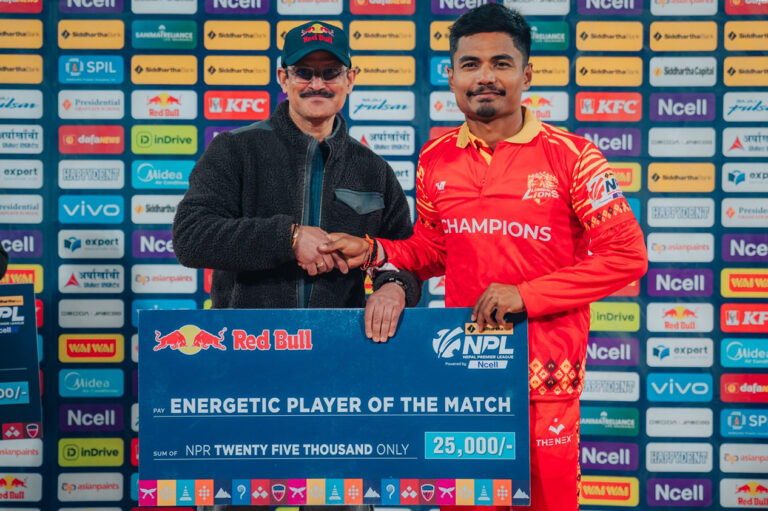
Rohit after winning the energetic Player of the Match. Photo: NPL
Sudurpashchim’s bowling, batting, and fielding were all excellent. Opener Binod Bhandari scored 264 runs in nine innings, including two half-centuries. Aarif Sheikh contributed 186, Dipendra Singh Airee 162, and Ishan Pandey 160 runs.
The team’s bowling was equally strong. Scott Kuggeleijn, who took the most wickets (17) in the first edition, could not shine as much this time, taking 10 wickets. However, the 30-year-old pacer Abinash Bohara found his rhythm. He took 17 wickets, the same as Biratnagar captain Sandeep Lamichhane and Lumbini’s Sher Malla.
Besides them, Harmit Singh delivered an all-round performance. He also scored 133 runs with the bat and took 12 wickets with the ball. Dipendra also contributed nine wickets. However, their collective failure in the final match gave Lumbini the opportunity to lift the trophy. Sudurpashchim, who scored above 100 runs in all their previous matches, was restricted to just 85 runs this time and lost to Lumbini by six wickets.
Coach Jagat Tamata did not hide his disappointment. “We had worked hard for a month with the goal of winning the title. Failing in the final made all the hard work go to waste,” he stated.
He concluded that the main reason for the defeat was their inability to achieve the expected score after winning the toss and opting to bat first.
Faf Du Plessis, the ‘entertainer’; Adam’s highest score wasted
This time, more than 52 foreign players from 14 countries participated in the NPL at the Tribhuvan University (TU) ground. These included famous cricketers like South African batter Faf du Plessis, England’s Martin Guptill and Ravi Bopara, and Australia’s Chris Lynn. However, except for Ravi, others failed to showcase their full potential. News reported that these players received salaries ranging from Rs 800,000 to Rs 5.7 million. But, except for Scottish batter Adam Rossington, his countryman Mark Watt, and England’s Ravi and Ben Charlesworth, others could not justify their high pay. Guptill, playing for Biratnagar, proved to be a ‘flop’ this season. Adam’s 323 runs for Pokhara Avengers went to waste as the team failed to qualify.
However, on a positive note, Pokhara, which won only two games in the first edition, won one more game this time. Pokhara finished in fifth place with three wins, while Karnali was sixth, Chitwan was seventh, and Janakpur, the winner of the first edition, finished last. Conversely, Lumbini, which finished last in the previous season, took Janakpur’s place as champions.
Unfortunately, Faf’s performance was disappointing. Brought in with the goal of winning the title for the first time, reportedly spending Rs 4 million, Faf proved to be merely an ‘entertainer.’ He played a 50-run inning against Sudurpashchim, helping Biratnagar reach Qualifier-1. However, in the two other must-win matches, he was restricted to 36 and three runs. Consequently, Biratnagar’s investment proved to be futile.
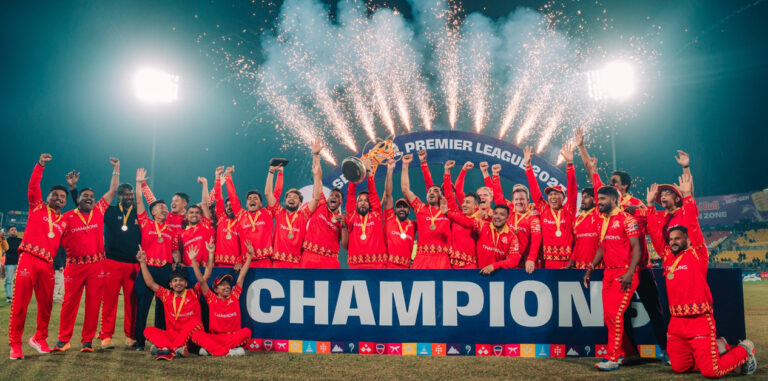
Lumbini Lions after winning the NPL Season 2 title. Photo: NPL
Transparency gaps and ticket chaos cloud CAN’s NPL management
The NPL succeeded in sending a positive message to the international cricket world. The participation of world-class players like Faf Du Plessis and Martin Guptill has established the perception that Nepal is a safe and competent country for cricket. It cannot be denied that this has further strengthened the international recognition of Nepali cricket. However, a tournament with such immense potential seems to have failed to reach its expected level of impact due to the internal management, lack of transparency, and controversies of the Cricket Association of Nepal (CAN).
The most serious problem with the NPL is the lack of transparency. Neither the franchise companies nor CAN have officially disclosed the amount for which foreign players were contracted.
In major global cricket leagues like the Indian Premier League (IPL), the Big Bash League, and The Hundred, player values, contract procedures, and financial details are publicly available. This practice is what makes those leagues credible. However, concealing the amounts paid even for bringing in famous players like Du Plessis in the NPL raises serious questions about CAN’s institutional transparency.
There is a noticeable lack of financial transparency within CAN. Even after a long time since the completion of the first NPL, its income and expenditure report has not been made public. The failure to audit the previous tournament even as the second edition has started signals CAN’s irresponsible management. A cricket association is an institution accountable to the government, sponsors, and spectators. World sports history has repeatedly proven that no league can survive long-term if financial accounts are not clear. In the context of Nepal, one only needs to look at the Football Association.
Ticket management also damaged the NPL’s image. Arbitrarily increasing the ticket price overnight from Rs 500 to Rs 2,000 without a clear policy was an injustice to the spectators. Incidents like the issue of ‘refunds’ after purchasing tickets and declaring ‘sold out’ even when empty seats were visible inside the ground certainly break the spectators’ trust. In modern sports management, digital ticketing systems, seat management, and real-time sales data have become essential. In the NPL, decisions were clearly made arbitrarily, leading to mismanagement.
Another serious issue linked to this is security and crowd management. It is certainly not a good sign to see empty seats inside the stadium while conflicts are occurring among spectators outside due to a lack of tickets. Even a small lapse in crowd management can lead to a major accident in an international-level tournament. CAN needs to be sensitive to this.
Ticket management also damaged the NPL’s image. Arbitrarily increasing the ticket price overnight from Rs 500 to Rs 2,000 without a clear policy was an injustice to the spectators.
Problems are clearly visible in CAN’s internal structure. With officials responsible for policy-making being directly involved in distributing tickets, collecting money, and managerial work, the ‘check and balance’ system appeared completely inactive. The foundation of institutional governance is having separate bodies for policy formulation and implementation. When the same person is both the decision-maker and the implementer, control becomes impossible.
Another sensitive issue linked to the NPL is the involvement of betting companies. This issue could become a headache for the International Cricket Council (ICC) as well. The franchise Sudurpashchim Royals openly promoted ‘Baji Sports,’ which is an online betting site. Although presented on the surface as a news website, betting networks like ‘Baji 88’ and ‘Baji Live’ are actively behind it. This is not a new incident. Last season, the Royals also used the surrogate logo of another betting platform called ‘Babu 88 Sports,’ another online betting platform.
The recent example of Jio breaking its long-term contract with the ICC midway due to the ban on betting in India is fresh in mind. Promoting gambling, directly or indirectly, in a country like Nepal is a risky step from both a social and sporting perspective. Given the strictness of the ICC’s anti-corruption standards, this could cause problems for Nepali cricket at the international level in the future.
In India, there is a history of Lalit Modi being removed due to the lack of transparency and centralization of power seen in the initial stages of the IPL. The CAN must learn from this. If the lack of transparency, financial ambiguity, and managerial disorder persist, investors will feel cheated. Ultimately, the league’s very existence may be jeopardized.
The NPL is a huge opportunity for Nepal’s cricket economy. However, that opportunity is not secured just by bringing in big players. What CAN now needs to demonstrate is management maturity, transparency, and institutional accountability. If CAN does not move towards reform in time, the NPL is at risk of being pushed from opportunity towards crisis.