Kathmandu
Tuesday, February 24, 2026





When will Nepali cricket rise above T20 on its journey to becoming a Test nation?
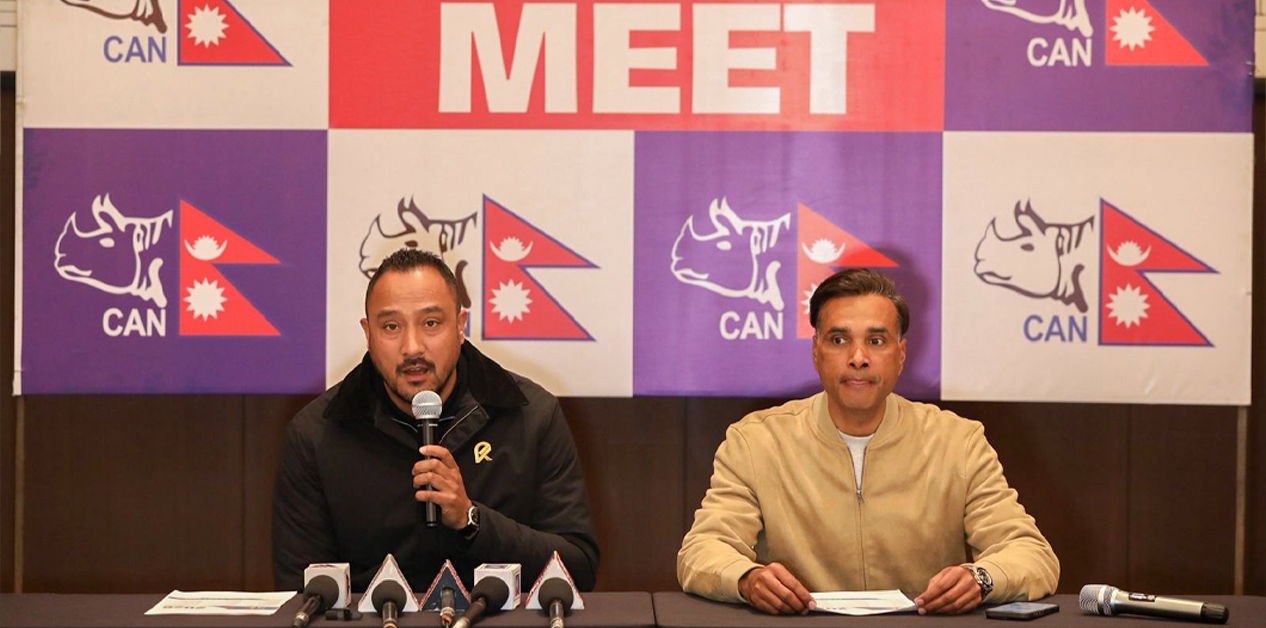
When Chatur Bahadur Chand was elected president of the Cricket Association of Nepal (CAN) on September 28, 2019, he declared his goal of earning Test status for Nepal within his own tenure. At the start of his first term, he said, “While maintaining ODI status, preparations have already begun to transform Nepal from an emerging nation into a Test nation. My goal is to achieve this within my tenure.”
This is his second term as CAN president. According to CAN’s statute, a president can serve only two terms. By that count, he has just about one and a half years left before leaving office. In this remaining period, achieving Test status has clearly become a distant dream; in fact, CAN has not even been able to prepare a proper cricket calendar during his tenure. More worryingly, Nepal is now at serious risk of losing its ODI status valid until 2027.
In this context, CAN released its annual calendar last Saturday. Unfortunately, the calendar does not even remotely prioritize multi-day cricket, let alone present a plan to institutionalize the achievements Nepali cricket has earned in the past.
The calendar does not include any five-day competition—the backbone of Test cricket. Even the Jay Trophy has been squeezed into just 10 days. The newly announced long-format women’s tournaments remain uncertain, with no clarity on whether they will actually be held.
Same old rhetoric
The CAN president’s statements have grown stale. Cricket fans have largely stopped taking them seriously. Yet, newly appointed secretary Paras Khadka has once again revived the same old Test-nation rhetoric this year. During an ICC meeting held in Singapore, he even encouraged CAN President Chand by claiming that Nepal was ready to become a Test nation.
However, after the calendar was made public, disappointment is widespread. Secretary Khadka’s background is certainly stronger than that of President Chand in terms of cricketing knowledge and experience. A former long-serving national captain who has now entered administration, Khadka has been sharing dreams of seeing Nepali players—currently playing League 2, the pathway to the ODI World Cup—play Test cricket during his tenure.
At the ICC Annual General Meeting held in Singapore on July 17–20, he showcased what he described as preparatory work toward Test status. But without even including five-day cricket in the calendar, he is bound to become a subject of ridicule in the international community.
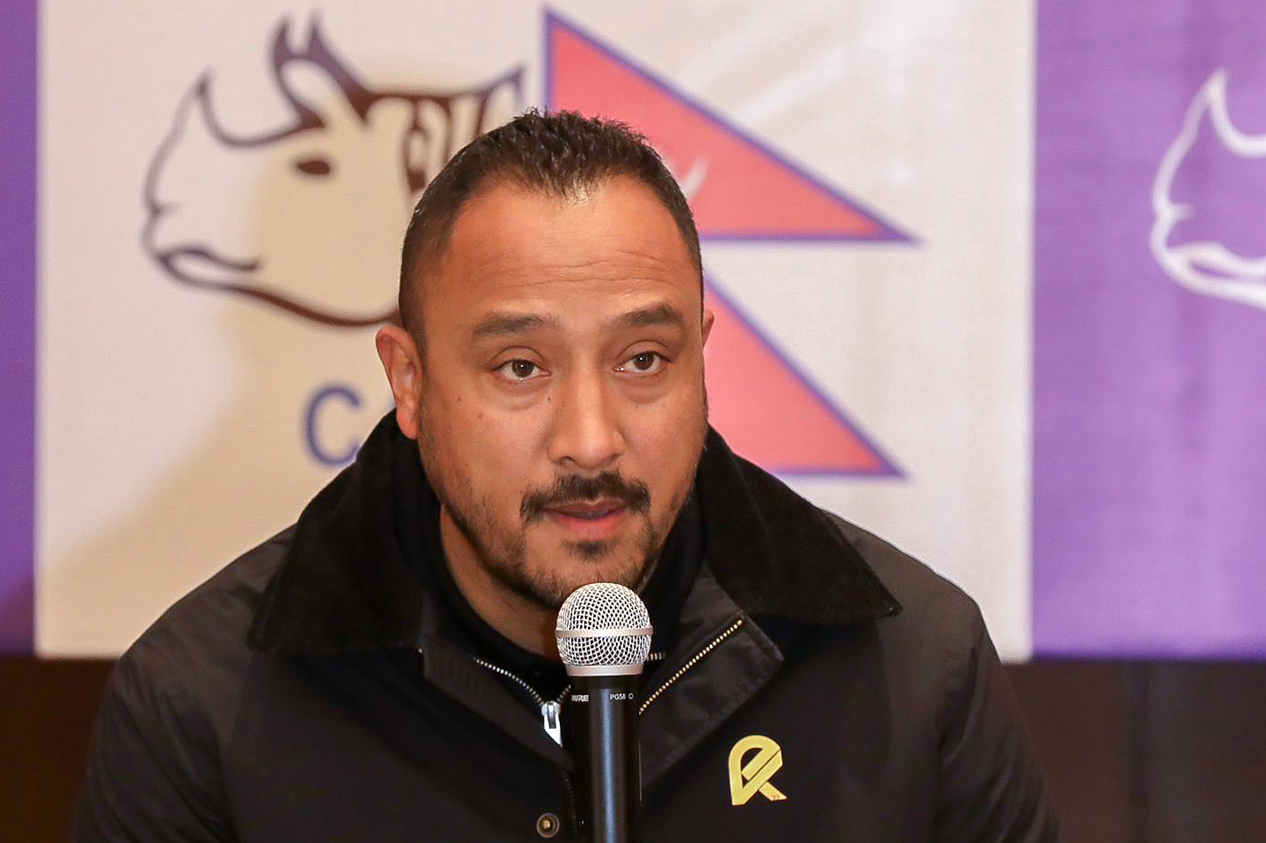
CAN Secretary Paras Khadka. Photo: Eliot Joshi
Former cricketer Rajkumar Pradhan says, “To play Test cricket, the most essential requirement is a strong ‘red-ball culture.’ That means developing the mindset and habit of wearing white clothes and surviving at the crease for five days.”
For this, batters must mentally prepare to face not 30 balls, but 300. Bowlers must be capable of bowling 15–20 overs in a spell with consistent line and length, not just two overs. Fielders, too, must maintain the same level of energy and concentration for five days. All of this can only be developed through long-term practice, training, and domestic competitions.
This raises a very relevant question: Is a red-ball culture developing in Nepali cricket?
Looking at CAN’s recently released annual calendar, the answer is clear—no.
The calendar is full of cricketing activities, but most are focused on short formats. Even the Jay Trophy, the red-ball tournament introduced last year, has been limited to just 10 days. Only the top four teams from the Prime Minister Cup one-day tournament—Nepal Police Club, Tribhuvan Army Club, APF Club, and Bagmati Province—will participate. According to CAN, league matches will be two-day games, while the final will be three days long.
The skills required for long-format cricket are not innate. Nor can they be developed through net sessions or short tournaments. These qualities are forged through repeated failure, surviving under pressure, struggling on difficult pitches, and making decisions in tough situations. Indian batters are refined through hundreds of hours of batting, bowling, and fielding in the Ranji Trophy. Australian bowlers mature by bowling long spells in the Sheffield Shield. Even Bangladesh strengthened its foundation gradually by consistently running its National Cricket League despite poor international performances.
To remain competitive internationally, India organizes domestic tournaments like the Ranji Trophy, Duleep Trophy, Vijay Hazare Trophy, and Syed Mushtaq Ali Trophy—and mandates national players to participate. Players who fail to do so risk exclusion from national selection, central contracts, match fees, or face disciplinary action.
“Playing multi-day cricket makes T20 and one-day cricket easier,” says former leg-spinner Pradhan. “Long games improve physical endurance, mental focus, patience, and tactical understanding. As a result, players can better handle the pressure and intensity of shorter formats.”
Most competitions included in CAN’s calendar are not new; they are largely the same old tournaments—Prime Minister Cup, Nepal Premier League (NPL), school, U-16 and U-19 competitions, district and provincial selections. The only difference is that tournaments named after political leaders are absent this time.
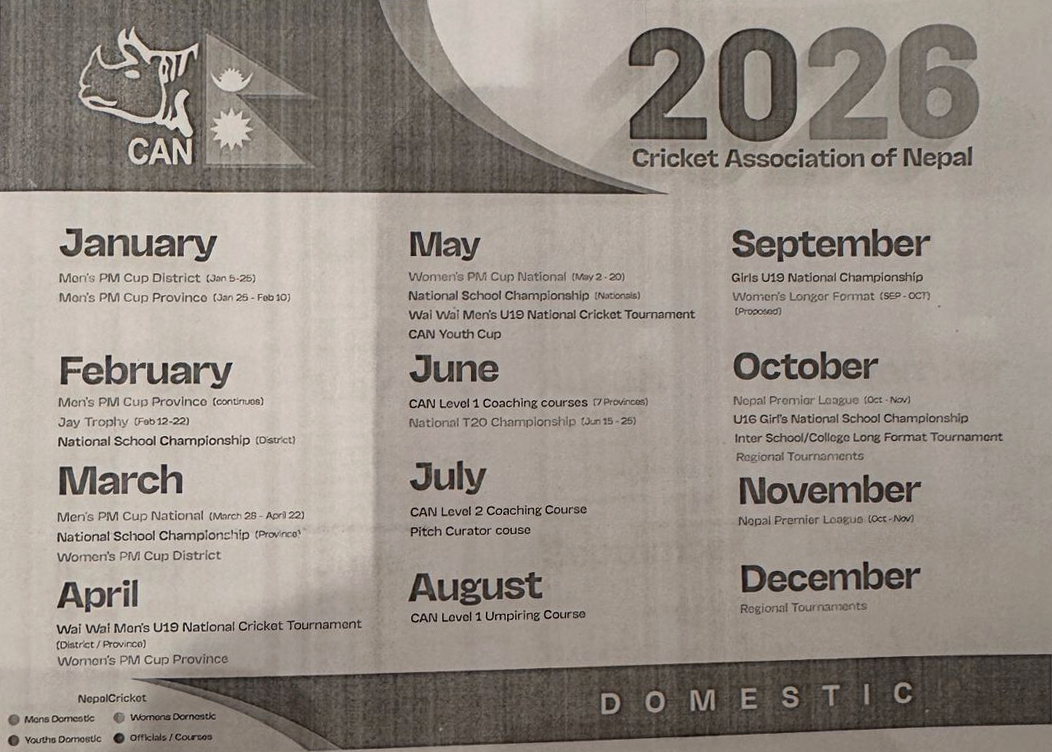
Nepal National Cricket Team’s 2026 Match Calendar
Ideally, CAN should collaborate with districts and provinces to keep domestic cricket busy. Instead, it continues to prioritize competitions involving the same 25–30 national players. Nearly a dozen of these tournaments are in the T20 format. CAN justifies this by citing the busy schedules of senior players due to international commitments. “Our calendar is very busy. National players cannot manage to play all domestic tournaments,” says Chand.
Why are domestic leagues and long formats important?
Occasionally, two-day domestic tournaments have been held in Nepal. In December 2019, the Himalayan Cricket Academy organized a U-19 two-day tournament. Earlier, in 2004, Nepal played a three-day match against the UAE in the ICC Intercontinental Cup—a first-class competition.
After CAN was suspended in 2016, its tournaments came to a halt. Private-sector investments then led to T20 franchise leagues like Everest Premier League, Dhangadhi Premier League, Pokhara Premier League, and Koshi Premier League. Initially, organizers invested heavily, and gradually crowds and sponsors poured in. This triggered a flood of T20 leagues.
Because these tournaments attracted sponsors and audiences easily, organizers also made financial gains. As a result, the private sector showed little interest in long formats. To capitalize on this popularity, CAN itself launched the Nepal Premier League (NPL). Since then, CAN has not granted national recognition to any privately organized leagues. Consequently, short-format tournaments have reduced somewhat.
However, such leagues have played a significant role in creating a cricketing atmosphere within the country and professionalizing the sport. In its very first edition, the Nepal Premier League (NPL) reportedly generated more than Rs 270 million in revenue, claiming a profit of around Rs 25 million. For the current edition, it has set a revenue target of Rs 400 million.
Yet, according to former women’s national team coach Manoj Katwal, the real need now is tournaments in the 50-over format and beyond. “Our players have technical problems. They get out playing reckless shots. Even in the U-19 Asia Cup, we couldn’t play a single match for the full 50 overs. And we are talking about becoming a Test nation. That means we must play as much long-format cricket as possible,” he says.
It has been nearly seven and a half years since Nepal received ODI status. The team has played more than 80 matches. However, Nepal’s performance has been impressive mostly against associate nations; against Test-playing countries such as India, Pakistan, Zimbabwe, and Ireland, batting weaknesses become clearly visible. Long-format competitions are essential to address these issues. “We should make players play longer formats as much as possible. If two- or three-day tournaments were held, players would get far more match exposure,” Katwal adds.
After Nepal managed to retain its ODI status recently, the cricketing environment has heated up again. More than a dozen cricket academies have opened across districts and provinces. Secretary Paras Khadka himself runs a Cricket Excellence Center, while CAN central committee members such as Sudip Sharma have also invested in academies. As a result, aspiring cricketers no longer need to travel long distances to Kathmandu to chase their dreams. This has led to a noticeable increase in player production in recent years.
These players are selected through tournaments organized by provincial and district cricket associations under CAN’s central committee and are expected to serve as “backups” for the national team. However, the backup pool for a strong national team has yet to become strong itself. The recently concluded NPL results clearly reflect this reality.
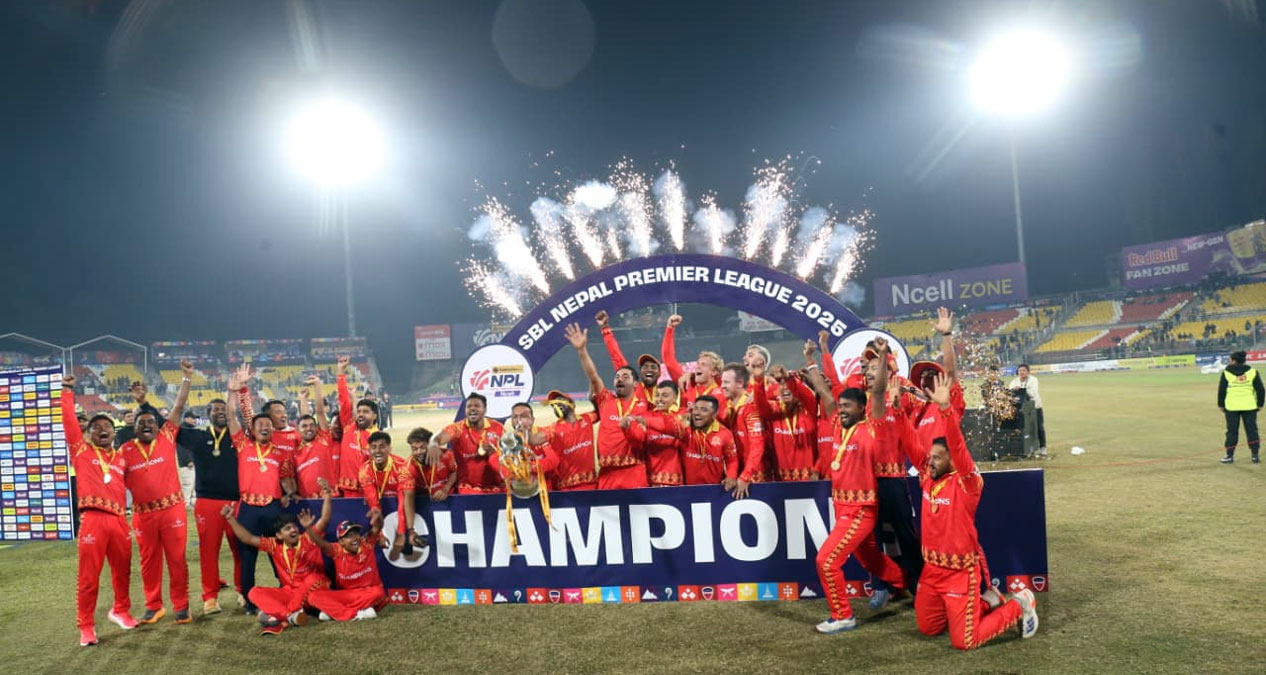
Lumbini Lions, the champions of the second edition of the NPL.
Except for spinner Sher Malla, performances from other emerging players were largely disappointing. National team players dominated the tournament throughout. Captain Rohit Kumar Paudel was named the Player of the Tournament and won a car. He also claimed the highest run-scorer award with 274 runs, earning a motorcycle. Leg-spinner Sandeep Lamichhane, who guided Biratnagar Kings to Qualifier 2, took the most wickets (17) and also won a motorcycle.
Binod Bhandari, who scored 264 runs and featured among the top run-getters, has recently been out of the national team. Along with Sandeep, Avinash Bohara (17 wickets) and Shahab Alam (13 wickets) are players who move in and out of the national squad. Apart from these, while some national players delivered average performances, young players failed to carve a clear pathway into the national team.
Raju Basnyat, coach of the Karnali Yaks, believes the lack of sufficient competitions has prevented capable players from emerging to challenge national team regulars. “Competitions are happening to some extent, but they’re not enough. Even now, players have to rely solely on CAN. If there were more tournaments, players would come to higher levels more mature and competitive,” he said during the NPL.
CAN widening the gap
By designing a calendar that keeps national team players busy while limiting domestic players to only a few tournaments, CAN risks widening the performance gap even further. When senior players skip domestic competitions, opportunities for new players shrink. This inevitably reduces the importance of domestic cricket and limits learning opportunities for emerging players.
As a result, maintaining transparency in national team selection becomes increasingly difficult. After playing the 2014 T20 World Cup in Bangladesh, Nepal struggled for a long time on the international stage. It took nearly a decade to return to that platform. Under Paras Khadka’s captaincy, Nepal played three World Cup qualifiers, and once under Sandeep Lamichhane. However, those successes could not be repeated.
In 2023, during another qualifier held at home, Nepal found a new captain—Rohit Kumar Paudel. Under the leadership of the youngest captain, Nepal not only avenged its previous defeat against the UAE but secured an emphatic eight-wicket victory to return to the World Cup after a decade. Once again, under his captaincy, Nepal has opened the door to consecutive World Cup appearances.

President Ram Chandra Poudel and Nepal cricket team captain Rohit Poudel, with CAN President Chatur Bahadur Chand standing beside them during the T20 World Cup trophy tour.
Alongside this progress, Nepal has begun hosting Test nations such as Ireland, Zimbabwe, and the West Indies for international matches. If CAN President Chand’s claims are to be believed, teams like Afghanistan and Bangladesh—encouraged by Nepal’s recent success—have also shown interest in playing bilateral series. Former national team player Shakti Gauchan argues that to continue playing such teams and further strengthen the squad, Nepal must build a strong domestic cricket structure starting from the school level.
“Nepal’s goal is Test status. That means the culture must be developed from school level itself. Unfortunately, players aiming for the national team are largely unfamiliar with long-format cricket. T20 is difficult and often heavily dependent on batting. But such competition does not benefit the game in the long run,” he says.
CAN on the wrong path
Cricket is no longer just a sport or a form of entertainment; it has increasingly become a part of national identity. From the perspective of popularity, commercial potential, and spectator engagement, CAN appears to be moving in the right direction. Investments in T20Is and ODI tournaments, the launch of a commercial league like the NPL, and regular limited-overs competitions such as the Prime Minister Cup have connected Nepali cricket with the public. Crowds have increased at the Tribhuvan University Cricket Ground in Kirtipur. Sponsors are interested, and cricket is increasingly being seen as a viable career option. For a country struggling toward economic self-reliance, this transition is both important and necessary.
However, there is another side to this positive picture—one tied to long-term goals. Nepal’s ambition is to become the number one associate nation and eventually a Test-playing country. But the current calendar does not align with that objective. Instead, CAN appears more focused on achieving financial stability. This is why it has scheduled around half a dozen bilateral series each for both men’s and women’s teams.
Secretary Khadka considers this a strong source of revenue. “Bilateral series are the backbone of our income. Our target is to play 12 to 15 matches between June and July. The revenue from those matches is sufficient to keep us running,” he says.
According to him, the ICC currently allocates Nepal a budget under four headings: annual membership grants, cricket development programs, tournament organization, and others. However, the funds must be spent strictly under the categories they are allocated for. CAN has been using most of this budget for national team preparation, which has increased dissatisfaction at the district and provincial levels—a reality he himself acknowledges.
On top of that, domestic cricket is expensive. Khadka claims that organizing last year’s Prime Minister Cup ODI tournament cost between Rs 100–120 million. Therefore, CAN has left the responsibility of organizing domestic tournaments open to districts and provinces as well.
In this sense, CAN currently stands at a crossroads. One path leads toward quick results, popularity, and financial stability through short-format success. The other shifts the responsibility of developing players capable of sustaining that path onto districts and provinces—allowing CAN to step back from its core responsibility. How successful this approach will be remains to be seen.