Kathmandu
Tuesday, January 20, 2026





With a market share of just 11 percent, how will the NAC repay Rs 52 billion in debt?
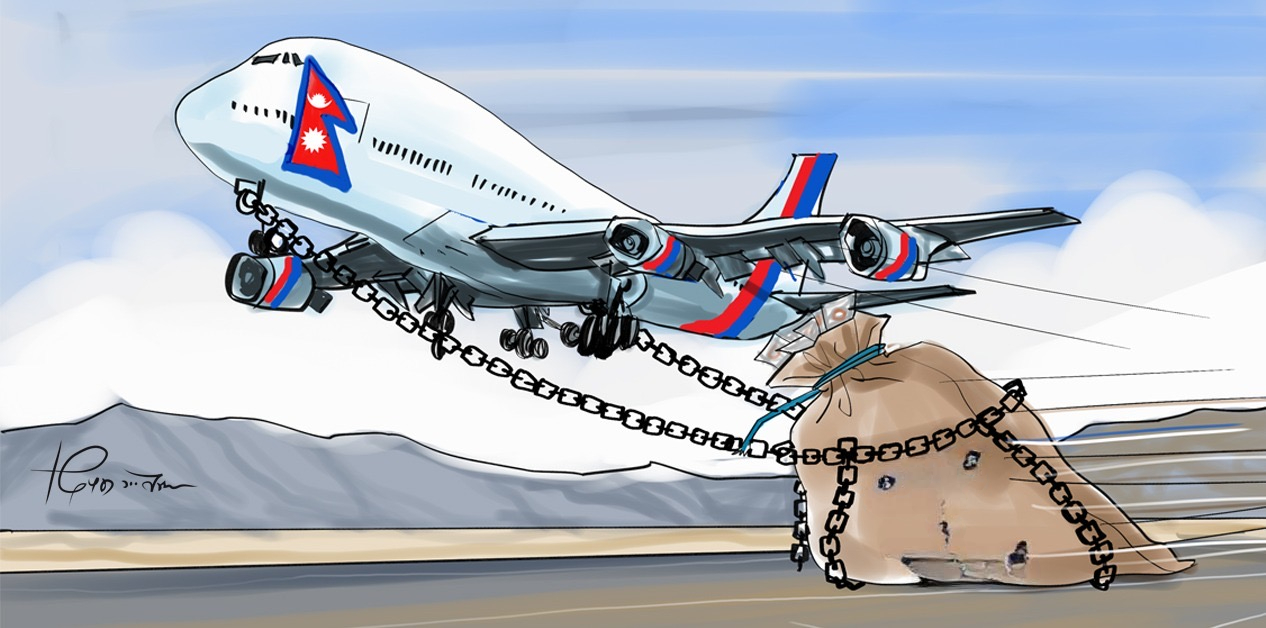
KATHMANDU: No market, no sufficient aircraft, no credibility. Crushed under a growing debt burden for over a decade. This is the current condition of the national flag-carrier Nepal Airlines Corporation (NAC).
Plagued by managerial and financial weaknesses, the NAC has become a symbol of state mismanagement and failure of good governance. Once flying to the skies of London, Paris, and Frankfurt, the corporation today is struggling merely to survive in its own airspace. Considered one of South Asia’s leading government airlines three decades ago, Nepal Airlines has been steadily deteriorating due to political interference, a debt of Rs 52 billion, and managerial incompetence.
In 2024, as many as 26 foreign airlines operating international flights from Nepal earned Rs 153 billion. In the same skies, Nepal Airlines’ market share was limited to just 11 percent. This fact alone signals the deepening crisis of the national flag carrier.
At present, the corporation is being run under interim leadership. Following the Gen Z movement, the newly formed government assigned Vice-Chairman of the Board Bikram Rai as chairman and Board Member Amrit Man Shrestha as executive director to handle day-to-day operations.
The government has initiated a process to appoint the 45th Managing Director of Nepal Airlines through open competition. On 31 October 2025, Prime Minister Sushila Karki, who also held the portfolio of the Ministry of Culture, Tourism, and Civil Aviation at the time, formed a committee under the leadership of Tourism Secretary Hari Prasad Mainali to recommend a Managing Director through open competition. After issuing a 15-day notice on 13 November, 16 candidates applied, out of which 10 were shortlisted.
Currently, Anil Kumar Sinha holds the responsibility of the Ministry of Culture, Tourism, and Civil Aviation. However, he has kept the Managing Director selection process on hold and is running the corporation through interim leadership.
Then glory, now decline
Established in 1957 (2014 BS), Nepal Airlines had, by the 1980s (2040s BS), expanded its operations to European destinations such as London, Frankfurt, and Paris. The corporation operated Boeing 727 and Boeing 757 aircraft, which were considered state-of-the-art at the time. Compared to airlines from other South Asian countries, Nepal Airlines was regarded as one of the most reliable and capable government airlines.
The corporation was Nepal’s first national air link to the world. Bearing the national emblem of the sun and moon, it served destinations such as Delhi, Kolkata, Dhaka, Bangkok, Hong Kong, Dubai, and onward to London, Frankfurt, and Paris.
By the 1990s (2050s BS), the corporation had four Boeing aircraft, three Avro aircraft, 11 Twin Otters, and one Pilatus Porter. It provided domestic services to 39 destinations and international services to 13 destinations in nine countries.
Toward the end of the 1990s, the corporation sold its Boeing 727 and began operating international flights using leased aircraft. From that point onward, its presence in international destinations gradually weakened. Once operating up to 14 Twin Otter aircraft domestically, the corporation is now limited to operating only two Twin Otters in remote regions.

Nepal Airlines Corporation. Photo: Bikram Rai/Nepal News
Four Chinese aircraft brought in to compete in domestic services have been grounded at Tribhuvan International Airport for over five and a half years. Citing excessively high operating costs, the corporation halted flights of these Chinese aircraft from 30 July 2020.
Due to aircraft shortages, the corporation began losing business and sinking deeper under mounting debt. In 2018 (2075 BS), Nepal Airlines purchased two wide-body aircraft from Airbus, having earlier acquired two narrow-body Airbus aircraft. To purchase the narrow-body aircraft in 2013 (2070 BS), the corporation borrowed Rs 10.49 billion, and in 2017 (2074 BS), it borrowed Rs 24 billion to purchase the wide-body aircraft.
These loans were invested by the Citizen Investment Trust and Employees Provident Fund under government guarantees. Including principal and interest, the corporation’s accumulated debt has now reached Rs 52.46 billion. In its 68th year of existence, Nepal Airlines is on a risky journey.
Political interference in management, employee infighting, and managerial weaknesses have continuously dragged the corporation down. After 2006 (2063 BS), “Royal Nepal Airlines” was renamed “Nepal Airlines” in an attempt to improve its international image, but the structure and culture remained unchanged.
Despite a growing number of tourists, the airline lacked sufficient aircraft. Profitable routes were gradually captured by foreign airlines, while Nepal Airlines remained stuck with limited routes. As a result, it lost market share and its financial crisis deepened further.
Including principal and interest, the corporation’s accumulated debt has now reached Rs 52.46 billion. In its 68th year of existence, Nepal Airlines is on a risky journey.
A report submitted on 5 September 2025 by the High-Level Study and Recommendation Committee for Reform of the Civil Aviation Sector, formed under the coordination of former justice Anil Kumar Sinha, stated that the corporation’s financial condition is alarming. The report noted that loans invested in Nepal Airlines by government-owned funds are at risk, and the absence of accountability for such investments is unacceptable from a governance perspective. Notably, Sinha himself is now the Minister for Culture, Tourism, and Civil Aviation.
Even if the corporation earns an annual profit of Rs 5 billion, it would not be able to repay the Rs 52 billion debt even in 10 years. Given the large size of the loan, interest obligations are also substantial, making it extremely difficult for the corporation to become debt-free.
According to the corporation’s data, in the last fiscal year it earned Rs 12 billion from wide-body aircraft and Rs 6 billion from narrow-body aircraft, totaling Rs 18 billion. Additionally, it earns about Rs 4 billion annually from ground handling services at Tribhuvan International Airport. However, due to excessively high expenses compared to revenue, the corporation continues to incur losses and is not in a position to repay loans from its earnings. Under such financial pressure, the corporation supports 1,471 employees.
Weak presence in international skies
According to data from the Civil Aviation Authority of Nepal, the 26 foreign airlines operating international flights from Nepal earned Rs 153.82 billion in 2024 alone. Nepal Airlines, however, earned only Rs 18 billion from international flights that year. Compared to foreign airlines’ earnings, Nepal Airlines’ share stands at just 11 percent.
In 2024, Nepal received 1,147,548 tourists. However, the corporation, operating flights to 12 destinations in nine countries, did not even carry as many passengers as the total number of tourists who arrived that year. Nepal Airlines carried only 559,812 passengers on international flights that year. In contrast, 28 airlines operating international services from Nepal carried a total of 4,928,925 passengers.
Foreign airlines are earning substantial revenue by carrying Nepali migrant workers traveling abroad and returning home. Qatar Airways tops the list of airlines earning the most from international services out of Nepal. Qatar Airways has received approval to operate 28 flights per week on the Doha–Kathmandu–Doha route, operating four daily flights. Nepal Airlines, however, operates only six flights per week on the same route. In the Nepali month of Mangsir (mid-November to mid-December 2025), Qatar Airways carried 48,483 passengers on this route, while Nepal Airlines carried only 9,489 passengers.
Another major destination for Nepali migrant workers is the United Arab Emirates (UAE). Flydubai, operated by Dubai Aviation Corporation, flies daily between Dubai and Kathmandu. Nepal Airlines operates only six flights per week on the same route. According to the corporation’s own data, in Mangsir, Flydubai carried 32,056 passengers, while Nepal Airlines carried only 6,593 passengers.
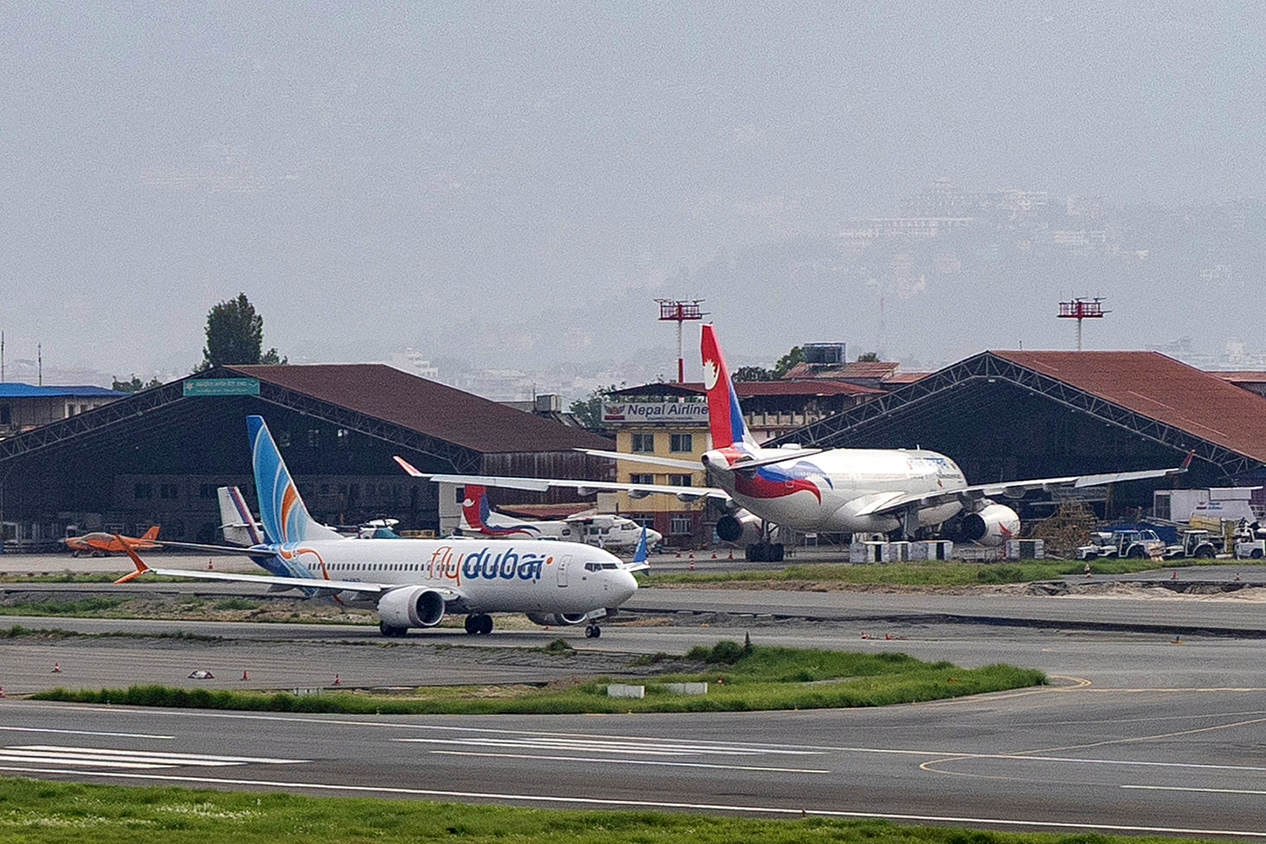
A Flydubai aircraft at Tribhuvan International Airport. Photo: Bikram Rai
Malaysia is also among the major destinations for Nepali workers. Nepal Airlines operates only one flight per week on the Kathmandu–Malaysia–Kathmandu route, whereas Malaysia Airlines operates 10 flights per week. In the month of Mangsir, Nepal Airlines carried 4,022 passengers on this route, while Malaysia Airlines carried 13,666 passengers.
Nepal Airlines operates three flights per week to Hong Kong. However, none of these flights are fully booked. During the entire month of Mangsir, across 24 round-trip flights on the Kathmandu–Hong Kong–Kathmandu route, the corporation carried only 1,148 passengers. Using narrow-body aircraft with a seating capacity of 158, it should have carried 3,792 passengers on those 24 flights. This data shows that more than half the seats remained empty on both outbound and return flights in the month of Mangsir. If wide-body aircraft were used on this route, the number of empty seats would be even higher, as the wide-body aircraft have a seating capacity of 274.
The operating cost per flight of a wide-body aircraft (A330–200) ranges from USD 43,000 to USD 70,000, depending on distance, while the cost for a narrow-body aircraft (A320–200) ranges from USD 9,000 to USD 18,000 per flight. These costs include fuel, aircraft maintenance, crew salaries, airport charges, and other unforeseen expenses. When aircraft fly with empty seats, there are situations where even the flight operating costs cannot be recovered.
A report submitted by a committee formed in 2080 BS (2023/24) under the coordination of former Vice-Chairman of the National Planning Commission and former Governor Deependra Bahadur Kshetry, tasked with studying and recommending structural and managerial reforms for Nepal Airlines Corporation, states: “Seat capacity utilization stands at 66 percent for narrow-body aircraft and 65 percent for wide-body aircraft. The corporation needs to realistically analyze sectors (air routes) and find ways to increase seat utilization.”
Even by carrying only Nepali citizens traveling abroad for foreign employment, the corporation appears to have sufficient business potential. However, the corporation does not operate flights on routes that have an abundance of passengers.
Data show that destinations currently served by the corporation—such as Kathmandu–Doha, Dubai, Dammam, Kuala Lumpur, and Abu Dhabi—have ample passenger demand. Yet, while aircraft of other airlines are packed with passengers, Nepal Airlines aircraft struggle to attract passengers. On the Hong Kong route, the load factor is only around 40 percent. When questioned as to why empty aircraft continue to operate on routes with little demand, corporation officials are reluctant to respond openly.
On condition of anonymity, a senior official of the corporation told Nepal News,
“We are compelled to maintain these flights due to political pressure. On the other hand, the General Sales Agents (GSAs) appointed there also use political and other forms of influence to prevent the discontinuation of flights.”

Chinese aircraft purchased by Nepal Airlines Corporation are seen warming in the sun near the Buddha Air hangar at Tribhuvan International Airport, from left: two Y-12s (small) and two MA-60s (large). Photo: Bikram Rai/Nepal News
GSAs handle ticket management and marketing for the corporation at respective destinations and receive a fixed percentage commission based on ticket sales. As a result, they do not want routes to be discontinued. GSAs are appointed in various destinations through collusion between political actors and senior officials of Nepal Airlines.
Former managing director of the NAC, Sugat Ratna Kansakar, says that due to inefficient management, the corporation is losing profitable routes and the benefits that could be derived from them. He states, “When we purchased aircraft, the plan was to operate the national flag carrier as far as London and New York, and to schedule three daily flights on the Kathmandu–Delhi route. We had planned to gradually add more aircraft. But now, it doesn’t even appear that the existing four aircraft are being managed effectively.”
He estimates that 90 percent of the responsibility for the corporation’s lack of progress lies with the Government of Nepal.
So far, Nepal has signed international air service agreements with 42 countries. Nepal first signed such an agreement with India in 1964. Under the agreement, Nepal is permitted to operate flights to 11 Indian cities, but currently flights operate to only three cities, and even those are not regular throughout the week.
From India, Air India, IndiGo Aviation, and SpiceJet operate regular flights to Nepal. In the month of Mangsir alone, these three airlines served 40,407 passengers on Nepal–India routes. During the same period, Nepal Airlines carried 16,029 passengers on its Delhi, Bengaluru, and Mumbai routes.
Nepal signed an air service agreement with Thailand in 1971, Bangladesh in 1976, Sri Lanka in 1977, the United Kingdom and Hong Kong in 1982, and China in 1987. More recently, Nepal signed air service agreements with Australia in 2019 and Switzerland in 2024. However, the corporation does not have a sufficient presence in these countries.
Director and spokesperson of Nepal Airlines Corporation, Archana Khadka, says that the lack of sufficient aircraft is the main reason the corporation cannot maintain an effective presence at all destinations. “The corporation has only four aircraft for international flights. With such a limited fleet, it is not possible to keep all aircraft equally busy. When problems arise, there is no spare aircraft to manage operations. Even so, we have operated the aircraft more than the average,” Khadka says.
Currently, Nepal Airlines operates long-haul flights to Narita, Japan. Using wide-body aircraft, it operates six flights per week for both departures and arrivals. In the month of Mangsir, Nepal Airlines served 5,692 passengers on the Narita route. During that period, 884 seats remained empty.
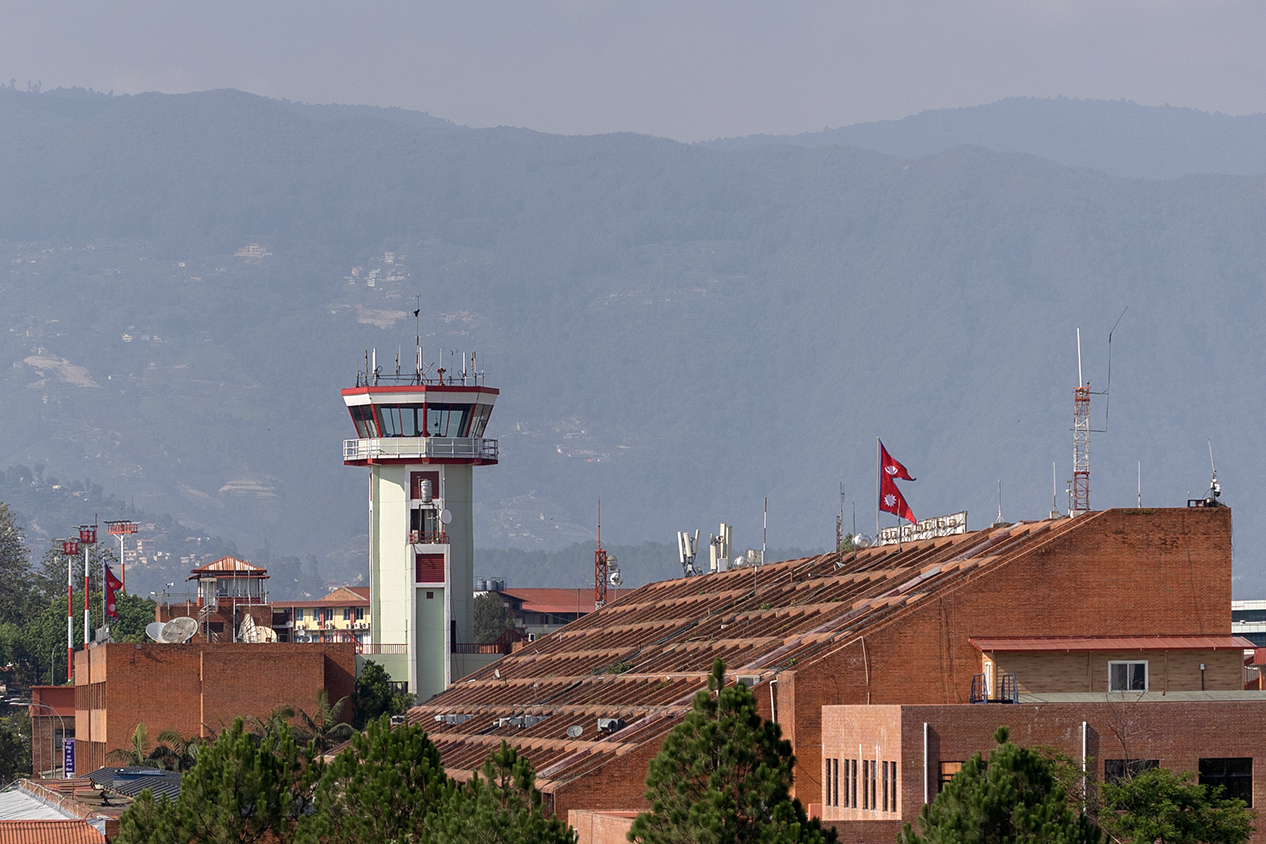
Tribhuvan International Airport/ Photo: Bikram Rai
The corporation has also attempted to initiate long-haul flights to South Korea. However, since the European Union has blacklisted Nepal’s aviation sector, South Korea has proposed conducting an audit of Nepal’s civil aviation sector. Nepal Airlines believes that the Civil Aviation Authority of Nepal (CAAN) did not cooperate with this process.
Officials at CAAN believe that a regulatory authority of the same level cannot audit another regulatory authority.
Former director general of CAAN, Rajkumar Chhetri, says that many aspects need improvement to operate the corporation effectively. “Nepal Airlines needs dynamic leadership. There are more employees than necessary. Four aircraft are not enough; immediate attention must be given to adding more aircraft,” Chhetri says.
Study reports not implemented
Since 2058 BS (2001/02), 10 separate studies have been conducted and reports prepared for the reform of Nepal Airlines Corporation. However, none of the recommendations from these reports have been implemented.
The first report related to the reform of the corporation was submitted to the Ministry of Culture, Tourism, and Civil Aviation on 4 February 2002. The report noted that the corporation’s revenue base was weak and recommended adding one aircraft for international flights to increase revenue.
Shortly thereafter, on 15 February 2002, a high-level recommendation committee led by former Chief Secretary Damodar Prasad Gautam submitted another report to the ministry. The committee recommended selling spare parts of Boeing 757 aircraft, bringing in foreign investors as strategic partners, and registering separate companies for domestic and international air services.
After studying the reports submitted by the high-level recommendation committee and the corporation, a High-Level Action Plan Committee was formed under the coordination of then National Planning Commission member Shankar Prasad Sharma. In its report submitted on 9 September 2002, the committee recommended choosing one of two options: either privatize the corporation or dissolve it and establish a new airline.
The first report related to the reform of the corporation was submitted to the Ministry of Culture, Tourism, and Civil Aviation on 4 February 2002. The report noted that the corporation’s revenue base was weak and recommended adding one aircraft for international flights to increase revenue.
In Ashoj 2061 (mid-September to mid-October 2004), a report by the International Civil Aviation Organization (ICAO) recommended splitting the corporation into two separate companies for domestic and international flights.
On 26 June 2005, a task force formed by the Ministry of Culture, Tourism, and Civil Aviation under the coordination of Kedar Lal Joshi submitted a report on 11 September of the same year, recommending privatization of the corporation and registration as a limited liability company.
A subcommittee formed under the coordination of former Secretary Sharda Prasad Trital submitted a report on 27 November 2007, recommending converting the corporation into a company and offering 30 to 60 percent shares to a foreign strategic partner, as well as establishing a subsidiary company for domestic air services.
A task force report submitted on 10 January 2010, under the coordination of Joint Secretary Murari Bahadur Karki of the Ministry of Culture, Tourism, and Civil Aviation, recommended structuring the company with 51 percent shares (Rs 14.28 billion) held by a management partner and 49 percent shares (Rs 13.72 billion) held by the Government of Nepal in the event of privatization.
In the FY 2073/74 (2016/17) budget statement, the government announced plans to bring in a strategic management partner for the corporation and initiated related work. Notices were issued inviting proposals from airline companies in the UK, France, Germany, the United States, and Australia. At that time, only Lufthansa Consulting of Germany submitted a proposal. However, the process was halted midway.
In 2076 BS (2019/20), a reform recommendation task force led by former Secretary Sushil Ghimire submitted a report recommending converting the corporation into a company while retaining 51 percent government ownership.
A report submitted in 2080 (2023/24) by a committee led by former Governor Deependra Bahadur Kshetry included recommendations such as strengthening internal audits, forming an audit committee to enhance board decisions, and improving corporate governance.
A more recent report submitted last Bhadra (mid-August to mid-September 2025) by a committee led by the incumbent Minister for Culture, Tourism, and Civil Aviation Anil Kumar Sinha recommended dividing the corporation into three separate entities: Nepal Airlines Company Limited to operate international services only, Nepal Aviation Services Company for ground handling and Nepal Airlines Corporation, in its current form, to operate domestic services.
Sinha, who led the committee that studied the aviation sector and prepared the report, is now responsible as the line minister. However, for the past two months, he has been unable to finalize the selection of a Managing Director for the corporation.